
MHT Day 26: Back Over the Mountains
Today I woke to cool temperatures in the 50s, made dreary by foggymistycloudy skies and the expectation of rain. Nevertheless it wasn’t actually raining, so I donned rain pants just in case, left the rain jacket off and began my ride to the base of the beautiful Bitterroot mountains on Highway 12 along the Middle Fork of the Clearwater River. To my great delight, in about 20 miles, before I even started climbing the winding river road to the summit at Lolo Pass, the foggymistycloudy stuff cleared up and, while cool temperatures remained, at least I saw blue skies from time to time.
So that was my start to the day returning back over the Bitterroots. What about the Corps of Discovery? Despite warnings from the Nez Perce that the forbidding mountains were not yet passable, the expedition resumed its eastward trek toward home on June 15, 1806. Two days later, Lewis wrote
we found ourselves invelloped in snow from 12 to 15 feet deep even on the south sides of the hills with the fairest exposure to the sun; here was winter with all it’s rigors; the air was cold, my hands and feet were benumbed.
Duh. Maybe he should have listened to the people who had lived there for 500 generations. At any rate, the captains decided to leave the baggage where they were and return with their horses to the flats below until they could procure Indian guides and the barely-marked path became passable. Not until June 25 could they return to the place where they had left their baggage, accompanied by several young Nez Perce guides who not only knew the trail, even in deep snow, but who knew where grass would be abundant for their four dozen horses. Five days later they were back at Travellers Rest on the east side of the mountains, having covered the 156 miles from Weippe Prairie in six days with the Nez Perce guides what it had taken 11 days to cover with the Shoshone guide in 1805.
At Travellers Rest the captains confirmed earlier plans to split the party first into two groups, then to split those two groups again into two groups. Historians and other scholars have criticized that decision, though ultimately the expedition survived intact. Lewis would take himself and nine others north, following the land route known by the Nez Perce and other mountain tribes as the “Trail to the Buffalo” and go to the Great Falls of the Missouri. There they would split again, one group preparing to portage what had been left at the Great Falls in 1805 while Lewis and the rest of the group would explore the Marias River north toward Canada and to conduct a “peace” mission to the notoriously hostile Blackfeet. Clark, with the remaining 23 persons, would return to Camp Fortunate, where they had met the Shoshone on the Jefferson River, recover the cached items there, then follow the Jefferson River to Three Forks where the Missouri River begins. At Three Forks, a sergeant and nine men would continue down the Missouri until they met with the part of the Lewis contingent that stayed at Great Falls. Clark and 12 others, including Sacagawea and her son, would take most of the horses and go until they found the Yellowstone River, then build canoes and paddle to the Missouri, where, if everything worked out, all the disparate parts of the expedition would regroup and head for St. Louis.
Most of this plan worked out, except that Lewis’s “peace” mission turned out to be the only time during the three-year expedition where there was a violent encounter with Indians. They met a small party of young Blackfeet and attempted to explain their new relationship with the United States. But the young warriors attempted to their guns and horses, and Lewis and his party killed two of the warriors. Presuming that the “peace” mission was shot to hell, they galloped as fast as they could for 24 consecutive hours back to the Missouri to escape a retribution-seeking war party they believed would pursue them. There they met with the men on the Missouri, and continued down river to the Yellowstone to meet Clark’s group.
Much of my day today was spent successfully dodging serious but scattered thunderstorms all over Idaho and Montana while retracing at least part of Lewis’s northern route. I had to forego part of that route knowing I would head into heavy rain if I didn’t, but at least I covered part of the “Trail to the Buffalo,” which, as the Indians had know for thousands of years, was the shortest route between the Columbia and the Missouri rivers. (Note: On the way west on this Magical History Tour, I covered part of Clark’s route, except that I was going the wrong direction when I stopped at Pompey’s Pillar on Day 13 and at the Big Hole Battlefield on Day 18. Tomorrow I’ll follow the rest of Clark’s route to the Yellowstone River, this time going in the right direction. I’m getting dizzy trying to remember where I was, when I was there, and what direction I was going.
Because of the threat of rain and because I had made most of the important stops on the outward half of my journey, today I didn’t stop at any historic sites or interpretive centers. I did, however, make one stop based on a recommendation of a North Carolina friend. (Thanks, Janet.) I stopped for coffee at the Lochsa Lodge, originally built as a hunting lodge in the 1920s, long before U.S. Highway 12 was finished in 1963. It sits about 1/4 mile from where Lewis and Clark camped when they were struggling through the mountains in 1805 with their Shoshone guide.


While I was at the lodge enjoying a warming cup of pretty decent coffee, I struck up a conversation with another motorcyclist. Ned, a sixth-grade teacher from Portland was headed home at the end of a nearly three-week long solo trip through Oregon, Washington, Idaho, Montana, and British Columbia. Ned’s journey featured a dual-sport bike good for on-road and off-road riding, while mine, of course, is a big Harley bagger that much prefers asphalt to rocks and gravel. But we both have a wanderlust satisfied only on two wheels, and enjoy the solitude that riding alone offers. We didn’t have long to talk since he was trying to beat the rain in Idaho and I was hoping to do the same in Montana, but our conversation reminded me again of how many interesting people I meet while traveling on a motorcycle. The history lessons I learn are good; the country I see is amazing; but most of all I love meeting people from all over who help enrich and round out my life.
Tomorrow I’ll follow Clark’s Yellowstone track for a while, then say goodbye to the Lewis and Clark Trail as I dive south into Wyoming. But I’ll keep writing if anyone wants to keep reading.
MHT Day 25: In the Land of the Nez Perce
On May 1, the expedition, guided by several Indians of different tribes, left their remaining canoes, the Walla Wallas, the Yakimas, and other Columbia River tribes behind and headed east on foot with pack horses. Their land route to the Snake and Clearwater rivers, which they had canoed down five months ago, was about 80 miles along creeks and rough and rocky grasslands and took four days to complete. From there, the route to the foot of the Bitterroot Mountains was only another 125 miles. So why did they delay starting over those mountains until June 15? What kept them in the land of the Nez Perce for five long weeks?
Snow. They had left Fort Clatsop early. They had moved as quickly as they could up the Columbia. But they could not hurry the snow melt in the Bitterroots. They knew they had to wait and the Nez Perce confirmed it. On May 7, Clark recorded in his journal that
the Indians inform us that the snow is yet so deep on the mountains that we shall not be able to pass them untill the next full moon or about the first of June; others set the time at still a more distant period. this unwelcom inteligence to men confined to a diet of horsebeef and roots, and who are as anxious as we are to return to the fat plains of the Missouri and thence to our native homes
The winter of 1805-1806 had been a hard one for the Nez Perce. When the Corp traveled across western Washington in early May, they marched through blowing snow and sleet and slept in the cold without tents. The salmon had not started their spring run up the Snake and Clearwater rivers, and the Nez Perce were still eating roots and tree bark to get by until the rivers filled with fish.
The first order of business when Lewis and Clark reached Nez Perce lands in Idaho was to reclaim the horses left in the Indian’s care in 1805. Although there were difficulties involved with that effort, ultimately they added the horses left behind to the horses they brought from the Columbia for a total of 50-60 usable animals. Those that weren’t usable were often eaten because the few deer available coudn’t feed the 33-member expedition.
During the month they spent at Camp Choppunish (about 1 1/2 miles from where I am tonight in Kamiah), they traded with the Nez Perce for necessary and useful goods. Clark used his skills and the limited medical supplies they had to treat various Indian ailments. It’s unlikely his skills or his medicine actually cured much, but in a placebo sort of way, the Indians believed it did and many of their conditions improved.
From May 10 to May 13, 1806, the expedition camped near where I am now in Kamiah, Idaho. On May 14 they crossed to the east side of the Clearwater River, about 1 1/2 miles upstream from here, where they stayed until June 10. Their stay at Camp Choppunish (their name for the Nez Perce) was longer than at any other spot except Fort Mandan and Fort Clatsop. During that time, the captains learned more about the Nez Perce and worked to advance the diplomacy necessary to incorporate them into the unfolding Indian policy of the United States.
But the men of the Corps were anxious to go home. On June 14, having moved their camp to Weippe (pronounced wee ipe) Prairie, where they first emerged from the mountains, famished and haggard the preceding September, Lewis wrote
we have now been detained near five weeks in consequence of the snows; a serious loss of time at this delightfull season for traveling. I am still apprehensive that the snow and the want of food for our horses will prove a serious imbarrassment to us as at least four days journey of our rout in these mountains lies over hights and along a ledge of mountains never intirely destitute of snow. every body seems anxious to be in motion, convinced that we have not now any time to delay if the calculation is to reach the United States this season; this I am detirmined to accomplish if within the compass of human power.
And so, on June 15, 1806, they headed back into the looming, snow-covered Bitterroots.
Much of my time today was spent riding. I stopped at the most significant sites in this area a little more than a week ago, and what I wanted today was to see the geography, to ride the hills and valleys they walked through or camped near. I’m not sure they would recognize the land were they to be magically transported to 2019. Where they saw rough and rocky grasslands and semi-arid desert, today I saw farms, wheat fields and giant wind turbines.
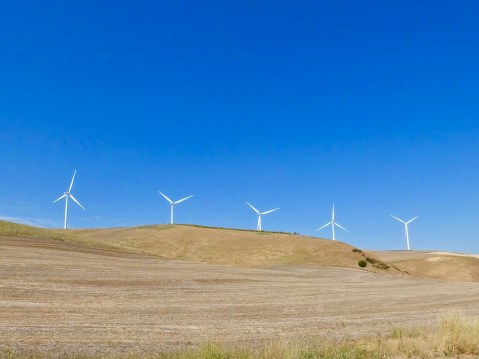
This picture was taken within a mile of where the expedition would have marched.
But the weather was good, as were the roads, and I had a pleasant ride from Walla Walla, Washington, to Orofino, Idaho. Not challenging in a “twisty” sort of way, but a nice gentle ride with sweeping curves, long-range vistas and time to think about changes that occurred in the past 200 years.
When I rode through here on August 5, less than a week ago, I wrote about the problem I had trying to go to Weippe Prairie using my GPS-provided guidance, which apparently forgot I was on two wheels and expected me to travel down unmeasured gravel roads. Coming from the opposite direction today, however, the GPS promised me a State Highway to Weippe that I knew would be paved. So, as directed, I crossed the Clearwater on a bridge under construction, and began the steep climb up the towering river hills. I had gone less than 1/2 mile when a sign announced “Loose Gravel Ahead. Motorcycles Proceed with Extreme Caution.” Hmmmm. How loose? How far? Important, but unanswered, questions.
Seized by yet another case of raging optimism and determined to see today what I failed to see five days ago, I proceeded on. The loose gravel was a result of the chip seal operation the state highway department was employing to resurface the road. OK, I thought. They’re going to work on a short stretch of road. I can handle this. But no. As it turned out, they’re resurfacing the entire 5 1/2 miles of twisting mountain road with a dozen or more hairpin turns leading from the river to the prairie plateau. On loose gravel. Once on the gravel, there were no safe places to turn around, so, onward and upward I went. At about 15-20 miles per hour with gravel clinking and clanking against the underside of my fenders. I finally reached the top of the river hills and the end of the road construction, but not before one particularly tight and steep section caused the bike to lose traction with both tires at once. It was only a momentary slide, but I have to admit that slide raised my “pucker factor” to an 8 on a 10-point scale.
Shortly I came to the town of Weippe (remember it’s wee ipe) on the Weippe Prairie where I knew there was a Lewis and Clark exhibit and interpretive center at the local library and where I could learn more about the first and last meetings the expedition had with the Nez Perce. I pulled up at precisely 1 o’clock only to learn that Saturday hours were 9 a.m. to 1 p.m. I opened the unlocked door, stepped in, and pled my case to a kindly assistant librarian. She kindly allowed me 10 minutes to look quickly through the displays, and I appreciated her timely flexibility.
She locked up the little library and I left the site to look at the small and growing smaller town. Not much there, but they did have a local museum with hours posted outside indicating it stayed open until 4 p.m. on Saturdays. I didn’t expect much on Lewis and Clark and got what I expected. But the sole operator of the museum talked with me for a while about the Prairie itself and her declining town. She also confirmed my suspicion that there was a third road that led to the prairie from the river highway. It would be longer by as much as 20 miles, but, hopefully, it wouldn’t have any loose gravel on it. Given the choice of going back down the “Loose-Gravel-Ahead. Motorcycles-Proceed-With-Extreme-Caution” road and taking a chance on another, longer road, I opted for the latter.
As it turned out, that road, unnumbered but named for a town I don’t remember seeing, was a great motorcycle road. Good surface. Nice turns with no hairpins. Winding through an aromatic pine forest. It was about 20 miles long and brought me out in Orofino where I started today’s journey to Weippe Prairie. It was a good way to end the day.
Rain obscured the horizon as I pulled into the parking lot of my old-but-clean motel in Kamiah, and a few drops splattered my windshield and muddied the dust on my fenders, but I was mostly dry. Tomorrow, however, may be another story. Thunderstorms are forecast for western Montana. Nevertheless, I’ll proceed on.
MHT Day 24: The Return East Begins
For five weeks after the Corps bid adieu to Fort Clatsop, they paddled and pulled against the current, up the Columbia River, portaging around various falls and rapids as they went. Three weeks after they began their eastward journey, they lost one of the canoes in the rapids and it smashed to pieces, which meant that they had to overload the remaining canoes and carry some of their baggage on their backs. What they needed were horses, and on April 15, Captain Clark made the first attempt to purchase several from Indians above the falls but failed because his short supply of stores and trade goods limited his purchasing power. What they could trade, the Indians didn’t want; what the Indians wanted–guns, kettles, iron goods–,they couldn’t trade.
On April 18, Clark finally purchased their first four horses, which were desperately needed to portage their dwindling but still substantial baggage around the great cataract at Celilo Falls (now buried by The Dalles Dam). Each day, when they encountered another group of Indians, they attempted to buy more horses. By April 20 they had eight. A few days later the number had increased to 14 and they made a like number of pack saddles to carry their stores.
Finding and buying horses wasn’t the only problem. Lewis became increasingly irritated by petty thievery practiced by Indians they encountered along the way. On April 21, he lost his temper, struck an offending Indian and had pilfered a small piece of metal and ordered the men to kick him out of the camp. That evening he wrote about Indian misdeeds, saying
they have vexed me in such a manner by such repeated acts of villany that I am quite disposed to treat them with every severyty, their defenseless state pleads forgiveness so far as rispects their lives.
A few days later they reached the point where the Columbia turns north to meet the Snake River, about 30 miles south of present day Pasco. By that time, the captains had determined to heed the advice of a Nez Perce warrior traveling east with his family back to the land where the Nez Perce had fed and cared for the starving party when they emerged from the Bitterroots the previous fall. They would leave the river and march cross country until they reached the confluence of the Snake and Clearwater rivers and reclaim the Shoshone horses they had left there the previous fall. On April 28, after noting they had purchased an additional 12 dogs to supplement their pounded fish diet during the overland march, Sergeant Ordway wrote:
our Indian guides who are going over the mountains with us inform us that their is a nearer way across the plains to the forks of Lewises river [Snake] at the entrence of Kooskooske [Clearwater] which is a Smooth way and only 3 days march to that place which is allmost as near again as to follow the river round.
For the first time since leaving Fort Clatsop, they were going to travel an uncharted route.
Since I had followed the route down the Columbia a few days ago on my way to Astoria, I thought I would make today a motorcycle ride with sight seeing detours and no museums or interpretive centers. I had missed seeing Mount Hood on the way west, so at Portland I ventured southward to get a view of the mountain which had become one of Lewis and Clark’s important landmarks.
It was cloudy (of course) in Astoria when I left this morning wearing my heavy gloves and leather jacket, and, to my chagrin, the clouds didn’t lift as I motored east. Still, I thought, maybe they’ll clear as I near Mount Hood. So, with a raging case of optimism, I sought out Mount Hood. Still cloudy when I got to Mount Hood Village and no mountain was visible. But I was committed to my detour, so I started up the grade that goes over the south shoulder of the mountain. Here is what I saw:
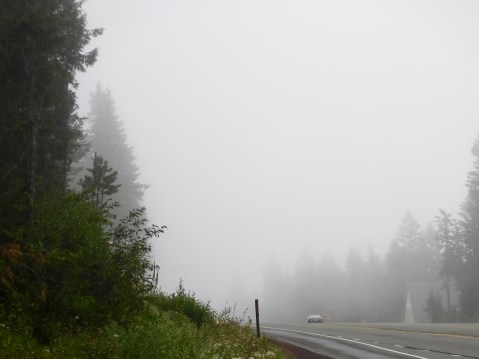
Somewhere in there is a mountain. Use your imagination.
I decided, as I rolled down the eastern slope of the shoulder that as long as I was detouring, I would leave the U.S. highway and find something a little more isolated. I saw a sign with highway numbers that I presumed indicated a county road or a forest service road. No matter. It looked inviting, so I executed a sharp right turn and headed into the alluring unknown. Here is what I saw:
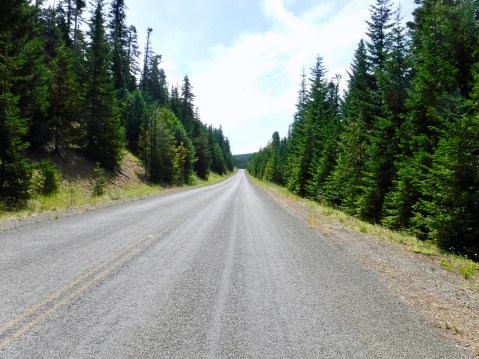
Not wilderness, but at least I was off the main road and having an adventure. And the sky was clearing.
As I putted along, a little north, a little east, a little north, a little east, I knew I was going generally in the direction I needed to go and that eventually I would probably emerge from the woods somewhere near The Dalles. There were some nice twists and turns, but the condition of the road meant keeping my speed a little lower than some adventures allow. And then I turned another corner. Here is what I saw:
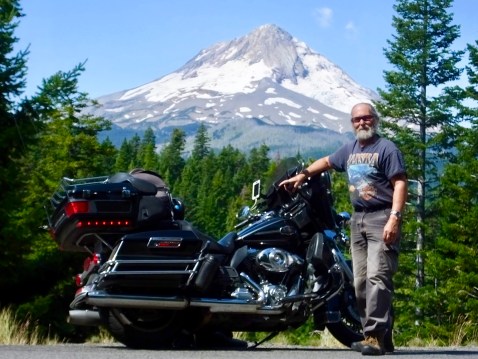
Not as much snow as I expected, but I had finally found Mt. Hood.
That discovery made my day, and the rest of the afternoon spent on the highways again went by pretty fast.
Tomorrow, I’ll go cross-country as did Lewis and Clark, back to the land of the Nez Perce.
MHT Day 23: Nice Fall Day . . . in August
Many pleasant things about the Magical History Tour deserve mention, but let me start with this: Other than a brief two-minute shower in Dillon, Montana, this trip has been rain free for more than three weeks. I don’t believe I’ve ever done a long motorcycle ride where I had 23 straight days of dry weather. And today the temperature in Astoria never reached above 70°. People in most places consider that Fall, but here it’s just another summer day.
Speaking of weather, when the Expedition finally decided, by a vote that included Sacagawea and York (Clark’s slave), to make a permanent camp on the south side of the Columbia River a few miles up a small creek, they started a habitation of 106 days, only 12 of which it didn’t rain. And of those 12 days, they only saw the sun six times.
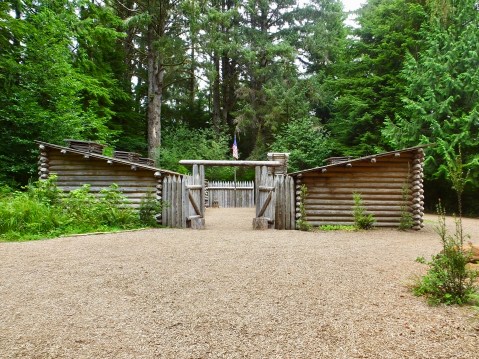
The National Park Service based this reconstruction of Ft. Clatsop on descriptions and measurements found in the expedition journals. One row of four rooms for the enlisted men and one row of three rooms for the officers and the interpreters faced a small parade ground. All 33 persons in the expedition lived in this 2500 square foot structure.
The Corps wintered for slightly more than three months at Fort Clatsop in two small log structures of seven rooms enclosed by pickets and a gate. All 33 members of the expedition lived in this small fort in addition to the occasional natives who stayed overnight by invitation only. Construction on the fort began December 10, 1805, and was mostly completed by Christmas Day. Private Whitehouse recorded events of the 25th this way:
We had hard rain & Cloudy weather as usual. We all moved into our new Garrison or Fort, which our Officers named after a nation of Indians who resided near us, called the ClatsopNation; Fort Clatsop.— We found our huts comfortable, excepting smoaking a little.—
From December until they packed up and left, the men of the expedition repaired equipment, traded with the Clatsop and Chinook for goods needed for the return trip, scraped and tanned hides, made clothing, and sewed more than 300 pairs of moccasins from the 130 elk and 20 deer the hunters killed during their soggy stay at the Pacific coast camp. The life span of a pair of moccasins in the desert or on the river rocks was often only a week and multiple pairs would be required to get the Corps back to St. Louis. In addition to eating elk and deer meat that wet winter, the expedition also traded with natives for dried salmon, dogs, and wapato roots, which Indian women dug from marsh bottoms with their bare feet.
The winter the Corps spent at Ft. Mandan in 1804-1805 was brutally cold. The winter at Ft. Clatsop in 1805-1806 was miserably wet. I’m not sure which overwinter the men would vote as the worst. At any rate, despite having set their departure date as April 1, by the third week of March they had had enough of Fort Clatsop, so they left their humble abode on March 23, 1806, in three of their remaining canoes, plus one they bought from the Clatsops and one they stole from them. That evening, Captain Clark wrote, perhaps a little sarcastically,
at this place we had wintered and remained from the 7th of Decr. 1805 to this day and have lived as well as we had any right to expect, and we can Say that we were never one day without 3 meals of Some kind a day either pore Elk meat or roots, not withstanding the repeeted fall of rain which has fallen almost Constantly
If their canoes had been equipped with rear-view mirrors, they would have declared they were glad to see Ft. Clatsop in them.
During their time at Ft. Clatsop, a contingent of three to five men were tasked with making salt for the return trip by constantly boiling sea water on the beach at a location 15 miles from the fort that required a hike over a small mountain range and across two small rivers. By the end of their salt-making activities, they had collected enough to fill three casks. Today there’s a pitiful structure in the middle of a nondescript neighborhood in Seaside, Oregon, marking the location of their work. Unfortunately, the site wasn’t even significant enough for me to find a parking place and get off the bike. A little disappointing.
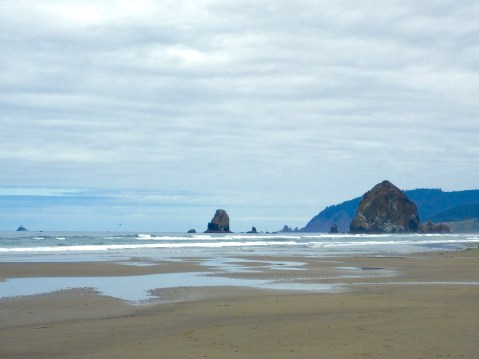
The tide is out at Haystack Rock on the Oregon coast.
In January 1806, they received word from a Clatsop leader that a whale had washed ashore about 15 miles south of the salt-making operation, so Clark and a handful of others, including Sacagawea, journeyed to the site in hopes of obtaining some blubber and oil. When they arrived, all they found was a skeleton, which Clark measured at more than 100 feet. Local Indians had stripped the carcass to the bones, and Clark was forced to buy about 300 pounds of blubber (which he said tasted like dog or beaver) and a cask of rendered whale oil to supplement their diet and flavor their elk meat.
I rode to Cannon Beach where the whale had washed ashore to look around and get a few pictures of the area. While walking on the beach, to my great luck, I met Alonna Woodward, a professional photographer, who took several pictures for me with my camera and one with her Nikon, which she forwarded to me to use in today’s post. Thanks, Alonna!
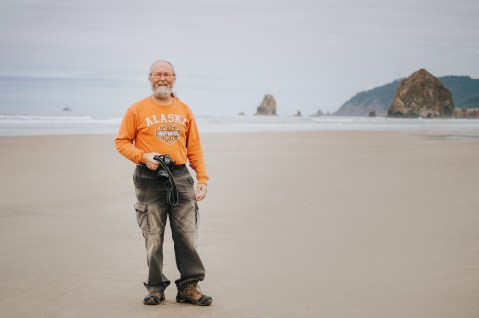
No washed up whale, just a washed up historian.
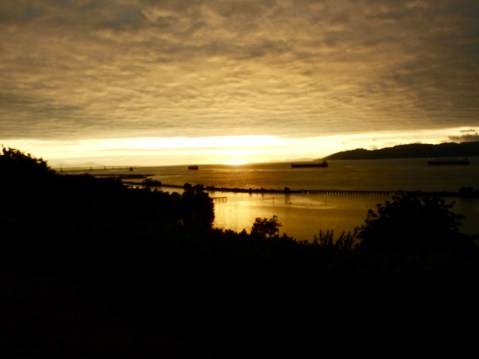
Tonight, I started early on the blog and sat outside my hotel in Astoria above the expansive Columbia River writing and watching the sun set on the Pacific Ocean. Although that doesn’t have anything to do with the Lewis and Clark Expedition, it is a huge part of making the Magical History Tour magical. Tomorrow I ride east on my return trip home, continuing to make Lewis and Clark stops when they present themselves, especially on those parts of the return that deviated from their westward trek.
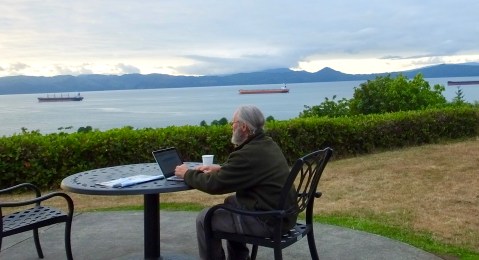
One of the guests at the hotel thought I should have a picture of myself writing the blog.
MHT Day 22: Half Way There
Great joy in camp we are in View of the Ocian,. . . . this great Pacific Octean which we been So long anxious to See Captain William Clark, November 7, 1805
Oh Crap. Now I have to turn around and go back. Dr. Dennis Frobish, August 7, 2019
Captain’s Clark’s comment when he reached the Pacific Ocean on a cold, rainy November day in 1805 is often quoted; my comment, after achieving the same goal, will no doubt rightly be consigned to the dust bin of history. Nevertheless, more than two and a half years after starting his trek with Captain Meriwether Lewis on the banks of the Ohio River, Clark and the Corps of Discovery fulfilled another of President Thomas Jefferson’s instructions to Lewis and the expedition:
The object of your mission is to explore the Missouri river, & such principal stream of it, as, by it’s course & communication with the water of the Pacific ocean may offer the most direct & practicable water communication across this continent
I’m not bragging, but I made the outward bound trip in three weeks. Of course, I had GPS. And I was standing on the shoulders of giants. Metaphorically, of course, because I was actually riding a Harley-Davidson.
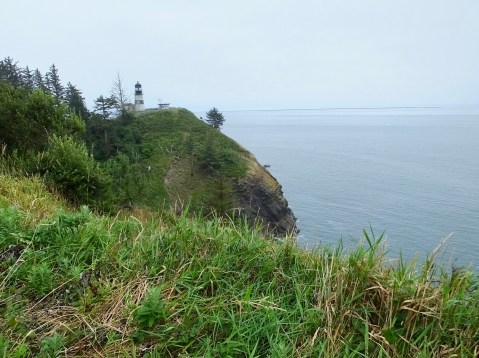
Cape Disappointment and the Cape Disappointment light house, where the Columbia River meets the Pacific Ocean. The river flows in from the left.
Technically, Clark was seeing the expansive bay at the mouth of the Columbia River and not the ocean when he made that comment and the weather and high wind and massive waves meant it would take another 10 days before he actually reached Cape Disappointment, and he had to cover the final 12 miles on foot. Still one has to admit, he and the members of the party had just completed, with the help of countless Native Americans, an amazing, incredible, awe-inspiring, stupendous, historic trip.
During the final three weeks of their westward voyage, the Corps encountered more falls, more rapids and a variety of animals they had never seen before, including seals that swam all the way to Celilo Falls. And they also encountered more than a dozen new, but relatively small, tribes of west-coast Indians whose culture, language and various skills related to life in a wet, coastal climate posed new challenges and new opportunities. These Indians had experience with white Europeans for more than a decade, beginning with American sea captain Robert Gray’s first visit to the waters of the Columbia River in 1792 followed by English ships shortly thereafter. Trade with other tribes had been part of Columbia Indian culture for thousands of years, and trade with the white newcomers continued that tradition. That trading practice was fortunate for the Corps, of course, because it allowed them to trade trinkets and small goods for the food that kept them alive until they found game on the south side of the river where they wintered.
But they also encountered dramatic geologic formations and geographic climate changes and they passed through a landscape sculpted over hundreds of millions of years. For example, as they moved from the semi-deserts of western Washington and Oregon to the Cascades and coastal areas, the areas went from an annual rainfall of 10 inches to an average rainfall of more than 100 inches, most of the latter falling during the months spent on the Pacific coast. Yesterday I ended my day on the semi-desert side with temperatures of more than 100°; today, 170 miles further west, I finished the ride at 69° with my leather jacket on.
On October 31, Clark recorded in his journal that
a remarkable high detached rock Stands in a bottom on the Stard Side near the lower point of this Island on the Stard. Side about 800 feet high and 400 paces around, we call the Beaten [NB: Beacon] rock.
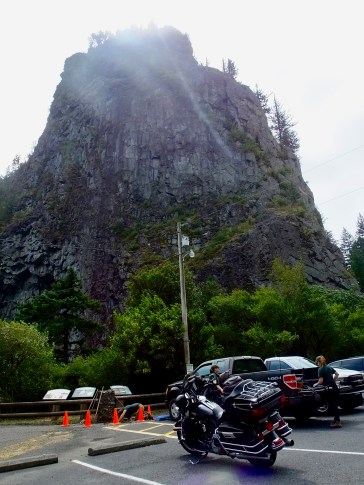
850 foot tall Beacon Rock dwarfs my ride.
Beacon Rock is still there today, and Clark’s estimate of its height was off by only 20 feet. Clark did not, and probably could not, have climbed that massive rock. But today, thanks to an early 20th century entrepreneur, a steep and rocky path with a series of bridges and boardwalks and scores of switchbacks allow visitors to Beacon Rock State Park in Washington to climb to the top. The path is almost a mile long and is the equivalent of climbing a 75-story building. But it’s not a building; it’s a volcanic core that hardened 57,000 years ago whose outer layers were eroded away by ice-age floods 600 feet deep and moving at 60 mile-per-hour, sweeping by the small volcano and eroding its outer layers leaving only the rock visible to Clark and to us today.
Since I gave my shoulders a work-out last night kayaking on the Columbia River, I thought I’d balance my on-the-road work-out routine with a a quick scamper to the top. Well, with a slow climb to the top, anyway. It took nearly 30 minutes to make the one-mile climb, but the view of the Columbia River Gorge more than matched the effort.
So. I’ve ridden the outward bound journey of the Lewis and Clark expedition. In the process, I’ve learned new things and confirmed other things I thought I knew. The Lewis and Clark crew, as I came to realize while reading the 5,000 pages of their journals last winter, were hard-working, disciplined, tenacious, determined, resourceful, and damned lucky not to have died on this expedition into the unknown. While I knew, to some extent, the degree to which the natives they encountered aided them in reaching the Pacific Ocean, I now believe that without that aid, the expedition would have been a failure. For historians who have studied the expedition, this is common knowledge. For me, it was a revelation and has given me much to consider.
I wish I could have seen the country they saw as they saw it. But what I saw of Missouri, Kansas, Nebraska, Iowa, South Dakota, North Dakota, Montana, Idaho, Washington and Oregon reminded me, as all my cross-country motorcycle trips remind me, that we live in a gorgeous country full of amazing people.
In the winter of 1805-1806, the Corps spent a miserable four months on the south side of the Columbia River near the Pacific coast. More on that tomorrow after I’ve visited Fort Clatsop where they huddled, wet and cold, until they could begin the trip back to St. Louis. After tomorrow, I too will turn around and head east, retracing some of the same route but also following, when I can, deviations they made to accelerate their return to their pre-expedition lives.
MHT Day 21: Their Columbia River is Gone
I knew last winter, long before I began this ride, that a series of dams built beginning in the 1930s and continuing into the 1970s stretched across the Columbia River and the rivers that flow into it. Some of the dams are above the confluence of the Snake and Columbia Rivers where I was yesterday, but four of them are between Pasco and Astoria, including one of the largest at The Dalles where I am tonight. I passed two others on the way here: The McNary Dam (1954) and the John Day Dam (1971). I understand the need for flood control and the production of renewable hydroelectric power, but the presence of all those dams, as well as those on the Snake River and the Missouri River, have buried hundreds of historic sites related to the presence of the 1804-1806 Corps of Discovery, as well as thousands of Native American sites. The rivers Lewis and Clark paddled, rowed, sailed and towed their various craft on are gone.
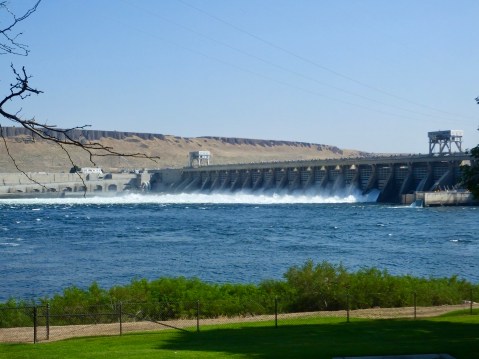
The McNary Dam

The John Day Dam
Today I realized something else is also gone. The air through which Lewis and Clark saw distant mountains, especially in Oregon and Washington, was clear and the horizon could be seen 100 miles away. Mountains such as Mt. Hood and Mt. Saint Helens which they recorded in their journals could be seen from the right promontories at a distance of 70 miles or more. I still haven’t seen them and I’m getting close to the Cascades. I.m not saying I want to endure the rigors they endured, but I sure would like to see the world they saw.
During today’s ride, I stopped at several sites mentioned in their journals, but unlike the sites I saw east of the Rockies and even in Idaho, there doesn’t seem to have been much effort on the part of Washington or Oregon to preserve or interpret Corps of Discovery sites, at least in the western parts of both states. A couple of roadside historical markers with a paragraph or two was the extent of the historical explanation I saw today. It reminded me of the “Kilroy was here” graffiti popular in WWII.
Travel for the Corps was fairly rapid going downstream on the Columbia, as long as they didn’t encounter serious rapids or, especially, waterfalls. On October 19, 1805, for example they covered 36 miles on a day in which Clark recored a large rock formation shaped like a hat, caught the first glimpse of the volcanic, snow-covered Mt. Adams and spent two-hours dragging the party’s canoes over a long shoal; before they even began the day on the water they had a two-hour meeting with a chief of the Walla-Walla band and 30 or so of his people to announce their intentions and offer gifts.
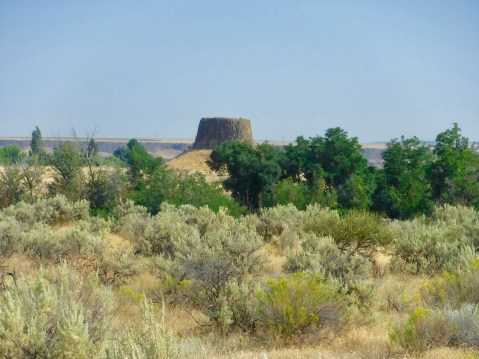
Hat Rock was mentioned by Clark in his journal. In fact, it does strongly resemble beaver-skin hats popular in 1800. The formation is the result of a series of volcanic eruptions that lasted for 10-15 million years and covered parts of Washington, Oregon, and Idaho with nearly 40,000 cubic miles of basalt. Formations like this are common in the area as erosion during the last two million years washed away the top soil and softer rock leaving basalt formations behind.
I also stopped at Celilo Park, thinking there would be some mention of Celilo Falls also known as the Great Falls of the Columbia, which Clark recorded on October 22, writing I beheld an emence body of water Compressd in a narrow Chanel of about 200 yds in width, fomeing over rocks maney of which presented their tops above the water. The falls, which had been a prime salmon fishing location and meeting place for tribes in the area for thousands of years, required a strenuous portage the next day by the Corps. Clark’s description suggests some of the problems they encountered:
I then decended through a narrow chanel of about 150 yards wide forming a kind of half circle in it course of a mile to a pitch of 8 feet in which the chanel is divided by 2 large rocks at this place we were obliged to let the Canoes down by Strong ropes of Elk Skin which we had for the purpose, one Canoe in passing this place got loose by the Cords breaking, and was cought by the Indians below. I accomplished this necessary business and landed Safe with all the Canoes at our Camp below the falls by 3 oClock P. M.
Today this prime fishing spot, this meeting place for hundreds of generations of native people is completely submerged by the waters behind The Dalles Dam. A ramshackle group of buildings and a small rock ledge where Natives of four different tribes are allowed to fish with dip nets according to agreements with the Federal government is the sole remnant of the Celilo Falls fishing culture.
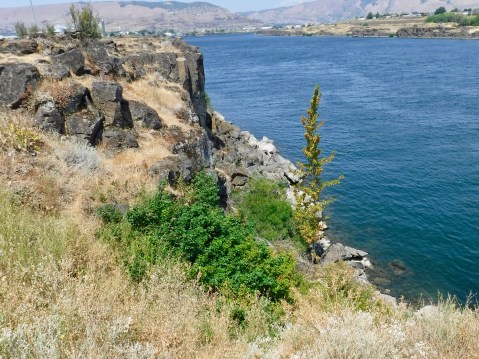
Somewhere under the water is the Great Falls of the Columbia, about which Lewis and Clark wrote extensively.
I had one more stop to make related to Lewis and Clark, and once again, I found that their alleged campsite at Fort Rocks in what is today The Dalles contained several interpretive panels, but nothing else. One of the problems with determining exactly where they camped is the lack of physical evidence to prove they were in a specific location. Even the journals and Clark’s mapping coordinates are sometimes at odds with each other, and historians can often only approximate where they might have camped.
I stopped early today and wrote this in the afternoon while the blazing sun raised temperatures to 100° again today. This evening I’m going to get out and try something different. If everything works out, I’ll amend this post later today.
[It’s about five hours later and I’m back with a small addendum.]
One of the things I had hoped to do on this trip was get ON the water that the Corps of Discovery travelled on. The boat trip up the Gates of the Mountains covered the Missouri River, though I still wish I could have made the three-day canoe trip. Time and money constraints meant I missed the Clearwater and the Snake Rivers. But tonight, at least, I could check off the mighty Columbia River. I booked a “Sunset Kayaking Tour” with the Gorge Paddling Center out of Hood River, Oregon. The plan was to kayak on the Columbia down river from Hood River, but when the kayaks were put in the water at the launch site, the 30 mile per hour wind–which draws hundreds of kite surfers every day to the Columbia River Gorge–made going on the Columbia a little dicey. So, we paddled up the Wind River, a Columbia tributary, in the hopes that the wind would abate later on. Toward the end of the tour, the wind died down enough for Todd, the owner and chief guide, to take me out on the mighty Columbia River, the same one (sort of) that Lewis and Clark and the gang floated down in late October 1805. The Wind River diversion actually worked well, because unlike the lake-like Columbia, it had a current. I’m now even more convinced than before that the Corps of Discovery MUCH preferred going downstream to upstream. I’ll know tomorrow just how sore I’m going to be, but whatever discomfort these old bones feel, it will be worth it to have joined Lewis and Clark, briefly, on their trip down the great western river.
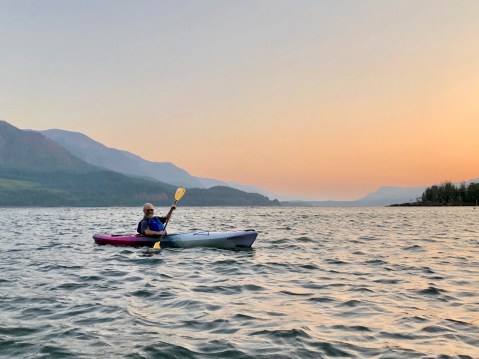
The sun had sunk below the horizon by the time we paddled onto the great river.
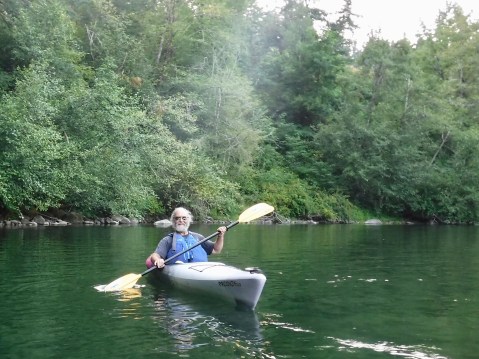
The Wind River offered a shelter from the wind.
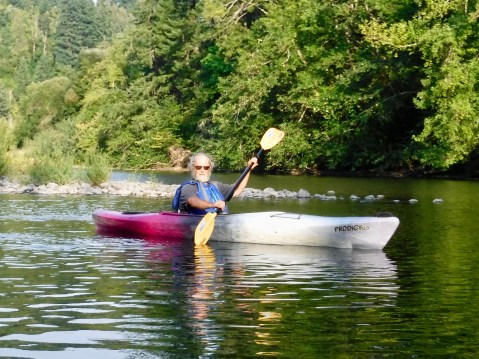
Paddling upstream was not nearly as much fun as floating back downstream with a well-deserved glass of Chardonnay.
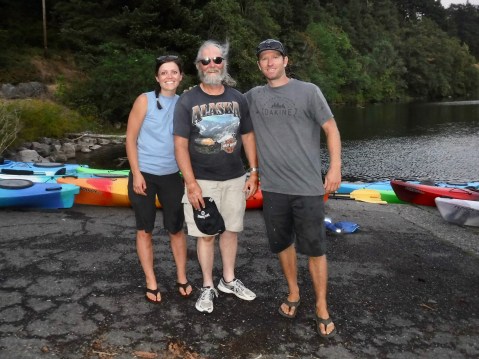
Lindsey, Todd and one worn out old man.
.
MHT Day 20: From Confluence to Confluence
From October 11 to October 16, 1805, the expedition paddled 154 miles downstream, overcoming several treacherous rapids along the way, in their five dugout canoes plus one canoe with two helpful Nez Perce guides from the confluence of the Clearwater and Snake Rivers at present-day Lewiston, Idaho, to the confluence of the Snake and Columbia Rivers at present-day Pasco, Washington. What they saw then is what I saw today. Not much.
With temperatures in the 90s much of the ride and reaching 100° by the time I reached Pasco, a little shade along the way would have been nice. But that would have required trees. And there weren’t any. Nor were there any when the Corps made its downstream run on the Snake River in 1805. Three days after leaving the Clearwater River, Captain Clark noted in his journal that, with the acquiescence of their two Nez Perce guides, the lack of any trees made them do something they would have preferred not to at a temporarily uninhabited Indian fishing camp.
we have made it a point at all times not to take any thing belonging to the Indians even their wood. but at this time we are Compelled to violate that rule and take a part of the Split timber we find here bured for fire wood, as no other is to be found in any direction.
The next day, Sergeant Gass added a similar comment in his journal, noting that “we had great difficulty in procuring wood to cook with, as none at all grows in this part of the country.”
What I did see, for the first 100 or so miles as I headed west, was rugged, sometimes rocky, treeless prairie grassland, followed by miles and miles of wheat and hay fields being harvested by teams of huge tractors and harvesters, clearly not a family farm operation. At one point, I passed a parade of green agrotechnological behemoths lumbering in the opposite direction looking for a fertile field to ravage; it was a good thing I was on a motorcycle because there wouldn’t have been room for these giant machines and a car on the narrow road at the same time. When I got to within 30 miles of Pasco the temperature dropped a few welcome degrees and a couple miles later the wheat fields were replaced by fecund orchards, fructuous vineyards and a few hopeful fields of hops.
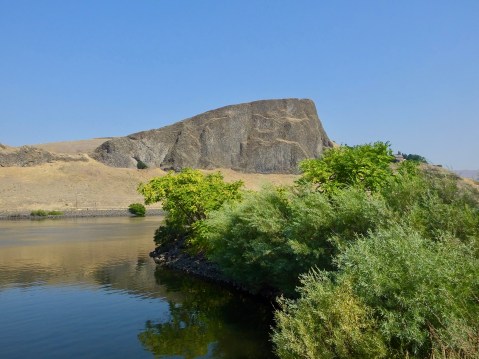
Swallow Rock, so named for the thousands of swallows that build nests there, sits across the Snake River from the Hells Gate State Park.
I began the morning in Lewiston/Clarkston by visiting a small Lewis and Clark Interpretive Center at Hells Gate State Park in Idaho. While the displays were limited, they did have one of the best short videos I’ve seen of the Expedition, focusing on the time the Corps spent between the Bitterroot Mountains and the Pacific Ocean and the aid provided to the Corps by various native tribes, including the Nez Perce. Without exception, I think, each time I visit one of these small museums or interpretive centers I learn something new. Today, for example, I learned that when the captains and enlisted men wrote their daily observations and occurrences in their journals, they used powdered ink which, when mixed with water, gave them the indelible medium they needed for their quill pens and for posterity. Not earth shattering, I realize, but this minor details helps me develop a more complete picture of the Expedition.

This osprey at Hells Gate State Park was looking for breakfast when he turned his head to look at me.
Knowing today’s ride wasn’t going to be a long one and based on a breakfast conversation with other bikers, I took a 20-mile detour before leaving Clarkston to ride what is referred to locally as the “Spiral Highway,” an old section of U.S. 95 with 64 turns in its eight-mile, 2,000 foot climb up Lewiston Hill. Very few guardrails line the shoulder to ensure careless motorists (or bikers) don’t go sliding down the hill. Unfortunately, the road was covered with “tar snakes,” an asphalt sealer used for crack repair that produces significantly dangerous traction challenges for two-wheelers, and I had to moderate my speed considerably, especially going into each of the 64 turns. One final note: It’s said this precipitous grade inspired the 1955 rockabilly hit “Hot Rod Lincoln.” That’s probably as important to know as that the Corps used powered ink. But there you have it.
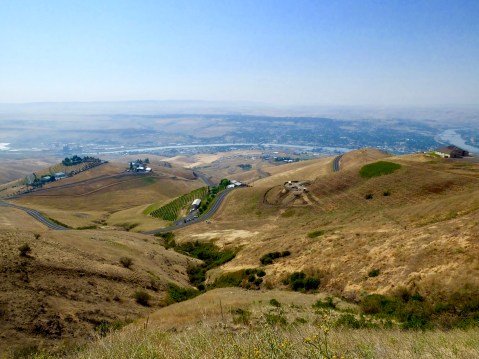
Sections of the “Spiral Highway” can be seen in the foreground. Running through the middle of the photo is the Clearwater River, to the right is the Snake River.
When Lewis and Clark reached the confluence of the Snake and Columbia Rivers, several hundred Yakima and Wanapam Indians greeted them, singing and dancing and providing “eight fat dogs and Some fresh sammon” for dinner. This was not the first time during the expedition the men had hot dogs for dinner; over the course of the trip they consumed, according to one count, more than 200 dogs, which they preferred over fish or horse meat.
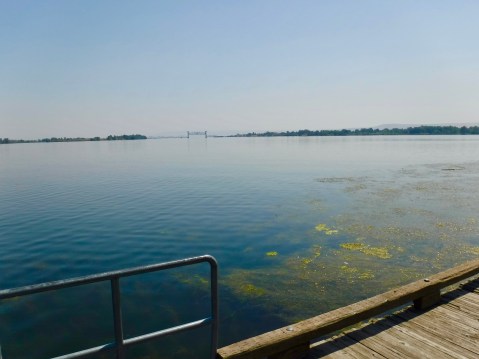
Because the Snake and Columbia Rivers are so wide where they meet, it’s hard to get a good photograph. I’m standing on the point where the two rivers merge. To the right is the Columbia River; to the left is the Snake.
When I reached the confluence of the same rivers, on the other hand, I was greeted by a locked door at the Sacajawea State Park Museum. Seems they’re closed on Monday and Tuesday. If anyone’s wondering, I had a club sandwich for dinner.
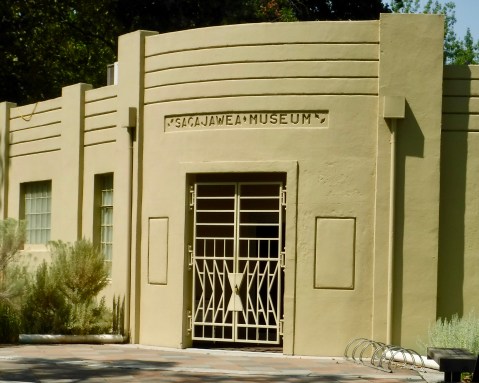
A locked door kept me from seeing what the Sacajawea Museum in Pasco had to offer.
Tomorrow I work my way down the Columbia toward the Pacific Ocean. I’ve just about reached the half-way point of this adventure.
MHT Day 19: Over the Bitterroots to Nez Perce Country
On September 11, 1805, the Corps of Discovery left their camp at Travelers Rest and started their trek up and over the Bitterroot Mountains. Eleven days later they emerged from the mountains onto a prairie where they received food and a friendly greeting by a band of Nez Perce. That eleven day period was the most dangerous and most difficult stretch the Corps had experienced since leaving St. Louis.
The first several days of the journey the route was steep and game was scarce but they continued on, even finding a hot springs on September 13 used by Indians for bathing. Private Joseph Whitehouse, who also kept a journal during the Expedition, wrote that they
passed a warm Spring, which nearly boiled where it Issued out of the rocks a Short distance below the natives has dammed it up to bathe themselves in, and the water in that place is considerable above blood heat. it runs out in Sundry places and Some places cooler than others. Several of us drank of the water, it has a little sulpur taste and verry clear. these Springs are very beautiful to See, and we think them to be as good to bathe in &c. as any other ever yet found in the United States.
An omen of what was to come, however, occurred after they left the springs and their Shoshone guide, who they called Toby, took them down the wrong path resulting in a laborious trek up the side of a steep mountain to regain the correct path. The next day, because the hunters had been largely unsuccessful in their pursuits, the party killed and ate one of the horses they had purchased from the Indians. They named the place where they camped that night “Colt Killed Creek.” On their fifth day crossing the Bitterroots, September 15, after a particularly arduous climb during which several horses fell down the mountainside, Clark offered this description:
From this mountain I could observe high ruged mountains in every direction as far as I could See. with the greatest exertion we Could only make 12 miles up the mountain and encamped on the top of the mountain near a Bank of old Snow about 3 feet deep lying on the Northern Side of the mountain and in Small banks on the top & leavel parts of the mountain, we melted the Snow to drink, and Cook our horse flesh to eat.
On the next day, with more than half of their mountainous trek still ahead of them, snow fell on the party making conditions even more precarious as they trudged through some of the most rugged mountains in the continental United States. Private Whitehouse wrote this description of that depressing day:
We were all surprized when we awoke this morning; to find ourselves covered with Snow, which was 2 Inches deep . . . some of our party are without Socks, and are forced to wrap Rags round their feet to keep out the cold. The Snow fell so fast that it is now from 5 to 6 inches deep & where old the Snow remained it was considerably deeper . . . . The party were all much fataigued & hungry, our officers had a Colt killed and the party eat the half of it this evening.
By the seventh day, having killed and eaten three horses, Clark took six hunters and went ahead of the party, hoping to kill game and leave meat near the trail for the remainder to find and eat. Clark described the plan this way:
The want of provisions together with the dificuely of passing those emence mountains dampened the Spirits of the party which induced us to resort to Some plan of reviving ther Sperits. I deturmined to take a party of the hunters and proceed on in advance to Some leavel Country, where there was game kill Some meat & Send it back, &c
On September 19, from a high peak over which they were crossing, Lewis saw a level plain in the distance, about 60 miles away, but they, quite literally, were not out of the woods yet. Sergeant Patrick Gass wrote in his journal about both privation and hope:
The men are becoming lean and debilitated, on account of the scarcity and poor quality of the provisions on which we subsist: our horses’ feet are also becoming very sore. We have, however, some hopes of getting soon out of this horrible mountainous desert, as we have discovered the appearance of a valley or level part of the country about 40 miles ahead. When this discovery was made there was as much joy and rejoicing among the corps, as happens among passengers at sea, who have experienced a dangerous and protracted voyage, when they first discover land on the long looked for coast.
Clark and his advance party made contact on September 20 with a small village of Nez Perce on the plains Lewis had seen, but the latter would not emerge from the mountains until September 22, when he wrote, “the pleasure I now felt in having tryumphed over the rocky Mountains and decending once more to a level and fertile country where there was every rational hope of finding a comfortable subsistence for myself and party can be more readily conceived than expressed.”
The Nez Perce, who numbered in the hundreds in this area and could easily have killed the weakened troops, provided camas roots and salmon for the famished men who wolfed down huge portions of the unfamiliar food only to be stricken for the next several days with severe cramps and diarrhea, prolonging their recovery and, in several cases, nearly killing a couple of them. But they finally recovered enough to begin building five canoes that would take them down the Clearwater River to the Snake River and on to the Columbia River. On October 7 they launched all their new canoes, built with the help of the Nez Perce who had also agreed to look after the expedition’s 38 remaining horses until they returned. Four days after launching their new craft, they reached the confluence of the Clearwater and Snake Rivers, where I am spending the night.
Well that was their trip from Lolo/Travelers Rest to the Snake River at Clarkston, Washington. Mine was a damn site better. The day started off cool, but not as cool as I had thought it might be up in the mountains. After a hardy breakfast in Missoula, I packed my gear on the bike, donned my leather jacket and gloves and headed to my first stop–Lolo Hot Springs. I knew it had been commercialized but not to what extent. There no longer exists a free-flowing hot spring, only a worn-out, swimming pool and soaking pool at a cheesy resort. I did find some warm water to stick my hand it, but it must have been some distance from the source since no skin peeled off. So, I proceeded on.
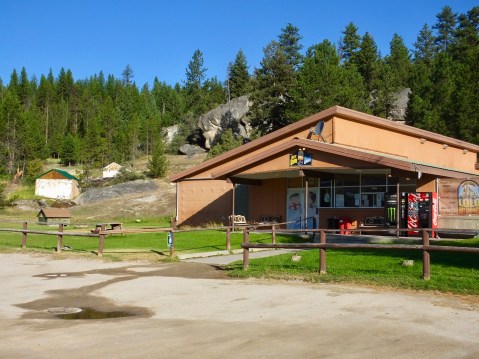
I’m sure it was a beautiful spot when Lewis and Clark were there.
At Lolo Pass, I stood at or near the spot where the Corps crossed the Continental Divide before being led astray again by their Shoshone guide and having to backtrack and climb one of the steepest inclines they encountered just to get back on the trail. I also had a chance to visit Packer’s Meadow, where they rested, grazed their horses, and got fresh water.
But the best part of the ride between Lolo and the Clearwater River on the other side of the mountains was. . . .well, it was the ride. U.S. 12 is one of the great motorcycle rides in the west. More than 100 miles of mostly gentle curves along a beautiful, flowing Lolo Creek on the Montana side and the Lochsa River on the Idaho Side. Interestingly, the waters of both rivers eventually ends up in the Columbia River. This road is a motorcyclist’s dream. Lots of pull offs to use if you want to see the river at a much slower pace or if slow-paced cars with courteous drivers want to use them to let impatient bikers pass.
I mostly behaved myself with the throttle, but I found I disagreed from time to time with Law Enforcement’s suggested speeds and I exceeded their recommendations, especially on the Idaho side where they laid about 50 miles of new surface just last year. If they went to all that trouble to make the roads more conducive to speed, it was the least I could do to oblige them.
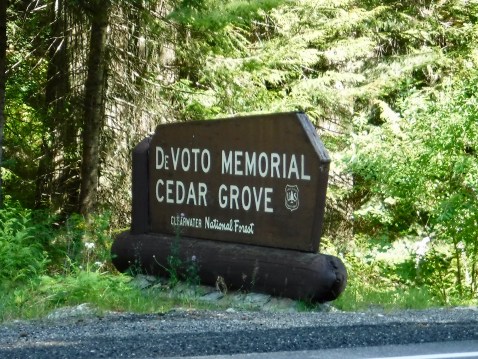
I did make one other stop that had been recommended to me by one of the historians I met at the beginning of this trip. A grove of old-growth cedar trees was named for Bernard DeVoto, one of the great historians of the American West and an early editor of the Lewis and Clark Journals. I stopped there, looked in awe at those 2,000 year old trees, said a thank you to DeVoto at a marker in the grove, and headed down the road once more.
I had planned a stop at Weippe Prairie (pronounced Wee Ipe), which is where the expedition emerged from the mountains and met the Nez Perce. But my Google GPS, after taking me up an incredibly steep and winding asphalt road to get to the top of the prairie, consistently wanted me to go down a gravel road for about 10 miles. No thank you. So I kept going on the asphalt hoping for a better route. But no, two miles later, another command to go down another gravel road. And again about two miles after that. So I just stayed on the asphalt. Until the asphalt ended and I found myself on a very narrow gravel road that made turning around difficult, but not impossible. So I headed back down the same way I came up and decided there wasn’t much to see at Weippe Prairie after all.
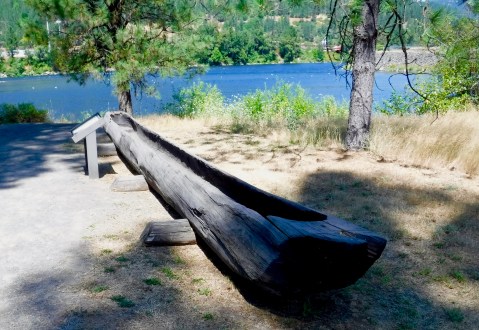
Another 30 miles down the road, I spied an historic marker located at the “Canoe Camp” where the Corps members and the helpful Nez Perce built the pine canoes destined for the Pacific Ocean. So, I missed Weippe Prairie but saw where they built and launched the canoes. And Canoe Camp was next to an asphalt road.
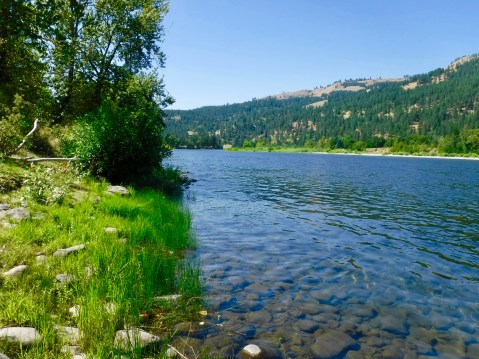
One final stop for the day at the National Park Service Nez Perce National Park headquarters. While there I picked up several brochures and maps for the Nez Perce National Historic Trail which follows the route of the 1877 flight from the army. I think I see another road trip in my future.
The day started out cool but it was 100 degrees when I pulled into Lewiston, Idaho, across the Snake River from Clarkston, Washington. To my delight, the Hell’s Canyon Harley-Davidson store was on the same road I was on, so I stopped in to get a Harley-Davidson t-shirt. The other one I brought with me is starting to smell.
MHT Day 18: Ups and Downs
Today was a day of ups and downs. Of course, when you’re riding a motorcycle in the mountains there are always ups and downs (and twisties). But in a more general sense, today had ups and downs as in good and bad.
Good: 55° and clear skies to start the day
Bad: First planned stop closed to public
Good: Great stop at Big Hole Battlefield in Montana
Bad: Disappointing stop at Sacajawea Interpretive Center in Idaho
Good: Floorboard-scraping ride going down and then back up on U.S. 93 in Idaho from Lost Trail Pass
Bad: Pull-your-hair-out road going down U.S. 93 in Montana from Lost Trail Pass
Good: Less than 90° degrees this afternoon and a cold beer in Missoula
Sometimes (most of the time?) these posts can be a little confusing. Today’s may be of that nature, but I’ll try to make the chronologically-challenged nature of my travels today as clear as I can. I’ve been writing most of the time as if I’m following the trail of Lewis and Clark on their 1804-1805 outward bound journey. Except, for example, when I followed the Yellowstone River upstream, backtracking on William Clark’s 1806 return trip or when I made an 1877 side trip to Bear Paw Battlefield.
The first part of today’s ride covered part of Clark’s 1806 return trip with another side trip to 1877.
In 1805, just before crossing over the Continental Divide at Lemhi Pass, the Corps had cached some supplies and canoes at Camp Fortunate on the Jefferson River, not far from where I stayed last night in Dillon. They expected to return to there the following year. When Lewis and Clark decided to split up after re-crossing the Bitterroot Mountains in 1806 on their way home, Clark took a route that would bring him back to Camp Fortunate but on an easier path than the one they took in 1805. Today I followed Clark’s 1806 route, only backwards. Clear?
At any rate, as Clark and his party crossed the Big Hole Valley in 1806 they came to a bubbling hot springs in the middle of the valley. Clark wrote on July 7,
we arrived at a Boiling Spring . . . this Spring contains a very considerable quantity of water, and actually blubbers with heat for 20 paces below where it rises. it has every appearance of boiling, too hot for a man to endure his hand in it 3 seconds. I directt Sergt. Pryor and John Shields to put each a peice of meat in the water of different Sises. the one about the Size of my 3 fingers Cooked dun in 25 minits the other much thicker was 32 minits before it became Sufficiently dun.
So, I wanted to stop and see the hot springs where they cooked their dinner. But, I discovered to my chagrin, it’s on private land and no long accessible to the public, even though I could see it from a highway pullout. The best I could do was a long distance picture of steam rising up from the ground.
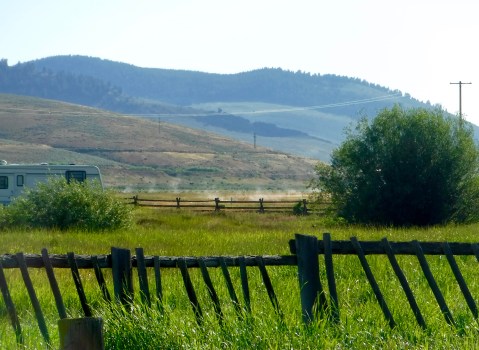
Hot Springs at Jackson, MT, visited by William Clark on July 7, 1806.
My second stop of the day was also chronologically misplaced, but since I don’t even know what today is, I guess it doesn’t matter if I mix up some events from hundreds of years ago. This stop had me back on the Nez Perce trail that I first mentioned when I stopped at the Bear Paw Battlefield a week ago. This was another battlefield during the same desperate cross-country flight of the Nez Perce in 1877. I knew it was there and expected to stop for 15 minutes, take a couple pictures, and move on. But the National Park Service has a great interpretive center and, once again, I struck up a conversation with an informed and knowledgable NPS staff member, and then spent time walking on the battlefield itself. My 15 minute stop took an hour and a half.
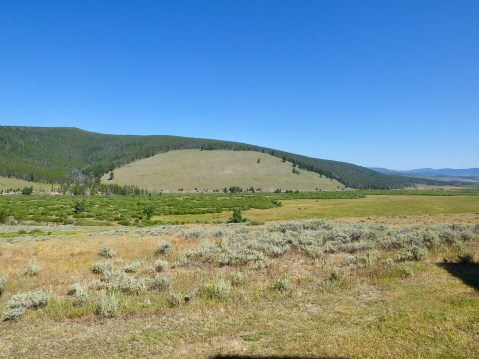
The Nez Perce were camped on the prairie to the right when they were attacked on July 9, 1877.
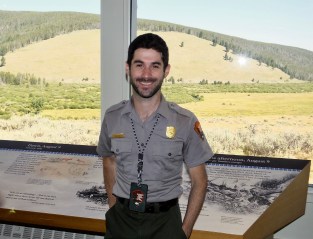
NPS employee Joey Wohl provided great help in explaining this historic site.
In August 1877, as 750 Nez Perce were attempting to escape pursuing Army troops, they stopped to rest for a few days on a prairie in the Big Hole Valley just over the Continental Divide in Montana. In the pre-dawn hours of August 9, U.S. 7th Infantry troops and a few civilians attacked the quiet village, shooting men, women and children as they slept in their tipis. The Nez Perce warriors, led by several warrior-chiefs, recovered from the initial attack, drove the troops back and began a siege which gave the surviving Indians under the leadership of Chief Joseph a chance to escape once more.
The National Park Service has done an excellent job preserving the site and explaining why the Nez Perce consider it sacred ground today and why they hold ceremonies each August commemorating the battle and honoring their people who died there. Seasonal interpreter Joey Wohl walked me through the details of the battle, pointing out in the landscape spread before us where the action took place. We talked at length about the different concepts of land and land ownership that separated, fatally it seems, whites from Indians. After we talked, I rode to the site and spent time trying to image the chaotic scene from 1877.
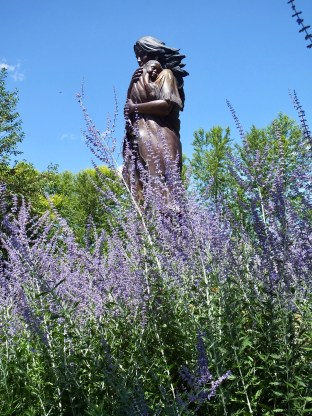
Sacagawea and Jean Baptiste (Pompey)
For months, as part of my Lewis and Clark trip planning, I had strongly considered literallyfollowing their 1805 route over the continental divide at Lemhi Pass where an historical marker signifies their achievement. But after talking with several people who had been there (and paying heed to Marilyn’s importuning), I opted not to challenge the 35-mile dirt and rock, one-lane road over the mountains. Instead, after leaving the Big Hole Battlefield, I crossed over the divide at Chief Joseph Pass (fitting, no?), continued on to Lost Trail Pass on U.S. Highway 93, then headed down the mountains to Salmon, Idaho, near where Lewis and Clark traded for horses with the Shoshone and where today there is a Sacajawea Interpretive Center. I had thought this would be an important stop on my educational journey, but I was sorely disappointed.
The small interpretive center and museum, operated by the town of Salmon, didn’t offer any new information about Sacagawea, repeated several myths that have grown up around her, and sugar-coated parts of the story that could have been dealt with more honestly. I’m hardly an expert on her or the Lewis and Clark expedition, but I’ve learned enough in the past year to know when its history is being presented through distorted lenses. Tourists who know little about the expedition can learn some important truths at this center, but scholars seeking to expand their knowledge about this important but largely unknown woman would be better off at the Interpretive Centers in Great Falls or Washburn at Fort Mandan. I thinks it’s important to note that no Shoshone any longer live in Salmon, having been forced onto reservations hundreds of miles away about 150 years ago.


(Click on the images above to enlarge.)
The Lewis and Clark Expedition spent two weeks with the Shoshone from August 13 to August 31, 1805, bargaining for horses, locating a guide, and exploring the Salmon River looking for a shortcut to the Columbia, even though the Shoshone had told them that navigating the river was impossible. They were right, and so the Expedition spent a tortuous 10 days hacking their way north over a series of mountains until they finally reached what they referred to as Travelers Rest, and camped for several days to rest and provision themselves before turning west for what would be one of the toughest challenges of the expedition: crossing the snow-covered Bitterroot Mountains as winter set in.
While their experience traveling from the Salmon River in Idaho to Travelers Rest in Montana was much worse than mine, my ride down from the top at Lost Trail Pass was awful. “Road Construction Ahead” was my first sign (literally) that there could be a problem. For nine grueling miles, highway crews were resurfacing the road with chip seal, something I hadn’t encountered since my Alaska trips in 2013 and 2016. They had just put a fresh layer of fine gravel down, and the pilot car led us at 10 miles an hour for nearly an hour of dust, flying chips (rocks), and a very hot air-cooled Harley-Davidson. When road conditions are good, that road is a great ride. That was my final “bad” and I washed some down some of the dust with a 23 ounce Scottish Ale at the end of the ride.
Tomorrow I should have a beautiful ride over the Bitterroots, which almost ended the Expedition in 1805.
MHT Day 17: One Very Long River
The Missouri River is 2,341 miles long, measured from the confluence of the Jefferson, Madison, and Gallatin rives in Three Forks, Montana, to the confluence with the Mississippi River just north of St. Louis. The Big Muddy is the longest river in the United States, and it seems like it to my Harley butt. Since I left Maggie Valley, I’ve ridden 3,748 miles to get to Three Forks today, including a few planned and unplanned detours. The last two miles of today’s ride, I rode through moderately hard rain, the first time I’ve dealt with that since I started this Magical History Tour. I’ll take 16 dry days in a row, even if some of them were hot.
I also had two other firsts today. A tour boat trip through the Gates of the Mountains canyon marked the first time I’ve been ON the Missouri River this trip. The final first for the day was my first spotting of snow on the distant peaks of the Rocky Mountains looking over the Jefferson River.
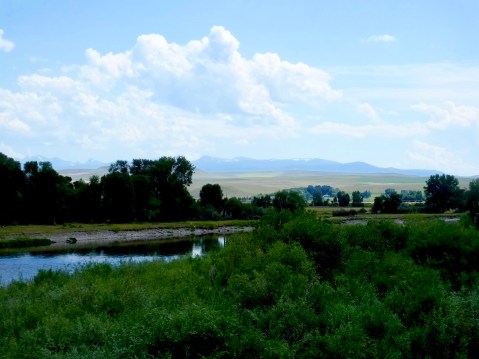
As I looked beyond the Jefferson River, which the Corps of Discovery went up in July and August 1805, I could see snow glistening at the tops of some of the distant mountains. Not big is this picture, but the white spots on the tops of the mountains are snow.
On July 19, 1805, Captain Lewis wrote in his journal about an unusual river canyon in which he was encamped for the night.
this evening we entered much the most remarkable clifts that we have yet seen. these clifts rise from the waters edge on either side perpendicularly to the hight of 1200 feet. every object here wears a dark and gloomy aspect. the tow[er]ing and projecting rocks in many places seem ready to tumble on us. the river appears to have forced it’s way through this immence body of solid rock for the distance of 5¾ miles and where it makes it’s exit below has thrown on either side vast collumns of rocks mountains high. the river appears to have woarn a passage just the width of it’s channel or 150 yds. it is deep from side to side nor is ther in the 1st 3 miles of this distance a spot except one of a few yards in extent on which a man could rest the soal of his foot. . . . from the singular appeaerance of this place I called it the gates of the rocky mountains.
Lewis’s Gates of the Rocky Mountains canyon is still there, though the presence of a dam downstream a few miles from the entrance to the canyon has raised the water level by about 18 feet. Today’s two-hour trip once again offered me a chance to see what the Corps of Discovery saw, with only a few changes. The rock walls still tower more than 1200 feet above river travelers and the canyon still inspires awe in those who pass by. Bald eagles and ospreys still soar overhead, occasionally plunging to the surface in search of a meal. Swallows still dart in and out of the canyon walls where they build their nests. The monstrous rocks still tower overhead, threatening, as Lewis noted, to tumble from their lofty perches into the cold, clear water below. Native American pictoglyphs painted by unknown shamans or artists more than a thousand years go still catch the eye of the observant voyager. Two hundred years haven’t changed this landscape much.
I was lucky once again to have found a knowledgable guide for this tour. Kari (pronounced Car ee) has been piloting tour boats, pointing out hard to find features, and relating history and stories related to the canyon for seven years. She knew how Lewis felt on entering the Gates and what he wrote about it. She told the story of the Mann Gulch Fire in the canyon in 1949 that took the lives of 13 smoke jumpers and is still used to teach fire fighting skills today. She knew the history of the first steamboat to go through the canyon. She explained the almost sacred relationship between the previous owners of the land bordering the river and the canyon. I would love to be able to spend a full day in a small boat with Kari slowly coursing through the towering canyon and hearing more of what she knows about this powerful landmark in the voyage of Lewis and Clark.
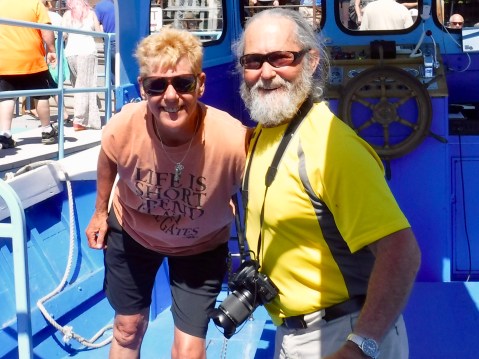
Kari shared a wealth of knowledge about the Gates of the Mountains.
Although they didn’t know it, when the men of the expedition exited the canyon they were only 90 miles and five days from the beginning of the Missouri River at Three Forks.
Clark arrived on foot at the Three Forks on July 25, having gone ahead of the main party hoping to make contact with the Shoshone (Sacagawea’s people), from whom they had to obtain horses if they were to continue their march to the Pacific Ocean. Lewis arrived by boat with the rest of the Corps on July 27 and they spent the next several days scouting, trying to determine which of the three rivers would be the real headwaters of the Missouri.
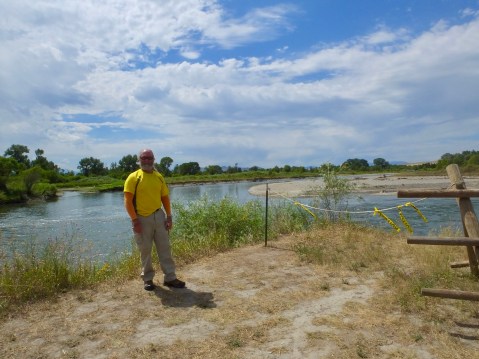
The river to the right is the Missouri; the river behind me is the Jefferson which the Corps ascended, the river to the left is the Madison. The Gallatin enters the Missouri about 1/2 mile downstream.
On July 28, Lewis recorded his and Clark’s decision to discontinue using the name Missouri to designated any of the rivers above Three Forks:
Both Capt. C. and myself corrisponded in opinion with rispect to the impropriety of calling either of these streams the Missouri and accordingly agreed to name them after the President of the United States and the Secretaries of the Treasury and state having previously named one river in honour of the Secretaries of War and Navy. In pursuance of this resolution we called the S. W. fork, that which we meant to ascend, Jefferson’s River in honor of 〈that illustrious personage〉 Thomas Jefferson. the Middle fork we called Madison’s River in honor of James Madison, and the S. E. Fork we called Gallitin’s River in honor of Albert Gallitin.
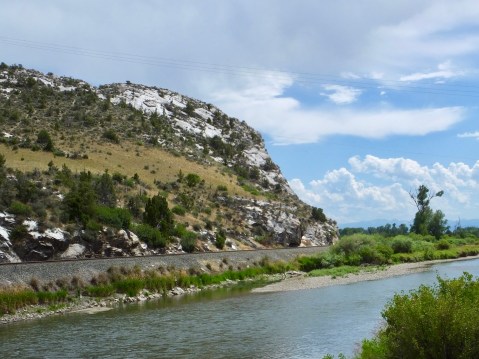
On July 27, 1805, Meriwether Lewis wrote that he ascended the point of a high limestone clift from whence I commanded a most perfect view of the neighbouring country. His vantage point was the cliff in this photograph, from which he could see all three rivers for a distance of 10 miles or more and helped him decide the Jefferson River was the river they should continue on.
By August 10,1805, the party had reached the place where I am now, Dillon, MT on the Jefferson River. On August 1 Lewis and three others made their first contact with the Shoshone and a few days after that, following an emotional meeting between Sacagawea and her brother Chief Cameahwait, they crossed the continental divide at Lemhi Pass and left the United States.
Tomorrow I’ll follow the Corps over the divide, into Shoshone country and on to the foot of the Bitterroot Range of the Rocky Mountains.
 hdriderblog