
MHT Day 6: A Changing River
Today I traveled in about seven pleasant hours what the Corps of Discovery in 1804 managed in a little more than two labor-intensive, back-breaking weeks. From May 20 when they left St. Charles to June 4 when they passed the spot where Jefferson City, Missouri’s capital, now stands they covered about 125 miles up the river, or fewer than 10 miles per day. I actually rode nearly 200 miles, but there were some expected and unexpected detours involved.
The expedition group numbered about 48 men as it made its way up the Big Muddy, including 28 members of the permanent party who would go on to the Pacific, about 8 members who were scheduled to return to St. Louis before winter set in, and another dozen laborers, mostly French boatmen hired in St. Louis who knew the river and how to handle large boats in its dangerous currents.
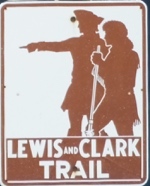 For most of the day, I followed roads that advertised the Lewis and Clark Trail with this sign. I’ll follow similar roads for the next 5,000 miles or so. (I’ve only logged 1,200 so far.) The National Park Service uses this sign to let motorists know they are about as near to the actual route of the expedition as they can be short of paddling or walking it. It will be a friendly reminder that I’m headed in the right direction as the miles roll by during the next three weeks or so.
One reason the Corps of Discovery took so much longer is that the Missouri River, as difficult as it is to navigate today in non-motorized craft, was a beast in 1804. It was much wider (more than 1/2 mile wide then, less than 1/4 of a mile now) and the surface area of the river water between here and St. Louis was three times greater. Oh, and the Army Corps of Engineers hadn’t begun to straighten the river and remove all the debris that spring floods uproot and deposit in terrible tangled masses to the great hazard of boatmen who couldn’t always see the snags.
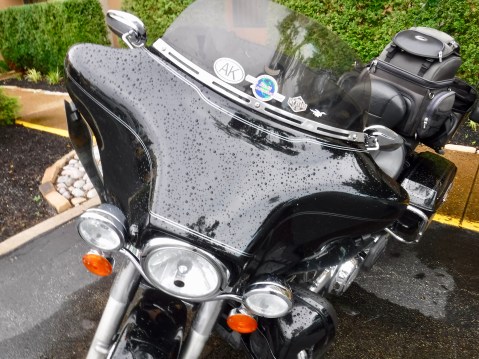
Strong storms several hours before departure today made the roads a little slick, but they dried out before noon and at least I didn’t have to ride in the rain.
I, on the other hand, after a damp beginning, travelled some very nice asphalt roads in balmy temperatures, roller coasteering up and down the hills of rich farm country that stretched for miles on either side of the road. There was one section of Highway 100 not far from the river that was still closed either by debris on the road, or, more likely, water. I had expected the detour and anticipated which roads I would need to take on my alternate route. What I had NOT anticipated was that one of the roads called for in the detour was gravel, so, not knowing the condition or the length of the rocky road, I added a detour to my detour that padded today’s ride by about 25 or 30 miles. But it was beautiful countryside, and I sat back and enjoyed the scenery that whizzed by.
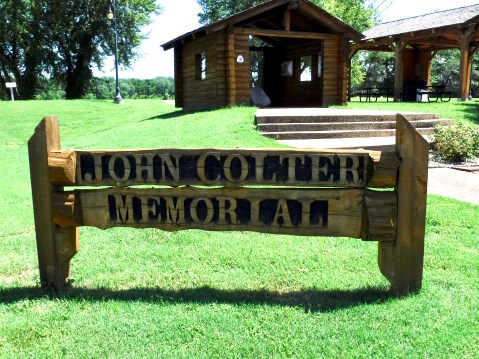
Stop One: The John Colter Memorial in New Haven on the banks of the Missouri.
I had planned three stops today at sites related to the expedition. First was a modest memorial to one of the crew’s better-known members: John Colter. Historians believe Colter had been picked up by Lewis in Pittsburg or shortly after leaving there as a “trial” member. Other than a couple of disciplinary matters which were resolved without much ado, Colter quickly became one of the expedition’s best hunters. He made it all the way to the Pacific and most of the way home, but when they got to within about 1,000 miles of St. Louis on the return, Colter asked to be released from service early; he wanted to return to the country they had just explored and seek his fortune trapping beaver. The seasoned mountain man made an infamous escape from the Blackfeet Indians after returning west and was probably the first European to see the extraordinary geysers, mud pots and canyons in what is now Yellowstone Park in Wyoming. Within a decade, he gave up trapping and the dangers of life in the west, bought a farm in Missouri near New Haven, and died and was buried there in 1812. In 2004, during the Lewis and Clark Bicentennial, local folks erected the memorial in his honor.
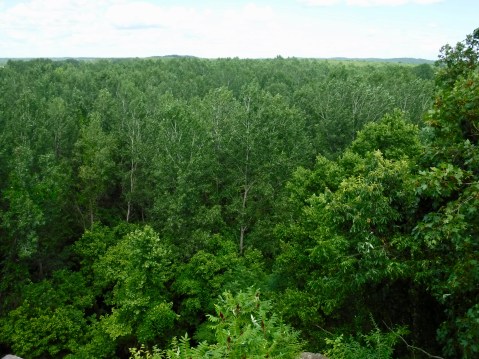
The view of the Missouri River from the top of Clark’s Hill.
The second stop was Clark’s Hill or Norton State Park about 20 miles east of Jefferson City. This was a rocky outcrop on a bluff above the confluence of the Osage and Missouri rivers where the party stayed for two days to take surveying and celestial measurements and was described by Clark in his journal entry for June 2, 1804: “. . . from this pt. which Comds both rivers I had a delightfull prospect of the Missouries up & down, also the Osage R. up.” I knew it was accessible and wanted to see what Clark had seen. So I rode half a mile down a potholed dirt road, hiked a mile up the hill and saw . . . Trees! Nothing but trees! I knew the Osage River had changed course about 100 years ago and now emptied about five miles further downstream. But I also knew–or thought I did–that the Missouri River was still there. Near the top of the trail I met, Linda, a volunteer working for the Missouri Natural Resources Department trying to remove invasive species along the trail, who explained to me that the Army Corps of Engineers had in the last 30 years or so deepened the river channel on the northern side, which in turn made the river narrower and the bottoms wider, which in turn provided a prime spot for cottonwood trees to thrive, which in turn blocked MY view of Clark’s view. Oh well, it was pleasant hike, and I had nice conversation with Linda while I caught my breath for the downhill return.
Finally, I wanted to stop at the State Capitol and Museum in Jefferson City, because I had read that it contained a few items and memorials related to Lewis and Clark. Once again, I was a little disappointed in what I discovered. First, the Capitol is undergoing major renovations to prepare for the state’s upcoming bicentennial and it’s wrapped up like some weird Christmas present while workers clean the exterior surfaces. And there’s green chain-link construction fencing all around which prevents weary motorcycle riders from getting too close.
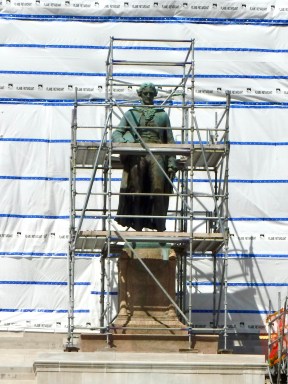 One item in particular I hoped to see was a statue of one of my favorite presidents, but they had the city’s namesake in a cage. I’m not sure if they’re making a political statement given the current administration’s predilection for putting people in cages or whether it’s just part of the construction process.
In the museum inside the Capitol, I learned that the limited exhibit space was given over to a centennial look at Missouri’s role in WWI and to the upcoming bicentennial. They did have two large statues of Lewis and Clark in the rotunda but they were set back in dark alcoves and didn’t do much for me. On the outside, on the Capitol grounds, I finally found a fairly decent memorial erected during the Lewis and Clark bicentennial in 2004-2006. Although I think the artist took liberties with the appearances of the figures in her tableau, it was nice to see Clark’s slave York (they referred to him as Clark’s “man-servant”) and French-Indian George Drouillard included in the group.
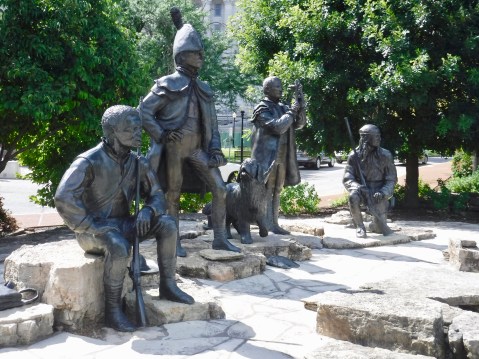
York, Lewis, Seaman, Clark the mapmaker, and Drouillard, York and Drouillard are just guesses, of course, since there are no portraits of them available.
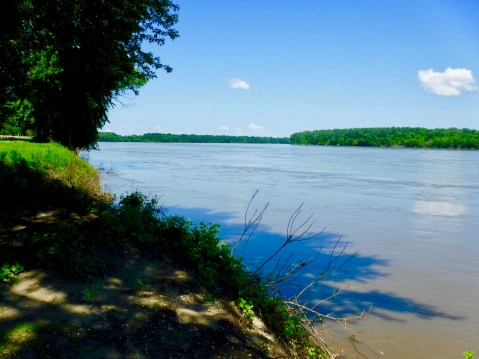
I had several good looks at the Big Muddy as I crossed it and stopped next to it several times today. Today’s river is mighty, but it’s a far cry from the wild river that the Corps of Discovery ascended in 1804.
MHT Day 5: The Corps’ Journey Begins
From the middle of December 1803 until the middle of May 1804, the captains made final arrangements for the historic voyage that would answer President Jefferson’s questions about a water route to the Pacific, the nature of the new land and its peoples acquired through the Louisiana Purchase, and the commercial and trade potential for the western portion of the United States. For Clark, that meant instilling military order and discipline to a permanent party that grew to 28 men. At the same time, he also had to determine the skills each man possessed and how they could be harnessed for the good of the party. Some of the recruits were well-behaved and reliable, while others needed to be molded by Clark’s firm hand before they could find a place in the Corps.
For Lewis, that five-month period meant spending much of his time several miles down stream in St. Louis or one of the nearby communities gathering additional supplies and working through the political tangles caused by Spanish occupation of French territory that was soon to be American soil. Although the Louisiana Purchase was ratified by the U.S. Senate in October 1803, the official transfer in St. Louis didn’t occur until March 1804 and involved the Spanish representative turning the territory over to the French who held it for one day before turning it over to the Americans. Lewis, still the private secretary to the President, was on hand to witness and sign the transfer document in March 1804. Firm possession of the Louisiana Purchase made an American military expedition up the Missouri River much easier, though little about the next two and a half years would be easy.
By May 1, the men of the Corps had gelled into a regular army unit and were ready to begin their voyage. Clark had them pack and repack the 55-foot keelboat which had been outfitted with additional storage lockers and prepare and pack the two pirogues (39 feet and 41 feet). They were, after all, taking with them about 12 tons of supplies.
On Monday, May 14, 1804, Clark wrote in his journal:
Set out from Camp River a Dubois at 4 oClock P. M. and proceded up the Missouris under Sail to the first Island in the Missouri and Camped on the upper point opposit a Creek on the South Side below a ledge of limestone rock Called Colewater, made 4½ miles, the Party Consisted of 2, Self one frenchman and 22 Men in the Boat of 20 ores, 1 Serjt. & 7 french in a large Perogue, a Corp and 6 Soldiers in a large Perogue. a Cloudy rainey day. wind from the N E. men in high Spirits
Finally, after years of planning, the Lewis and Clark Expedition was underway. Except that Lewis wasn’t with them. He was still in St. Louis and would join the group about 20 miles west at the village of St. Charles on May 20. OK, then the Lewis and Clark Expedition could get underway.
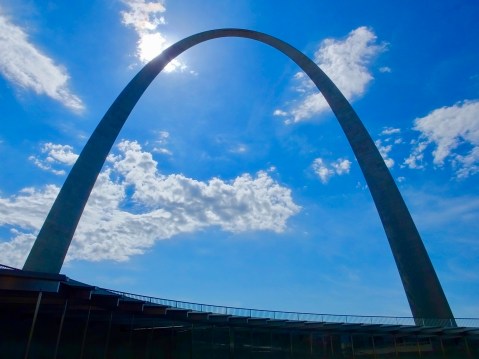
The Gateway Arch in St. Louis is hard to miss.
My day was spent at two locations in St. Louis and one in St. Charles learning about the St. Louis Lewis and Clark saw, the preparations they made, the craft they sailed (or rowed, or poled, or towed as conditions demanded), and the expedition leaders’ traits and personalities. First, I went to the iconic Gateway Arch, not to ride to the top to see the view from Missouri’s tallest structure, but to explore the interpretive museum at its base. Given a huge budget, experts can put together truly first-rate museum exhibits and the Gateway Arch museum is no exception. I discovered the history of St. Louis: Native American for thousands of years, then the Spanish to a small degree followed by the French who arrived both from Canada and by way of New Orleans, and finally the Americans. St. Louis itself was officially founded by the French in 1764 though its position at the confluence of the Missouri and Mississippi rivers had made it a Native American trading and commercial center for a thousand years. I pressed several park rangers into service to fill in some of the blanks not satisfied by the exhibits and left with a clearer understanding of frontier St. Louis and the international politics Lewis contended with.
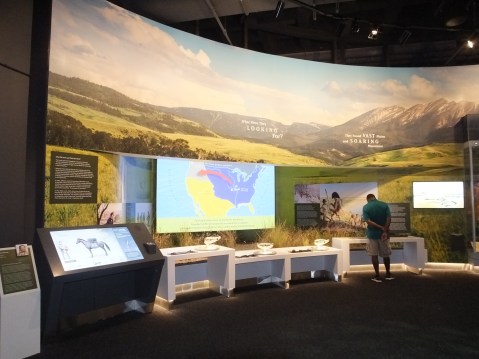
Interactive exhibits and well-displayed artifacts abound in the Gateway Arch Museum.
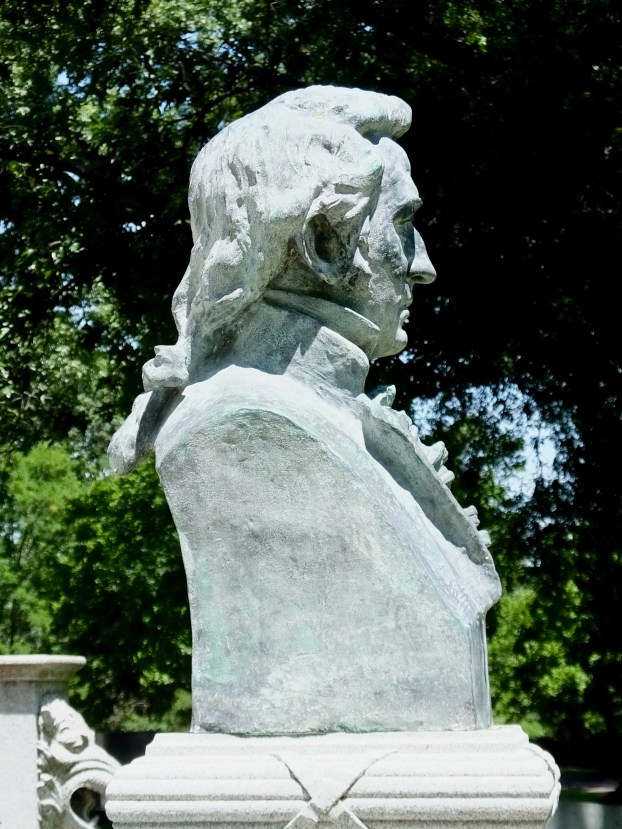
William Clark showing a fine queue.
My next stop was Bellefontaine Cemetery (aka Bell Fountain in the anglicized patois), one of the city’s largest cemeteries with about 87,000 interments on 350 acres. Who was there that piqued my interest? General William Clark, who, after returning from his voyage with Lewis, was promoted to Brigadier General, named governor of Missouri Territory and appointed Superintendent of Indian Affairs for all land west of the Mississippi. Clark died in 1838 at age 68 after a long life as a soldier and a statesman. I read inscriptions on various memorial stones at the site, then sat for a while and reflected on what he and Lewis and their men had done. I concluded, like many others, that the ledger of his life had a mixed result. On the plus side, he was brave, honorable, fair, and sought justice for those in his charge.
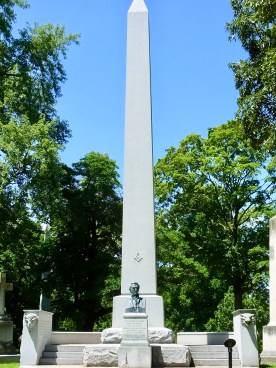
Clark’s obelisk at Bellefontaine Cemetery. He is buried there with his second wife and three sons.
But at the same time the tragic results that his expedition helped accelerate for native cultures and thousands of native people cannot be understated. He knew what was happening as well as anyone, but was unable to alter the course of history he had helped set in motion. In 1825, he wrote to his old friend Thomas Jefferson, “It is to be lamented that the deplorable situation of the Indians do not receive more of the human feelings of the nation.”
Finally, I headed to St. Charles where the Corps stopped on its second day on the river to wait for its co-commander. In 2004, a group of re-enactors based in St. Charles but drawing its membership from far and wide, built and set sail in three accurately built replicas of the boats used by the Corps, going up the Missouri River to Mandan, North Dakota, in the keelboat and continuing on to Great Falls, Montana, in the two pirogues. Following their maiden voyage the boats were stored in a new boathouse and museum facility on the north bank of the Missouri River in St. Charles.
Several replicas of the keelboat will be available on my route west, but this was the first opportunity I had to see full-scale models of all three. Although the boats are not well-displayed for most visitors to see since the boathouse is mostly for storage of the boats, I met one of the re-enactors today who was hard at work cleaning up from this year’s flood, which deposited six feet of water and a foot of mud in the boathouse. He opened the heavy grated door and invited me to look around and see the boats in a way most visitors do not. We talked about the boats, their construction and their use, but we also talked about this year’s flood and how it compared to previous years’ floods. He reminded me that the Missouri River, when the Corps plied its waters, was much wider than now but much also much shallower. Constant dredging along the river’s course has deepened the channel and sped up the flow.
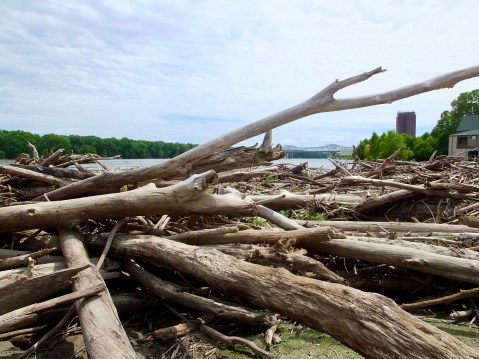
Some reminders of this year’s flooding line the bank next to the boathouse in St. Charles.
One final note: Today I visited two museums. One is well-funded by public monies and clearly the work of professional historians, exhibit designers and curators. The other is a volunteer effort maintained by donations and perhaps some small grants. The two were strikingly different, though each is important in its way and each helps preserve, interpret and display America’s past. I’m glad both exist and glad I was able to visit and learn at each of them.
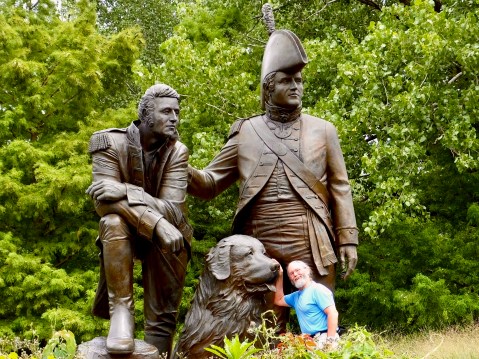
Meriwether, Bill, Seaman and me in St. Charles. They were truly giants.
MHT Day 4: Camp River Dubois–The Expedition’s Starting Point
On December 12, 1803, William Clark and the men he and Captain Lewis had gathered, landed on the eastern shore of the Mississippi River across from the mouth of the Missouri River a few miles north of St. Louis where the “Riviere Dubois” or Wood River emptied into the Mississippi. For the next five cold months, that would be their home as they added new members to the expedition and morphed from a group of disparate frontier individuals into a cohesive 28-member military unit under the command of Captains Lewis and Clark and three sergeants appointed from the ranks.
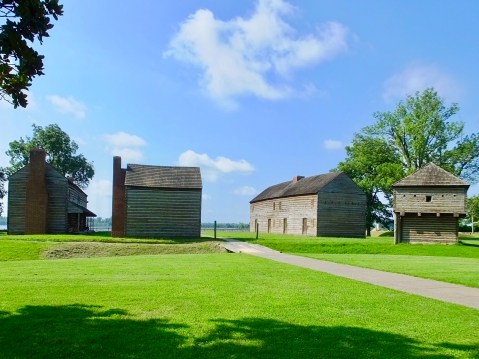
A rebuilt Fort Massac, located about 50 yards from the original (and archaeologically-important site. Unfortunately, all these buildings have been closed because they’re deemed unsafe.
My ride today generally followed the route they took, beginning at Fort Massac State Park at Metropolis, Illinois, down the Ohio River to the confluence with the Mississippi at Cairo, Illinois, (pronounced “care-o”) and then north to the Lewis and Clark Memorial State Park where the state of Illinois built and developed a Camp River Dubois interpretive center as part of the park. I say “generally followed” because my planned route on Illinois Highway 3 was cut short by “Road Closed” signs thanks to the continuing disruptions caused by this year’s flooding throughout the Midwest. Highway 3 is part of “The Great River Road,” a collection of scenic roads that run the length of the Mississippi and I was looking forward to seeing what the Illinois section had to offer. Instead, I rode through the searing heat wave scorching the county looking at some nice Illinois farmland, but it was not the view I had hoped for. In addition, my effort to stand on the point where the Ohio and Mississippi rivers join forces was also scotched by flooding that had closed the road into Fort Defiance State Park which contains said point.
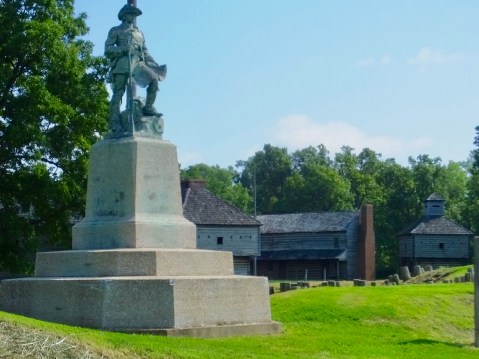
A statue of George Rogers Clark sits on the site of the original Fort Massac.
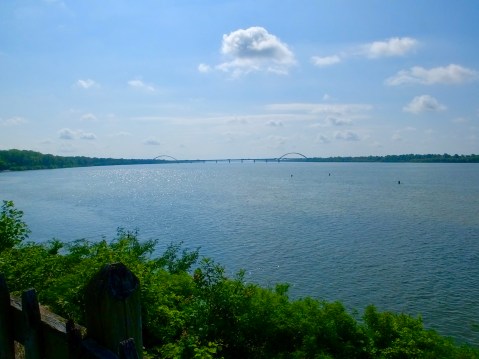
If the statue of George Rogers Clark could see from his position on the bluff above the Ohio, this would be his view. The bridge is I-24 and Paducah is on the other side.
I arrived at Fort Massac about 9:30, half an hour before the museum and visitor’s center opened and had time to look around the site which sits on a small bluff above the 3/4 mile wide Ohio River. The historic site is located in a state park which has campgrounds, picnic areas, a very busy disc golf course, and hiking trails (when it’s not underwater).
Fort Massac’s historical importance is much more than the two-day visit by Lewis and Clark, in November 1803. Its history dates to the early 16th century when Spain first claimed the area, followed by French trading and military interests in the mid 18th century before France ceded it to Great Britain in 1764 following the end of the French and Indian War. During the American Revolution, General George Rogers Clark (William Clarks older brother) used the destroyed Fort Massac in 1778 as his jumping off point for securing all of the western territory for the rebelling British colonies. George Washington ordered the fort rebuilt in 1794, and when Lewis and Clark stopped there in 1803, it held less than 100 soldiers, two of whom plus the civilian George Drouillard eventually joined the Corps of Discovery.
When Lewis and Clark’s mini-flotilla reached the confluence of the two great rivers, they halted for six days (November 14-20, 1803) during which time William Clark took a crash course in celestial navigation (using the sun, moon and stars to determine latitude and longitude). These skills proved vital to his role as the expedition’s chief cartographer, as he mapped the northern reaches of the Louisiana Purchase and the unclaimed land between the northern rockies and the Pacific Ocean. His published maps guided early settlers and explorers for decades as whites moved into the area to trap, hunt and settle.
At Lewis and Clark Memorial State Park, east across the Mississippi and a few miles north of St. Louis, I took a welcome respite from the oppressive heat (index about 110) in the air-conditioned comfort of the visitor’s center. A brief movie about the Corps’ stay at Camp River Dubois confirmed what I had read last winter in the journals. But the displays were especially helpful in fleshing out my understanding of their living conditions, both at Camp River Dubois and aboard the 55-foot keelboat. The interpretive center has a unique full-size cut-away model of the boat which demonstrates how they were stored and moved several tons of supplies, food, trade goods, and tools necessary for various trades. Outside the visitor center were examples of the crude log huts they hurriedly built in December of 1803 and in which they lived 9-men to a hut.
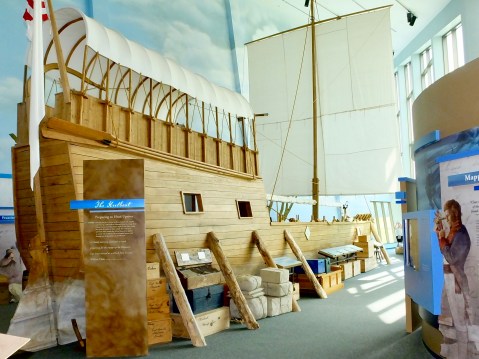
The cutaway replica of the keelboat dominates the exhibit space inside the interpretive center.
Toward the end of my visit I talked with one of the staff who turned out to be the park superintendent and who had been there since the site opened in 2002. Historian Brad Winn, as it turned out, answered several questions I had about the expedition, and then we began talking about his recent cross-county trip that followed much the same route I’ll pursue during the next three weeks. In his office, he showed me an excellent collage containing a map, pictures from the trip and a copy of the National Park Service road signs designating the Lewis and Clark trail. Unfortunately I met Brad only 15 minutes before the building closed; I would liked to have spent more time picking his brain about expedition minutia.
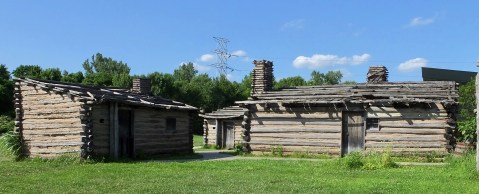
Replicas of the log huts hurriedly built by men anxious to escape from the freezing temperatures in the winter of 1803-1804.
One of the things we discussed concerned the exact location of the original Camp River Dubois. During the past 200 years, all three of the rivers involved (Mississippi, Missouri and Dubois/Wood) have shifted location by as much as three or four miles. Clark, for example, drew maps showing the Missouri and the Wood rivers directly across from one another. Today, the Wood River empties into the Mississippi several miles north of where it did in 1803. And the Mighty Mississippi has also shifted its banks about one mile to the east. In short, the original camp site, once on the eastern bank of the Mississippi, now lies either somewhere on the western shore or, perhaps, even underwater in the great river itself. We can write the history of the beginnings of the Lewis and Clark expedition without knowing exactly where they set up camp. But it sure would be nice to know for sure.
The Corps spend five months in the vicinity of St. Louis. The least I can do is spend an extra day here learning a little more about their beginnings by visiting several key interpretive centers, which is what I’ll do tomorrow.
MHT Day 3 (?): On the Road. Again.
I finally now seem to be securely on the road, though the early days of the Magical History Tour have been fraught with motorcycle-related delays. Yesterday, I picked up the bike in Morristown after a new stator and new voltage regulator installed by the technicians at Colboch Harley-Davidson remedied the electrical issues that delayed my progress for three days. My destination, as I rode the hills of eastern Kentucky and admired some of the state’s smaller horse farms, was Clarksville/Louisville, where Clark joined Lewis and his growing band of adventurers in 1803 for the final leg down the Ohio River and up the Mississippi River to St. Louis.
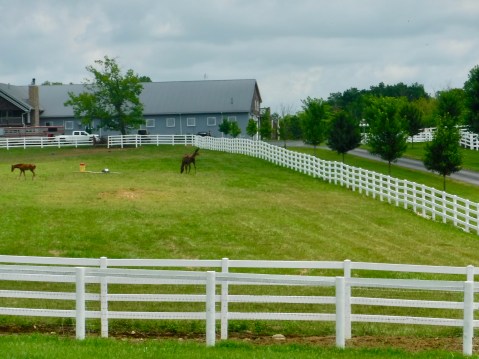
There were bigger horse farms in Kentucky but this one caught my eye and had a safe place to pull off and get a picture for Sue in South Carolina.
About 30 miles from my destination yesterday, I experienced a problem I associated with a slipping clutch. Although I continued to ride the bike through the 95 degree temperatures to the day’s target, I wasn’t sure what the problem was nor whether the bike could go another 8,500 miles without leaving me stranded. So I tracked down the local Harley dealer, detoured to the store and pled my case for quick attention to the service writer. By the time I arrived at the store, it was nearly 3 p.m. and the service department was backed up with Harleys in need of repair. But, convinced of my importunate desire to continue my westward quest to the Pacific, the service writer said she would schedule my bike first thing this morning to determine what mischievous gremlins were messing with my clutch.
I didn’t post a blog last night because I didn’t know what to write. I had seen nice country but hadn’t made the L&C historical stop that I planned for Louisville. And I didn’t know what to say about how long the trip might be delayed again. So I waited until today to resume writing.
When I rode the bike to the dealership this morning, I tried to reproduce the issue I experienced yesterday, but–and this is good news–I couldn’t make the clutch slip even when I duplicated yesterday’s conditions as nearly as I could. What was different? Yesterday the temperature was in the mid 90s and this morning it was 20 degrees cooler. Perhaps, I thought, the problem was, at least in part, heat related. But even though the problem wasn’t recurring I decided to have the bike checked out by Donnie, the Master Technician at Bluegrass Harley-Davidson. After multiple mechanical surprises over the past two weeks, I should be pardoned if I’m a little gun shy.
When they opened the service door I drove in and the technician went through his paces. An hour and a half later, he reported that he couldn’t find an obvious problem, though he did tighten the clutch cable and made a couple other adjustments. He said the bike should be good for my proposed cross-country jaunt. I paid my bill, saddled up and hit the road at noon for Paducah, Kentucky, along the banks of the Ohio. One final note about today’s visit at Bluegrass Harley-Davidson. While I was waiting in the service area, John Dunn, former service writer at Adamecs in Orange Park, FL, where I bought the very bike that was then in for repair called my name and reintroduced his still-bearded self. He is the service manager at Bluegrass and just as he took care of me in Florida, he did the same in Kentucky. Small world.
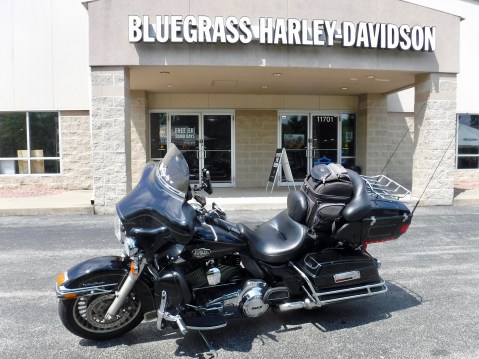
Repaired AGAIN and ready for the road thanks to the folks at Bluegrass Harley-Davidson.
Today was another day in the mid-90s, but unlike the previous two riding days there were no mechanical issues, no furtive sounds, no surprise jerks or jolts, no warning lights. Just smooth sailing. At last.
Because of the four-hour repair delay, I didn’t have time today to visit any historic sites, but I did cross the Ohio river that carried the expedition in 1803 three times today. It’s breadth and depth must have been a welcome relief to Lewis after his painfully long voyage over shoals and rapids from Pittsburg to Clarksville. I did have time after checking in to my motel and cooling off for a few minutes to ride to the river and take a long, contemplative look at this vital and historic waterway.
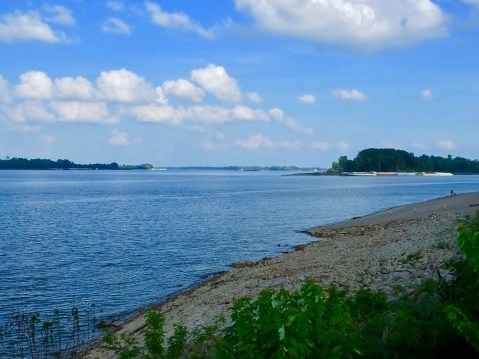
The Ohio River at Paducah. To the right, the Tennessee River joins the much larger Ohio. The Ohio presented some early problems for Lewis, but at least he was going with the current. When he reached the Mississippi his crew was rowing upstream. Good practice since they would be rowing or paddling upstream on the Missouri for many months.
Lewis and Clark stopped for several days across the river from present-day Paducah at Fort Massac in mid-November 1803. Their most important acquisition at the fort was a hunter/interpreter name George Drouillard, the son of a French-Canadian father and Shawnee mother. Neither Lewis nor Clark ever learned to spell his name correctly, usually using “Drewyer” when referring to him in their journals. Drouillard was one of only five civilians among the 33-member party who made the journey to the Pacific and back and proved to be the most reliable hunter on the expedition as well as a skilled user of sign language among plains Indians.
While I was enjoying the view of the Ohio from the banks of downtown Paducah I noticed something completed unrelated to this trip but of great interest to Marilyn back in Maggie Valley. So I took a picture of the National Quilt Museum just so she can add it to her future travel adventures.
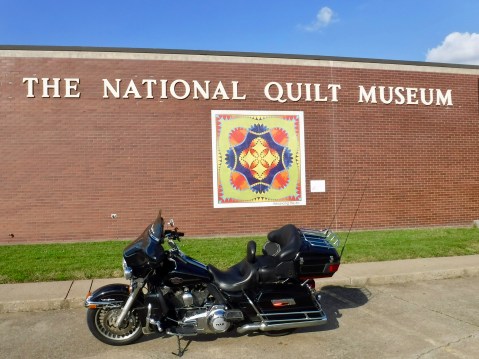
I see another trip to Paducah in my future.
Tomorrow, I’ll begin with a stop across the river at historic Fort Massac, then continue down the Ohio to the confluence with the Mississippi, then turn north and follow the great river to St. Louis. The day is expected to be hot again as a vicious heat wave swallows middle America but, hopefully, there will be no mechanical mishaps to report. It’s good to be on the road again.
MHT Day 2: Disappointment not Despair
When I posted last night, I optimistically suggested the electrical issues with my bike would be remedied in short order and I would be on the road again in a day or two at most. This morning, the service manager at the Harley dealership in Morristown called to say that the earliest they might be able to diagnose and work on the problem would be Wednesday, but more likely would be Friday. He added that if they had any cancellations of previously scheduled jobs they would try to work me in, but he didn’t expect that would happen. It’s a small service department–only two or three technicians–and summer is peak riding season; I understand their inability to focus their attention on one impatient old rider who is extremely anxious to start logging miles again.
So, to my great chagrin, I’m hitting the reset button for this trip and will resume it just as soon as my Harley is road-worthy. I’m hopeful that will occur Friday or Saturday, but the timing of the re-launch is out of my hands. I’m not unpacking my bags and I remain primed and ready to restart my one-person, cross-country expedition at the earliest moment.
During their historic journey across America, the Corps of Discovery experienced countless disappointments, delays and detours, but they persevered, proceeded and overcame myriad difficulties. I will do the same.
I won’t post again until I’m on the road or I have word that I’ll be on the road the next day. For those who signed up for email notices when a post is made, you will know when the adventure recommences. If you haven’t signed up for email notices, please consider that. Or you can check back every few days to see if I’m rolling again. Sorry for the disruption in the blog, but I’ll be back to reporting on the Magical History Tour soon.
MHT Day 1: The Best Laid Plans…
When Captain Lewis left Washington, D.C., on July 5, 1803, he had a pretty good idea of the schedule he planned to keep on his way to the Pacific and expected to be hundreds of miles up the Missouri River west of St. Louis before cold and ice halted the Corps of Discovery. In the spring of 1803, during visits to Philadelphia and Harpers Ferry, he ordered supplies to be delivered to Pittsburgh, where the Ohio River is born of the joining of the Allegheny and Monongahela Rivers and where he had contracted for a 55-foot keelboat to be built and ready by July 20. He arrived in Pittsburgh July 15 only to discover the keelboat was nowhere near ready and the drunken shipbuilder in charge had a boatload of excuses but no boat. Lewis had tons of supplies waiting to move downstream, he enlisted three men who would become part of the permanent party plus several more adventuresome souls to help transport his supplies down the Ohio, and then he waited. And waited. On August 31, a month and half after he reached Pittsburgh, he and his crew finally launched their craft on an Ohio River woefully short of water, which made moving a keelboat with a three-foot draft a frustratingly time-consuming challenge.
A month and a half later, on October 14, Lewis and his group reached Captain Clark in Clarksville, Indiana, across the river from Louisville, Kentucky. Lewis must have been anxious to press on, but the group, now grown to more than a dozen with the addition of at least seven men chosen by Clark, delayed leaving Clarksville until October 26 and didn’t reach the confluence of the Ohio and Mississippi Rivers until November 20. After rowing upstream for more than three weeks, on December 12 they ultimately reached their destination on the Mississippi River across from the mouth of the Missouri River and a few miles upstream from St. Louis. There they would stay for five months, enlisting and training new recruits for the Corps of Discovery and preparing for a spring 1804 start up the Missouri on their voyage across territory that now officially belonged to the United States thanks to the recently ratified treaty confirming the Louisiana Purchase.
Despite years of preparation, Lewis’ plan to be several hundred miles further west before stopping for winter had been upset by numerous delays over which he had little or no control. Isn’t that the way things usually work out?
I mention all of this historical background to help put in perspective today’s travels.
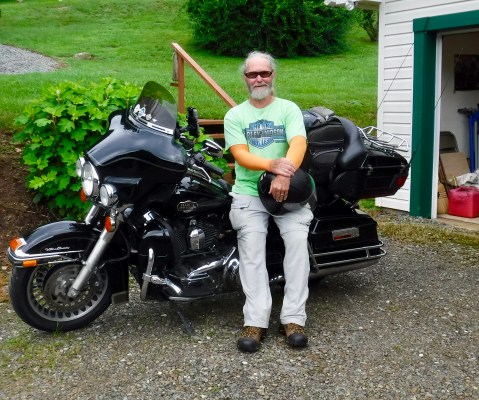
Prepared and packed for an early departure.
After years of planning and months of preparing, I rolled out of my driveway this morning a little before 8 a.m., ready for a 350-mile ride through Kentucky to Clarksville, Indiana, where Lewis and Clark had joined forces in the fall of 1803. A little rain splattered my windshield as I passed through the northeast corner of Tennessee, but not enough to be of concern or to slow me down. I had a schedule to keep. I had plans.
About 10:30 a.m. and two miles from the Kentucky border, I glanced at my gauges and noticed, to my great dismay, that the check engine light and the battery light were both illuminated and the voltage gauge was reading 11 volts when it should have been reading 14. I crossed the border at Cumberland Gap, braked to a stop a mile or two later in Middlesboro, and began assessing my sorry situation. I suspected it was a stator (think alternator) gone bad or the voltage regulator. In either case, I knew I couldn’t ride the bike far because the battery would eventually die and I’d be stuck on the side of the road. The fact that today is Sunday and that Middlesboro doesn’t boast a Harley-Davidson dealership severely limited my options to get back on the road quickly.
I had noticed a Harley dealer about an hour earlier as I whizzed through Morristown, Tennessee, and a quick internet search showed that Colbochs Harley-Davidson was indeed the nearest source of help. The dealership was open from 12 to 5 but the service department wouldn’t open until tomorrow at 9 a.m. At noon I called the dealership to see if anyone there could help transport my bike 45 miles back to their shop. They didn’t have anyone who fit that bill, but Ernie, the sales manager, went above and beyond and made some calls until he found a towing service that would come to Middlesboro, pick up my bike and me, and deliver us to the dealership. Arrangements were made and a driver with a roll-back truck was promptly dispatched.
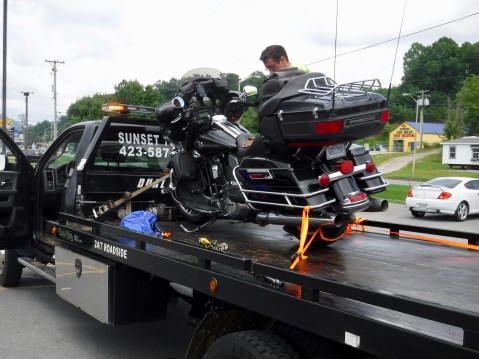
There is no sorrier sight than a Harley Davidson on a roll-back truck.
That solved part of my problem. Now I had to figure out where I was going to spend the night. A series of conversations with Marilyn resulted in her driving 75 miles to Morristown to pick me up and take me back to Maggie Valley, where I currently sit sipping a well-deserved glass of Jack Daniels, pondering the annoying vagaries of travel in the 19th and 21st centuries. Tomorrow, if Ernie is true to his word–and I have no reason to think he won’t be–Colboch’s crack service department will dismantle my aged bike first thing, remove bad things and install good things, and get me on the road again ASAP. I’m hopeful their call to me tomorrow morning will be good news and that I can pick the bike up early in the afternoon, and, like Captain Lewis two centuries before me, continue my unexpectedly delayed trip to St. Louis. If not tomorrow, then an early Tuesday delivery will still get me to St. Louis Tuesday evening after 10 hours and 550 miles on what will probably be wet roads thanks to the rainy remnants of Hurricane Barry.
I’ve said before that these trips are adventures not vacations. But I didn’t expect this adventure to start producing the unexpected so quickly. Stay tuned to see what further misadventures enhance the Magical History Tour.
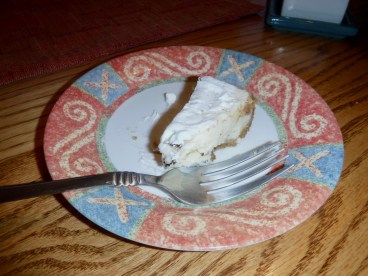
By the way, for those who follow the blog just to see what pie I eat, today’s pie was leftover cheesecake at home. And yes, cheesecake is technically pie.
Magical History Tour (MHT): Prologue
In the spring of 1801, 57-year old Thomas Jefferson, newly elected third President of the United States, asked 28-year old Captain Meriweather Lewis to become his private secretary. No one is quite sure why he chose Lewis, but Jefferson’s long-term dreams and plans for the western portion of North America must have played a role. During the next two years, while European intrigue boiled around them, the two Virginians talked at length about exploring the un-explored West. As construction crews continued work building the “President’s House” (aka The White House), the new president and his young protégé poured over existing maps and descriptions of the largely unknown American west and put in motion a plan to explore and stake the new nation’s claim to it.
By 1803, efforts were underway to secure for the United States land claimed by France east of the Rocky Mountains and west of the Mississippi River, culminating in what we know today as the Louisiana Purchase. At the same time, Jefferson and Lewis had developed the outlines of a western expedition, and Lewis began to make specific plans to form, outfit, and assume command of what became known as the Corps of Discovery.
Lewis, without hesitation, asked that 32-year old William Clark, with whom he had served in the army on the frontier several years earlier, be assigned as his co-equal in the adventure. These two young army officers and 30 some other enlisted men and civilians would spend the next three years living an early and crucial chapter in American history as they searched for the headwaters of the Missouri River, looked for a feasible water/land route to the Pacific, expanded scientific knowledge by identifying hundreds of previously unknown plants and animals, and established relationships with native peoples whose ancestors had lived in the area for thousands of years.
During the next five to six weeks, I’ll once again expand my geographic and intellectual horizons by retracing the route of the 1804-1806 Lewis and Clark Expedition, up the Missouri River to its source in Montana, over the Rocky Mountains to the land of the Nez Perce Indians (aka Niimiipuu) in Idaho and down the Snake and Columbia Rivers to the Pacific coast at present-day Astoria, Oregon. Along the way, as I navigate my well-traveled Harley-Davidson on scenic and lonely backroads that parallel their mostly-water route, I’ll visit historic sites, explore museums large and small, catch glimpses of the wild and rugged lands they traversed, and learn more about their incredible journey. And I’ll share my journey—and theirs—through daily blog postings and pictures. I’m glad you’re reading this and hope you follow along in the coming weeks as I joyously pursue two passions that have occupied much of my adult life: motorcycling and history.
For those who followed my two-wheeled rambling via earlier blogs (e.g. Alaska, Newfoundland, the Rocky Mountains, Alaska again), welcome back. For newcomers, know that I’ll try to entertain you for a few minutes each day with various misadventures, serendipitous encounters with interesting people, and pictures of our beautiful land and its amazing inhabitants. During this year’s great adventure, I’ll include a little more history than in past blogs. Please feel free to use the comments section of the blog to stay in touch, respond to my ramblings and let me know what you think about this year’s Magical History Tour.
Tomorrow it begins. “I can’t wait to get on the road again.”
Partial Cast of Characters: The Queue Crew
ROUTE MAP: Click here for a PDF map of the entire Corps of Discover route. This map opens in a new window.
GAFA Day 8: Round Trip
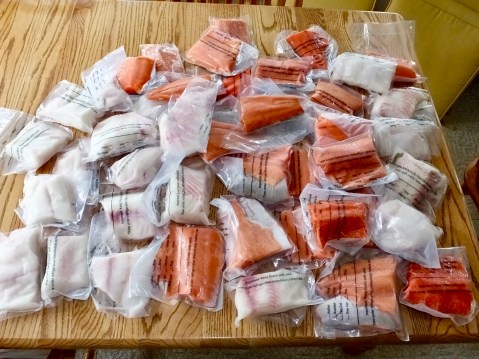
After a week in Alaska, this pile of fish is all I had to show for it when I returned to Maggie Valley this afternoon. Well, that and hundreds of memories of hours spent salmon and trout fishing in beautiful glacier-fed rivers, jigging for halibut in a salt water inlet surrounded by soaring mountains and snow covered volcanoes, confronting a grizzly, seeing moose, watching eagles, visiting local museums that aided my understanding of the people of the area and their relationship to a rugged environment and meeting some really good people from Texas, Minnesota, Tennessee, Florida, Georgia and, naturally, Alaska. And then there were the moose burgers, the reindeer sausage, huge sandwiches on fresh baked bread, melt-in-your-mouth pastries from the Moose Is Loose, fresh clam chowder, some amazing barbecue, a couple of nice craft beers and an abundant supply of Jack Daniels. But, of course, I prize most the hours of thoughtful conversation with John about topics mundane and meaningful.
So, yeah, I brought back a lot more than a pile of delicious fish. The Great Alaska Fishing Adventure is in the books (or soon will be when I publish the blog).
No adventure ever goes as planned. I hadn’t planned on ruining a brand new pair of waders and buying a second pair. I hadn’t planned on soaking and destroying a new, albeit inexpensive, camera. I hadn’t planned on the Sockeye limit being reduced from three to one just before we got to Alaska because the salmon run is half what it was two years ago. I hadn’t planned on getting rained out of a flyout trip to Bachatna Creek. I hadn’t planned on a perilously windy voyage across Skilak Lake. But I also hadn’t planned on the chance meetings, serendipitous encounters and pleasant surprises that all the people we met on the trip provided. But, as I’ve said in previous travel blogs, it’s the unplanned that makes a vacation an adventure. I’d rather have the adventure anytime.
I had planned to see beautiful country. Check. I had planned to catch a lot of fish. Check. I had planned to eat and drink well. Check. Check. I had planned to enjoy my first-class flight and chalet accommodations. Check. I had planned to have a great time. BIG CHECK.
Despite the sometimes late nights that writing the blog required and the missed conversations with John while he respected my need for quiet time to focus my Jack Daniels-adled brain enough to tap the right keys on the keyboard, I enjoyed, once again, writing the blog each night and sharing pictures of our daily adventures with the less fortunate who still work or have obligations that keep them close to home. I hope to be able to continue to write on hdriderblog in the years ahead and I hope friends and family will continue to follow along.
What’s in store for next year’s blog? I’ve already started reading about, preparing for and planning another two-wheel adventure next summer when I expect to follow (as closely as possible) the route taken by Merriweather Lewis and George Clark in 1803-1806 when they and the 30 men and Sacagewea of the Corps of Discovery became the first Americans to cross the newly-acquired Louisiana Purchase by traveling up the Missouri River from St. Louis and through the uncharted northwest lands from the Rocky Mountains to the Pacific Ocean. Six weeks or so on my motorcycle again studying history, seeing beautiful country and meeting new people. Sounds like a plan to me. Hope everyone follows along again and keeps me company when I get “On the Road Again.”
Thanks again for coming along this year.
GAFA Day 7: Headed Home
The Great Alaska Fishing Adventure has run its amazing seven-day course, and John and I are sitting in the Ted Stevens International Airport in Anchorage, waiting for our 8 p.m. departure for an overnight flight to Atlanta and then on to Savannah. We leave Alaska, of course, with mixed feelings. On one hand, each of us is anxious to get back home to our loving wife and jealous friends. On the other hand, leaving a place as beautiful and awe-inspiringas the Kenai Peninsula is difficult indeed. Alaska adventures produce tranquility and excitement in equal measure and few people are able to make just one trip to the 49th state. This was my fourth visit to Alaska and John’s first, but I predict we will return again someday.
We said goodbye to our gracious chalet hosts Jan and Don Shields after an extended snooze this morning and headed into Soldotna for a 10 a.m. appointment to pick up our fishy bounty. Each of us return home with about 20 pounds of salmon and an equal weight of halibut. I noticed this morning that the going price for salmon was about $12 a pound and $25 for halibut. Our flash frozen fillets won’t offset the trip’s cost, of course, but good eating for the next year makes the financial outlay more palatable.
We had thought about doing a little sight-seeing on the way back to Anchorage, and decided to stop in Hope, a little town I visited twice before on motorcycle adventures and the home of the best pie I tasted in Alaska. Pie was to be our lunch today, but when we arrived at the restaurant–which had changed ownership since my last visit–we discovered that the horde of salmon anglers who descended on the town this weekend to fish the creek for silvers and pinks devoured all the pie in town. I was crushed, and after a quick drive through what’s left of the historic gold-mining town, we left a pieless Hope and drove the remaining miles around Turnagain Arm to the airport. There, we unloaded our luggage and fish and returned the POS Focus to the rental company.
My camera remained in its bag all day, so there are no new pictures. But I know that most people come to hdriderblog.com to see pictures, so I’ve added a few more taken over the last week that probably should have made the blog earlier but didn’t. Tomorrow I’ll make a final post to wrap up the GAFA 2018 blog. Thanks to all who took time to join John and me on this wonderful adventure and to read my ramblings when they probably should have doing something constructive at work.
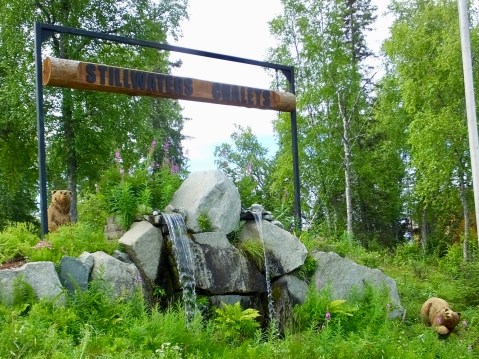
The entrance to Stillwaters Chalets in Soldotna
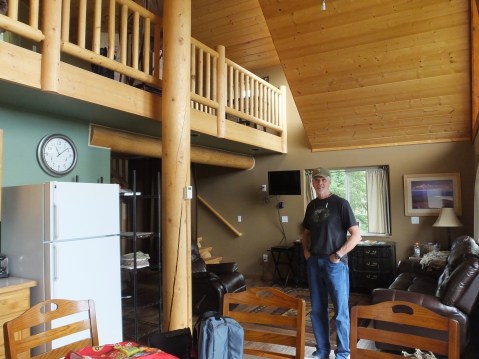
John checks out our lodging on the first day.
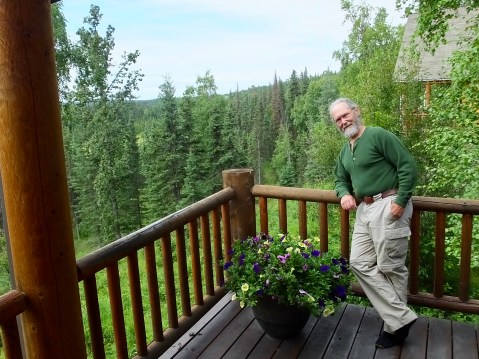
John called this my J.C. Penny catalog pose. I was just enjoying the view from the chalet deck.

Silver Salmon caught on the Kenai River.

Rainbow trout caught on the Upper Kenai River.
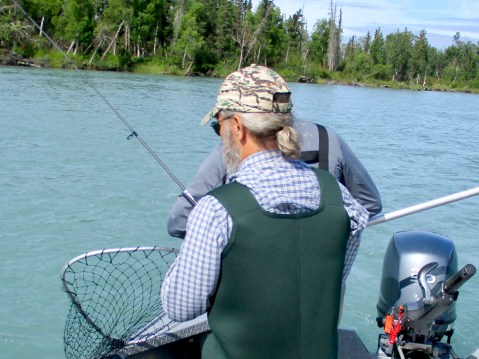
I’ve hooked a Pink Salmon.
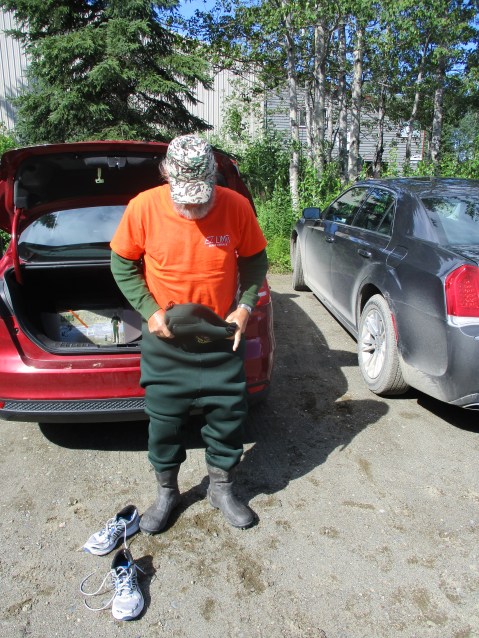
Waders were the uniform of the day on the Kustatan River flyout.
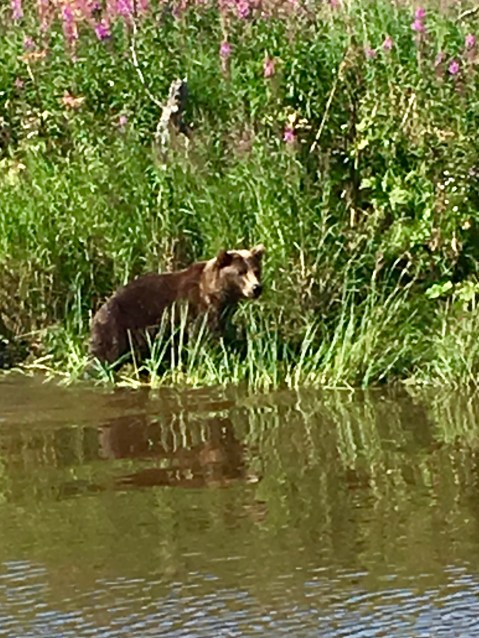
Another shot of the Griz that challenged our right to fish in his river.
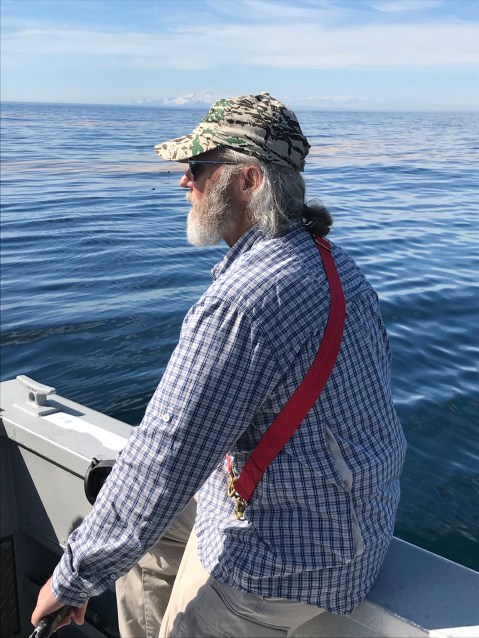
Waiting in vain for a halibeast to gobble my tasty fish-head bait.
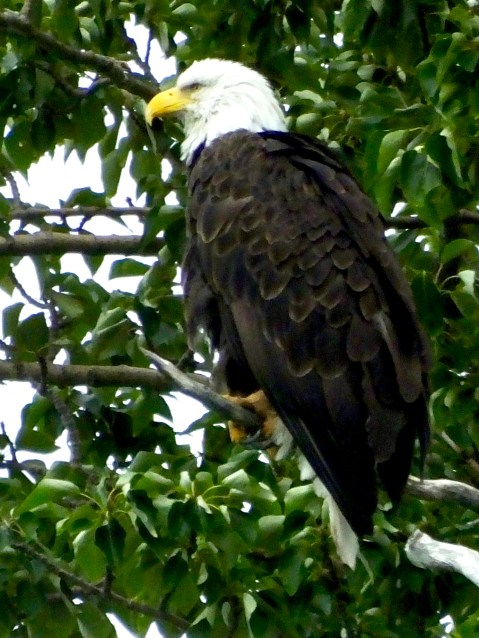
Another shot of the eagle perched high in a tree across the river from us.
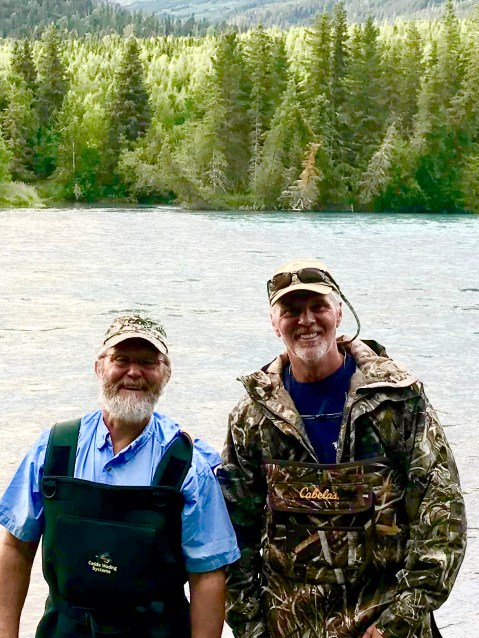
Fishing friends ready to float the Upper Kenai.
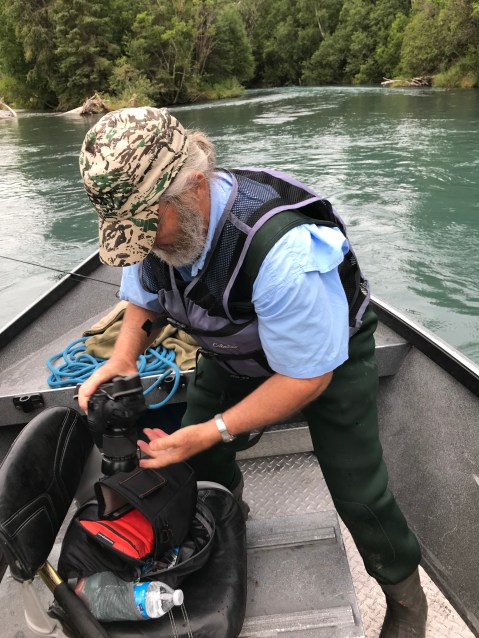
Getting to my camera before Jordon released the trout was always tough.

One more cast, just let me make one more cast.
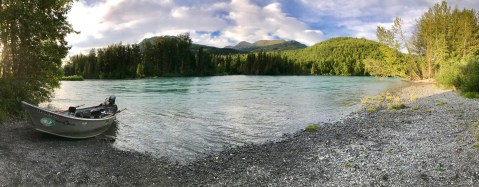
Our drift boat sits ready for its trip through the canyon.
GAFA Day 6: Trout in Kenai Canyon
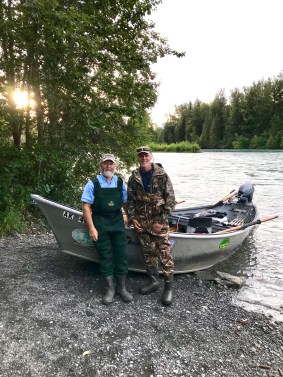
What a luxury sleeping until 5 a.m. was this morning, as our meeting time with today’s guide wasn’t until 7 a.m. and we only had a 45-minute drive to the meeting site near Coopers Landing. Nearly seven hours of sleep helped rest these weary bones.
 I didn’t know exactly what to expect today, having never been on an Alaska trout fishing trip, but I knew it would involve a boat, waders and trout. That was enough to get me started. After we navigated the ubiquitous road construction on the Sterling Highway and arrived at the designated meeting place, we met Jordon, our guide for the day, and young Charles from Knoxville, a recent high school graduate enjoying his graduation present, who would be our fishing partner in the four-man float boat.
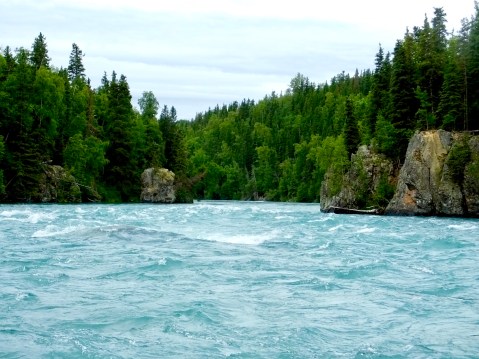
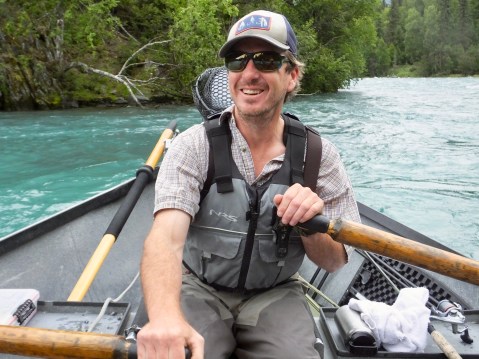 Following brief introductions and a 15-second safety briefing, Jordan ordered us into our flotation devices and launched the boat. He passed out rods with single-hook, deep diving lures attached and began rowing/floating down the Upper Kenai River Canyon.
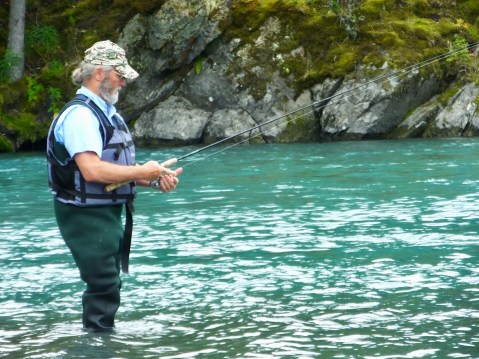
As has been the case every fishing day of this trip, John landed the first fish for our two-person party, as I predicted he would.
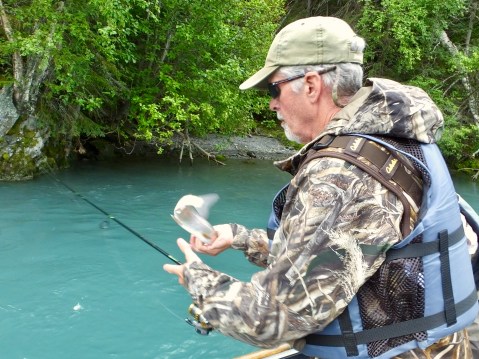
Jordan established a pattern immediately that would last all day and that made getting pictures for the blog difficult. Catch and release apparently means release as quickly as possible, both for the good of the fish and so the angler can continue fishing and Jordon could return to his oars and his cigarette. Consequently, the fish were usually returned to the water before I had time to reel in, grab my camera and start shooting. But I’m a quick learner and figured out that I needed to start the picture-taking process as soon as a fish was hooked. I also decuded to look for other shooting opportunities that may or may not include a fish in the picture, such as the scenic river, the ever-present mountains and whatever wildlife might offer itself along the river’s steep and thickly wooded banks.
The beautiful, glacier-fed turquoise water of the Kenai flowed more and more rapidly as we headed into the “canyon,” which, while it in no way compares to the Grand Canyon, had steep banks and large rock walls flanking the river. Jordon would row hard as we crossed and re-crossed the river to locate “trout holes” where the water eddied and slowed, allowing the trout to rest out of the main stream. Before long, I had boated my first trout and Charles soon followed. It was clear we were going to catch fish today.
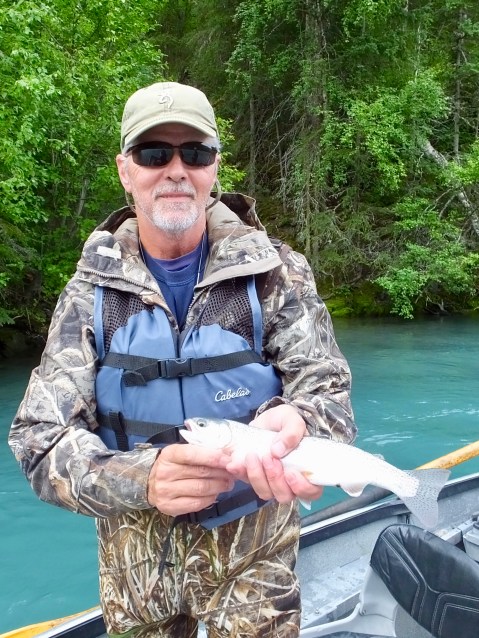
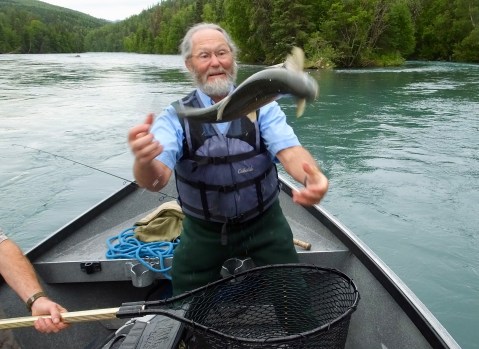 I missed the big halibut yesterday, but I scored today with the largest trout, a beautiful 22″ (measured by Jordon) Rainbow. I definitely wanted a picture with this fish, but he (or she) seemed uninterested in posing with me. I would try to hold it up and it would flip its slippery self from my slimy grasp. Fortunately Jordan had seen this show before and knew that he needed to keep the net under the fish even in the boat. Twice I tried my best angler pose with my catch and twice it slipped from my fingers and back into the waiting net. “Grab it tighter,” Jordon suggested. So I did and John finally managed to take the picture I hoped for. And then the rascal flipped loose again but it didn’t matter because Jordon was ready to return it to the cold waters of the Kenai.
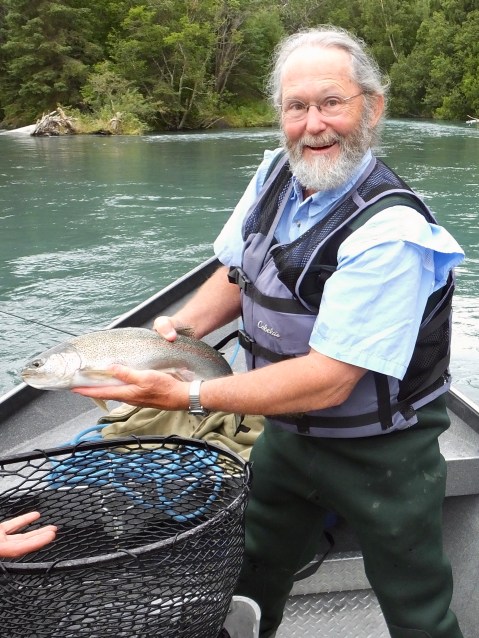
Down the river we went, stopping periodically at “trout holes,” gravel bars and small islands to try our luck in likely places where our guide thought our chances of finding fish would be improved.

John not only reeled in eight or ten trout of various sizes during our voyage down the canyon, he also managed to catch a pink salmon and a nice Dolly Varden. The latter fish is sometime confused with a trout but is actually a char. Charles also boated several nice rainbows after a slow start and by the end of the run down the canyon the three of us had a total of more than two-dozen rainbows to our catch and release credit.
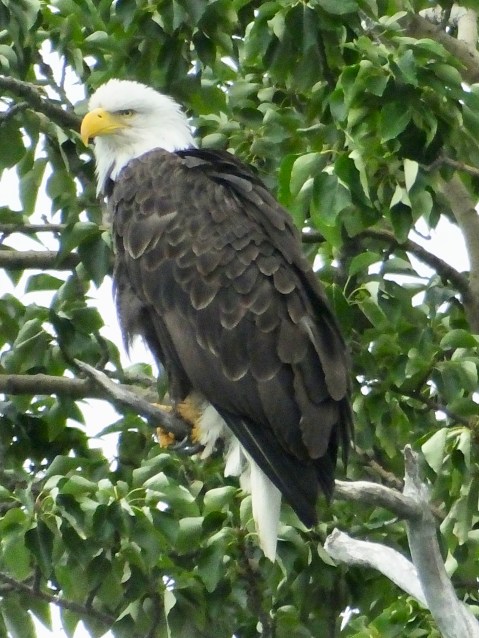 Although we saw evidence of bears in the tracks along the beaches and on the islands, today they kept themselves out of sight. But we did spot four eagles at various times perched in the pine branches in the trees along the shore or soaring above the river looking for salmon.
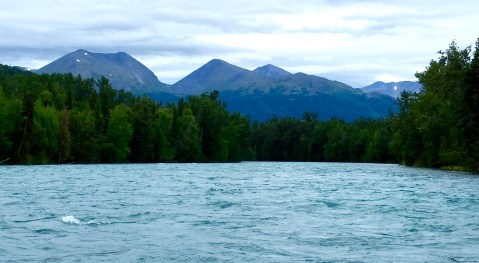 Clouds hung overhead most of the day and temperatures reache a pleasant 62-66 degrees. The weather forecast had called for wind, but I hadn’t thought much about it since we would be in the “canyon.” What I didn’t know was that the final leg of the trip required a five-mile, 45-minute boat ride on Skilak Lake (a 20-mile long, four-mile wide, 500 feet deep glacier-fed jewel in the middle of the Kenai Peninsula) to our final take-out point. As we emerged from the Kenai river onto the lake, we could see the 25-mile-an-hour winds whipping up whitecaps and treacherous 2-3 foot swells on the lake we had to traverse.
Jordon considered tieing the boat off in a creek and hiking up a trail over a small mountain to the nearest road. I’m not sure how long the hike would have been, probably an hour or more, and we would have been hiking in waders since our shoes had been left in the van that had pulled the boat trailer. In the end he decided to take the boat out onto the lake, so we stowed our gear as efficiently and tightly as we could, rearranged ourselves in the craft to provide the balance necessary to keep the bow up as we prepared for a trip for which this crescent-shaped boat had not been made.
Our guide piloted the bouncing boat cautiously, turning into the swells and causing the boat to come crashing down into the trough. Bam. Bam. Bam. Cold lake water splashed over the gunnels and drained over the stern into the boat on some of the biggest swells. We ran a zig-zag course, first paralell to the swells, then turning to face the biggest ones head on before steering the boat back on course to the landing area several miles away. The most adventuresome part of the trip across the lake lasted only the first 20 minutes, and conditions improved gradually as the lake narrowed and the towering mountains helped block the wind. The closer we got to the end of our five-mile lake voyage, the better the conditions became.
Finally, on the smoothest water of the final leg of today’s trip, we reached the take out point, waited 15 minutes for our van and trailer, then drove back to our origin point having made a great loop along the Upper Kenai River.
Bears, wind storms, flyout rainouts–that’s what turns vacations into adventures, and the Great Alaska Fishing Adventure has been just that. We fished for sockeye, silver and pink salmon; halibeasts, and beautiful rainbow trout. We saw bears, moose, eagles and more wildlife. We stayed in a comfortable, modern chalet that offered welcome refuge and a beautiful vier after a day on Alaska’s wonderful waterways. And tomorrow it comes to an end. I’ll post a short blog entry tomorrow evening as we wait to catch our nightflight back to the lower 48. And then on Tuesday I’ll add one final wrap-up entry to the GAFA blog for 2018.
Although this year’s travel blog has not been as extensive as my motorcycle-related ramblings, I hope it’s been entertaining and educational. It’s been fun to get back at the keyboard and share adventures with friends and family.
 hdriderblog