
F&F Tour Day 3:
I said I wouldn’t dwell on friends and family as I blog on this trip, and I won’t. But just to report on my day: Lucy (14) was sick and home from school when I arrived yesterday and woke up this morning feeling worse. So she stayed home again today and made a brief visit to a doctor who gave her the usual cocktail of antibiotics for a sinus infection. Poor thing. She’s miserable but was still good company for me today as she detailed her first, abbreviated week in high school.
I left her long enough to have lunch with Hanna (22) who caught me up on her life and current aspirations. It was a good conversation and nice to hear that she’s happy and doing well as she blazes a path through a forest of adult opportunities and challenges.
Today really was a non-active day for me, but I didn’t mind. Just sitting and talking with granddaughters that I see too little of was a nice break. I don’t expect that the next two days will be much different and I may not post a blog again until Friday when I get back on the road.
Thanks for checking in. If you’re checking in from Florida or anywhere else where Harvey or Irma disrupted your lives, I hope you’re drying out and that flicking your light switches produce the desired result. So far, all the Florida and Texas friends I’ve heard from have been spared serious damage. Hope it stays that way.
F&F Tour Day 2: Time is of the Essence
My decision to leave a day early turned out to be prescient. Rain began falling early this morning in Maggie Valley and would have made for a saturated and unpleasant ride if I had waited until today to begin the F&F tour. Fortunately for me, today I woke to a dry, cool, overcast day in central Kentucky, and as I headed north, the fitful skies gradually cleared and I finished today’s 500+ mile ride to Wisconsin in the upper 70s.
I opted for a less-than-direct route to Lake Geneva to avoid the butt-cheek clenching ordeal of nervously navigating unnerving Chicago traffic. I’ve ridden through the “City of the Big Shoulders” enough times on a motorcycle to know I would much prefer adding 80 miles to my trip to avoid the fierce gauntlet of distracted, rude, and just plain batshit crazy land pilots who menace innocent strangers who dare to drive in their midst. So today I bypassed the Windy City, steering my steel steed to Interstates well to the south and west.
That routing decision meant I had time to put my feet up, lock the cruise control slightly above the recommended speed suggestion, and contemplate any multitude of things. But today all thoughts seemed to come back to the issue of “time.” Not, “What time is it?” or “How much more time do I have to spend dodging potholes on the Interstate?” but more of the “Where the hell did time go?” variety. As in “I’m almost 70. Time to assess what I did during all that time.”
I concluded that maybe I wasted a lot of time. In 70 years I should have accomplished something. Not the “find a cure for cancer” kind of thing or “write the great American novel” kind of thing. But at least had some kind of impact. So I began to assess what I’ve done with my time.
I went to grade school and high school for 12 years but don’t remember learning much. Except that I can read, write and cipher some, so I must have learned something. Then some military service to make the world safe for democracy or some such nonsense which obviously didn’t work because democracy is no safer now than it was in the 1960s. Then college, a little work, more higher education and a couple of diplomas useful for covering the random nail holes that dot my walls.
Teaching. Well, maybe some students got something out of my classes. Not just names and dates and other imminently forgettable history stuff but, hopefully, some of those young scholars began to ask important questions of themselves that led to insightful answers that end up making the world a better place. I think most teachers hope for that.
Other odds and end jobs just seemed to take up space in my life. Writing sports for a small town newspaper. Working on the decennial national head counting project known as the Census. Serving as an anonymous civil servant in jobs that could have been done better by any number of people but probably didn’t need to be done at all.
But ultimately I remembered the purpose of this trip. Seeing “Friends and Family.” The memories that whizzed by in a blur as I sped down the concrete slab reflect the “times” that matter most. Friends from childhood and friends from more recent days. Family beginning with my parents (gone) and brothers (scattered and aging) and growing to include a 50-year marriage, two beautiful, amazing daughters, six promising granddaughters and one geographically distant great grandson.
Time passes slowly as one grinds through childhood and emerges gently scarred and barely scathed into adulthood. But at the upper end of adulthood, time moves much too quickly; I want to grab hold of it and slow it down. Of course, I can’t. So I’m going to use some of the present time to refresh old memories and some of it to create new ones that I’ll be able to look back on and use to answer the same question I had today when, 20 years from now, I wonder where the hell time went.
Friends & Family (F&F) Tour: Day 1
Well, I’m on the road again. This time I embark on a relatively short ride (three weeks & 4,000 miles) taking me through 16 states as I visit (impose upon?) family and friends, catching up on scattered lives while once again enhancing my own with a two-wheeled solo sojourn.
I wasn’t sure I was going to blog this trip. There will be no awesome scenery to gush over (e.g. Newfoundland or Alaska). There will be no wildlife adventures to regale readers with (e.g. Rocky Mountains). There will be no medeival castles or soaring cathedrals that stir my historic imagination (e.g. this summer’s river cruise). And there will be very few pictures to entertain blog followers who don’t really like to read the crap I write. This isn’t that kind of trip.
While I very much look forward to seeing brothers, daughters and granddaughters and reconnecting with friends from throughout the past six decades, I won’t dwell on my daily interactions with them as I unwind from a day’s ride sipping Jack Daniel’s and updating hdriderblog. Instead, I’m going to use this opportunity to write random thoughts about things of interest to me. I wish I did more of that because I enjoy making impulsive mental stabs at literary creativity, but motorcycle trips seem to lend themselves best to my amateurish writing impulses.
Before I forget, though, today’s F&F tour started with a goodbye from my sidekick of 50 years whose willingness to let me venture off on my own for three, four, five, six weeks at a time speaks volumes about her admirable adaptability to my wanderlust impulses. (There are probably some friends who know us who would say she’s glad to have me out from underfoot for a while, but you would be wrong.) Apropos of a “friends” and family trip, as I was leaving Maggie Valley, I made a quick stop to say goodbye to friends celebrating their 60th anniversary today with a luncheon I was very sorry to have to miss.
Why did I have to miss their celebratory luncheon? Well, for those who haven’t emerged from their cave in a while, Florida is currently awash in one of the most destructive if not the most destructive hurricane in American history. We’ll know for sure when all the scorecards are tallied. And that hurricane is forecast to have a soggy atmospheric impact in North Carolina, Tennessee and Kentucky. I wanted to avoid starting this trip in the precipitory detritus of Hurricane Irma. I’ve ridden in heavy rain before and will no doubt do it again, but I’d rather not if I don’t have to. And I didn’t have to. So I left today instead of on my planned departure date of tomorrow. Today’s ride started coolish (mid-40s), breezy and overcast, but, by the time I crossed into Tennessee and left the fast-paced Interstate for a more leisurely northwest course into and across Kentucky, blue skies and warmer temperatures made for a pleasant ride through still-green hills and mini-mountains.
As I rode under azure (as tinted by my aviator-style sunglasses) skies today, I thought about friends in north Florida preparing to experience Hurricane Irma. Why did they stay? I offered them shelter in the relatively safe harbor of Maggie Valley, but they opted to “hunker down” and take their chances. Did they stay to protect their “stuff?” Did they stay because the escape routes north had turned into 300-mile long parking lots? Or did they stay because, like most of us, they believe “it” won’t happen to them? “It” only happens to other folks. And what is “it?” Is “it” damage to their property? Is “it” injury to themselves? Is “it” something more final. “It’s” a mystery.
But don’t most of us or maybe all of us believe “it” only happens to others. Hurricanes and tornados hit “others.” But not me. Winning lottery tickets are picked by “others.” But not me. Cars run into “other” motorcyclists. But not me. A belief that “it” only happens to “others” makes it possible for us to proceed with our daily lives, to rationalize our fears, to accomodate an unknowable future.
At any rate, I will think often about my Florida friends during the next few days. I hope they avoid “it,” whatever “it” is. And I hope to see their smiling faces in a few weeks as the “F&F” tour eventually winds its way to Florida.
Day 14: The Last Day (and Night)
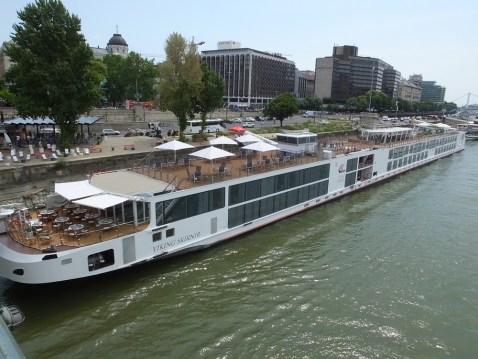
Our last view of the Viking Skirnir from the Chain Bridge.
While some passengers aboard the Viking Skirnir were off loading luggage and boarding buses at 3 a.m., we slept in until 6 a.m. But our turn comes tomorrow when we (hopefully) board a bus from our hotel in Budapest at 3 a.m. for OUR trip to the airport and the beginning of a long day that should end in Maggie Valley sometime before midnight.
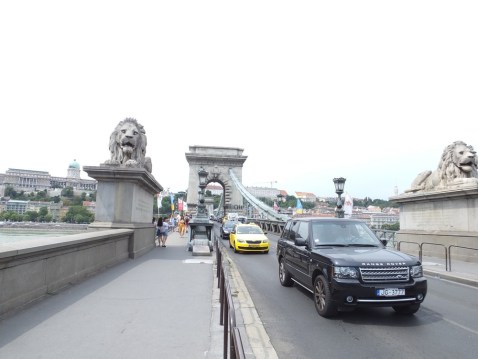
The chain bridge.
After being dropped off by our surly Hungarian charter bus driver three blocks from our hotel because he said his bus wouldn’t go down the street and dragging our luggage the remaining distance, we only had to wait about 30 minutes for a room to be ready. Once our luggage was stowed in the room, we took one final stroll through Budapest, walking all the way from Pest to Buda and back. (It’s actually only one step on the Chain Bridge because the river separates the two pseudo cities.) We really did walk across the rusting 7i00-year old bridge and then walked for several hours through the city.
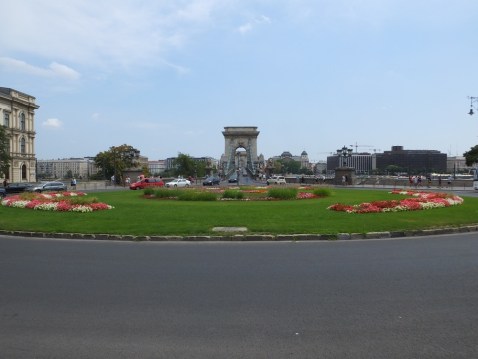
Looking back at the Chain Bridge from the Buda side.
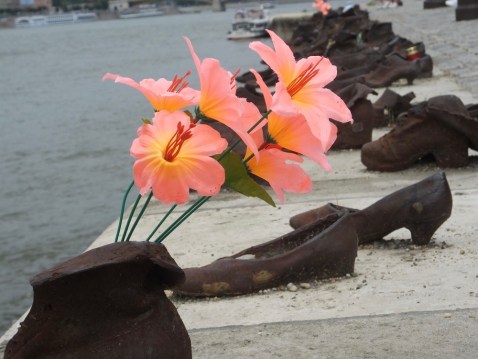
I wanted one last look at the Parliament building, which, as it turns out is far more impressive from a ship in the river. There was one site though that I did want to visit not far from the Parliament. About 12 years ago, the people of Budapest commemorated a memorial to the 600,000 Hungarian Jews, Gypsies, homosexuals and developmentally challenged individuals slaughtered by the Nazis as part of the Holocaust. The memorial is simple: 100 iron shoes on the edge of the river, each shoe symbolizing 6,000 innocent lives. The story we heard is that many of them were marched to the river and, after removing all of their belongings and valuables, including shoes, they were cast into the river. When their relatives went to find them, all they could find were shoes. Very touching.
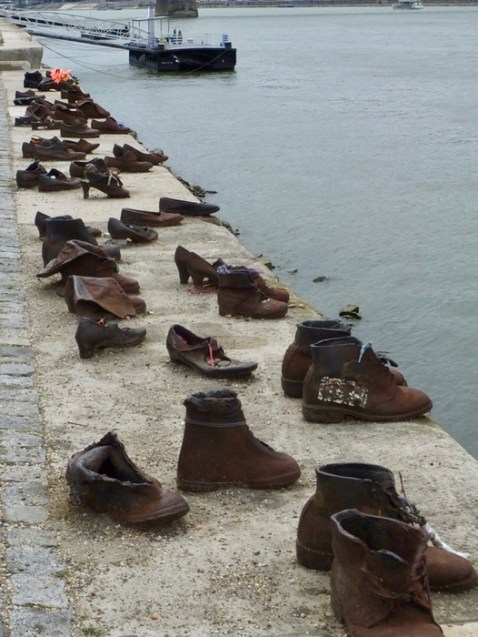
After lunch of a traditional Hungarian kabob and a beer at a street cafe near the shopping district, we headed back to our room for a short nap before going to dinner one more time with friends.
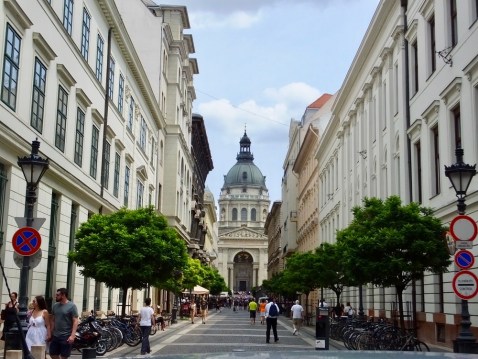
Last night, after the blog was posted, we cruised down the river to see Budapest after dark. I will let the following pictures speak to that experience.
This will probably be the last post for this trip. I don’t think I’m going to be up for it after flying all day and half the night. Budapest to Paris to Atlanta to Charlotte. Hope everyone who’s still with me at the end enjoyed our trip. I know we did.
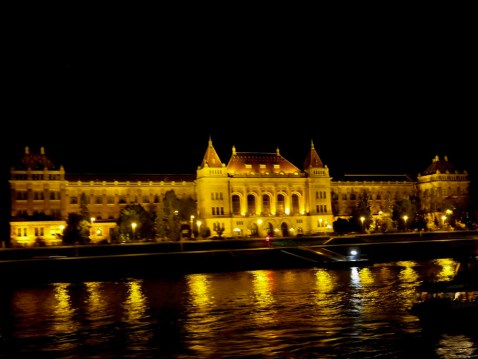
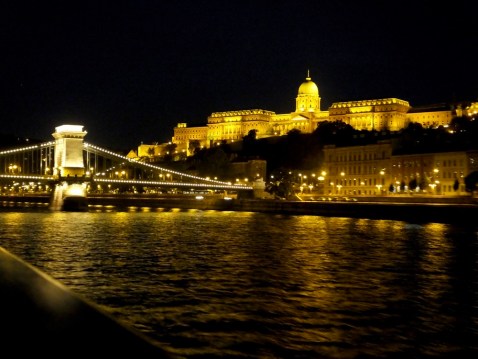
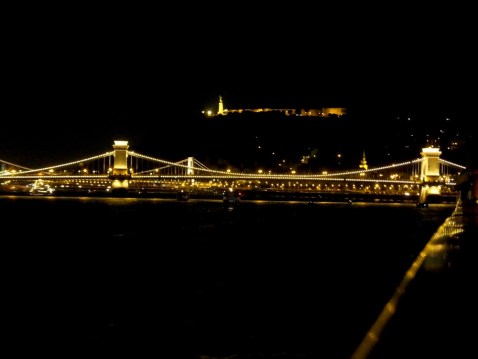
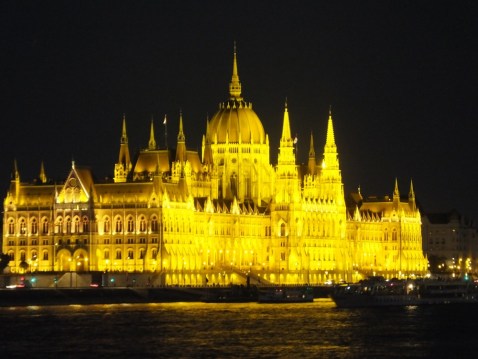
A few more from Budapest.
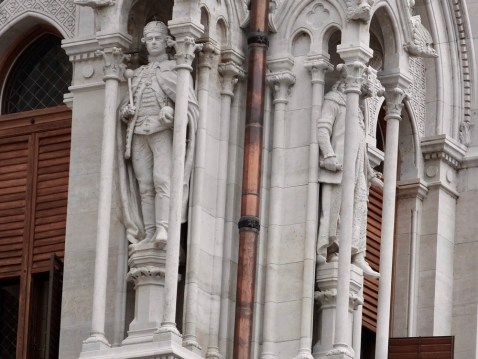
Detail from the Parliament Building. Multiply these by about 1,000 sculptures.
Day 13: Budapest: Buda and Pest
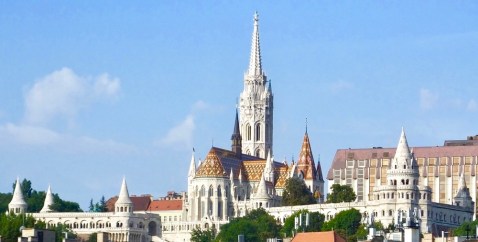
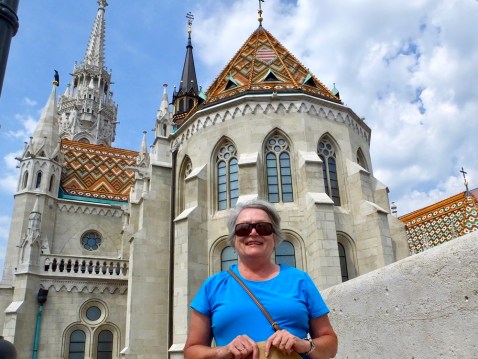
Matthias Church and the Fisherman’s Bastion as seen from the deck of our long ship on the Danube.
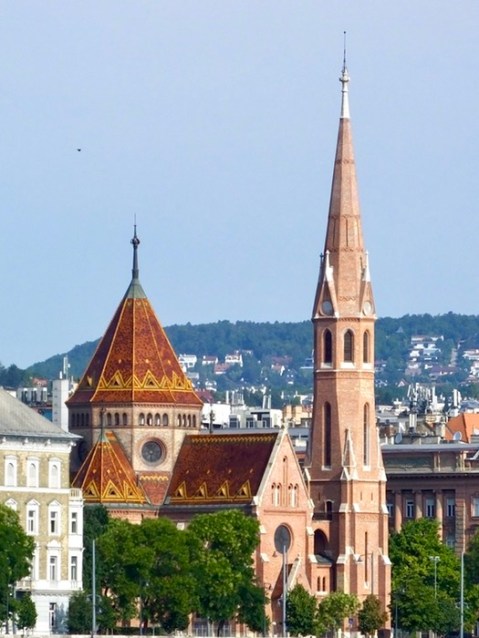
Split by the Danube River, Budapest is two cities joined by seven bridges. Buda, the city of the hills, rises on the south side of the river featuring such monumental architecture as the Baroque Royal Palace on Castle Hill, 700-year -old Gothic Matthias Church, and next to Matthias Church the 100-year-old Fisherman’s Bastion with it’s seven tent-like spires symbolizing the seven original Magyar tribes that settled Hungry more than 1,000 years ago.
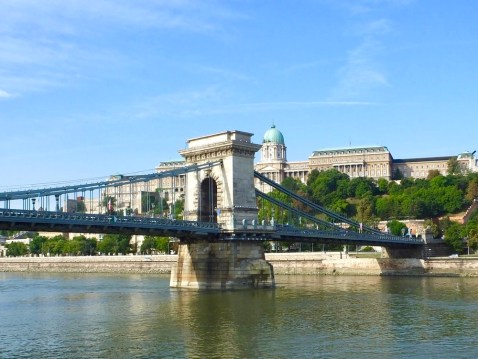
The world-famous Chain Bridge with the Royal Palace in the background.
Pest (pronounced Pesht), on the north side of the Danube, is much flatter, but also has a rich architectural past. Most obvious is the Parliament building, at one time the largest in the world and currently ranked third But there is also Hero’s Square, the Fine Arts Museum, and the Baroque Széchenyi Baths.
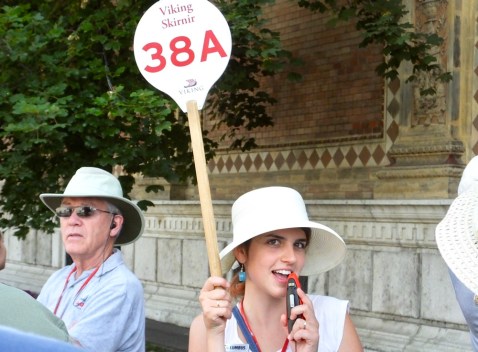
Agnes, our guide for the morning.
On today’s bus/walking tour, we managed to visit all these locations and a few more that I forgot quickly as the tour bus whizzed by and the guide hurriedly described in accented English (“Hunglish” she called it). Our first walking stop was Hero’s Square where we had a brief lesson in Hungarian History, beginning with the Magyar tribes, going through the relationship with the Hapsburgs, the growth and shrinking of the country over the centuries, its role on the losing side of WWI and WWII, the occupation by the Soviet Union and the installation of a communist government, and democracy (limited as it may be under the current authoritarian leader).
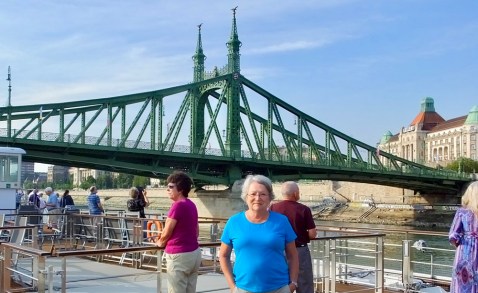
Just before docking we sailed under the Elizabeth Bridge.
Our tour took us over two of the important bridges (the Catherine Bridge and the Elizabeth Bridge) with nice views also of the world famous, 700-year old Chain Bridge that first linked Buda and Pest.
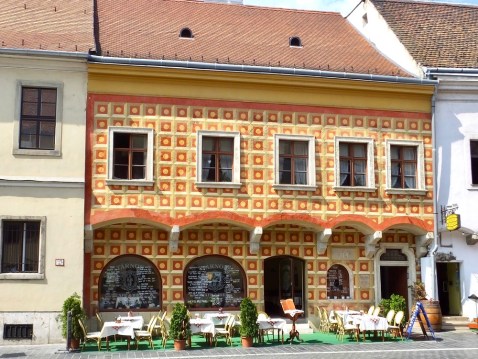
But we also had time to walk around one of the historic shop and residential districts and take in some of the local Sunday-morning flavor of the Buda side of Budapest.
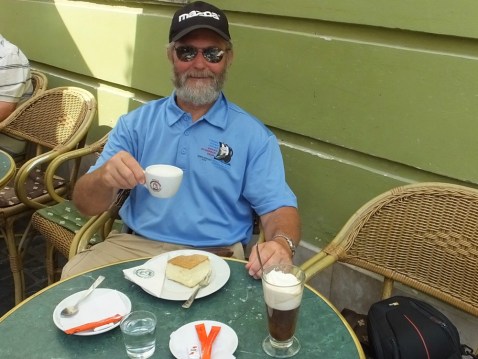
That meant another visit to another coffeehouse/bakery, this one recommended by our excellent guide Agnes (aka Aggi). Starbucks and even local coffee shops in the states just don’t have the atmosphere of these small coffeehouses that have histories, including recipes for their various cakes, pastries and chocolates, going back hundreds of years. Today’s cake to go with my cappuccino and Marilyn’s coffee Americano was made with the same recipe the same shop developed more than 200 years ago. It was easy to see, after only one delicious bite, why the recipe was a keeper.
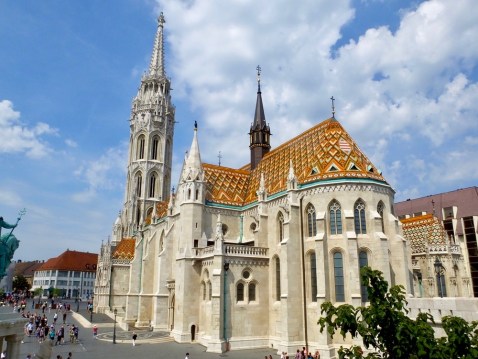
Matthias Church up close
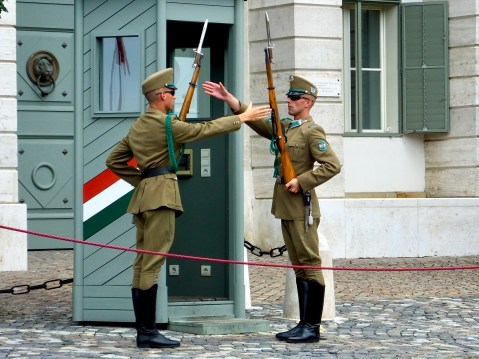
During our free time we walked to the edge of the Royal Palace (currently empty of furniture while its interior is being renovated) just in time to see the changing of the guard at the President’s Office next door. Not a big or long ceremony but still interesting as the guards went through their gun slapping routines while a loan drummer provided a steady beat.
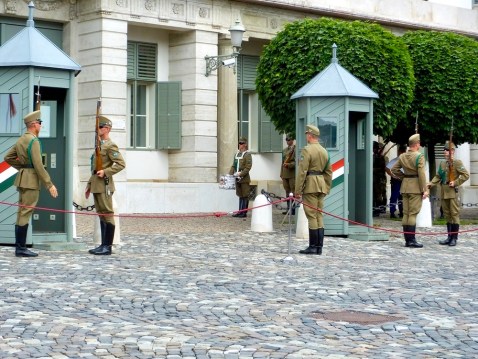
Changing of the Guard
Tonight, the ship will loose its moorings for a 90-minute night time cruise on the Danube to allow us to marvel at the city as it lights up. Maybe more pictures tomorrow.
More from Budapest
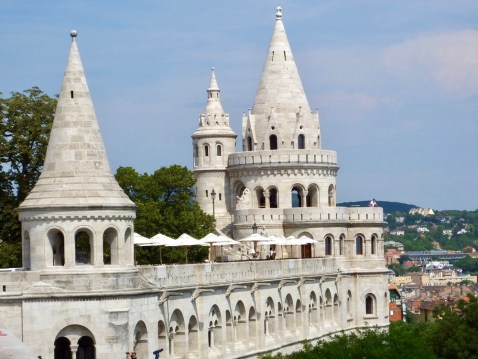
Only 100+ years old, the Fisherman’s Bastion is a popular spot for tourist photos. Like this one.
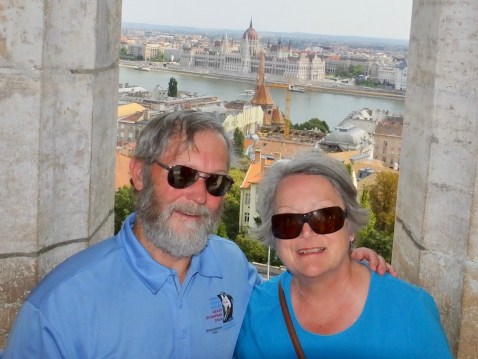
Two tourists take a photo with the Parliament Building across the Danube in the background.
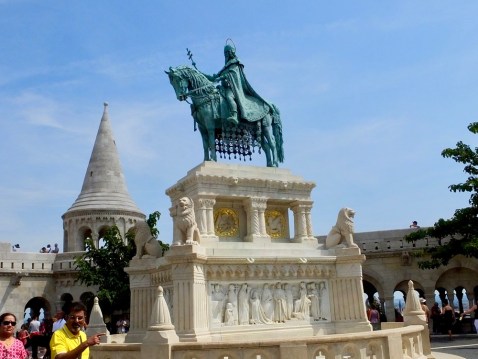
St. Stephen is the patron saint of Budapest and its first king who was crowned by the pope. He is almost always portrayed with the Apostolic Cross.
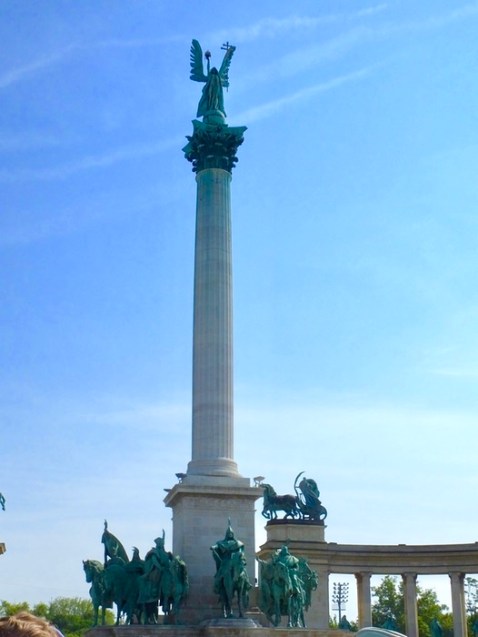
The primary monument in Hero’s Square.
Day 13: Another Day in Vienna, Another Sachertorte
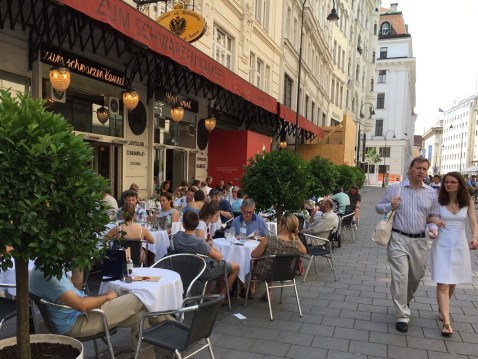
Viennese street scene. Outdoor cafes everywhere. And clean.
After yesterday’s full day in Vienna, I needed a day with a little less activity and a little slower pace. Consequently, after writing and posting yesterday’s blog, I relaxed a little this morning, had a (relatively) light lunch aboard ship, then jumped on the subway for a 15 minute ride to the center of Old Town again.
We visited the same area we spent part of yesterday in, but at a much more relaxed pace. I noted a few days ago that I would drink a little less wine and a little more Viennese coffee these last two days. At least I managed the latter.
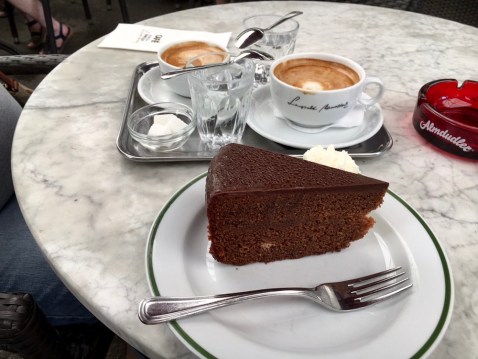
Properly served at Cafe Hawalka (pronounced HaValka)
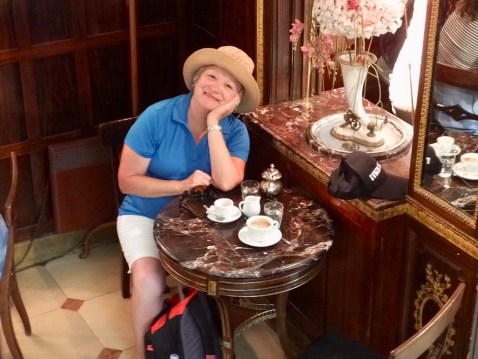
In addition to strolling leisurely through the crowded Saturday shopping district, looking again in the windows at mammon I will never have, I visited two more local landmarks that I’d read about and had put on my Vienna bucket list. Neither one was a castle or a fortress or a palace. Rather, they were the sites of local social interaction and relaxation. The first was Cafe Hawelka, a traditional Viennese coffee house and one famous as the gathering place for struggling and upward bound artists, who often paid their tabs in artwork rather than coin. Once again, I ordered Grosser Brauner and Sachertorte and once again I was not disappointed.
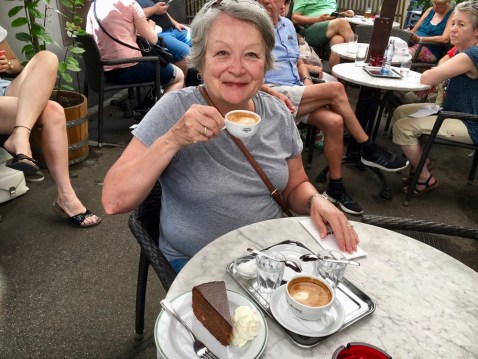
Enjoying Kliener Brauner and torte.
I had read that not only is their a closely guarded recipe for each coffee house’s liquid brew and its torte, but there is a standard and accepted way of serving it. The photo below depicts that. The coffee should be served on a silver platter, with a small glass of water with a spoon upside down on the top, and extra sugar. That’s exactly the way it came. And the Sachertorte was as good at Cafe Hawelka as it was at Deml’s.
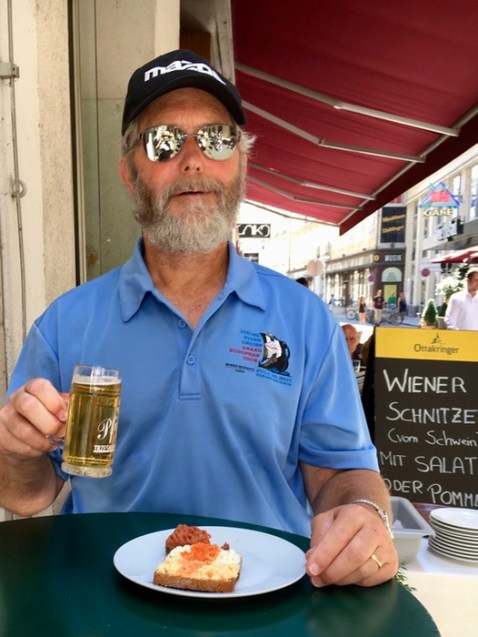
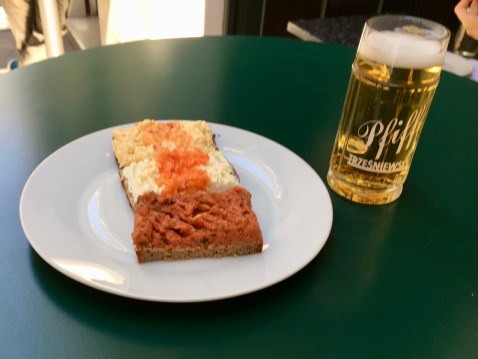
Sandwich spreads and bier at Trzesniewski’s
The second stop on my culinary tour of the Innere Stadt was Trzeniewski’s, a unique cafe that serves open faced sandwiches on rye bread made up of more thanks 50 different spreads. I opted for carrot and cream cheese, pureed tomato and red pepper. With a very small beer to wash each one down, it was the perfect mid-day snack and very affordable. While tourists visit Trzeniewski’s, most of their trade is probably conducted with locals who work in the inner city. It was a brief visit, but a real treat.
Back at the ship, I enjoyed a 45 minute lecture on Austrian history from a professor at Vienna University. Entertaining and informative, the talk covered more than 1000 years in less than an hour, focusing on the Hapsburg Dynasty and the dissolution of that dynasty in the 20th century following WWI and WWII. Very nice.
We are now sailing down the Danube again on our way to a wake up call in Budapest.
More from Vienna.
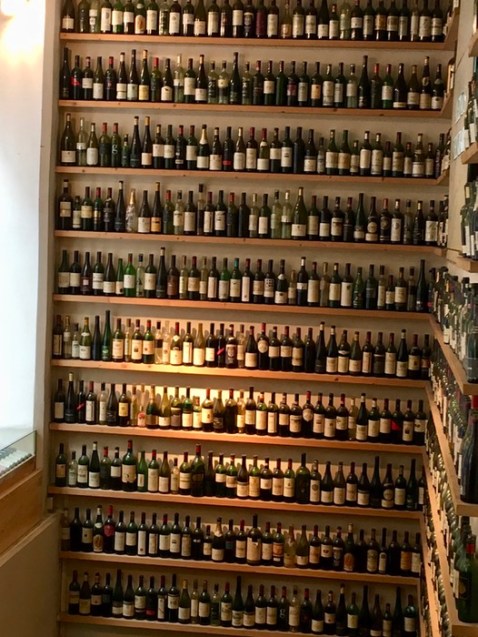
A picture of my stateroom and some of my souvenirs.
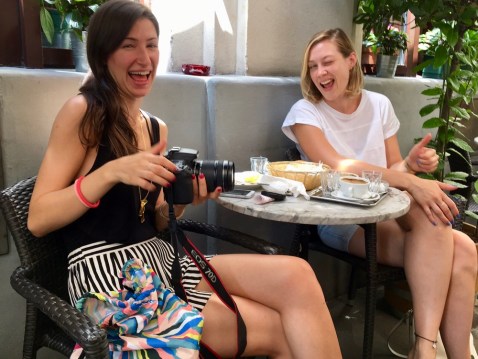
For those who tired of castles, fortresses, cathedrals and palaces. These two lovelies were at Cafe Hawalka and had their waiter take their picture. So I joined in. Then they ran away from the old man with fuzzy face.
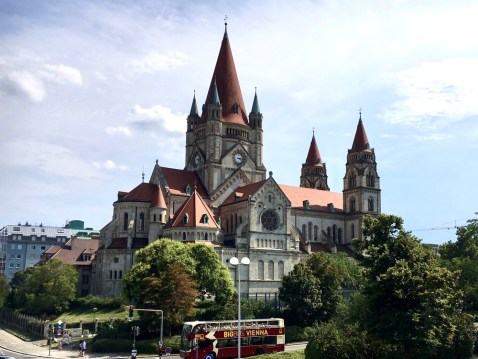
A baby church, only 150 years old. Just across the street from our ship.
Day 12: A Full Day in Vienna
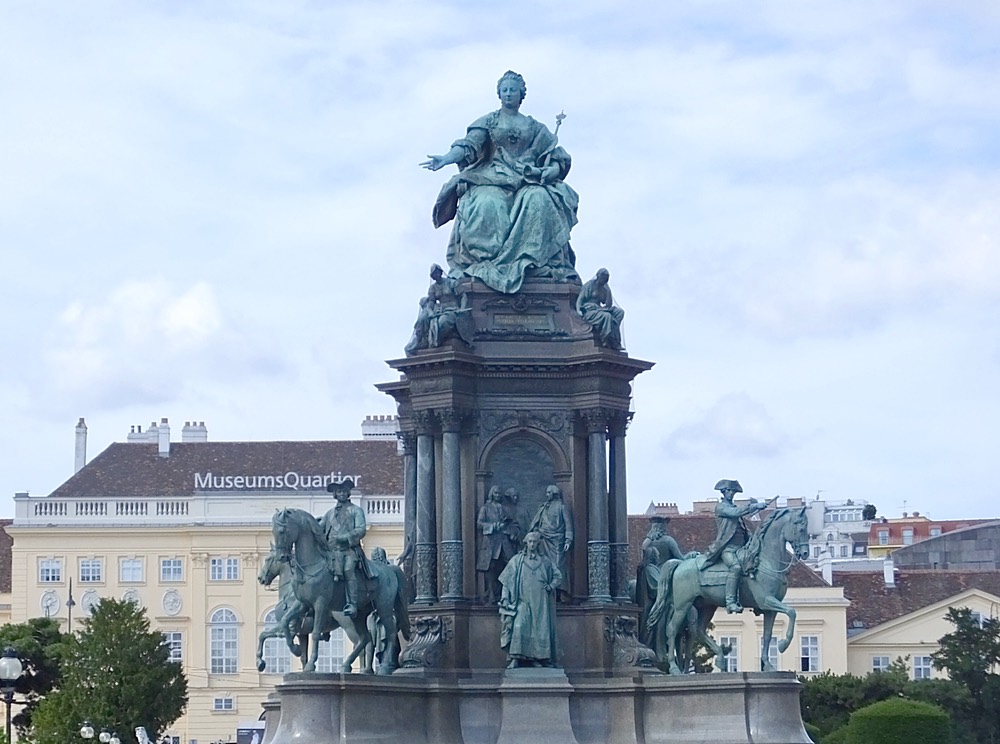
Empress Maria Theresa, the most important woman in Austria’s Hapsburg past.
For those who looked for a blog post yesterday, my apologies. After a full day in Vienna, I didn’t feel up to writing a post at 11 p.m. This morning (Saturday), I hope to write a little more cogently and post a few pictures. At any rate, here goes.
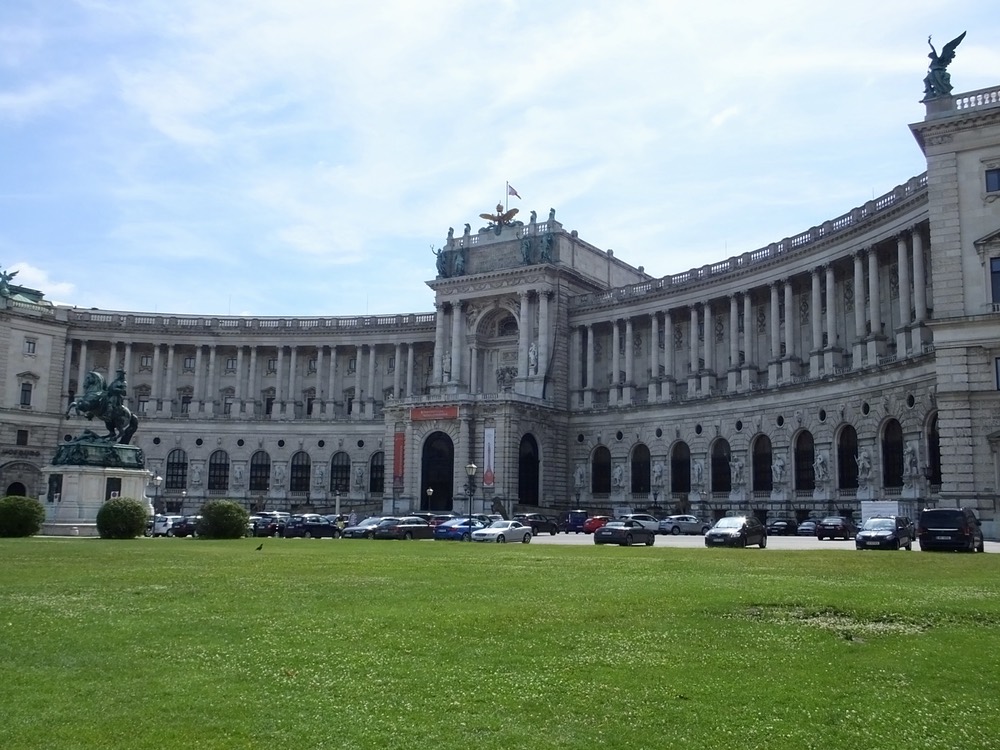
The Imperial Palace
A riding and walking tour occupied our morning hours as we oriented ourselves to one of the world’s most beautiful cities, Vienna. I’ve never been a fan of bus tours and yesterday’s did nothing to change my mind. For about 30 minutes, we drove in and around Vienna with a guide who described historic buildings usually hidden behind trees or trucks outside the bus or heads inside the bus. I was anxious to get off and start walking.
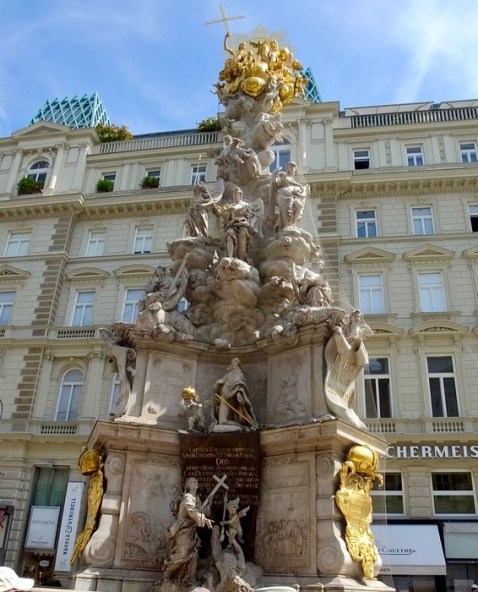
The “Plague Statue” took more than 20 years to complete in the 17th century and became a model for similar but smaller statues throughout Austria.
When the bus parked and we departed, the real tour began and we spent the next hour and a half admiring beautiful–though not terribly old–buildings. Most of the buildings in Vienna that give it a special character were built in the mid to late 19th century (old, I guess by American standards), though some, of course, are much older. In 1860, the old and now useless city wall was torn down and replaced with a road, the now famous Ringstrasse or Ring Street. Along or near this street, many new public buildings were erected, including the National Art Museum, the Museum of Natural History, the Parliament building and scores of others I can’t identify. The Imperial Palace had been in place for centuries before the 19th century building boom, as had St. Stephen’s Cathedral and other still standing structures in the Old City.
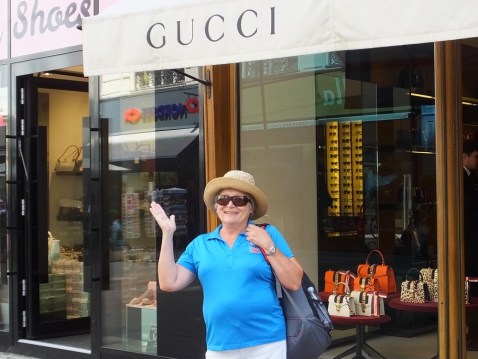
Shopping? I don’t think so.
As our tour wound through the city, we moved easily from one century to another, even to a site where second century Roman ruins were visible in an excavation pit. We passed through an “elite” shopping area where names like Gucci, Christian Dior, Louis Vuitton and others whose names I didn’t recognize but whose window prices on merchandise testified to a clientele that will never include me. We drooled as we strolled past window displays of chocolates and pastries at the iconic coffee houses for which Vienna is famous. We admired great statuary in the middle of crowded shopping streets. And we craned our necks to look to the golden top of St. Stephen’s Cathedral in the heart of Vienna.
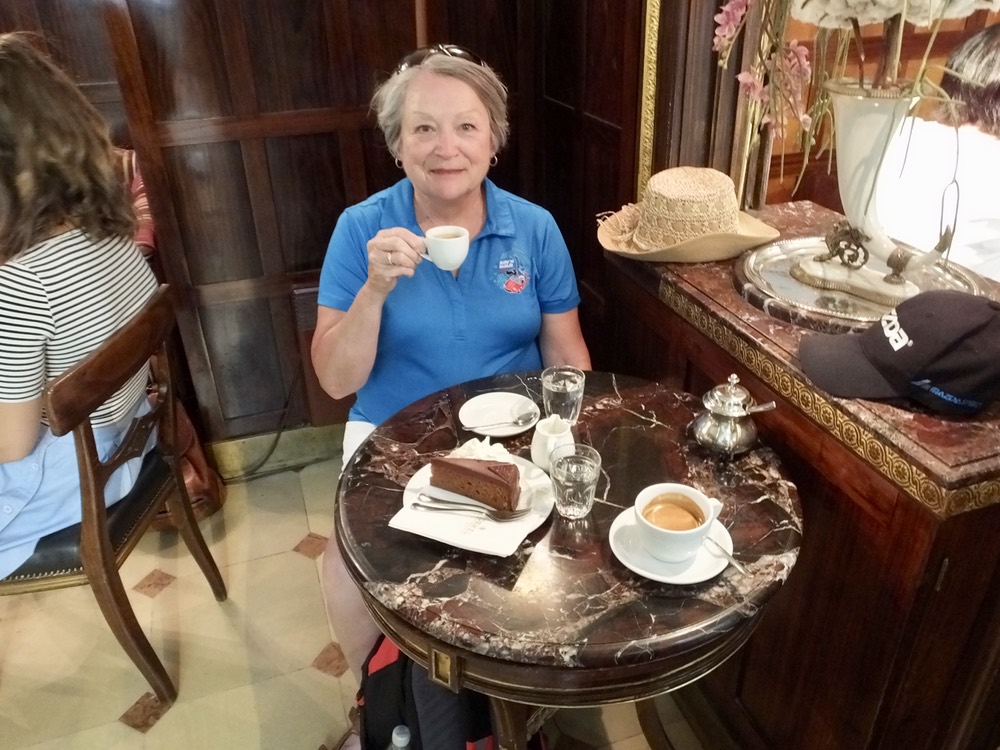
Sachertorte and grosser brauner at Deml’s
When the guided tour ended, we had about 40 minutes in which to explore on our own and I knew where I wanted to go. Deml’s, an historic coffee house in the elite shopping district, where sachertorte (so much more than just chocolate cake) was first created and which is now copied all over the world. A cup of grosser brauner (coffee) and a slice of sachertorte at Deml’s and my morning was complete.
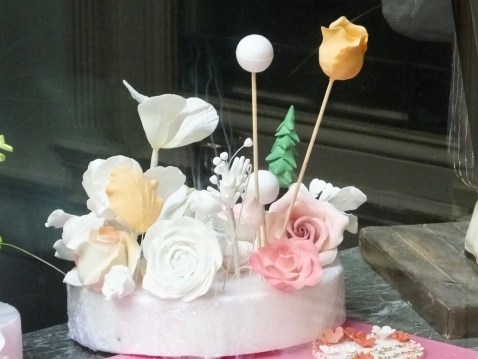
An icing display at Deml’s
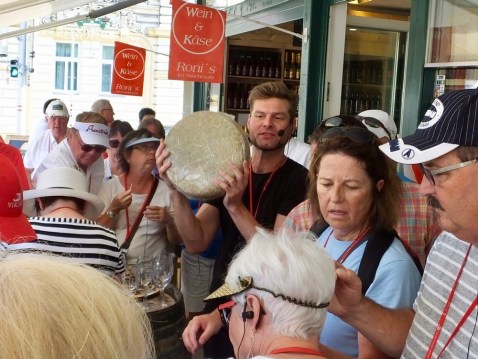
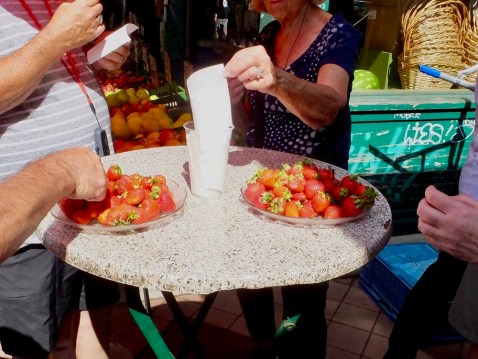
But the day was only 1/3 over. After lunch back at the ship, we joined the ship’s executive chef on a subway trip to the Green Market back in the heart of Vienna, where food stuffs, fresh vegetables, fish markets, cafes, wine bars, and an assortment of other stands stimulated all the senses. Chef Jhonny had arranged several tastings while we were in the market, including wine and cheese at one stop, fresh strawberries at the next, and a selection of wonderful pastries at the final stall. A short walk back to the subway and a quick ride back to the ship completed the afternoon.
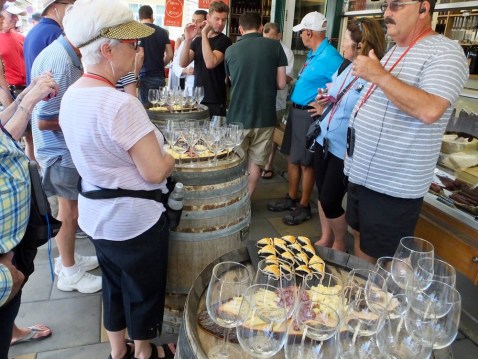
Wein und Käse (Wine and Cheese)
But there was one final Viennese treat slated for the evening. No one should go to Vienna without experiencing its most memorable commodity: Music. In the evening we went to the Auesperg Palace for two hours of Mozart and Strauss performed by the Vienna Residence Orchestra, two singers and two dancers. In a beautiful pale pink and green marble performance hall lighted with large crystal chandeliers, (reportedly the room where six-year old Wolfgang Amadeus Mozart jumped into Empress Maria Theresa’s lap) we listened to the inspired music that made Vienna famous. The music was the perfect end to our first day in Vienna.
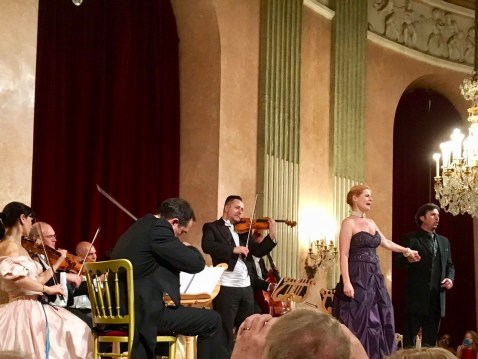
Ahh, Mozart.
But as I said, it had been a full day and I was ready to call it quits and start again today. After this blog is posted, I will be back on the subway for a return trip to town and more Viennese coffee, tasty treats, and people watching before the ship pulls out at 5 p.m. on its way to Budapest.
More from Vienna
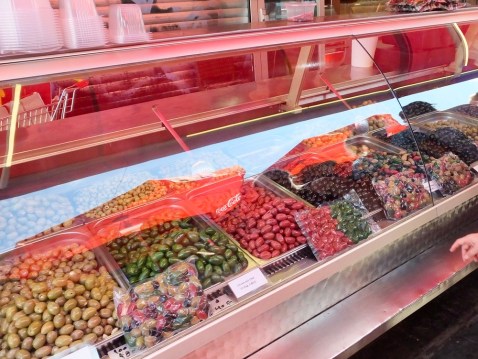
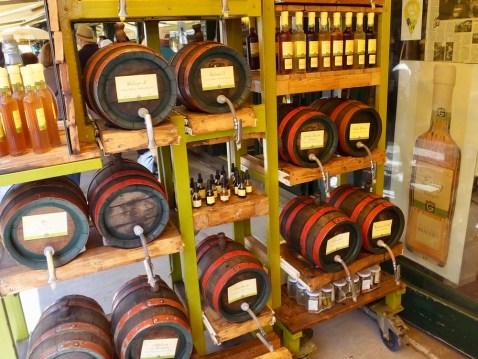
This shopping stall sold nothing buy vinegar. Who knew there were so many kinds?
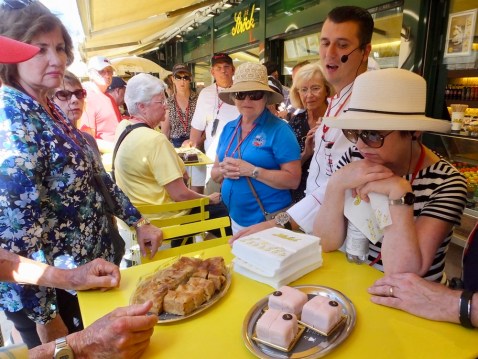
Marilyn admires deserts next to Chef Jhonny.
Day 11: Melk & Krems: A Benedictine Abbey and LOTS OF WINE (Not at the same time)
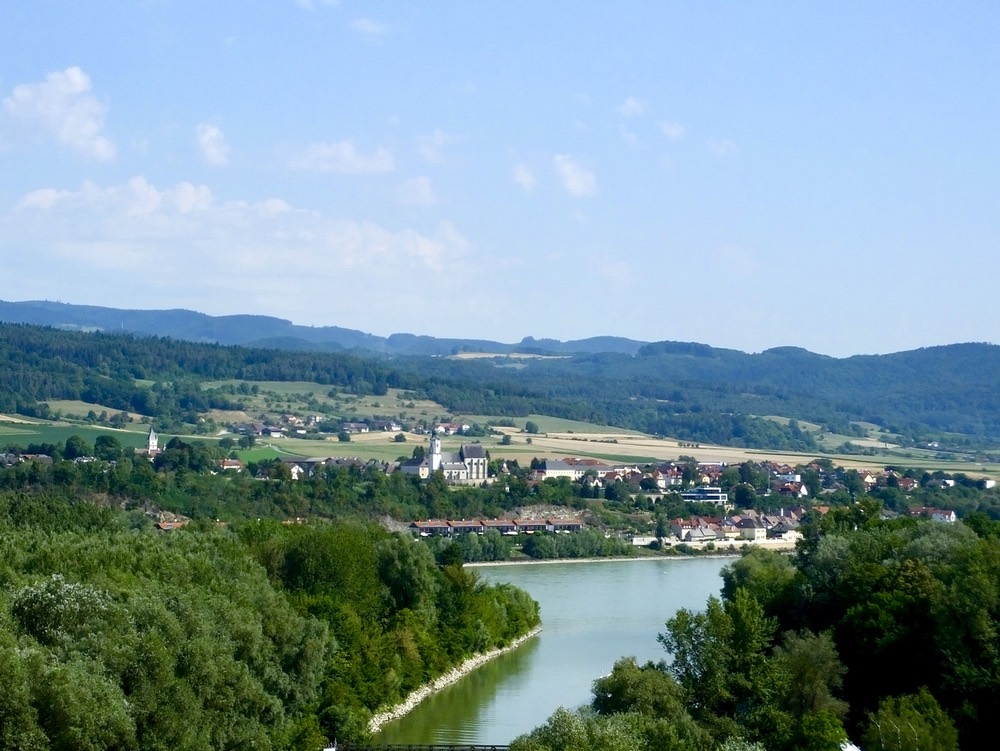
The Austrian countryside from Melk Abbey.
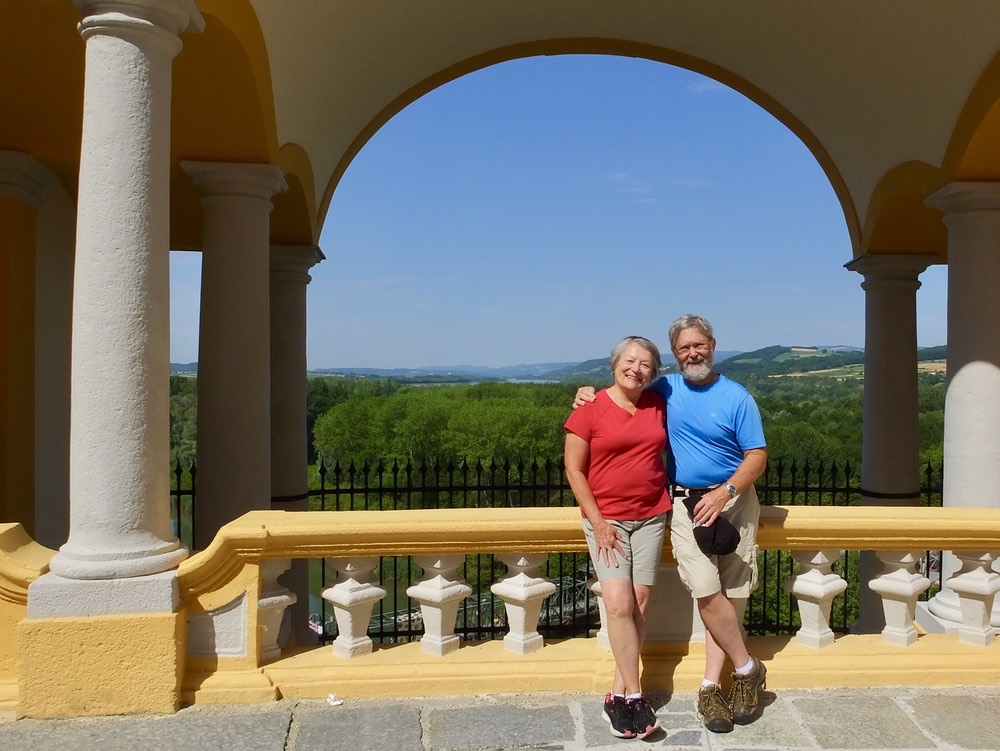
If there is a mathematical formula that determines the inverse ratio of wine consumption to blog length, this will be a very short blog. With some nice pictures.
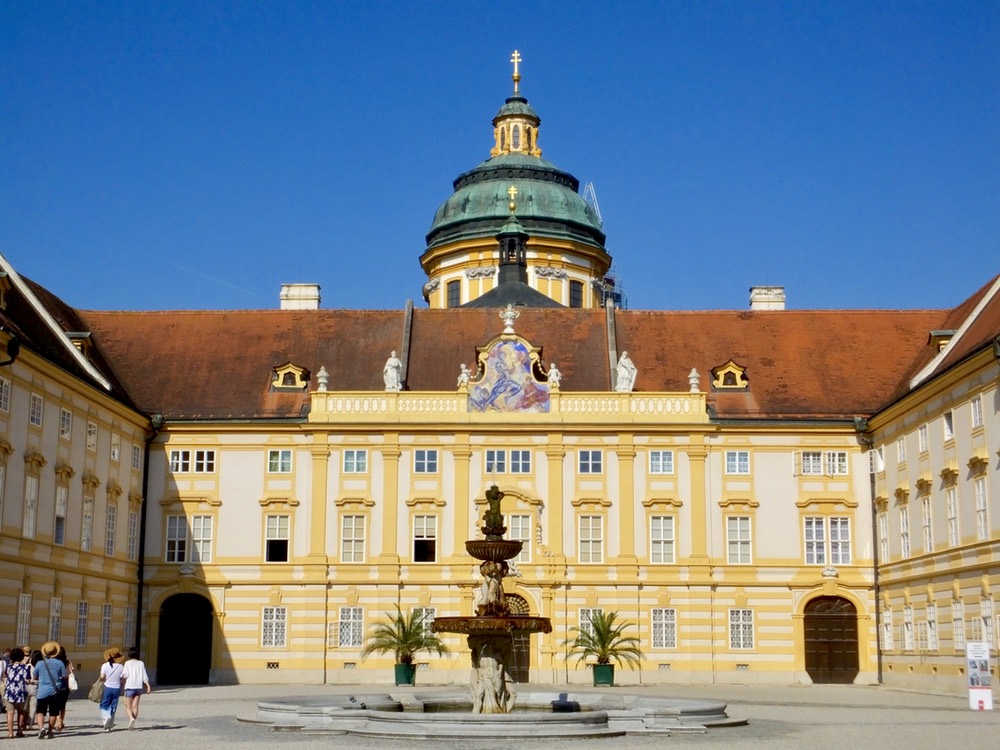
Melk Abbey Courtyard
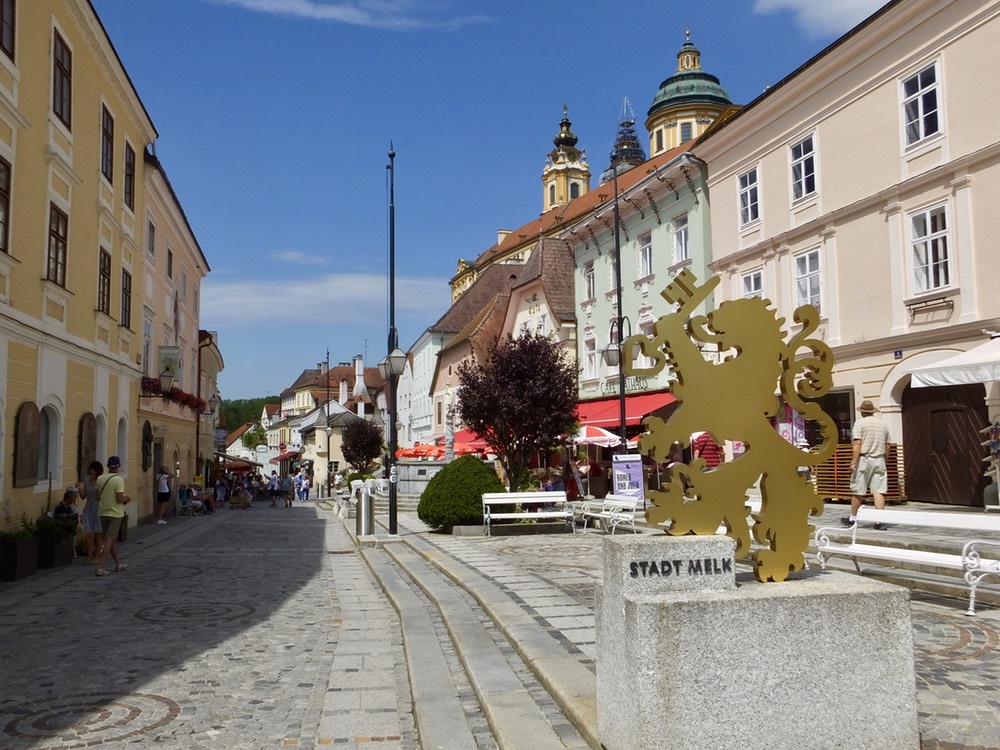
The Benedictine Abbey at Melk was the first stop of the day and, as are all the medieval and baroque structures we’ve seen, it was amazing. Benedictine monks have lived, studied, worked, prayed and taught at this site at Melk on the Danube for a thousand years and the recently restored but still active monastery stands as a tribute to the faith and hard work of these devoted men.
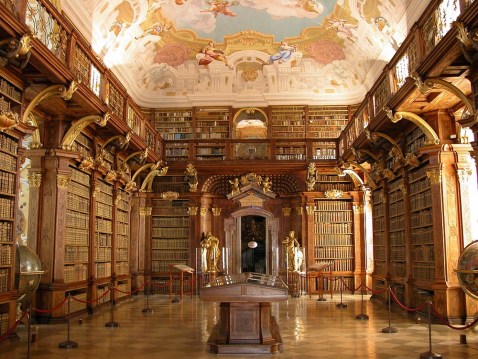
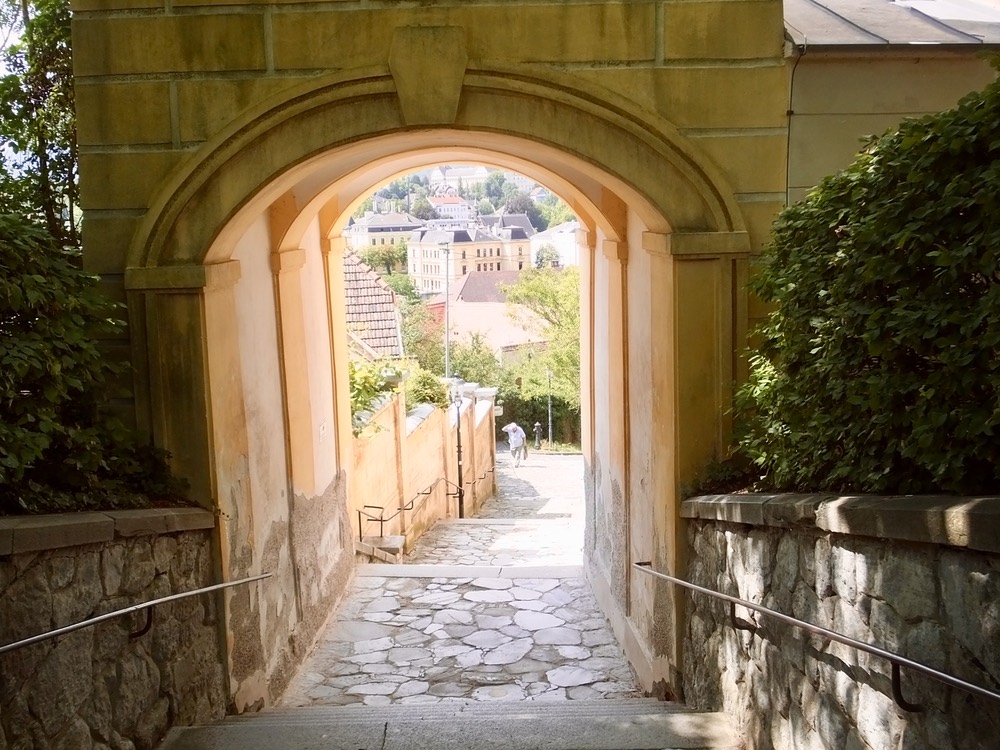
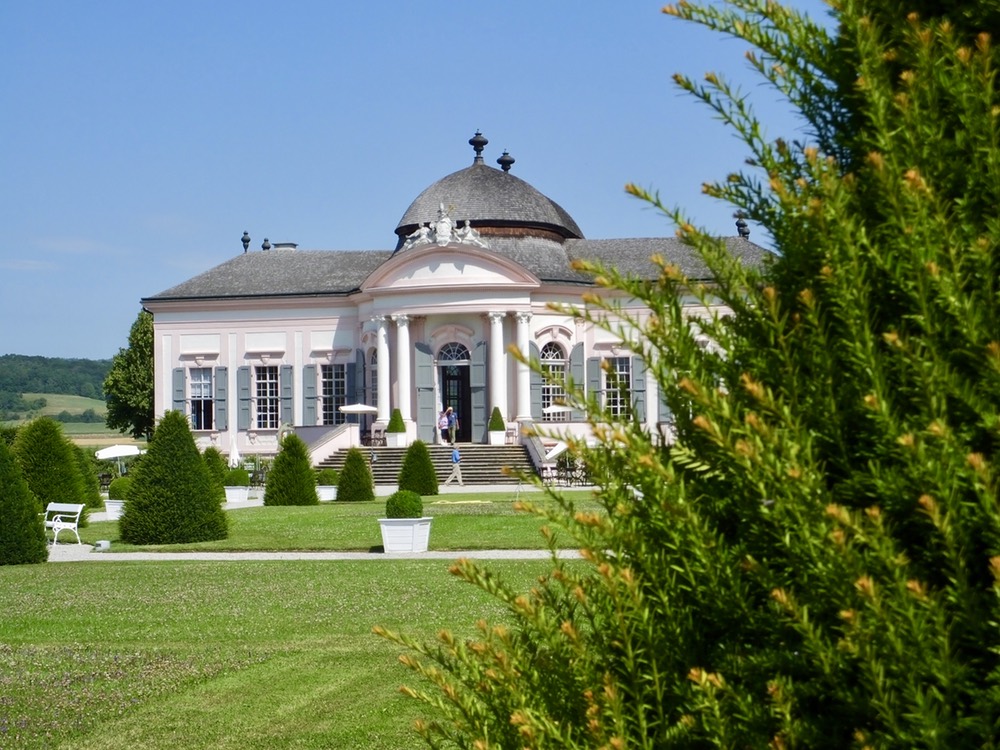
No photography was allowed in this UNESCO World Heritage site, so there are a limited number of pictures, mostly from the exterior. But touring the building and gardens was a great way to spend the morning. In particular, the library, which has one of the best print and manuscript collections in Germany smelled like history. The old, leather-bound books and manuscripts were multi-sensual.
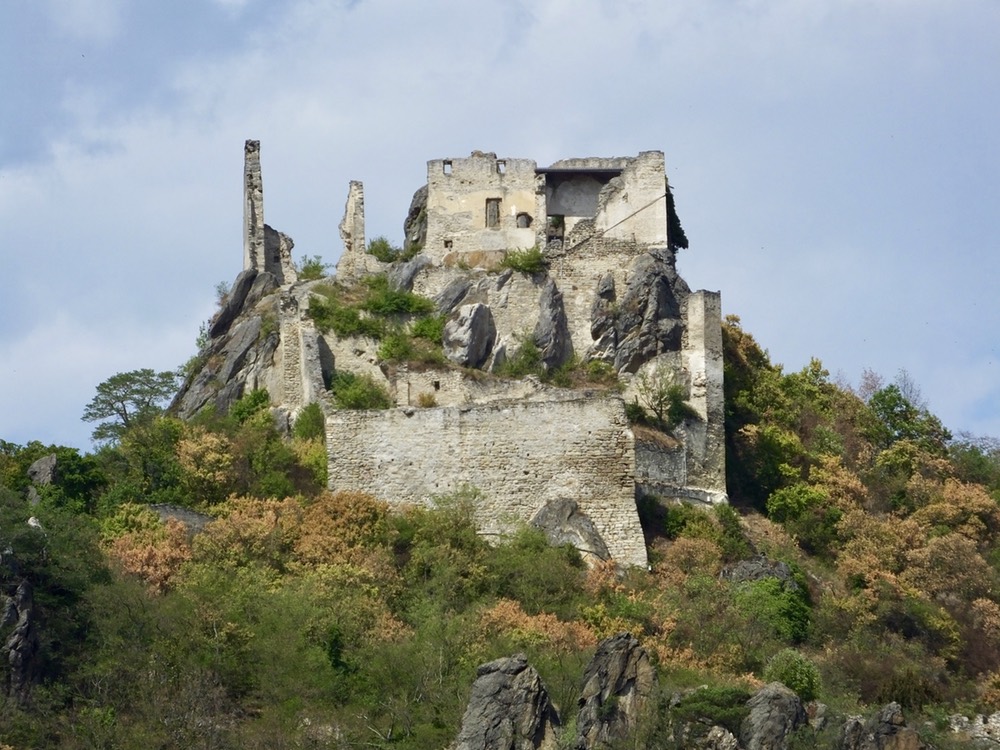
Richard the Lion Hearted was held captive in this fortress along the Danube on his return from the Crusades.
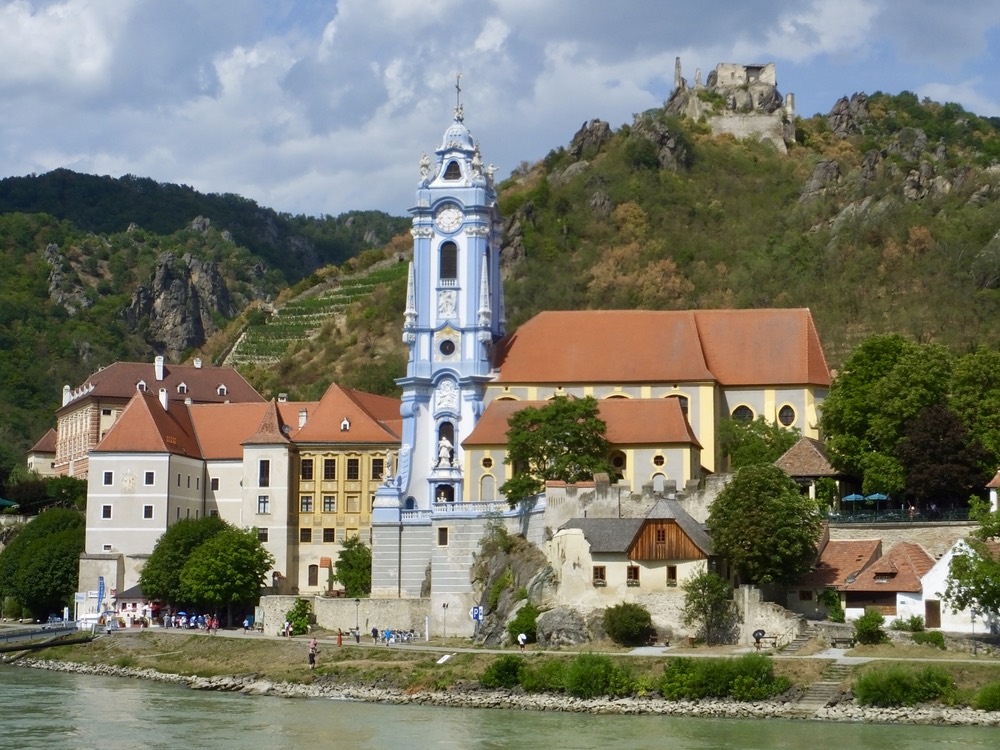
In the afternoon, we sailed on the Danube through the Wachau Valley wine country. Vineyards lined the river and old castles and picturesque towns made frequent appearances as we headed toward the day’s destination at Krems.
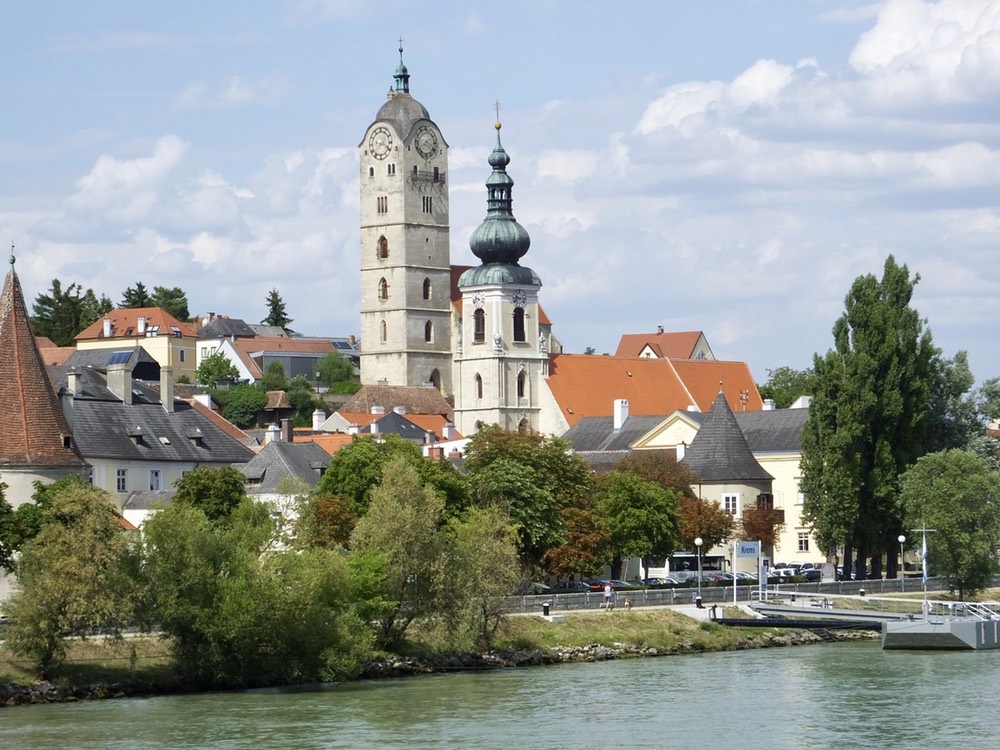
Typical village view along the Danube.
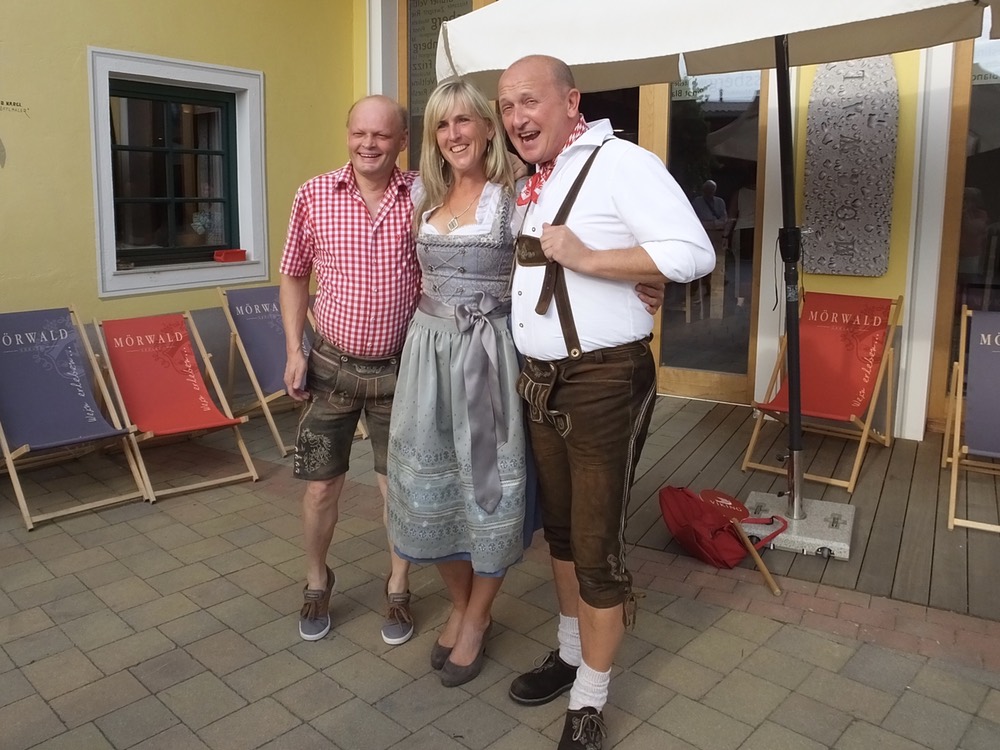
Erhard Mörwald, the vintner, Trinka, our guide, and Thomas, the ship’s Austrian Hotel Manager.
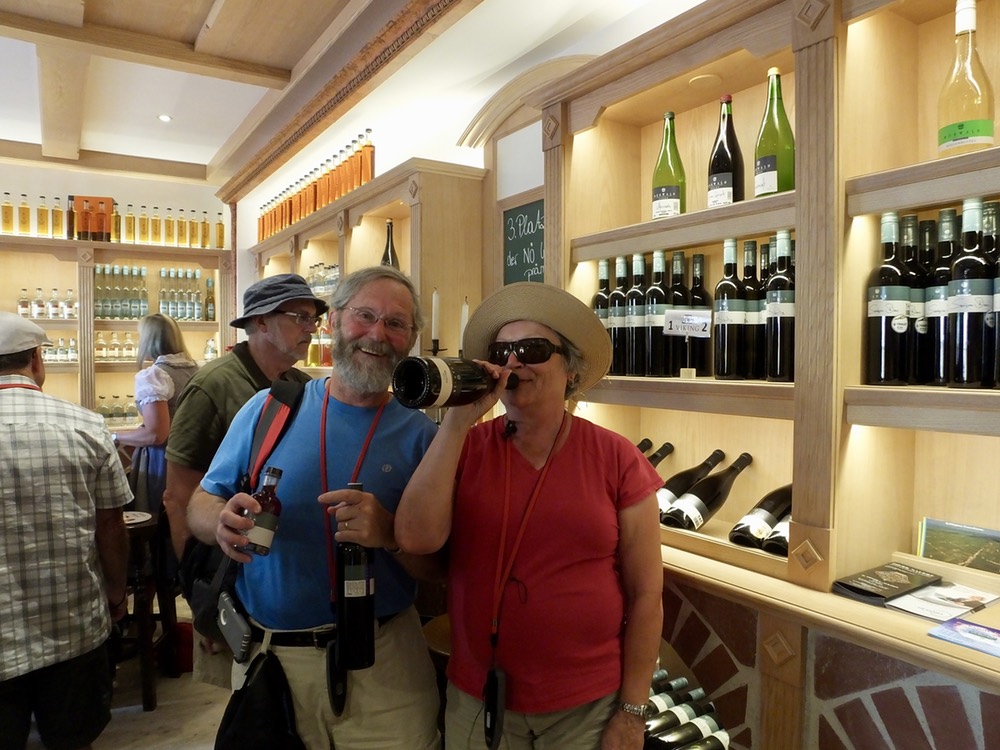
At Krems we debarked and traveled a short distance to the winery chosen to supply much of the wine consumed aboard the Viking Cruise Line’s 50 long ships. We met Erhart Mörwald, the owner of the winery and our special guide for the afternoon. This energetic Austrian took us through the winery, showing us the pressing process, the fermenting process, the bottling process and, most importantly, the tasting process. We sampled six of his award winning wines, then a shot of apricot schnapps. Oh, and then a glass of cherry cordial. I don’t know whether it was the delightful wine or the significant buzz, but we left with three additional bottles and an appreciation for Austrian wine.
This evening, celebrating our first day in Austria, the ship’s chef prepared an authentic Austrian dinner, complete with Austrian beer, Austrian wine and, of course, more Austrian schnapps. Holy Crappen. We had a good time.
Tomorrow we head to Vienna, and, I think, less wine and more Viennese coffee and sacher torte.
Gros Gutte.
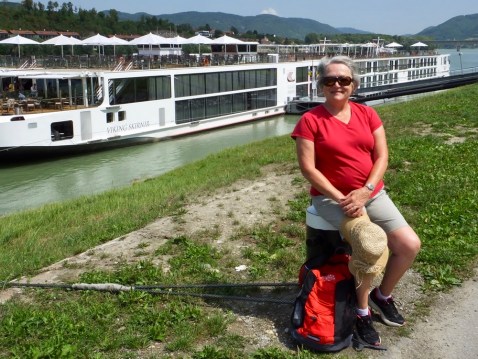
Returning to the long ship Skirnir
Day 10: Passau: Organ Concert on the World’s Largest Cathedral Organ

The north bank of the Danube from Passau. Please click on image for larger view.
After sailing calmly down the lovely River Danube all night, we awoke this morning in the border town of Passau, Germany, only one kilometer from Austria, which we can see in the distance and which is visible from several vantage points in town. Today’s docking is the closest we’ve had so far to a town center. Disembark, walk about 200 yards up hill, and you’re there.
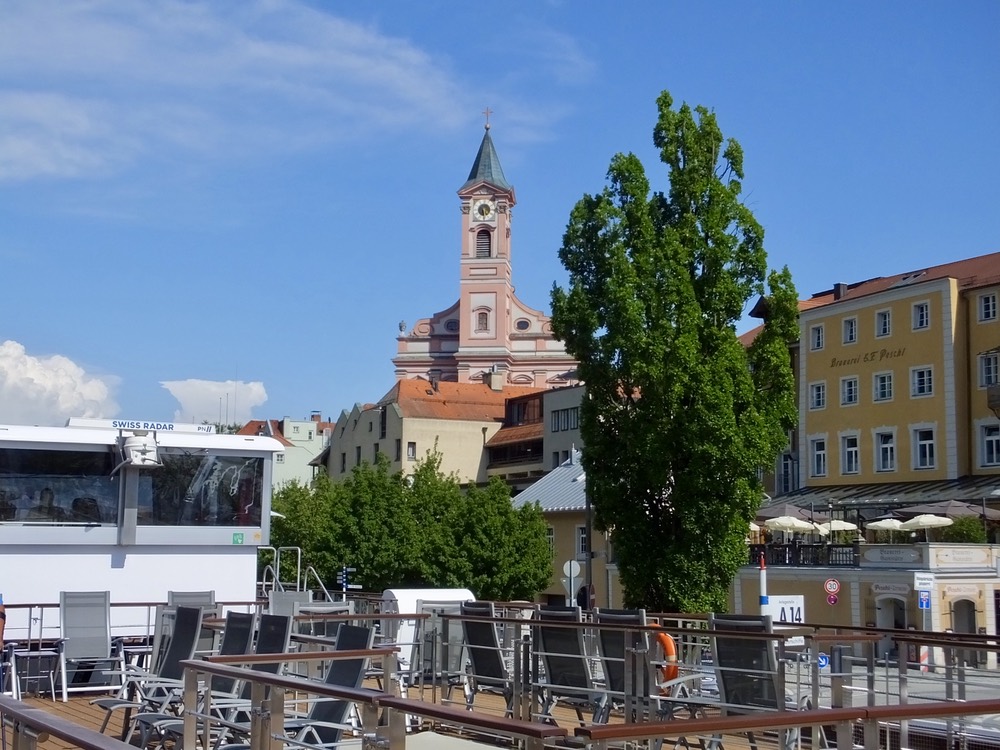
View from the sun deck of the Viking Skirnir.
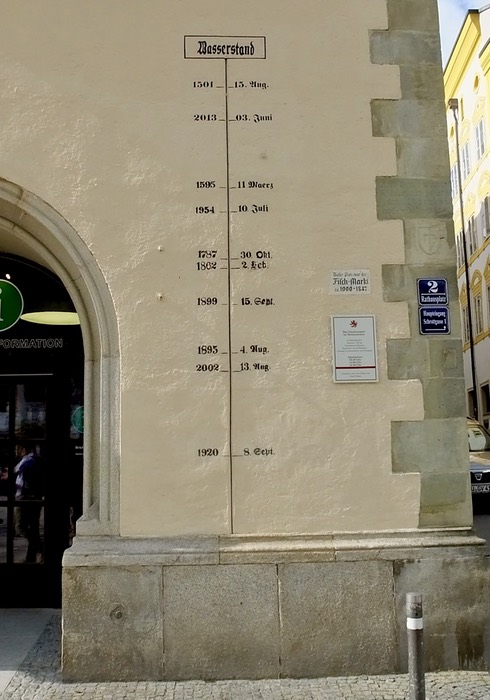
Our tour guide for the morning was Konrad, a professor of international relations at Passau University and a native of this town. He started our walk with a discussion of the city’s history, which can be traced to more than 7,000 years ago, thanks to its location at the confluence of three rivers: the blue Danube that originates in the Black Forest of Germany, the black Illz that originates in the Bohemian Forest of northern Germany and the green Inn that originates in the melting glaciers of Switzerland. The three rivers give the city much of its character, but they have also contributed to its unfortunate past, namely a series of devastating floods, the depth of which are documented on the photograph below. The most recent, and the second worst in history, occurred in June 2013 and reached the second story of all the buildings on the banks of the Danube and left behind more than three feet of mud when the waters receded.
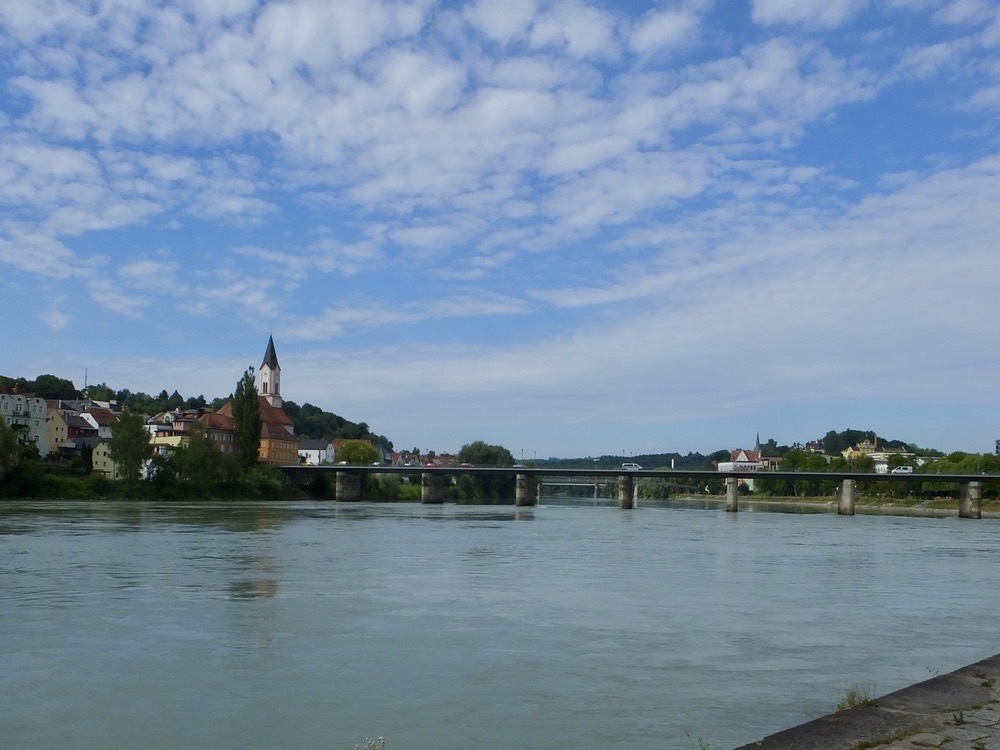
The Inn River a few hundred yards from where it merges with the Danube.
After pausing briefly on the banks of the Inn River and noting the milky color caused by the suspended sediment scraped and crushed from the sides of Swiss mountains by massive glaciers, we climbed the hill to town center and St. Stephens Cathedral. Unlike Gothic cathedrals we saw in other cities, Passau’s cathedral was different. The original Gothic structure, which had stood for hundreds of years, was destroyed by afire in 1683 that also destroyed or damaged much of the town. Italian baroque architects and craftsmen were hired to build a new church, a project that too more than a decade. The resulting edifice was very different from the older Gothic cathedrals that pepper the German landscape.
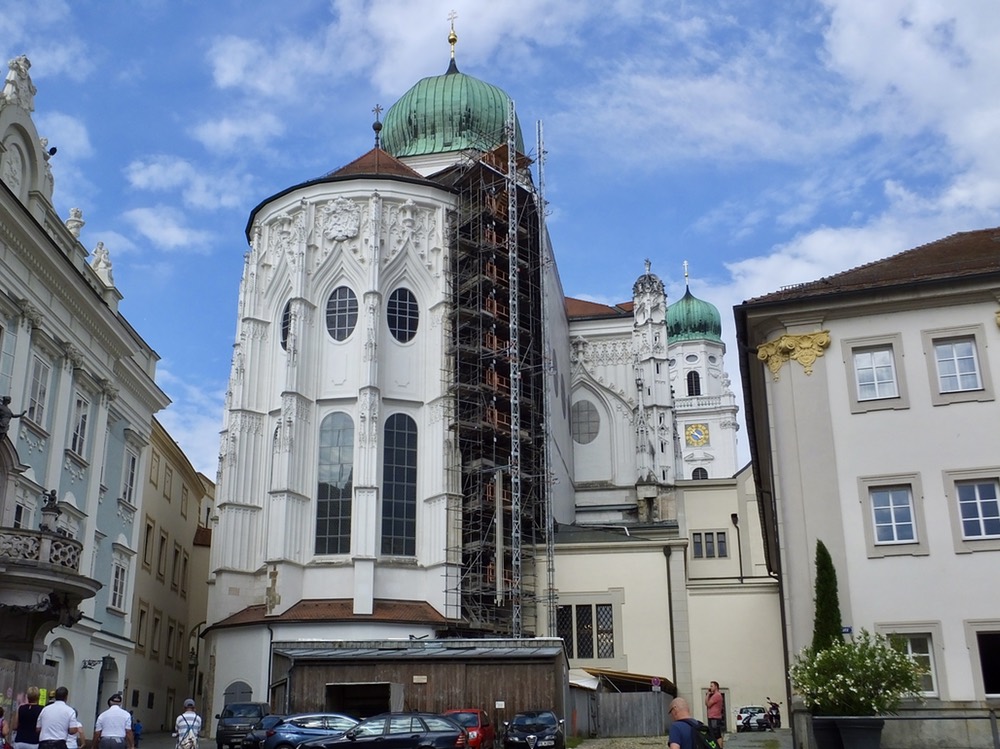
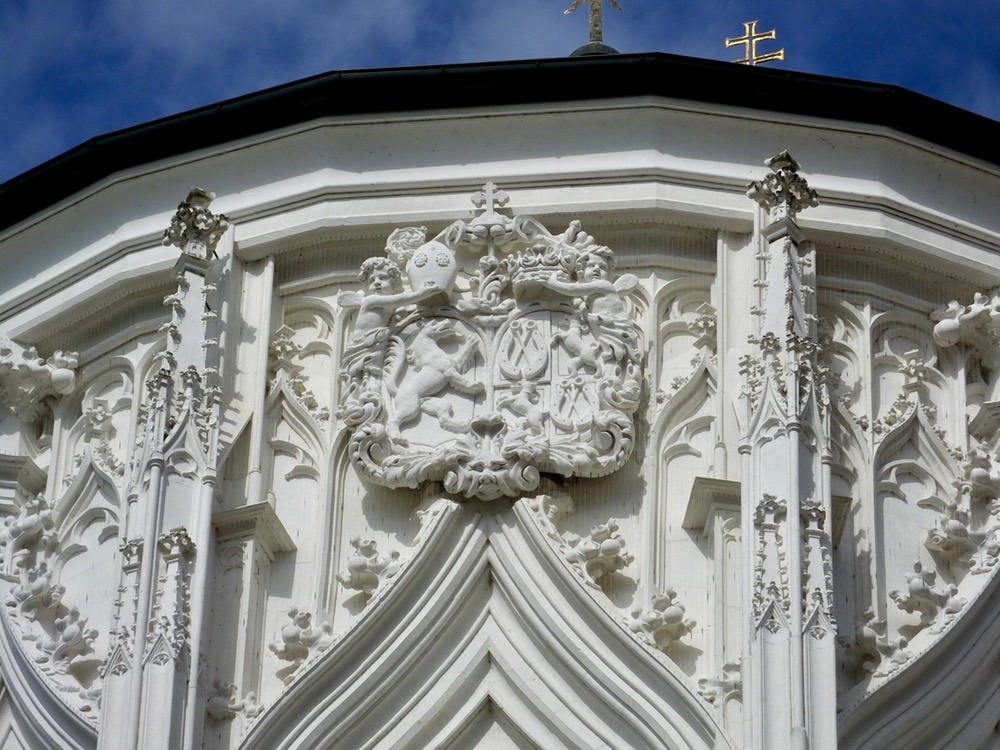
The rear of St. Stephens Cathedral with scaffolding that seems to be a permanent part of all German cathedrals. The photo that follows shows the intricate detail at the top of the tower. The attention to minutia at more than 200 feet in the air most people can’t really see is amazing.
The interior of the cathedral was as striking as the exterior, perhaps even more so. The Italian fresco painters and especially the stucco artists who finished the interior out did themselves. Once again, just as the exterior of the building was striking in it’s attention to the most minor details, the interior in itself could easily result in a multi-hundred page art book. Below are two photographs that show only a minute fraction of the thousands of detailed stucco sculptures and ceiling paintings. Neither my pedestrian writing nor my inadequate photographs do them justice.

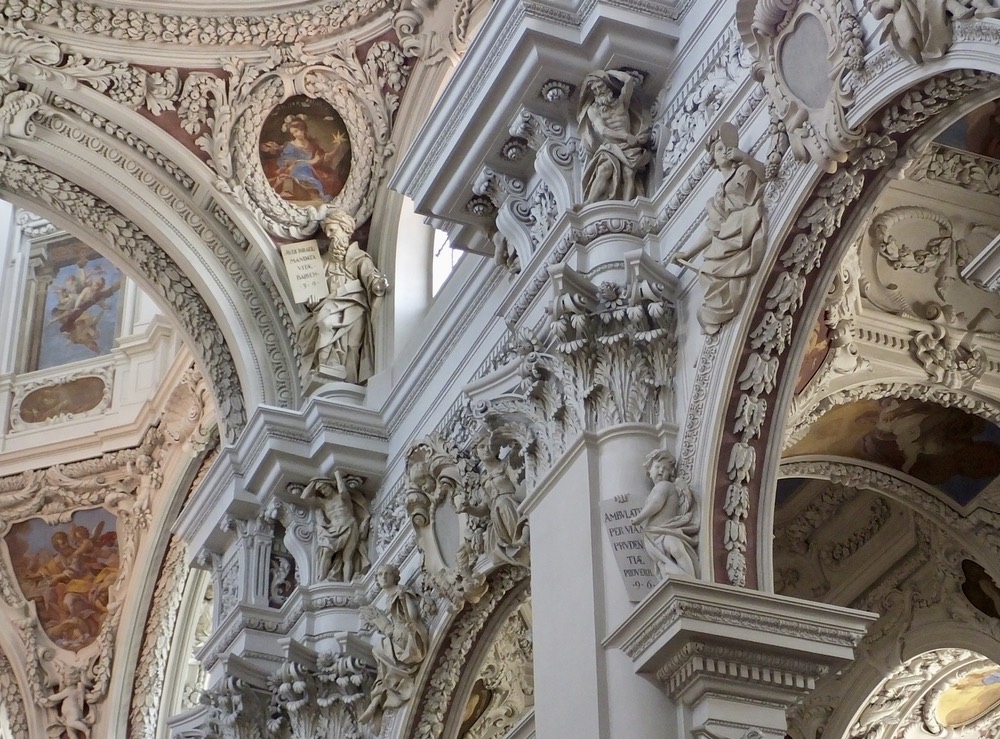
This shows a close up of the right middle portion of the photo above.
But the real treat at the cathedral today was not the gorgeous paintings or the stunning stucco sculptures. Rather, it was a 30-minute concert of baroque organ music on the largest cathedral organ in the world. The St. Stephens organ is actually a system of five organs connected together and played on a single console. The organ has more than 17,500 pipes ranging in size from more than 30 feet long to less than 3 inches long. The quality of the organ combined with the acoustics of the cathedral inspired feelings of awe and even reverence. The concert was tagged as the highlight of today’s tour, and it was.
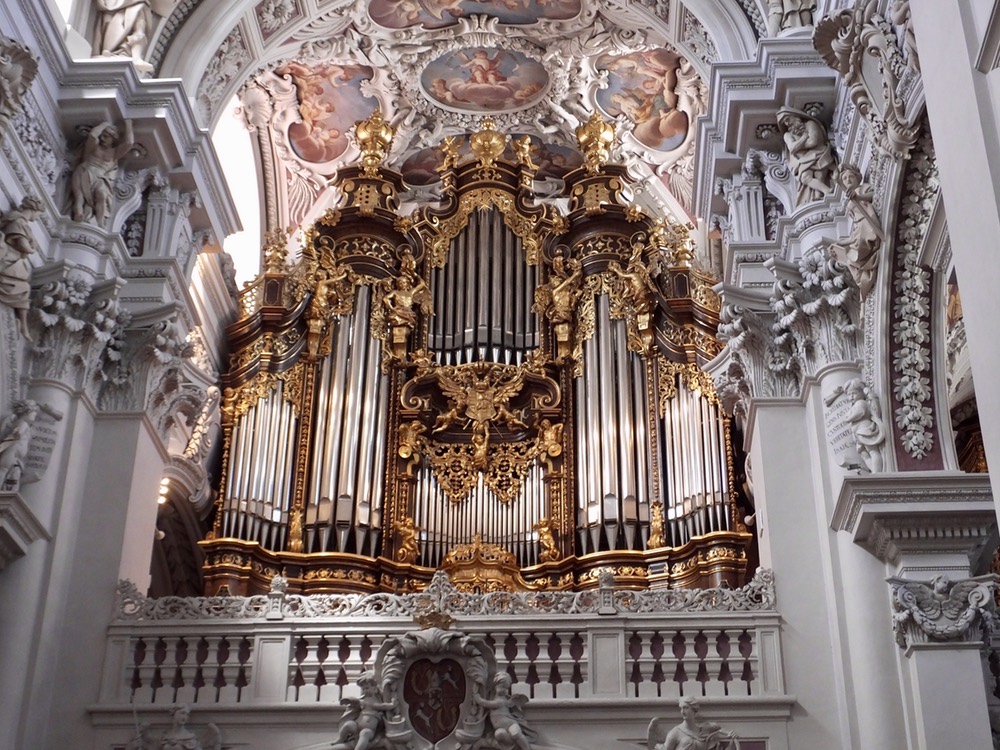
A few of the 17,500+ pipes that constitute the St. Stephens Cathedral organ.
The organ concert was the last stop on the tour and after another delicious lunch back aboard the Viking Skirnir, we returned to town for more sightseeing, some shopping, and, of course, a visit to a biergarten to sample the local brew, this time a pilsner. More staid than the brews I quaffed in the last few days, it was a good, cold drink on a warm German day when the sun warmed the city to about 87° F.
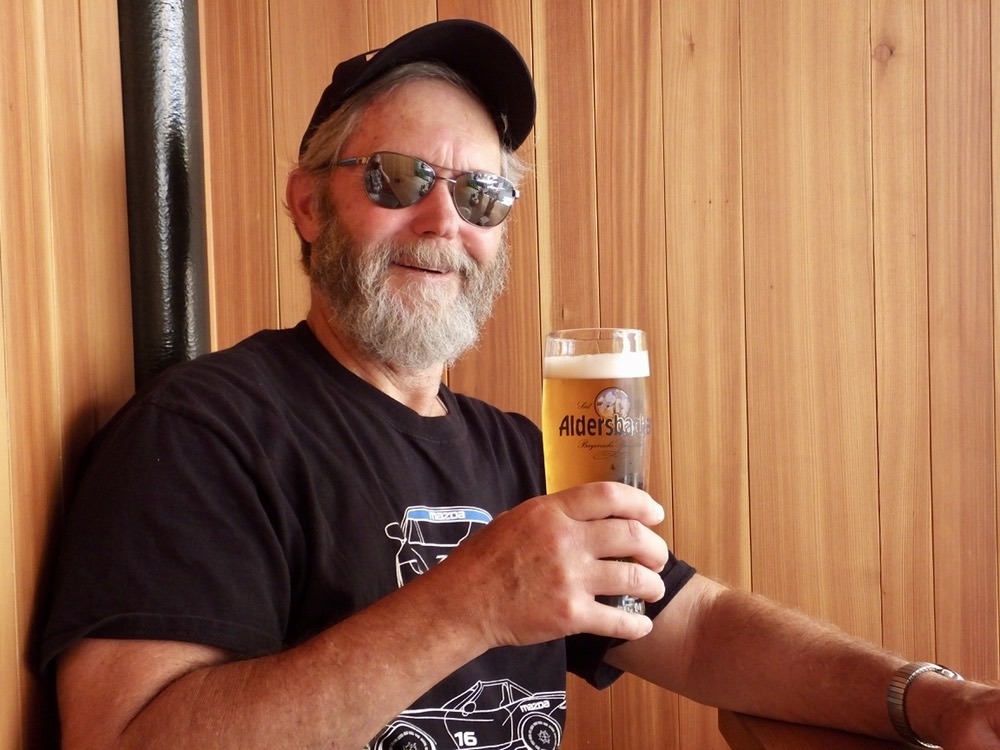
We returned to the ship at 5 p.m., the crew cast off the lines, and we soon sailed past the three river confluence and into Austria. Tomorrow, I give up beer and return to wine and a visit to a vineyard and winery. Life is good.
More from Passau
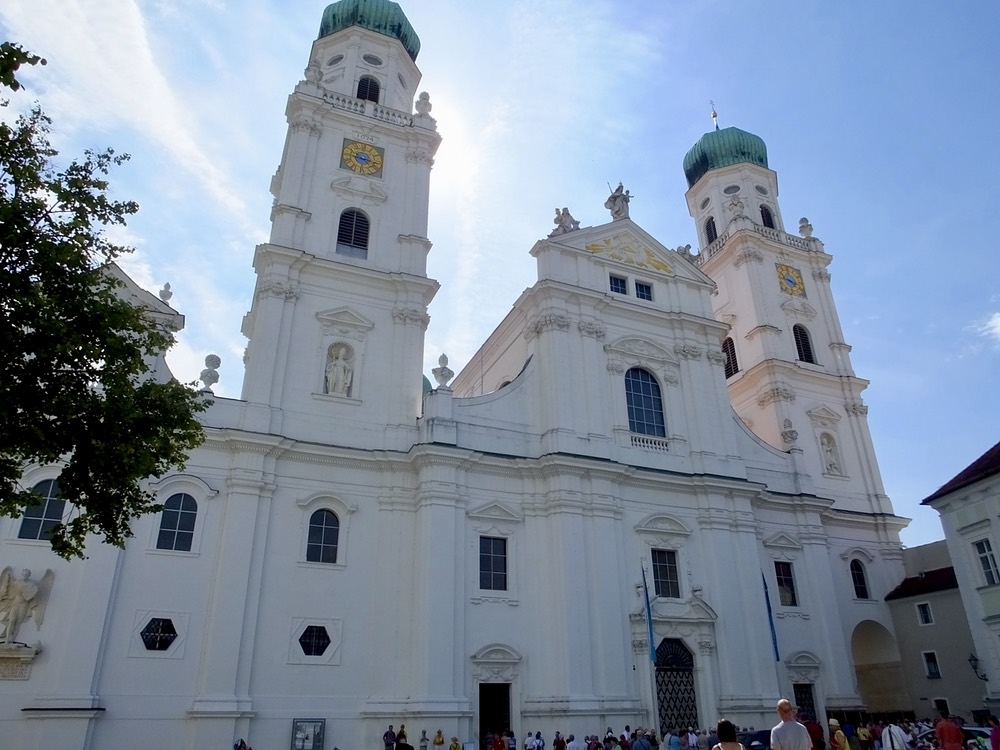
The front of the baroque St. Stephens Cathedral in Passau.
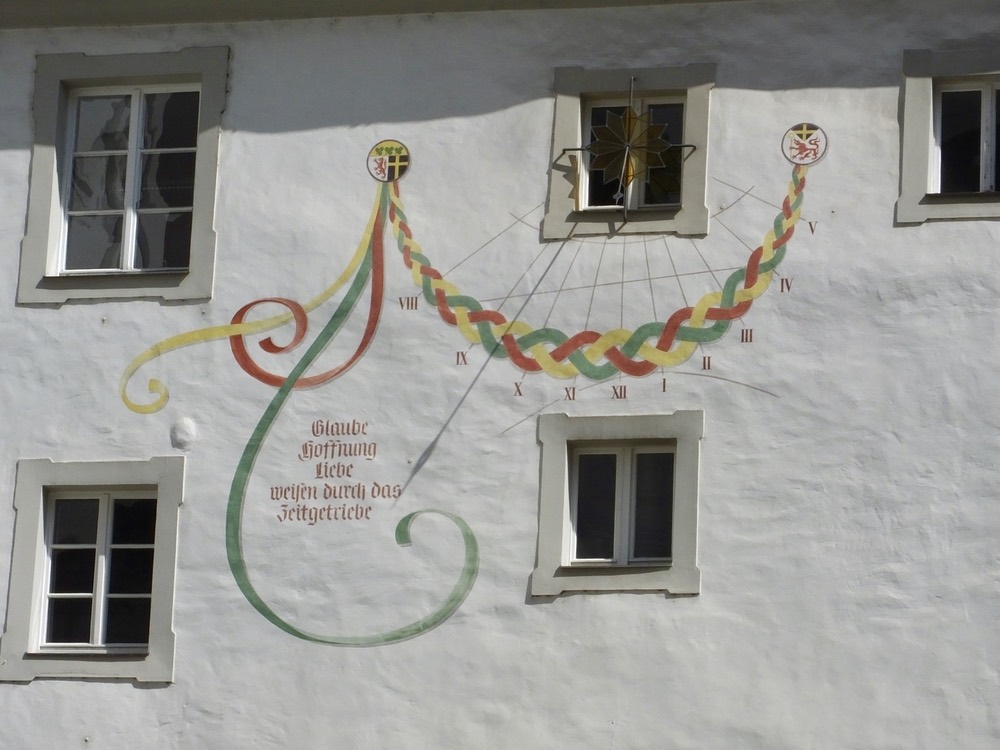
A working sundial on a wall in the inner courtyard of the cathedral. The current time on the sundial shows about 9:30 when it was actually about 10:30. But the artists of several hundred years ago didn’t have to contend with daylight savings time. Otherwise, it kept pretty good time.
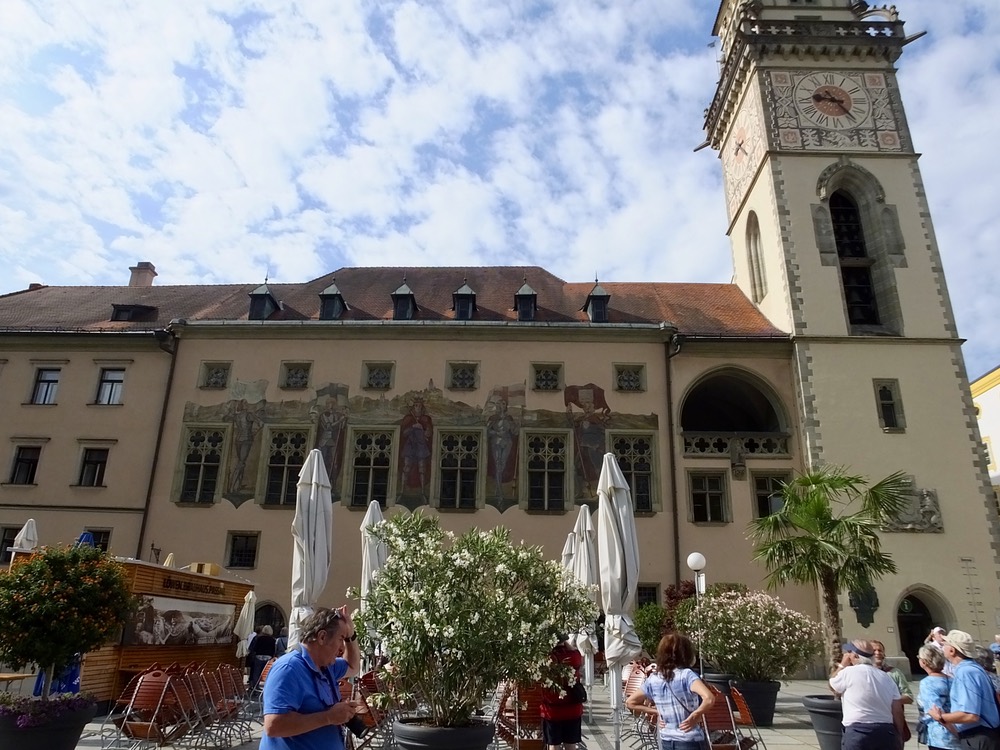
City Hall
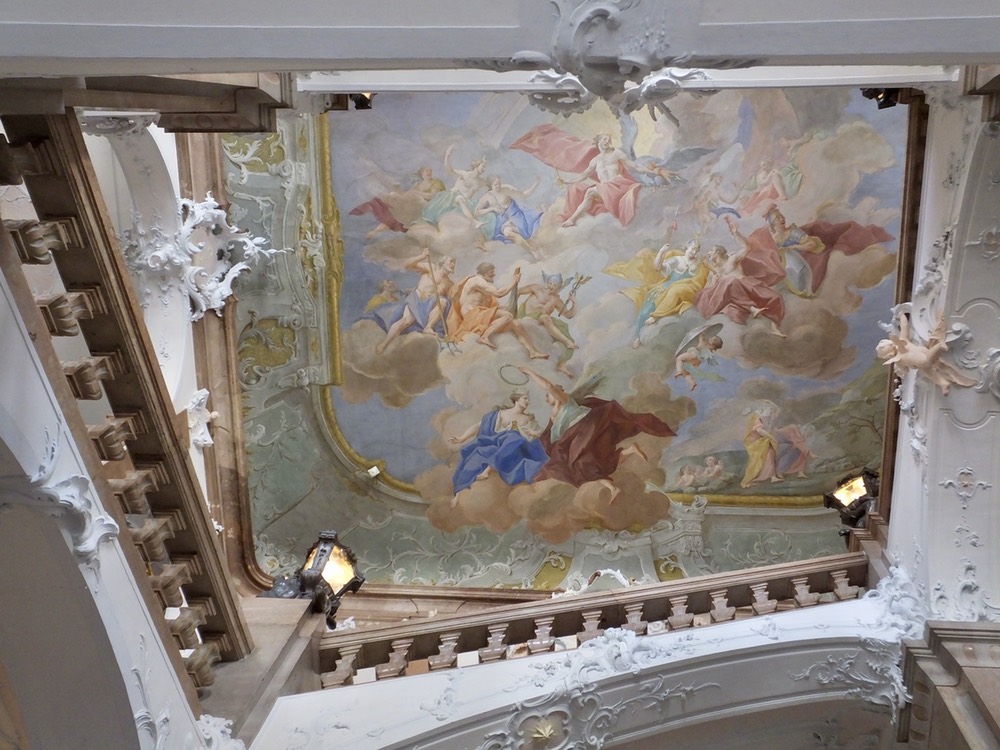
The ceiling fresco at the Bishop’s residence.
Day 9: Regensberg: A 900 year-old Sausage Shop
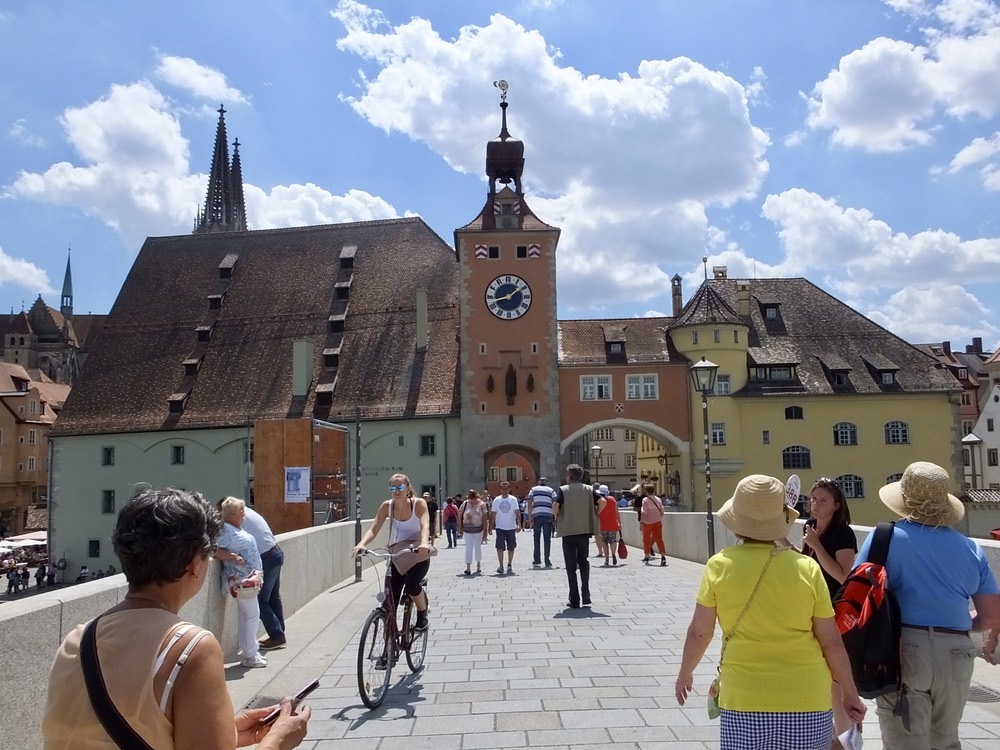
Crossing a 900 year old bridge into Regensburg
About mid-morning today we left the 106-mile long Rhine-Main-Danube canal and entered the Danube River. Along the way, we went through 27 locks, the highest of which was more than 82 feet, and near the middle of the canal we reached the highest point on earth where ocean-going vessels can go. The canal took more than 30 years to build and makes it possible for barges and ships like ours to go from the Black Sea to the North Sea across central Europe.
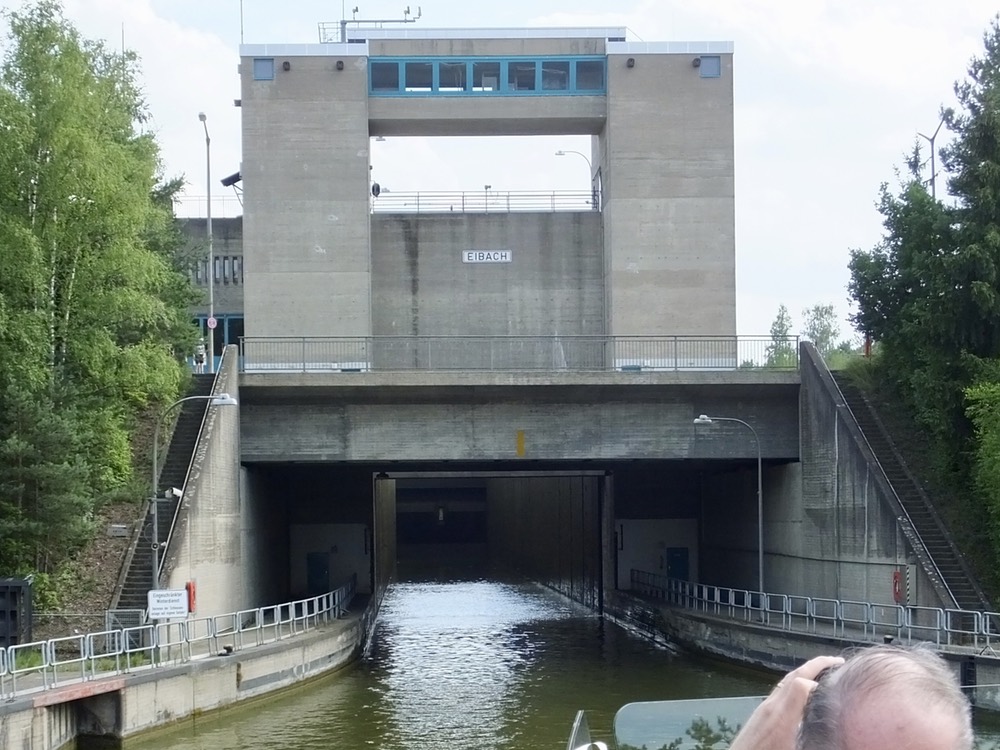
One of 26 locks, this one on the downhill side headed to the Danube
For the next seven days we will sail on the Danube, leaving Germany tomorrow night and entering Austria. The final two days will take us to Hungary.
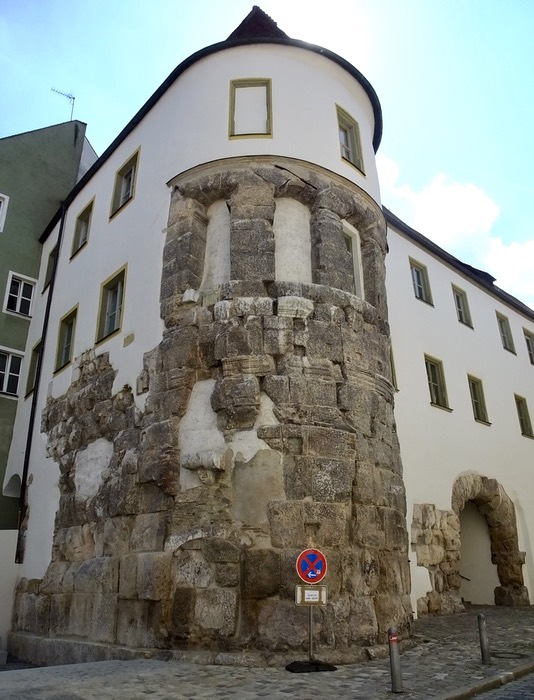
The stone tower was part of the Roman fortification and built around 173 AD. The upper room was added later and is now the honeymoon suite of a hotel inside the former Bishop’s Residence. It represents a nice shift from making war to making love.
Regensburg, our port stop today was another reminder of the length of European history. The area was probably settled nearly 2,000 years ago and in the first century AD it was the site of the second largest Roman settlement in Germany, hosting Castra Regina (Fortress by the River Regen) and some 6,000 Roman Legionnaires. The city still shows reminders of Roman architecture including walls, towers and the main gate to the fortress.
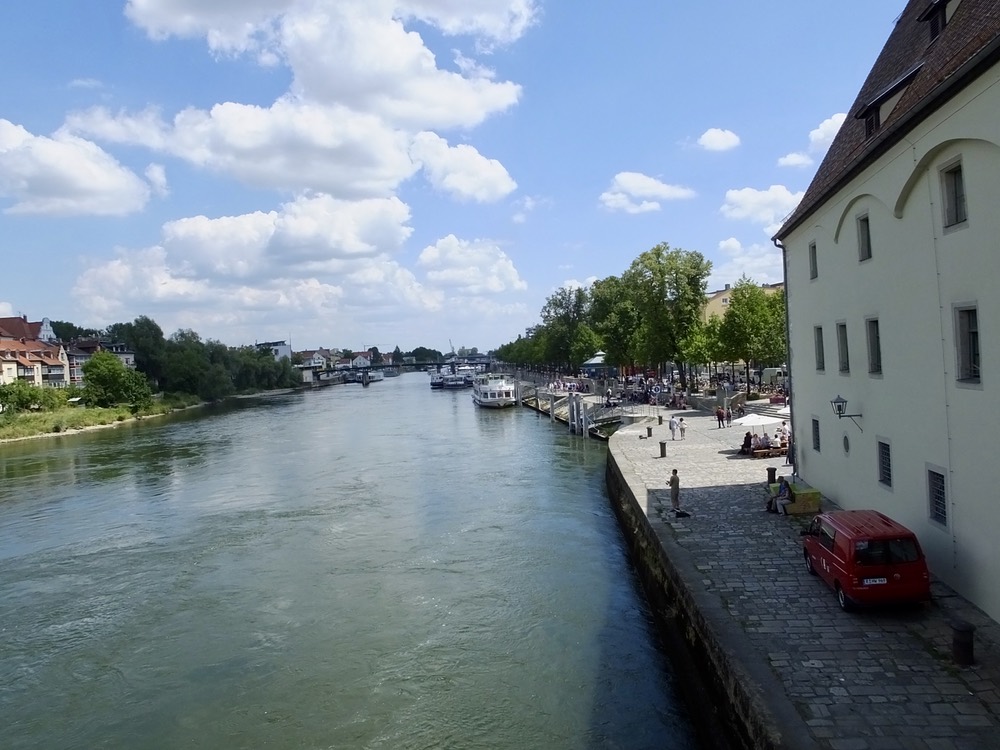
The Danube River from the Bridge into Regensberg.
It was another of those fortunate German cities, unlike Nurnberg, that largely avoided destruction in World War II and still boasts buildings built in the 10th, 11th and 12th century, including the city hall, St. Peters Cathedral, the bishop’s residence and hundreds of shops and houses. We walked into the city across a bridge over the Danube River built in 1135-1146, though after only 900 years, it’s already beginning to show its age and is undergoing some repairs.
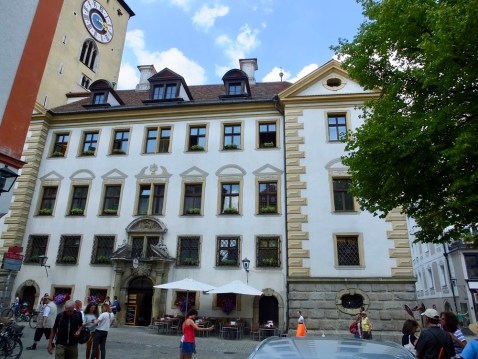
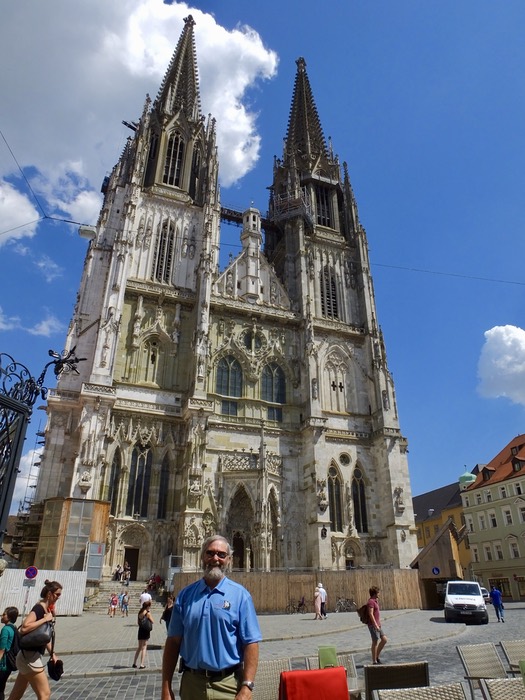
In addition to the City Hall (and the nearby Ratskeller) and the Bishop’s residence, the primary historical focus of the town is St. Peter’s Cathedral, begun in the 13th century and finally completed in the late 19th century when two soaring spires were added and at nearly 350’ tall are among the highest in Germany. We took a few minutes to step inside the massive cathedral and were confronted with brilliant stained glass windows dating from the 14th century and a nave which rose more than 100’ above us. Beautiful.
While not as impressive as the cathedral or city hall or the bishop’s residence, one of the high points of today’s walk through Regensburg was a stop for beer and sausages at the Sausage Kitchen (Historische Wurstküche zu Regensburg) which has been feeding workers and residents at the site since the bridge was built in 1135-1146. The same family has been operating the current restaurant since 1803 and has grilled sausages over charcoal since that time. I enjoyed a plate of sausages and sauerkraut washed down with a nice dark beer delivered by a surly waiter.
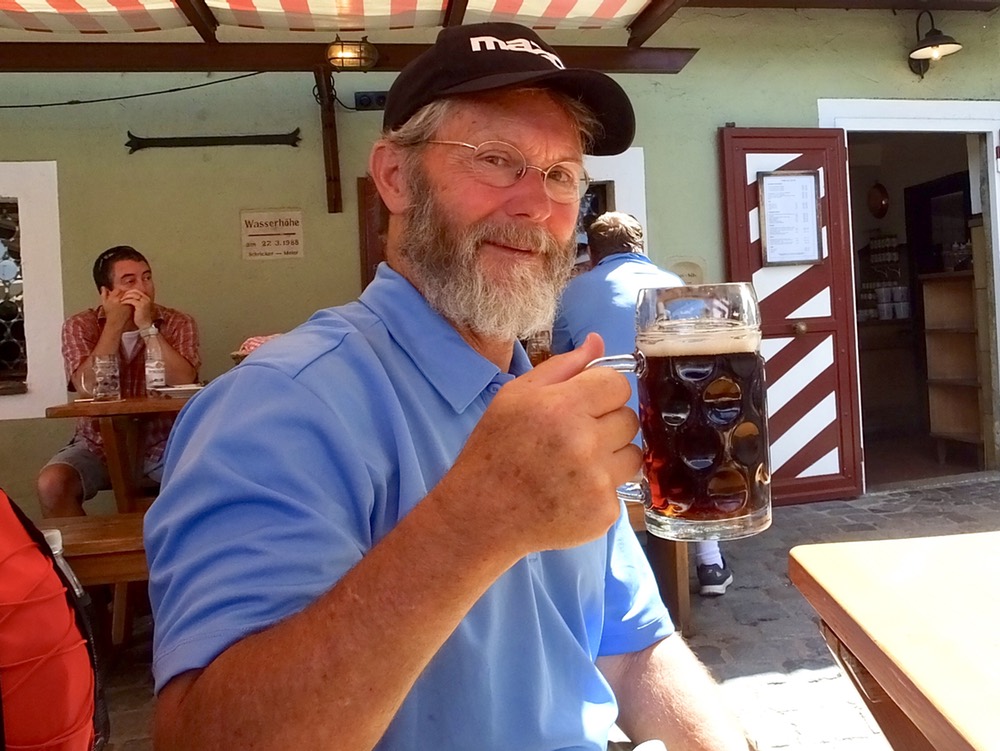
Once again, the WiFi connection is slow and sometimes fails completely. I’m hopeful I can post this tonight, but if the midnight hour comes and it’s not up, it will have to wait until tomorrow. All this walking, eating, drinking and other tourist activities is taking its toll and there are more castles, cathedrals and concerts ahead of me. But I’m not complaining. This has been a great trip so far.
More from Regensburg
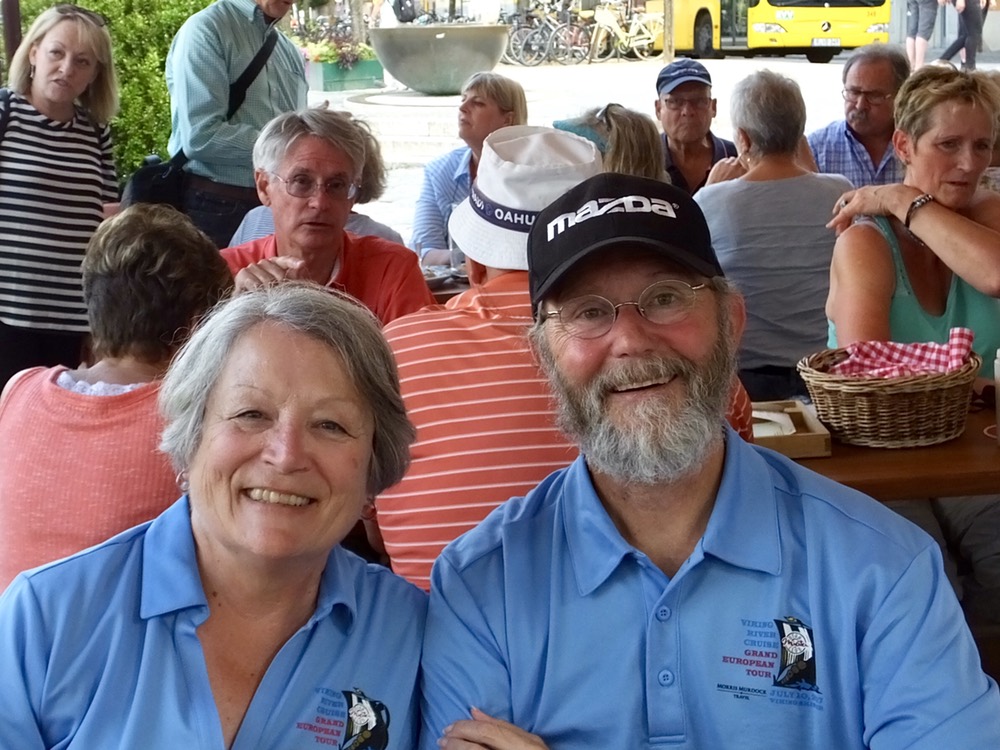
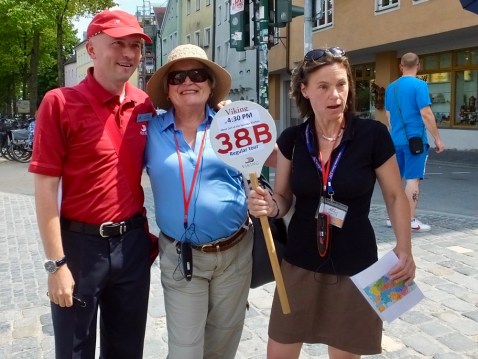
Marilyn is flanked by Carl, the ship’s Program Director, and Brigitta, today’s guide.
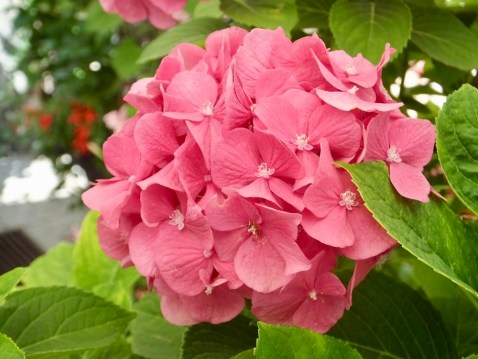
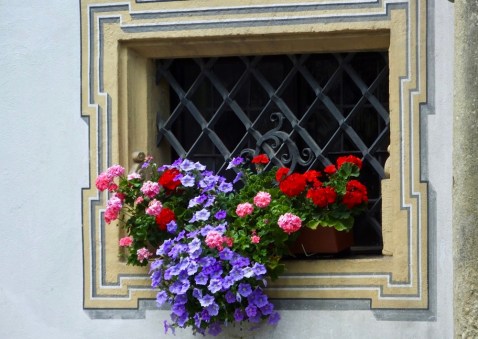
Flowers were everywhere, but we learned they had been banned from city windows before the 1980s. Weird.
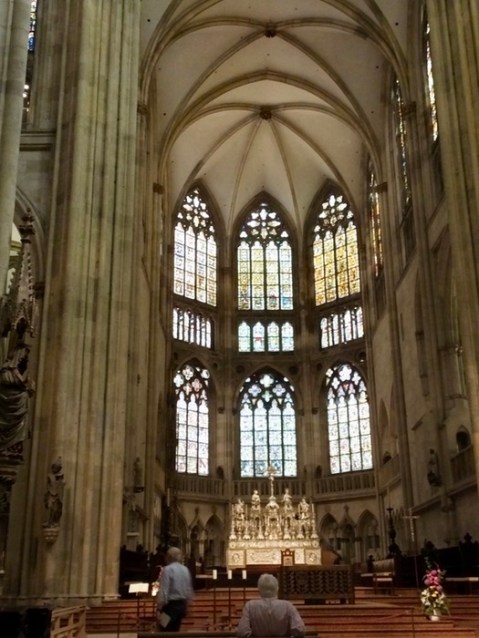
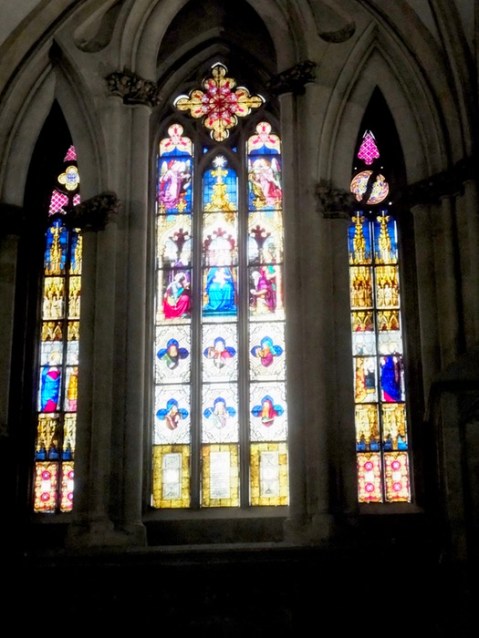
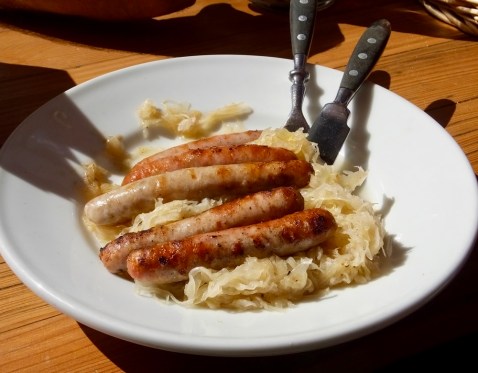
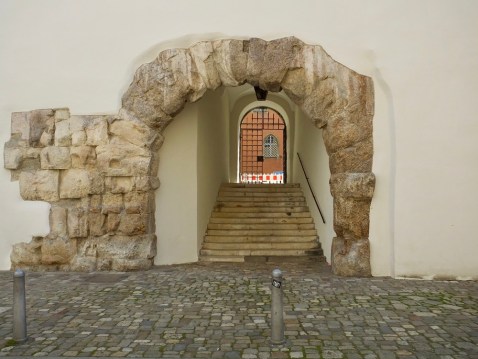
Pratorian Gate built in 179 AD
 hdriderblog