
Ride West: Day 23 to Westminster (again)
Today marked a day of high points.
After leaving Breckinridge under cloudy skies and temperatures in the upper 40s and devouring a huge breakfast in nearby Frisco, we rode several state highways and a little Interstate before arriving at the foot of Mt. Evans, the fourteenth highest peak in Colorado at more than 14, 200 feet. More importantly for us, Mt. Evans boasts the highest paved road in the United States. At about 10 a.m., at 10,500 feet, we prepared ourselves for temperatures in the mid 30s at the peak (according to the digital readout at the ranger/fee station) and began our climb under still cloudy, but rain-free, skies.
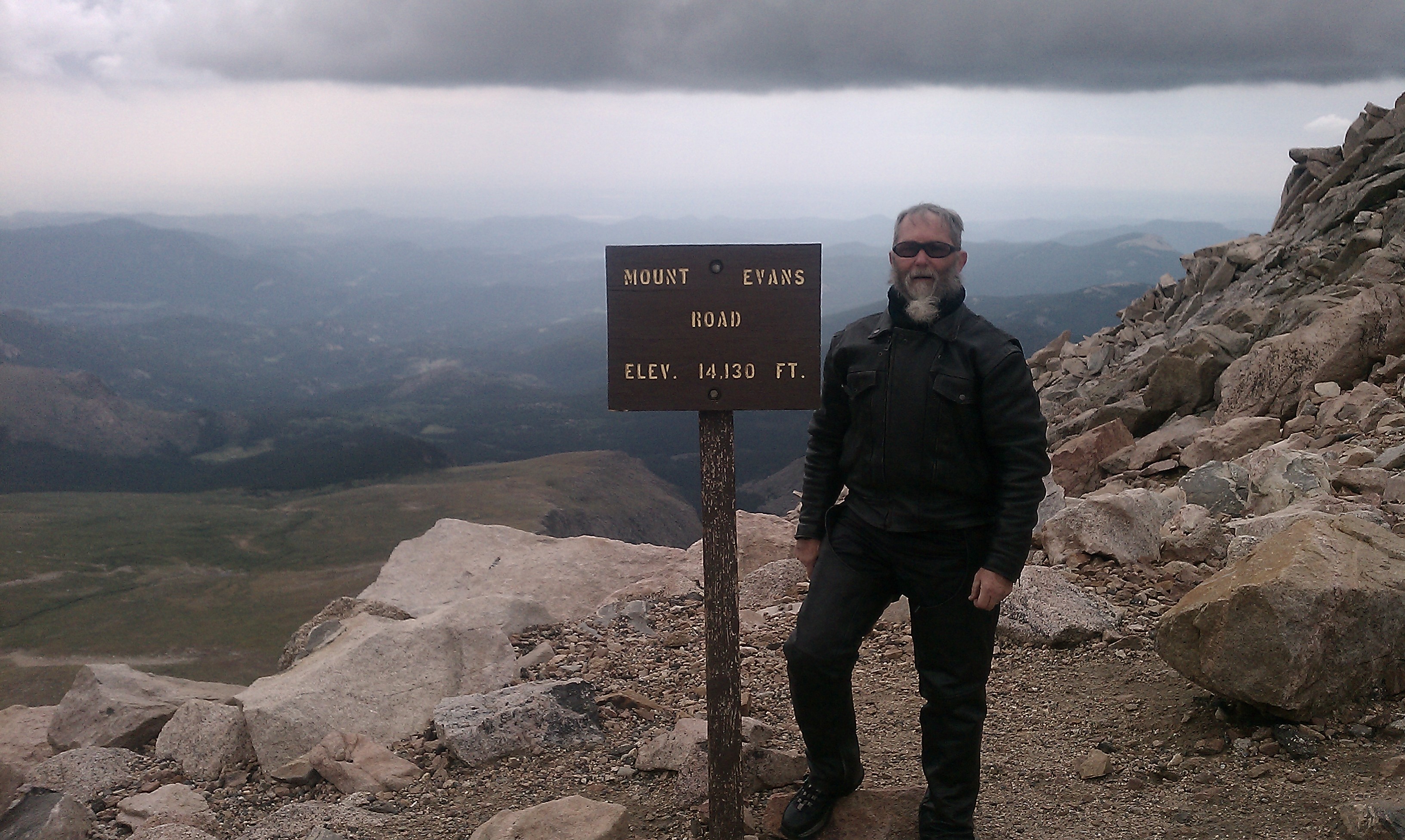
I came. I climbed. I conquered.
The 14-mile road to the peak began as a fairly gently climb with interesting but not challenging curves. As we went higher, the panoramic views of the surrounding mountain range became more spectacular and the road became more challenging, dominated by tighter turns and more severe drop-offs. With a treeline at about 12,000 feet, much of our climb was done in a rugged, rocky terrain that starkly attested to the powerful geologic forces that lie within the earth, creating mountains and then bringing them down again. The occasional critter (pikas?) scurrying across the road broke our concentration from time to time but the unseeable but always present chasms on the downhill side of the road consistently refocused our attention. By the time we passed the road construction at mile marker 9 (frost heaves had severely damaged the road), the temperature had dropped considerably and the road had definitely become more challenging. Steep grades and tight hairpins reduced our ascent speed to 10 mph or less, a pace which we had rarely seen all week. CB chatter was terse. “Sharp right, sharp left, sharp right, sharp left. Car coming down. Clear. Clear. Clear.” The climb continued with each hairpin teasingly but falsely offering the “final” climb until, finally, we reached the blustery summit at more than 14,200 feet where car-bound tourists shivered in their hiking shorts and hastily donned sweatshirts.
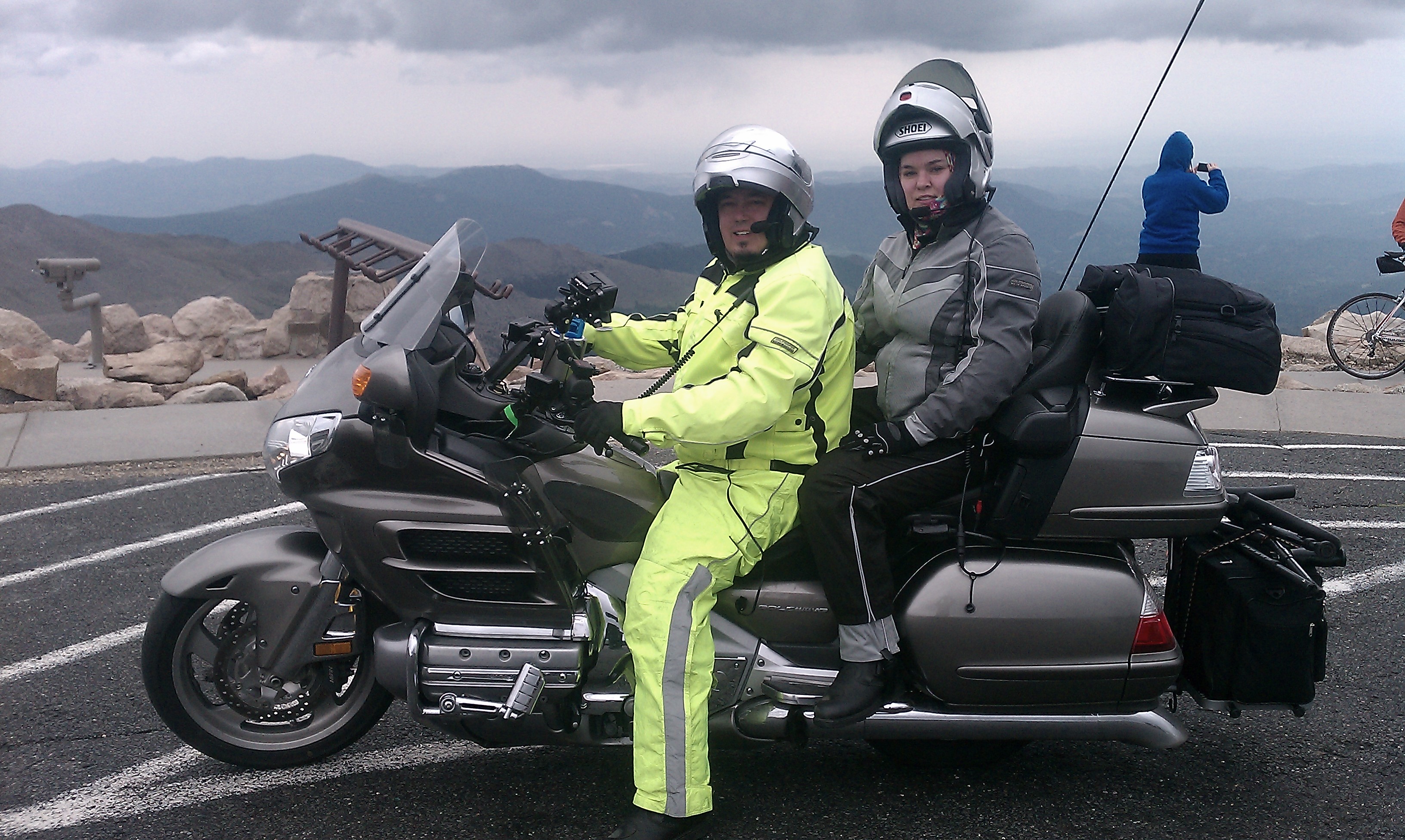
Kevin and Stephanie perched high in the Rockies. Stephanie made the entire trip with a broken foot and an unbroken spirit. She’s a trouper.
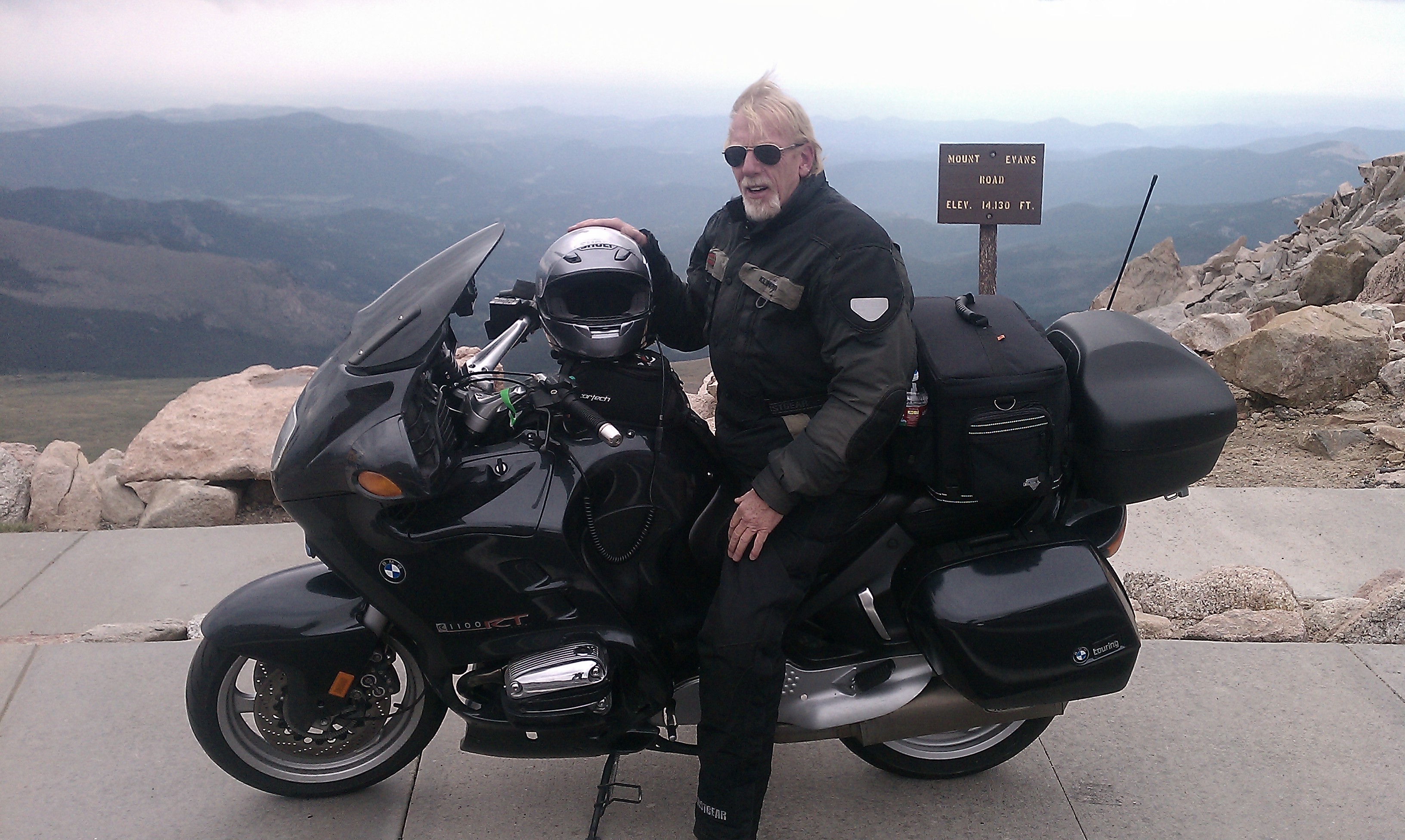
- Scott’s skill on his BMW set the standard for great riding.
With temps in the upper 30s and wind blowing steadily on numb fingers and cold cheeks, we stayed long enough to capture a few pictures, take a lasting look at the rugged and awesome Rockies from one of their highest peaks, and headed down. A couple of us spotted our first mountain goats (we had already seen big horn sheep) of the trip near the top of the peak just before the first hairpin on the way down.
Down was the easier direction, except that for much of the downward trip the right lane hugged the edge of the drop-off and parts of the road had, in fact, dropped off. (The Park Service did, however, mark the road collapses with cute little orange cones, which would have been of little help keeping us on the road had we had veered a foot or two closer to the edge.) I believe Brian referred to this stretch as the “White-Knuckle, Butt-Cheek-Pucker Highway,” though most of us found the views inspiring and uplifting. All depends on perspective, I guess.
Back down at the 10,500 foot level, we rewarded ourselves with lunch. I, naturally, had cherry pie and coffee as a tribute to my pie-laden Ride West. Pie is a good lunch at any elevation.
For the rest of the day, until we reached Westminster and our hotel, we rode at a fairly aggressive pace through the remaining mountains and foothills, when traffic allowed, despite suiting up once again for the afternoon rain that seems to be an indispensable part of the August Rocky Mountain experience. But the quick pace was a mixed bag. On one hand, the adrenaline-producing exhilaration of diving hard into a turn was hard to resist. On the other hand, we knew in our hearts that the faster we rode, the faster our time in the mountains would end. And we didn’t want it to end.
I said this was a day of high points. Clearly, Mount Evans was the highest elevation of our trip and thus a “high point.”
But another, and for me, more meaningful high point of this trip was being part of the Twisted Riders. Steve, Curt, Gary, Dennis, Brad, Scott, Ron, Brian and Kevin have in many ways over the last six days made me a better motorcycle rider. I wrote in the first blog of the Ride West that I expected to make new friends. I have. I’m very appreciative of their friendship and their willingness to include me as one of the band of Twisted Riders. It’s been a great ride, a great experience and a great adventure. Thanks guys. I look forward to many more miles and many more laughs.
Extra Note: On our first day of the Twisted Riders adventure in Colorado, I noted the hot air balloon send off. Tonight when we arrived safe yet weary back at our starting point, the kind folks of Colorado had apparently arranged for an impressive airshow as an F-18 went through its gravity-defying paces, aerobatic planes danced in the sky, and formations of planes trailed a smoky “Welcome Back” salute in the skies over Westminster. The Welcome Back was finished off with a pyrotechnic display that dramatically lit the sky after dark. This state is REALLY bike friendly. (On the other hand, it’s possible that the airshow MIGHT have been planned without any knowledge of the Twisted Riders’ presence in the Rocky Mountain State and that it was just a coincidence. You be the judge.)
Tomorrow: We all head east. I will split off at Salina, Kansas, to visit family in Wichita and keep an eye on tropical storm/hurricane Issac headed for Florida. I will offer a summary of the Ride West in the next day or two on this blog and I hope you’ll check back for that. Please feel free to leave comments about what you think of a bearded wild man who flees West to eat pie at unexpected times and terrify local wildlife by roaring through their world on a tw0-wheeled roaring steed.
Thanks, everyone, for letting me share the Ride West.
Ride West: Day 22 to Breckenridge
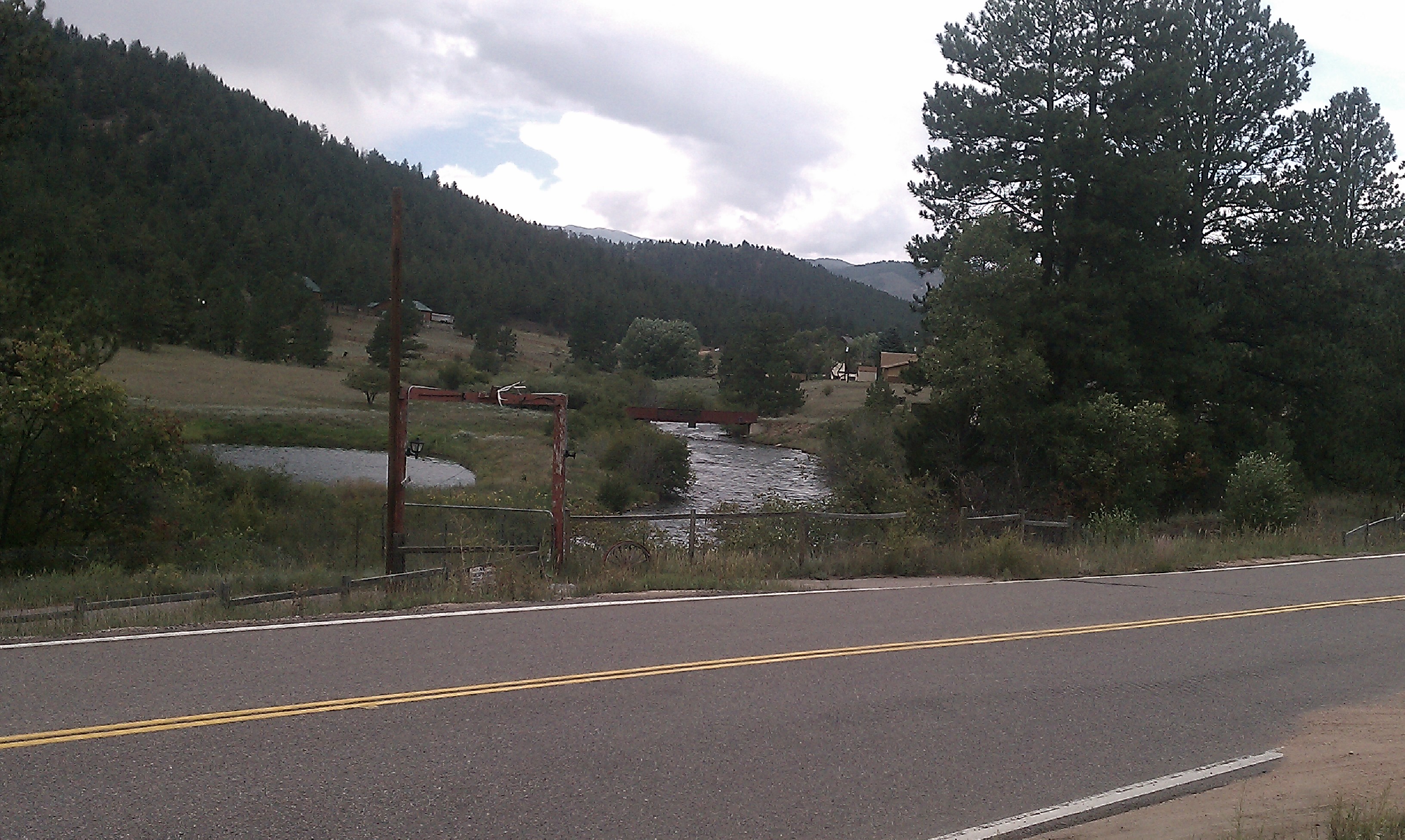
Typical of much of the country we rode through today.
If you’re looking for more pictures of Colorado’s geologic wonders or tourist Meccas, you can stop now. There won’t be any in today’s blog. Because today was not about sight-seeing. It was about riding. Motorcycle riding. Of course we saw mountains. I mean, we are in Colorado. We saw beautiful countryside, rich farmland, national forests, the scars left by a forest fire and a llama ranch. And we ended up in Breckenridge, which is a tourist destination of the highest order for summer hikers, winter skiers and shoppers of kitsch and “I Went to Breckenridge” t-shirts in all seasons
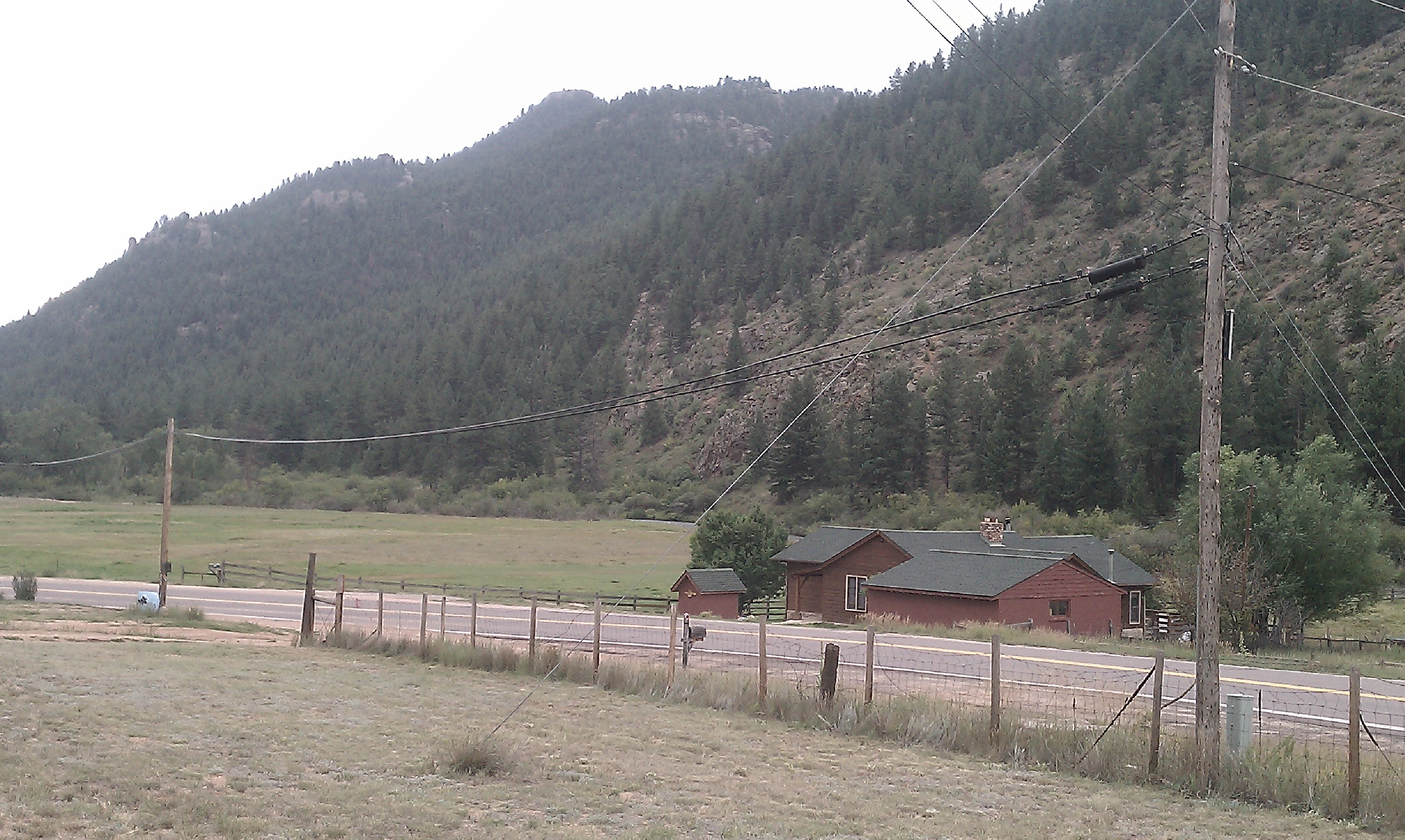
Typical of much of the country we rode through today.
Months ago, Kevin Rasmussen, one of the Twisted Riders, had carefully plotted today’s route, studying maps and scouring various forums for advice on which area roads would guarantee a challenging ride. Good job, Kevin. Without trying to re-create the route, suffice it to say that we rode a good mixture of US highways (50 and 285) State Highways (9) and several well-maintained hidden gem county roads that offered some of the best riding of the day. From broad sweepers to 180 degree hairpins, these county roads provided just the challenge these skilled riders were looking for.
Not all the roads were twisties, of course, and when we ran on straight roads we generally cruised at the posted speed limit (well, maybe slightly above). But once we hit the twisties all the riders knew the time had come for five or ten minutes of quick, throttle-twisting riding up, down, and around the mostly small mountains, leaning hard into the curves, straightening the bike back up, then racing along a short straight stretch before gently tapping the brakes and leaning hard again into the next curve. To the Twisted Riders, this is “pace” riding and it’s why they ride. When a mountain or valley had been conquered, we settled down to a more acceptable speed until the next challenge sent us careening through rock-wall-hugging curves once again.
Several of the Twisted Riders told me that today’s ride was more like their normal rides, which often occur in the mountains of West Virginia, Virginia and North Carolina. For them, it’s generally the road and not the sights that bring them to an area to ride. However, I must admit that they, riding almost effortlessly, found time to casually comment about the beauty of some of the mountains we passed or crystal clear streams we followed while I, on the other hand, with the pucker factor fully engaged, was focused intently on keeping the motorcycle in front of me in sight and staying in the 12 foot zone delineated by the white line to my right and the yellow line to my left. Pace riding with the Twisted Riders is challenging, exhilarating and life affirming. Hell, it’s just great fun.
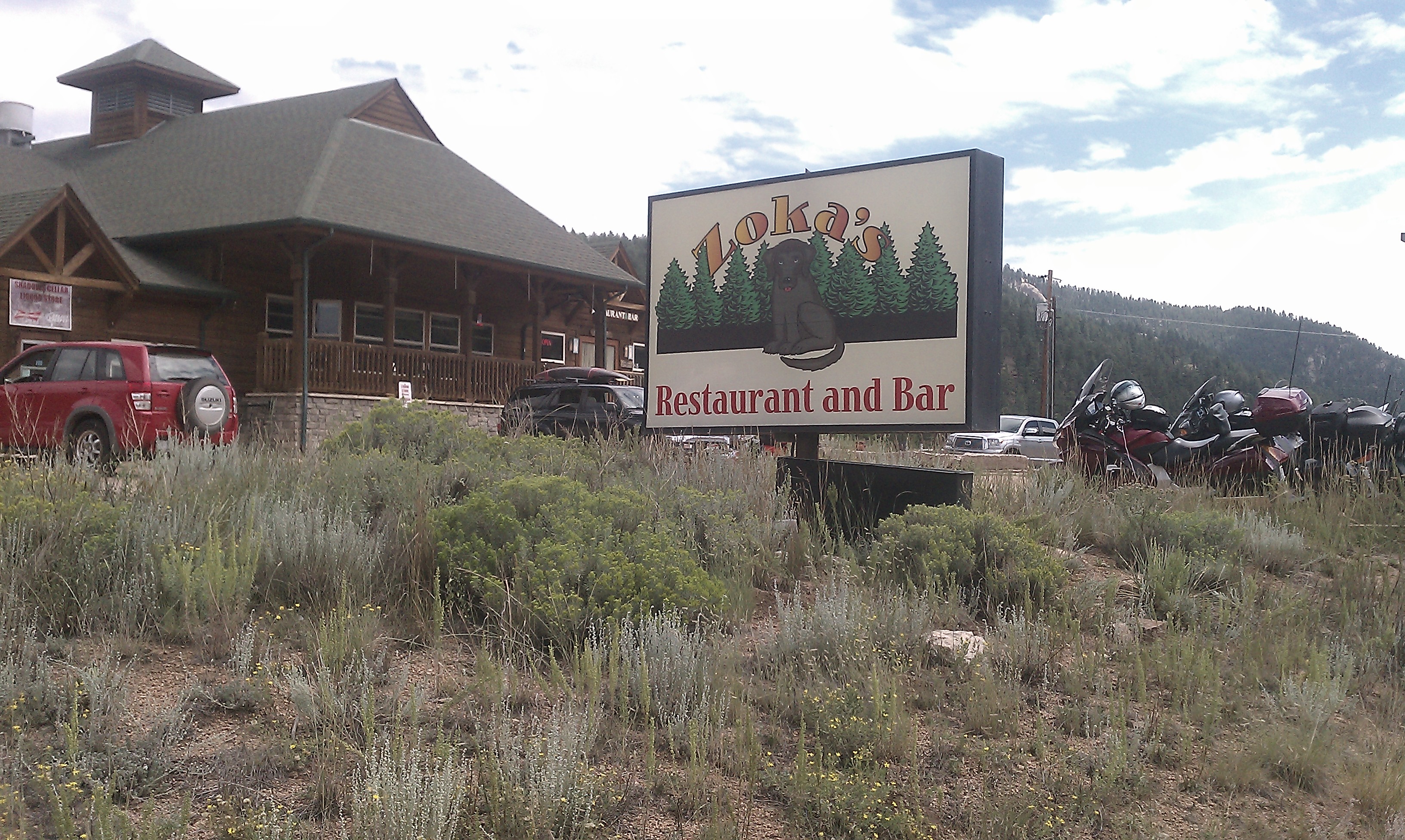 Relying on a friend’s advice, Kevin took us to Zoka’s Restaurant and Bar in Pine, Colorado, far from the beaten path on Country Road 126 in Jefferson County.
 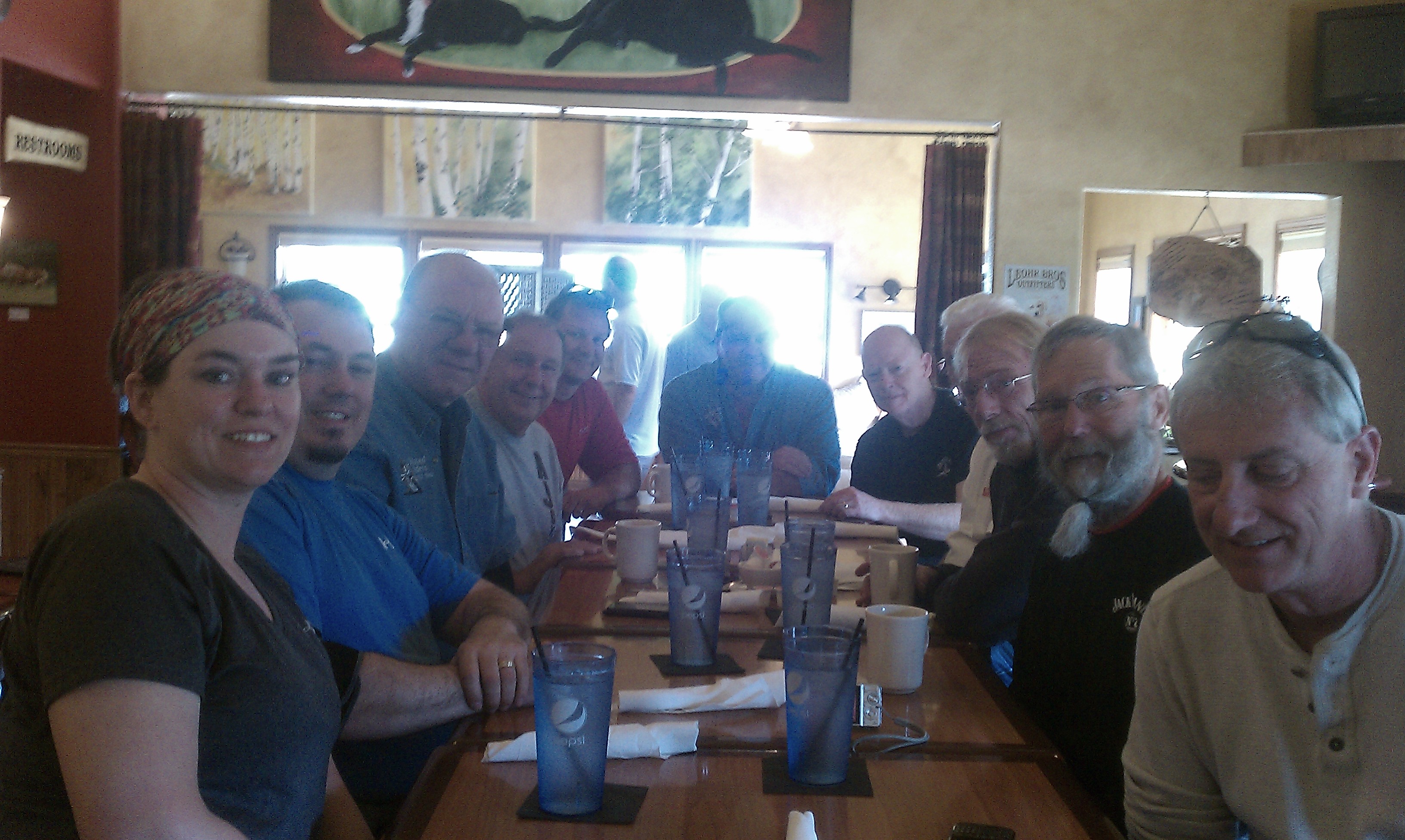 Run by a husband and wife and a professional chef, they make all their own sauces, smoke all of their own meats, and even brine their own corned beef for their outstanding Rueben sandwiches. The service was attentive and quick and the owners gracious and helpful. It was a perfect lunch stop on a great riding day.
The weather for the morning ride, which began at 8:30, was cloudy and cool but no rain, even though we could frequently see sheets of water shroud distant mountain peaks in sheets of gray-white mist. After lunch, that changed, and the rain, which seemed to be all around us, kept coming closer and closer. We thought for a while we might be able to carve a path through the isolated mountain storms to Breckenridge, but at a gas stop in Fairplay, only 25 miles from our destination, we were forced to once again climb into protective rain gear for the final ride up to and over the 11,500 foot Hoosier Pass. The higher we climbed, the more intense the rainfall, and by the time we reached the summit, we had ridden through the hardest rain we had seen all week. Shortly after cresting the pass, though, the rain slacked off and almost stopped and all we had to contend with was wet, slick hairpin turns as we descended 2,000 feet to the collection of t-shirt shops and sporting goods stores known as Breckenridge.
As we checked in at the old but comfortable Wayside Inn, there were smiles all round from Twisted Riders who knew they had done what they love to do best: Ride hard with good friends.
Tomorrow: An assault on Mt. Evans should be in the cards.
Ride West: Day 21 To Salida
How much fun can you squeeze into 11 hours of motorcycle riding? A lot. Even when several of those hours include riding in the rain at 47 degrees along a mountain pass where the outside edge of the road on which a white line should be painted has crumbled into the canyon 5oo feet below.
Yes, it was 11 hours plus a few minutes from the time we pulled out of our Grand Junction motel until we rolled in to the motel parking lot in Salida, still exhilarated from our ascent and decent of Monarch Pass (elevation 11, 300 feet) on US highway 50. I’m not sure if it was because we were anxious to get to Salida or everyone just wanted a chance to let it out after proceeding cautiously in the rain earlier, but the summit ride was done at “pace” (i.e. considerably faster than the local gendarmes would allow if they had witnessed our nefarious motoring activity).
Back to the beginning. Of the day. The first 60 miles was an easy ride down a relatively straight US highway 50 flanked by dun colored mesas on our right and gray mountains on our left. This was ranching country in the valley between the two geologic uplifts and cattle, horses, and the occasional cowboy and cowgirl watched us with little interest as we motored steadily south.
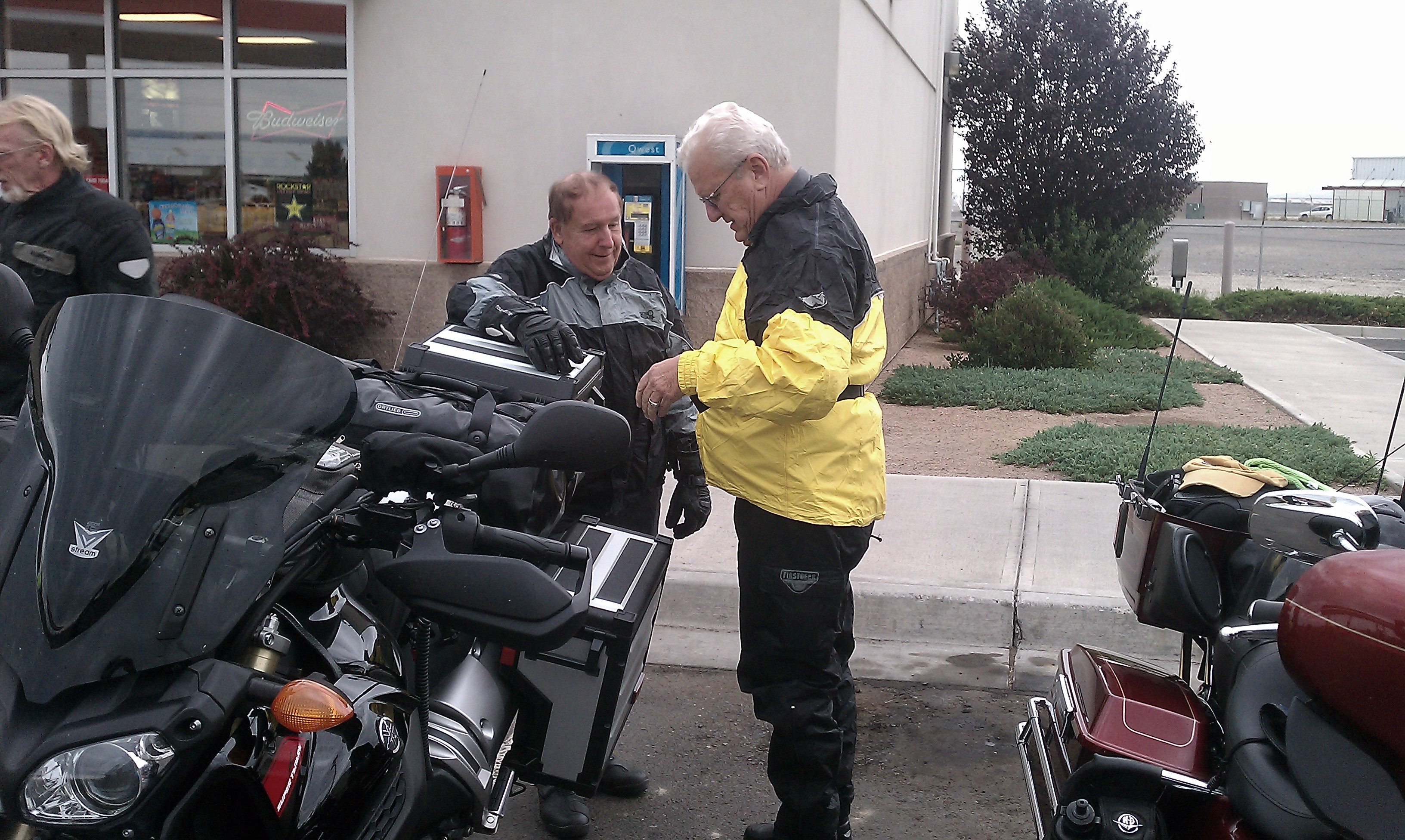
Gearing up for rain
As we passed through Delta again and on to Montrose, the gray skies under which we had been riding were turning darker and the occasional raindrop was becoming more common. We dug into our packs and attired ourselves in rain gear as a precaution. Good thing, because we were headed south on the “Million Dollar Highway” (aka US Route 550) and precautions there are a must.
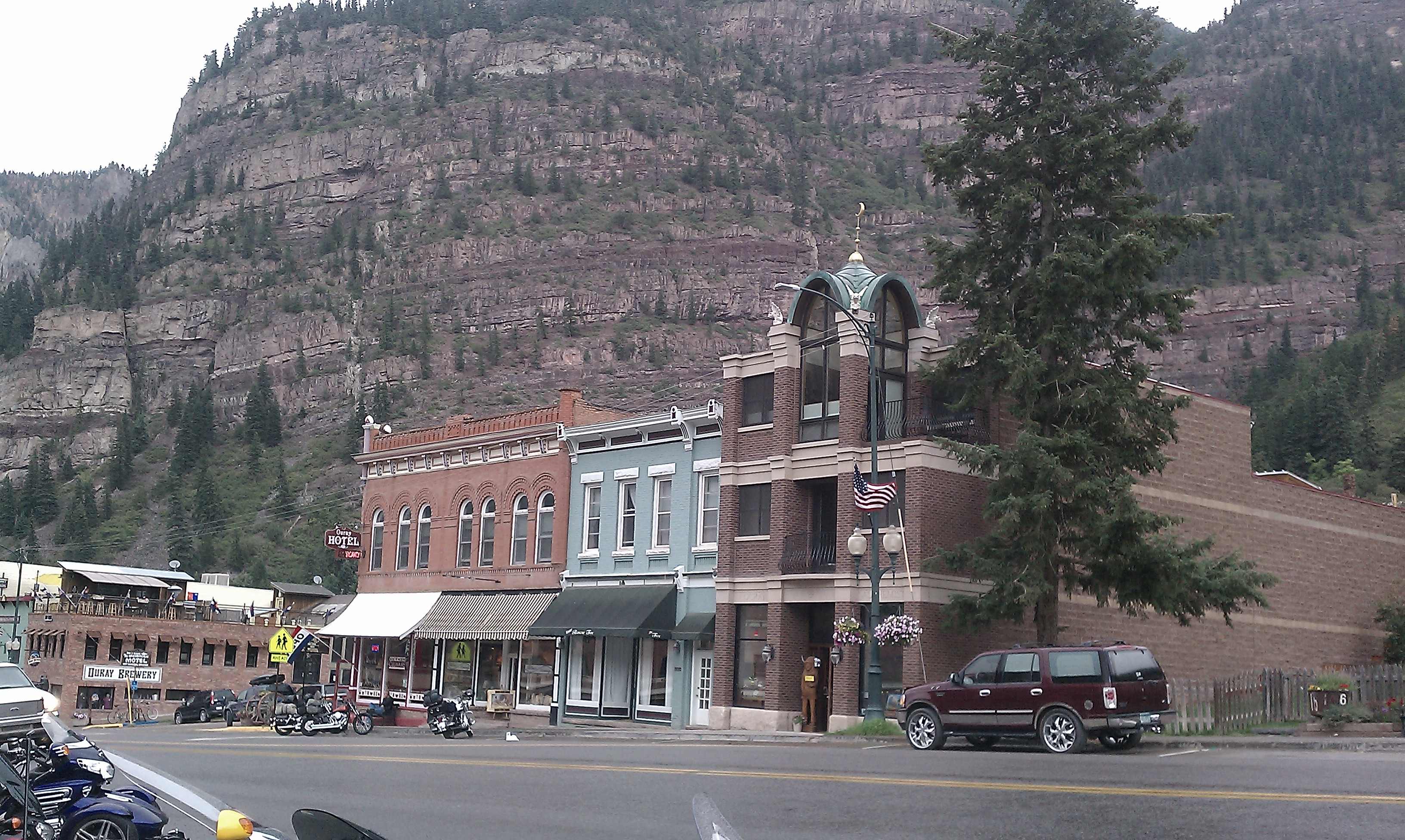
Ouray’s main street
By the time we got to the novel town of Ourey, we had been in and out of light rain several times, so we stopped to take a look around and to prepare ourselves for the assault on the looming mountains. Boasting 1,000 happy citizens, Ourey is an interesting little town with lots of shops, including candy stores which are open early in the morning and which sell tasty hard candy and delicious almond and pistachio chocolate covered toffee which sticks to your teeth and makes you wish you had a good cup of strong coffee to wash it down and melt it off your teeth and warm you up a little bit if its 52 degrees and sprinkling. But I digress; this is about motorcyle riding.
Immediately on leaving Ourey on US Route 550 and climbing several hundred feet, an awesome view of the town and the surrounding colorful crags offers itself, but we could only glance for a second or two because the rapidly rising and twisting highway demanded our full attention. Ouray sits at about 7,800 feet and we were about to climb more than 3,000 feet to the Red Mountain Pass over a road that requires constant attention from highway maintenance crews. The Million Dollar Highway has an inopportune habit of collapsing in chunks large and small to the valley below. The mountain on which the road was constructed responds like all things to the law of gravity and the second law of thermodynamics and has a tendency to seek a lower level, even if there is a highway in the way. Indeed, as we rode through, two separate road crews were responding to the collapsing road, shoring it up, even if only temporarily.
The view from the Million Dollar Highway (named for its cost per mile), for those who chose to look at something other than the road, was stupendous. Huge, soaring, steep-sided, red and salmon-colored mountains, flush with verdant conifers, rise above and a rushing, cascading, russet-colored stream flows below. It’s views like this that bring flatlanders like us to Colorado and that cause us to say repeatedly: “Holy crap. Did you see that? Wow!”
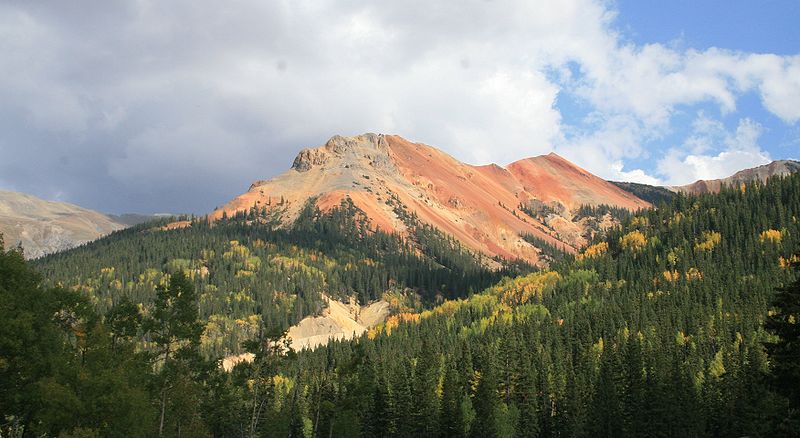
This picture of one the Red Mountains was ripped off from another website.
Red Mountain Pass is named for several red mountains (duh!) that dominate the skyline and which were and are the site of mining activity due to their high iron content. Even in the dull light of a rainy August morning, the red mountains make us, for a second, take our eyes off the road and wonder if we’re seeing something unnatural in nature. They were, in short, hypnotically beautiful. But we see them only for a second because the race down the other side of the pass toward Silverton is on and the 10 mph and 15 mph wet hairpin turns on the mountain sides once again focus our attention on the ride. Chasing down the mountain, we emerged, finally, in Silverton, frazzled yet stimulated and ready for lunch.

Steve and Blaze
Lunch is always a big part of each day’s ride. Today’s location had been visited recently by Guy Fiere of Drive-ins, Diners and Dives fame and seemed like a good bet for good food. Thee Pitts Again BBQ joint’s bright pink exterior and it’s equally bright pink delivery truck caught our eye and the choice was not regretted by anyone. Great food, and great service from 11-year old “Blaze” who’s probably the hardest working 11-year old in Silverton. We didn’t ask why he wasn’t in school as he hustled to and from the kitchen bringing trays of barbecue, chili and cornbread.
With barbecue sauce dripping from our thankful lips, we dressed again in our cold-weather and rain gear for the ride back north on Route 550 in the 47 degree light rain. The trip back was, of course, similar to the trip over. Great views for those who cared and wet, slick roads for everyone. This trip through Ouray resulted in only a 60-second stop for a brief costume change and then back to Montrose and Highway 50.
Fortunately, as went north the rain abated and the sun tried desperately and sometimes successfully to break through the hoovering clouds to warm us up. I say fortunately because the next leg of our trip involved the Black Canyon of the Gunnison, which we probably would have skipped if the chilling precipitation had continued.
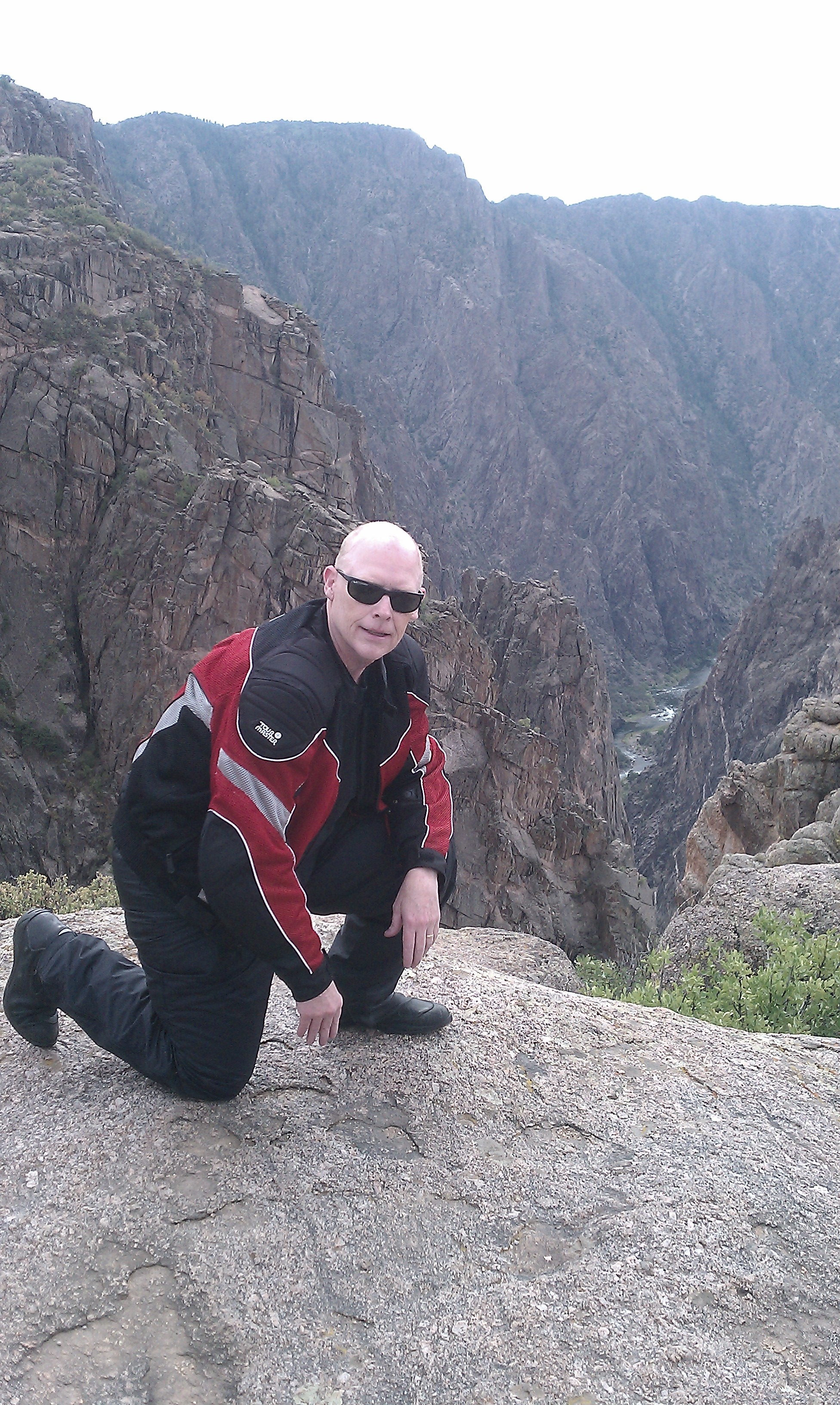
Brad Dykes, my Twisted Rider roommate, atop the Black Canyon of the Gunnison
The Black Canyon of the Gunnison, about 20 miles east and north of Montrose, is a sheer-walled canyon carved by the Gunnison River over tens of millions of years as the geology of the area went through dramatic changes. Most significant for tourists such as us, was the chance to view the largest cliff face in Colorado at 2,300 feet. As the National Park Service interpretive sign at the site informed us, you could stack two Empire State Buildings in the canyon and they still wouldn’t reach the top of the canyon. We toured the top of the canyon, breathlessly taking in several breath-taking views, and then took another road (less traveled?) which led to the bottom of the canyon in a switch-back filled, three mile decent that, as the WARNING signs said, had a 16 percent grade. Next time you’re on a road and a sign warns of a 7 or 8 or 9 percent grade, you may get a sense of how steep this road was. All of crept down the road in first or second gear and the flash of brake lights was commonplace on the trip down. The trip up the canyon road was a little more fun as we put our bikes through their paces on a tough course.
Safely out of the canyon, we headed for Salida. You’ve already read the highlight of that Monarch Pass leg in the second paragraph of today’s blog, so I’m done. And tired.
Tomorrow: Hmmm. Let’s see. How about more mountain roads with an ending in Breckenridge.
Ride West: Day 20 To Grand Junction
Occasionally on an adventure such as this a day unfolds like a multi-course meal at a fine restaurant. Today was one of those rare days.
We started with an appetizer that took us a brief distance up the aptly-named Frying Pan Road. An appetizer should pique one’s interest but not fill one up. This ride did that. We only went a few miles up the road, which followed the stream that ran behind our hotel, and then turned around and came back to our starting point. A couple of easy curves, some nice scenic views of impressive rock formations and one gorgeous look at a mountain in the distance. But it was a tasty beginning to the day’s menu.
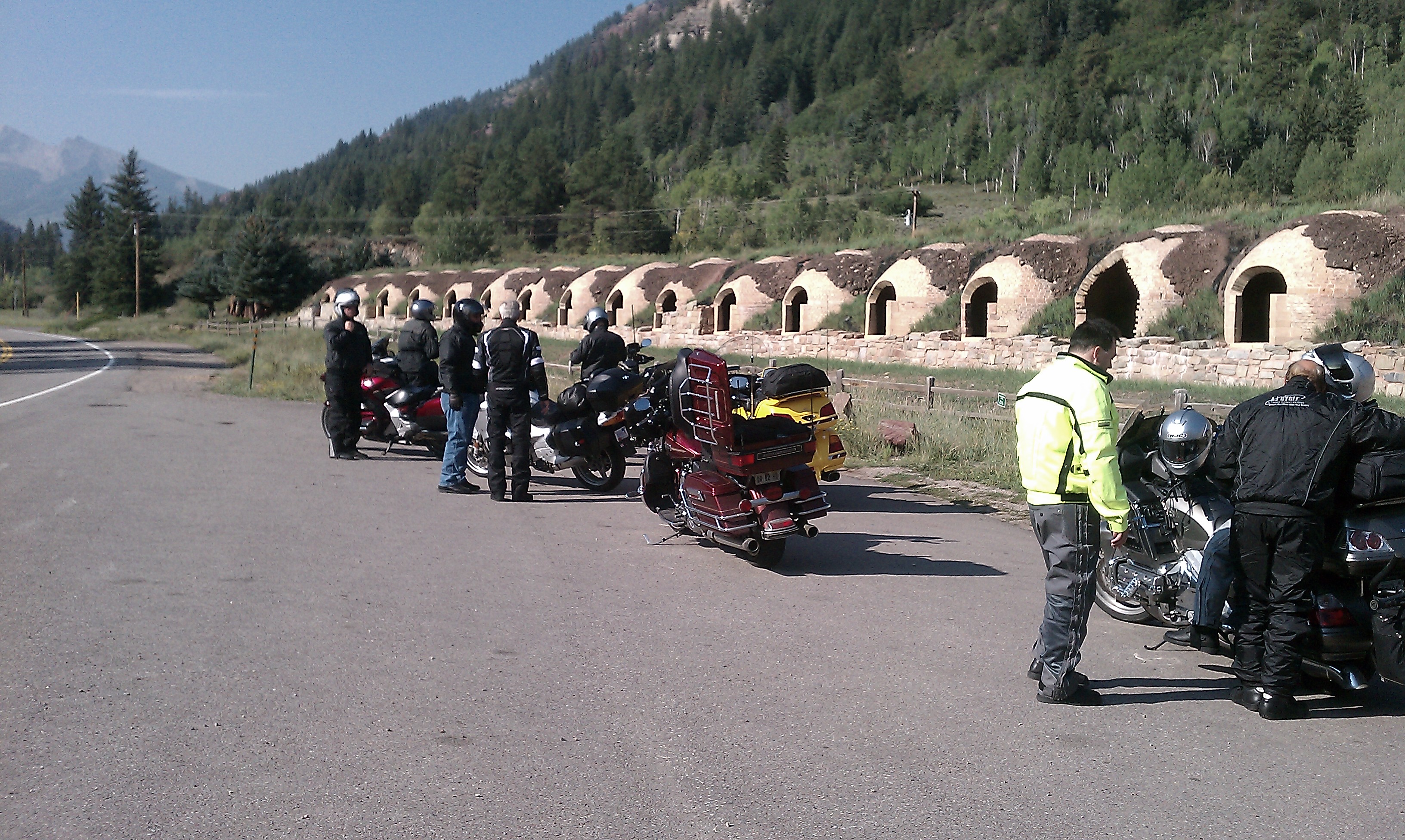
Historic Redstone Coke Ovens
For our next course, a salad perhaps, we rode west on Colorado Highway 82 along a valley filled with mountains rising on either side of us, funneling us toward Colorado Highway 133, where we banked south. Pulling over to stop for a clothing change to accommodate rising elevation and dropping temperatures, we found ourselves at the historic Redstone Coke Ovens, which are currently being restored. Dating back to the late 19th century these ovens converted bituminous coal to coke for use in smelting iron in foundries. Redstone had, in fact, been created as a company town by the owner of the coal mines and the coke ovens.
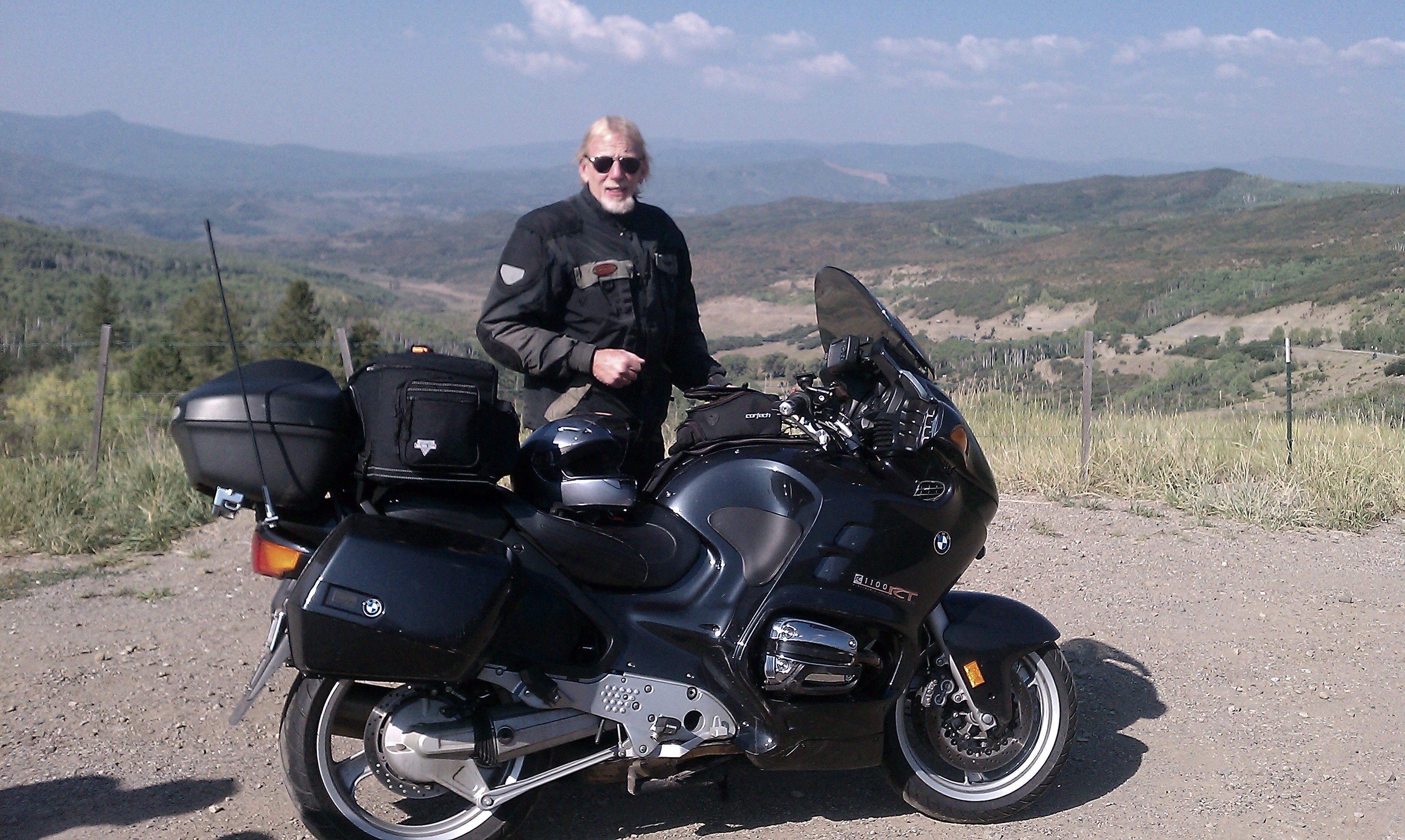
Scott Williams near McClure Pass
Continuing southwest with massive mountains poking their treeless tops into the clouds, we crested Highway 133 at McClure Pass (elevation 8,500 feet) and began a descent that ended in Hotchkiss and a trip to the Cowboy Collectibles store, which turned out to be both a tack and saddle store and a collection of artistic cowboy items, including a beautiful, hand-tooled saddle.
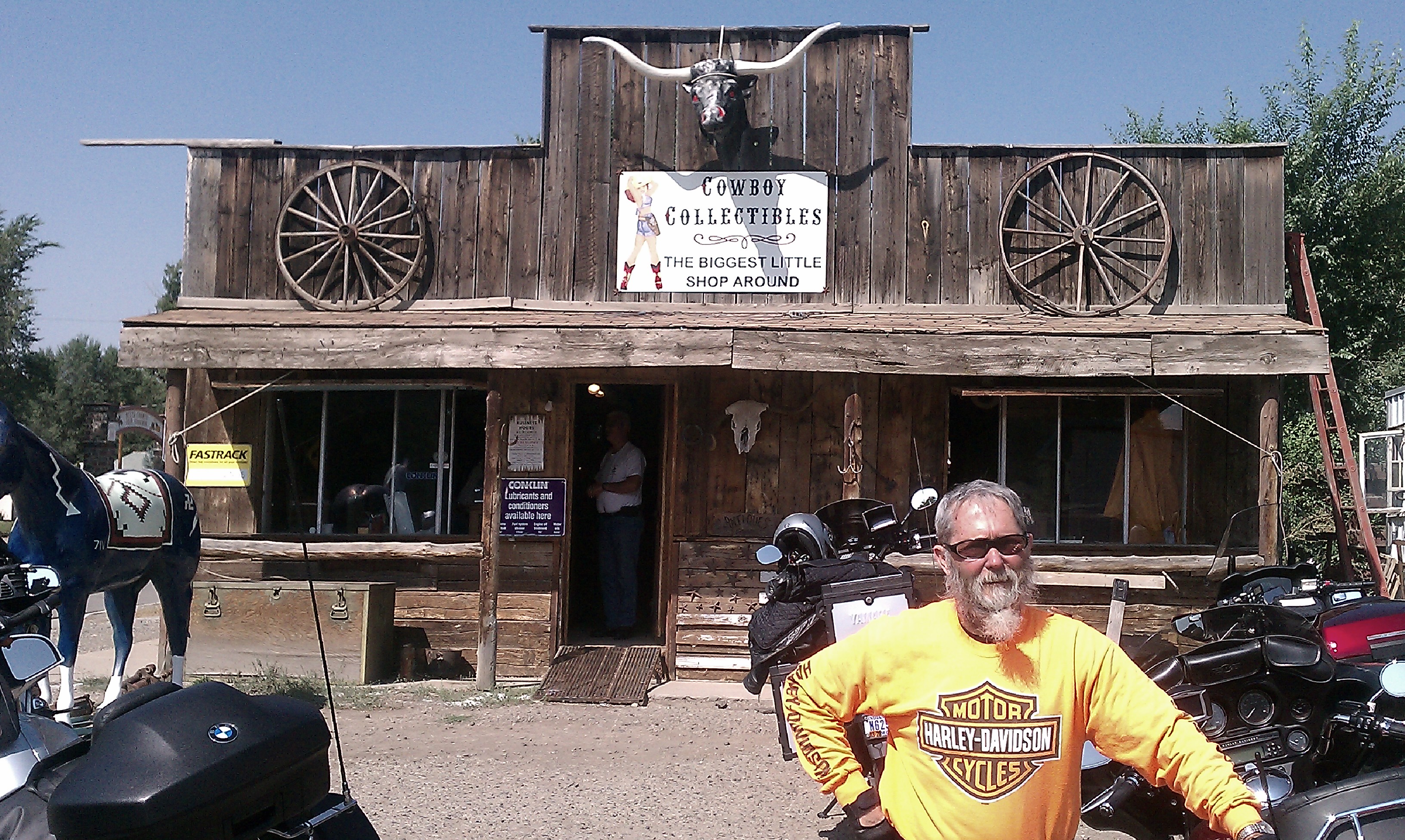
At Cowboy Collectables
Hotchkiss sits at a little over 5,000 feet and between there and Delta where we stopped for lunch at Wilson’s Barbeque and Beans, the countryside is dominated by orchards, wineries, and farming operations of many varieties. But the area also contains desert-like landscapes where nothing green met the searching eye. At less than 5,000 feet elevation, Delta was the lowest point on the Twisted Riders trip since we left Denver.
And now for the main course. Backtracking slightly after lunch at Delta we headed north on Colorado Highway 65, climbing steadily through the Grand Mesa National Forest to more than 11,000 feet. The Grand Mesa, bordered by the Colorado River to the north and the Gunnison River to the South, is a rugged, forested table-land that, at its edges, offers spectacular view of the valleys below, whether looking to the south back toward Delta or to the west toward Grand Junction.
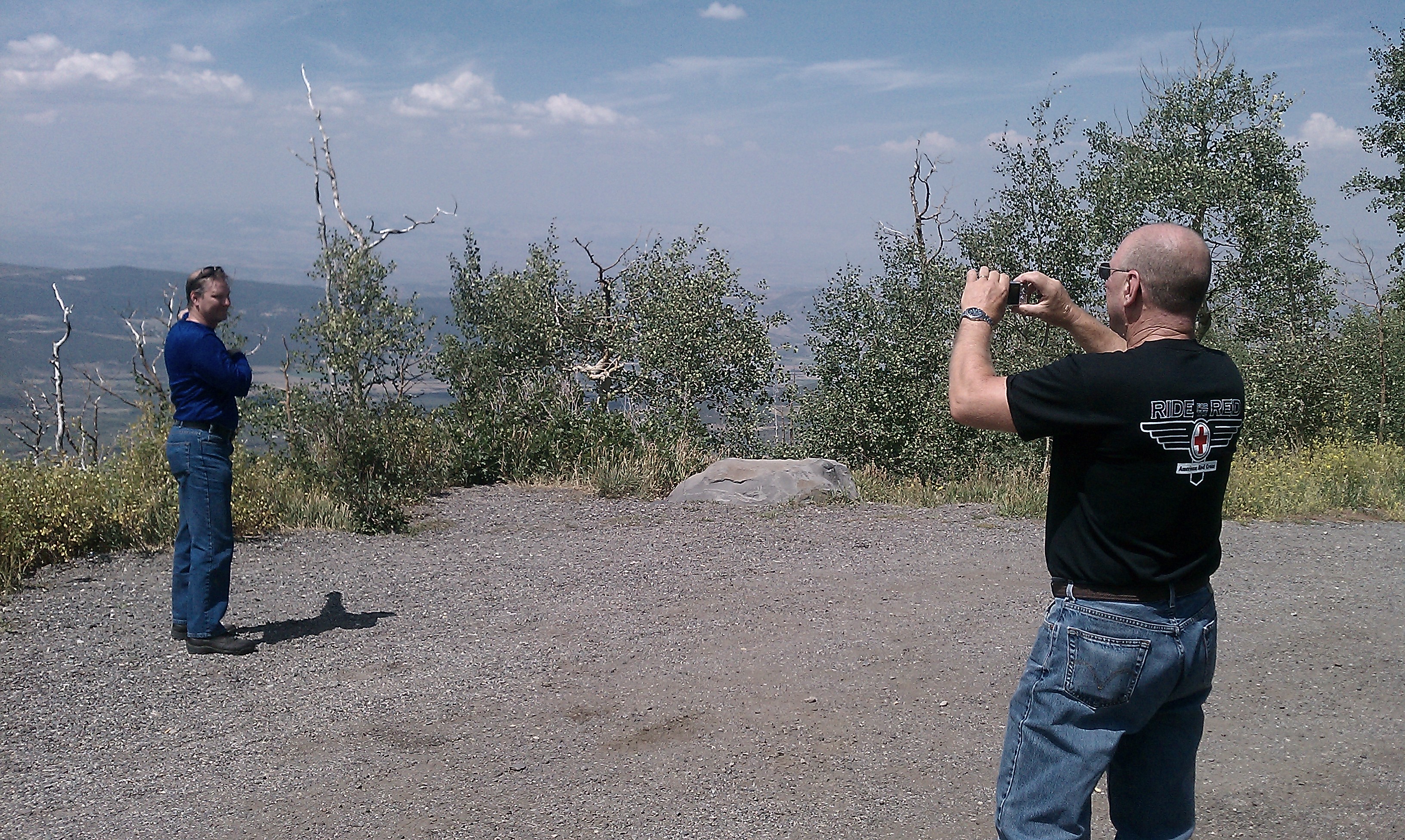
Steve shoots Brian on the Grand Mesa
Even from the top of the mesa, however, the mountains to the north towered above our position. The ride up and down the mesa was exhilarating, as all climbs and descents are, and the winding roads through the forest added their share of excitement. Once down from the mesa, it wasn’t far to Interstate 70 and Grand Junction and our hotel.
But the meal wasn’t over. We required dessert. And for dessert, we chose the Colorado National Monument, the same ride Jon and I took on Day 11of the Ride West. Brad Dykes, my roommate for this week, had been to the Monument several times before and both he and I tried to prepare the others for the treat that awaited their palates.
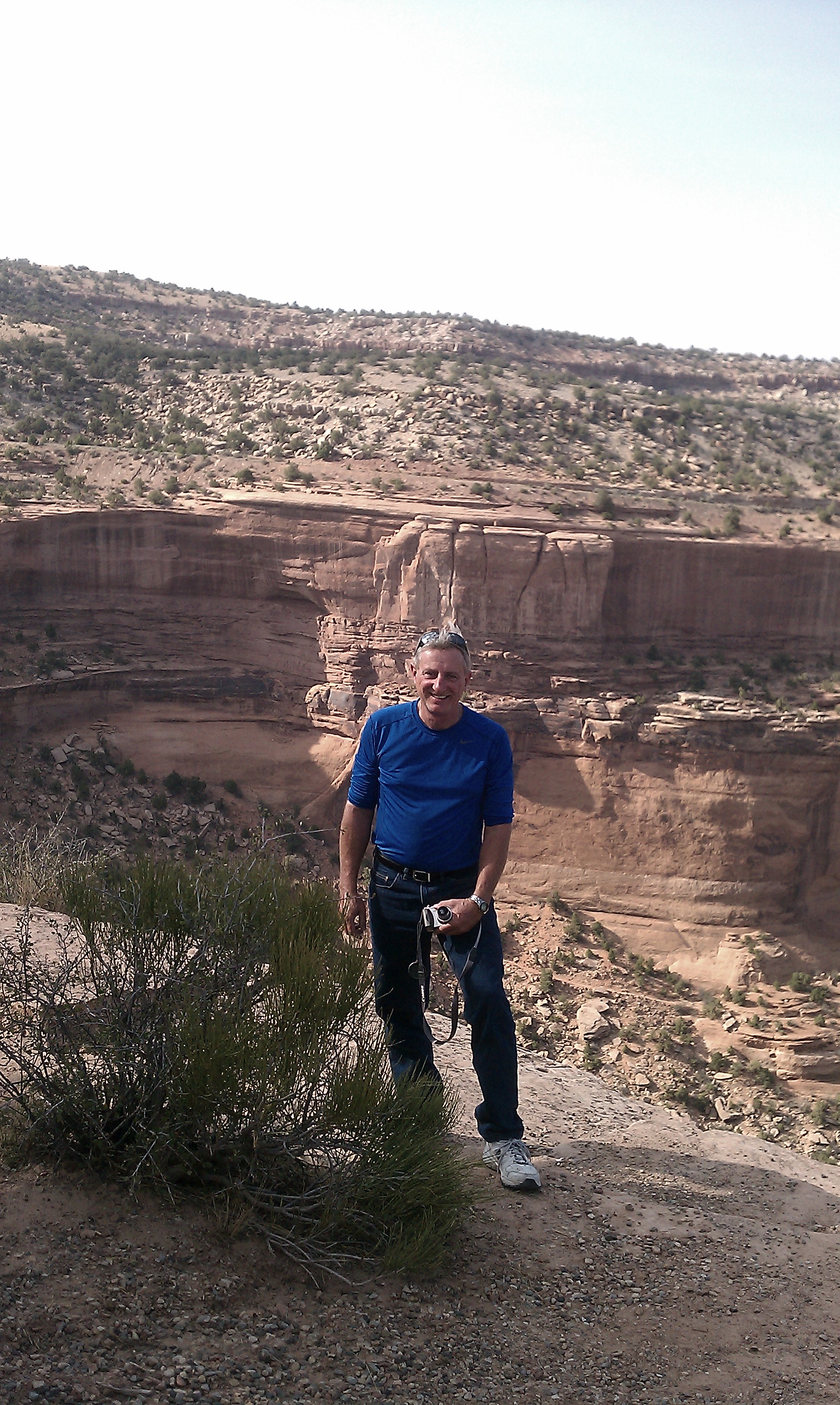
Gary Metzger at the edge of a canyon at Colorado National Monument.
But they were still surprised by the awesome views of the multiple, shear-sided, red-walled canyons that awaited at the top of the Monument and by the 24 miles of twisting road that hugged the precipitous drop to the canyon floor below. The most common comment was: “Wow!” It was, I think a great way to end today’s moveable feast.
Tomorrow: More Colorado Wonders to our south and east
Ride West: Day 19 To Basalt
Cloudy skies loomed overhead as we packed this morning and prepared for a 250 mile jaunt through Colorado’s bike-friendly mountainous terrain. But the ride would have to wait until we first visited the Glory Hole. Few things could possibly start a day off with greater promise than an early visit to the Glory Hole. From the outside, the Glory Hole may not look like much, but once you’re in the Glory Hole it’s a different story.
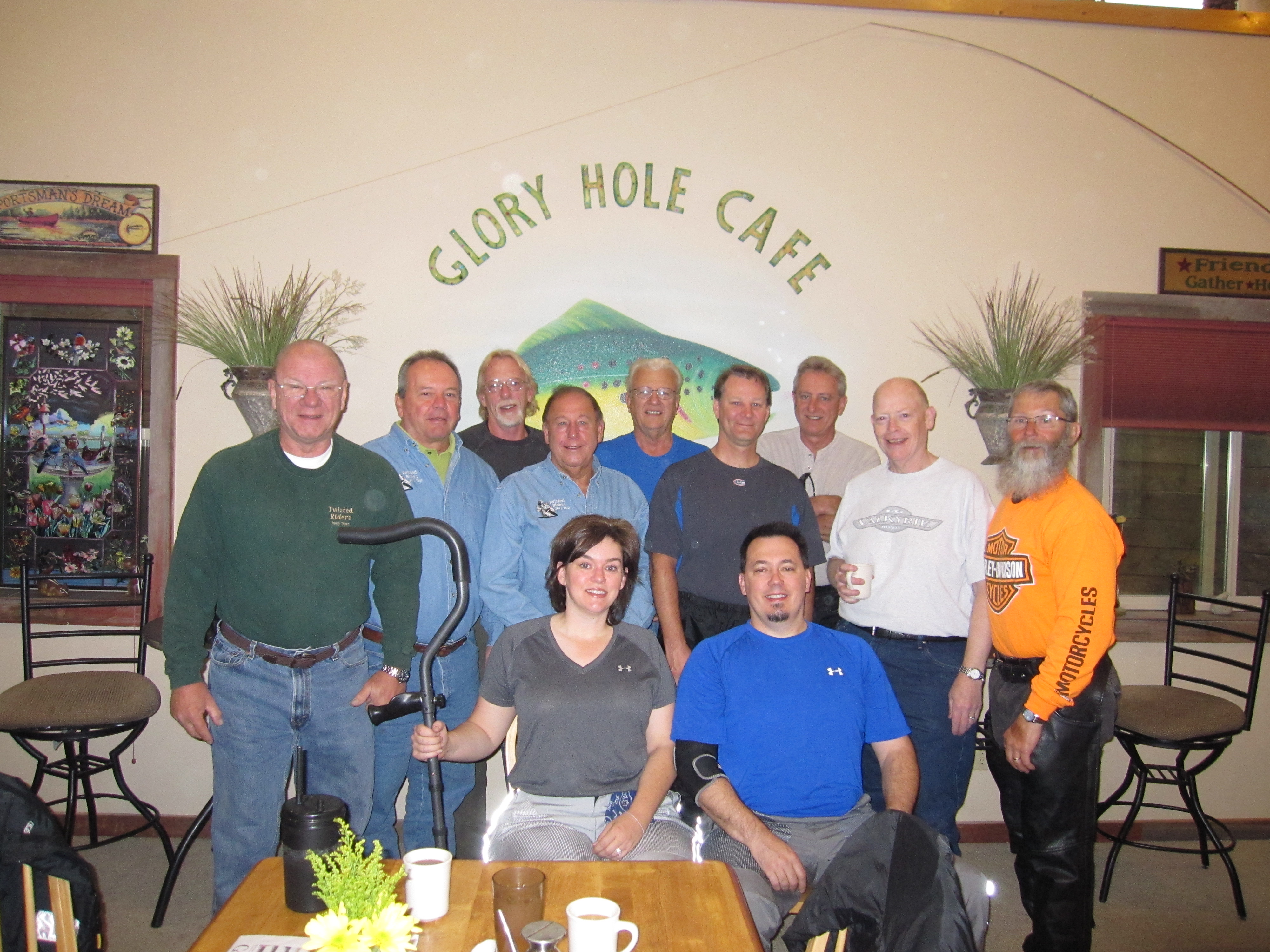
Twisted patrons of the Glory Hole
The Glory Hole, as some of you have guessed (and the rest of you have dirty minds) is a restaurant in Hot Sulfur Springs with great food, better service and a fascinating fishing/outdoors motif. Everyone filled up on omelets, biscuits and gravy and “really good” French Toast. Now we were ready to ride.
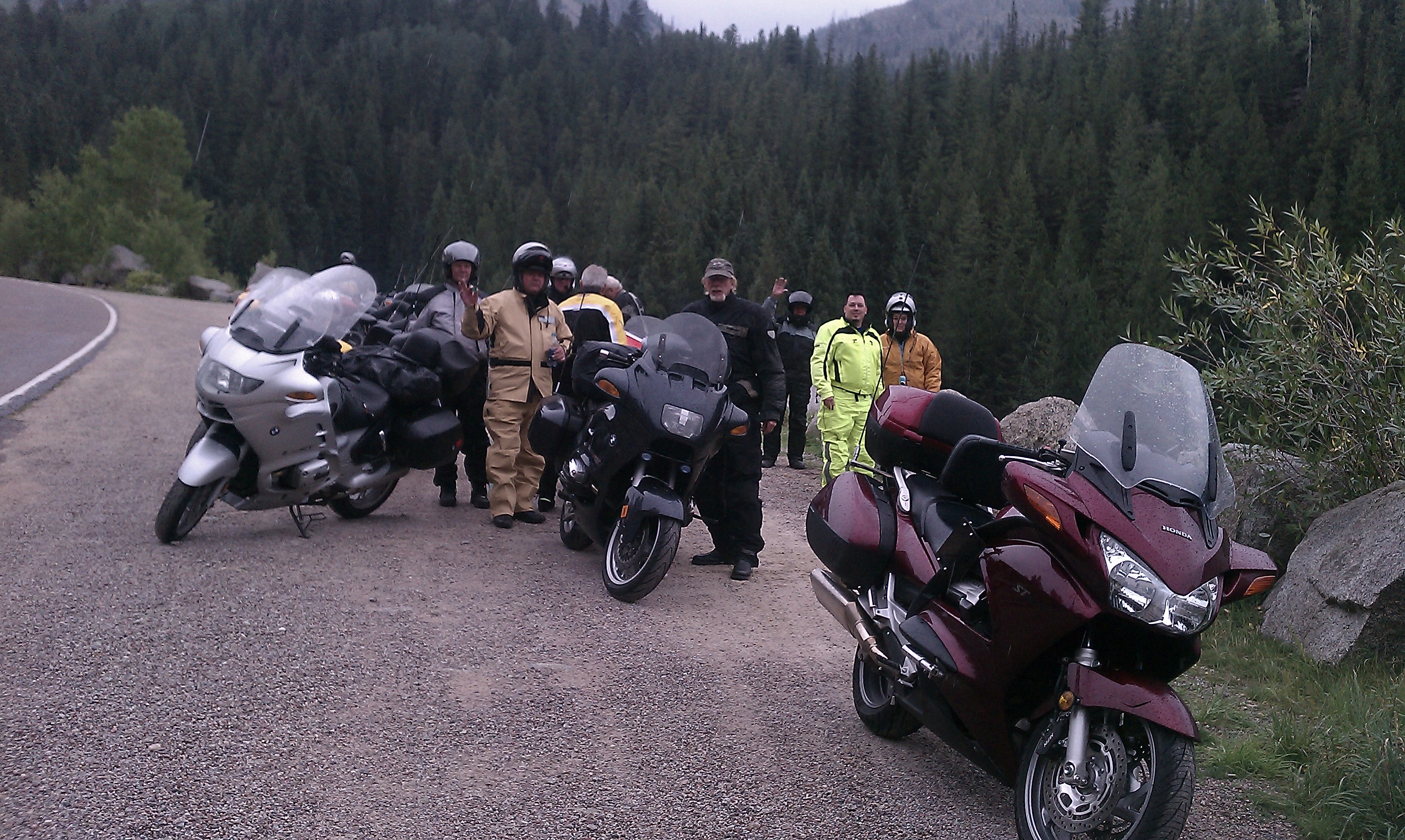 We headed west along gently twisting US 40 to Kremmling at a solid but not overly aggressive pace. Soon after passing Kremmling, we had our first splatter of moisture as a cold, misty rain began falling lightly, a condition that dogged us for most of the rest of the day. Whether the temperatures were in the upper 50s or, more often, in the mid to low 40s, we ascended and descended various mountains roads along our path.
After a brief sprint east on a rainy I-70, we shot south on US 24 and climbed steeply to Leadville whose lofty position at more than 10,000 feet makes it the highest incorporated municipality in the United States. Lunch at Leadville at a cafe was good, but the highlight was being served by a waitress from Nebraska whose previous job had been as a police officer in Leadville, a job which lasted until she got her face smashed in breaking up a bar fight and then found little solace or support from her colleagues on the force. We’re glad she left law enforcement because she was a great waitress.
From Leadville to Aspen and then to Basalt, our cold and soggy route took us up the precipitous incline to Independence Pass at slightly more than 12,000 feet. The trip to the top was breathtaking, for those who cared to take their eyes off the slick and winding road and look over the side to the stream-carved valley several thousand feet below.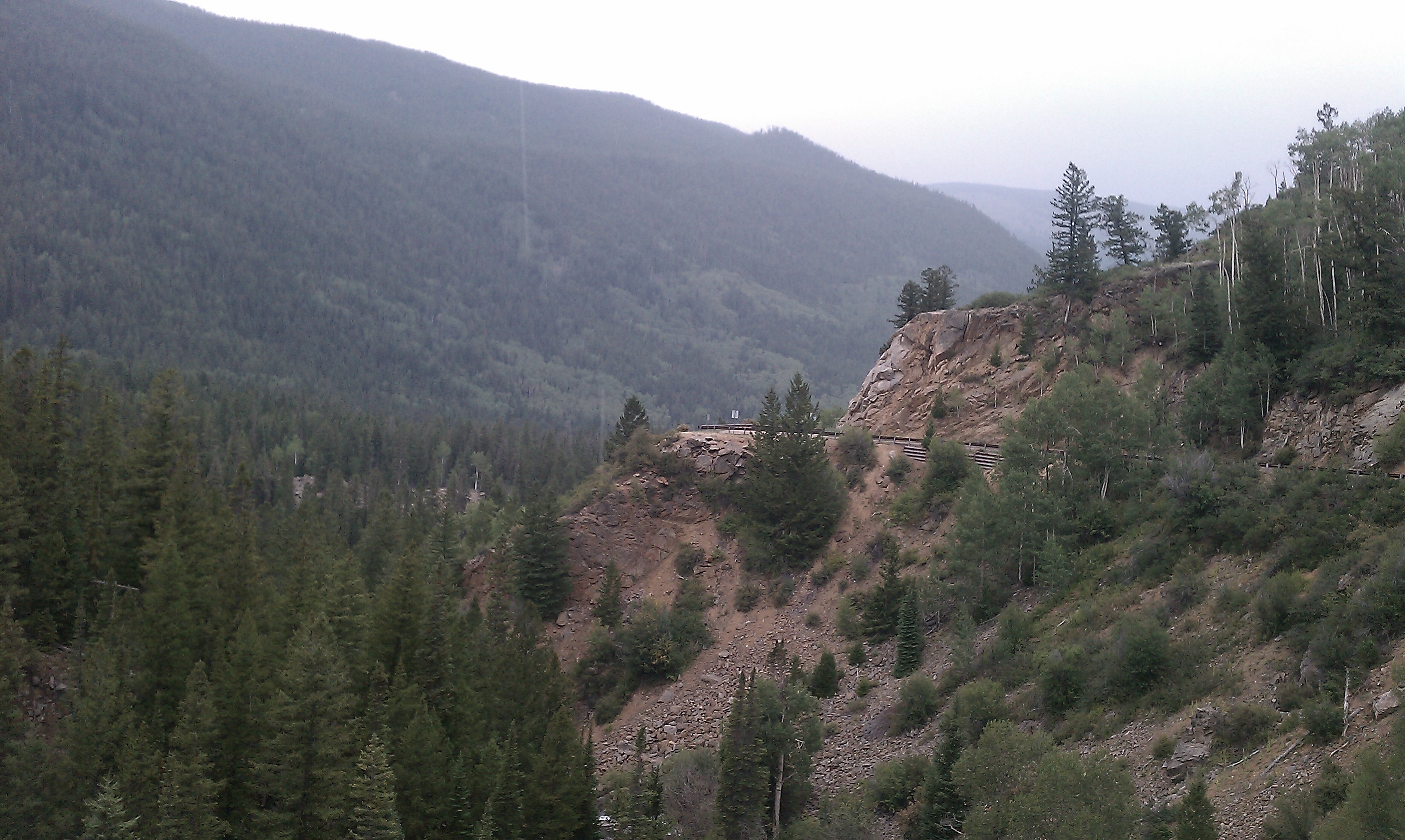 It was raining at the top and we didn’t pause for pictures, but during a near-break in the constant drizzle that was only about 10 degrees shy of solidity we paused long enough to take in the rain-soaked beauty that surrounded us on today’s ride.
Passing through Aspen the clouds finally parted–hallelujah–and by the time we got to Basalt, about 15 miles west of Aspen, we were under blue skies and more than ready to shed our rain gear and cold weather gear in the 80 degree heat. 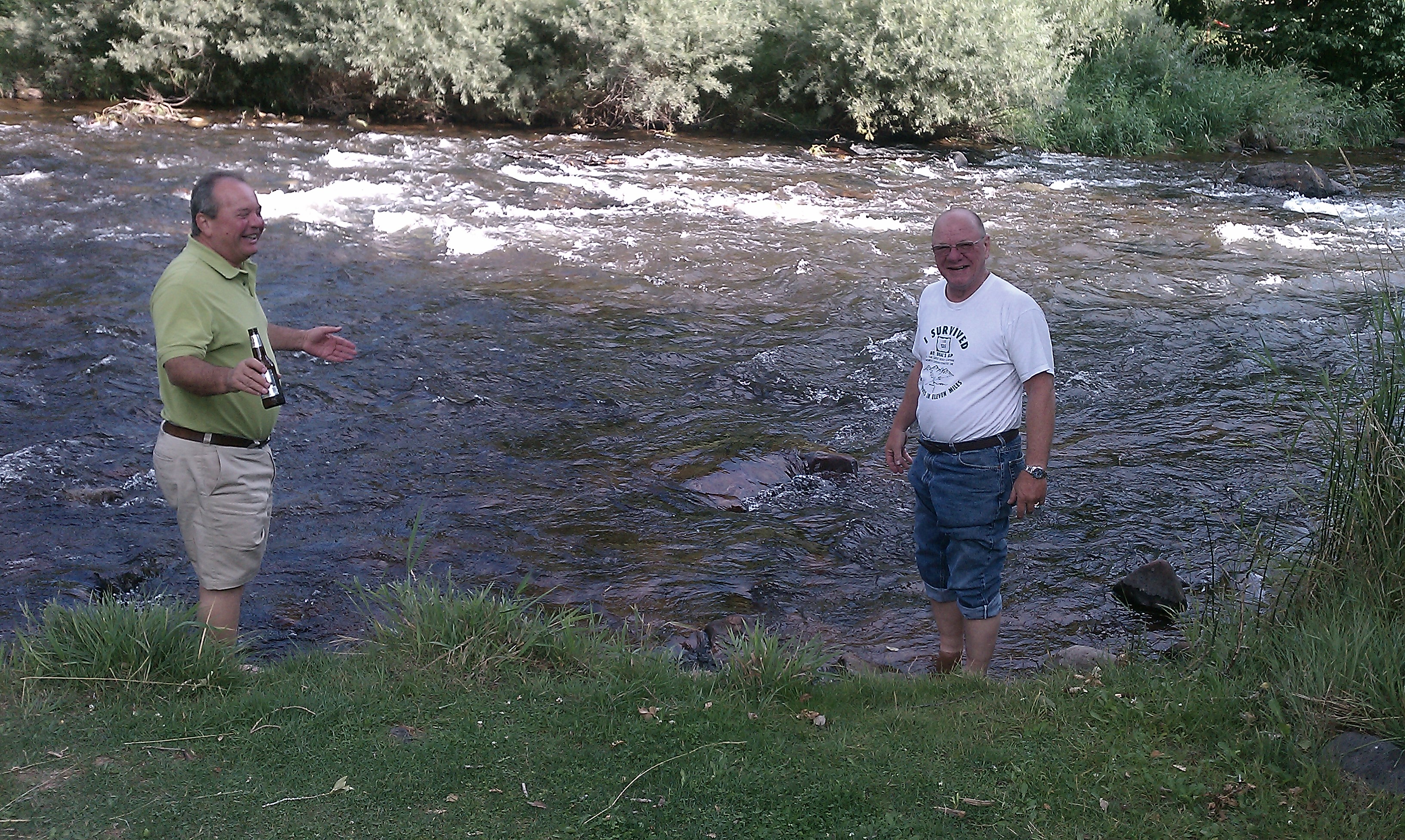 Much superior to last night’s lodging, the Aspenalt Lodge in Basalt was an excellent choice for ending the day. With a cliche-like babbling brook flowing just outside our doors and picnic tables which held a variety of libations, we settled in for an affable evening of camaraderie.
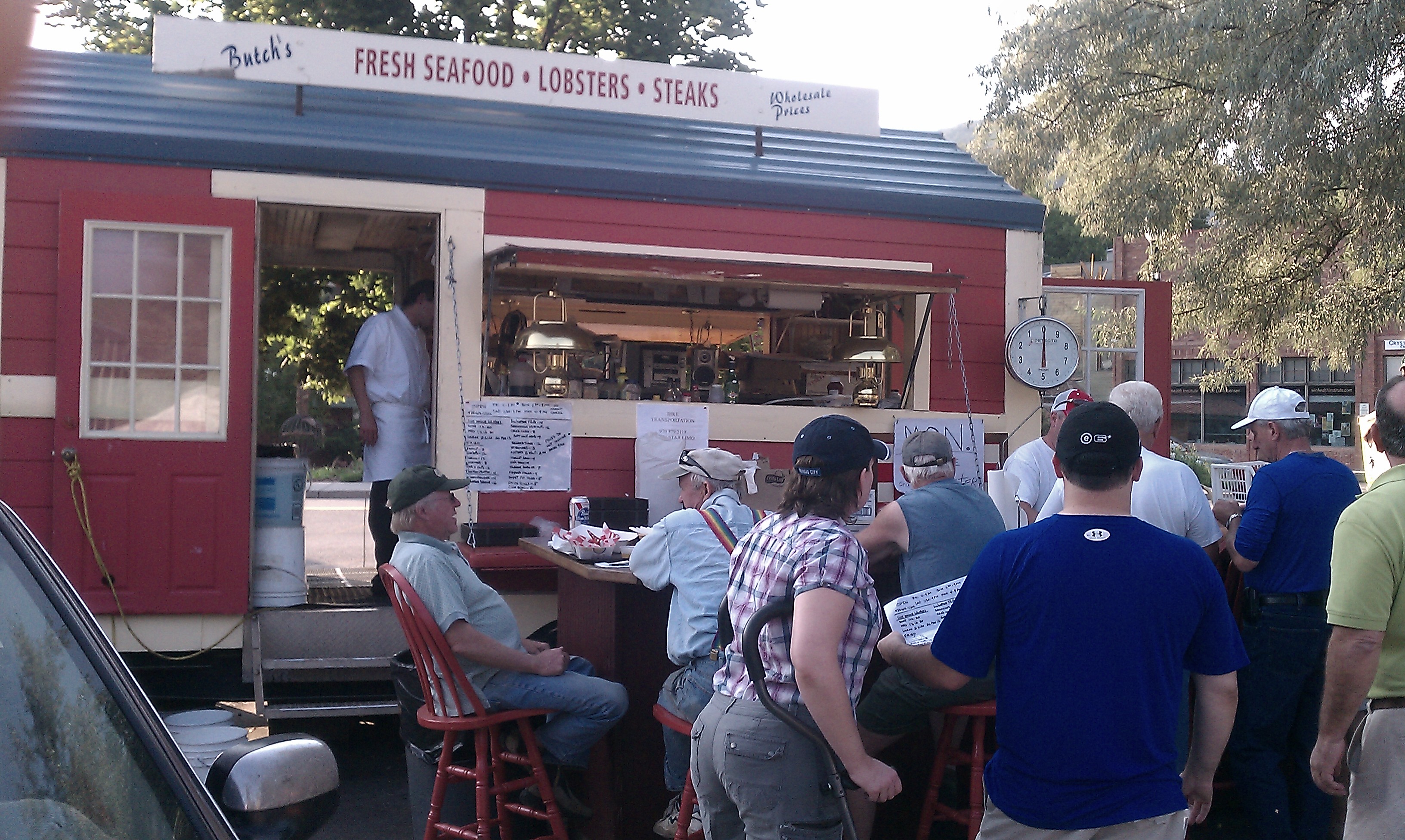 Today’s entry wouldn’t be complete without mention of our lobster-fest. Curt, scouting the area near our hotel, discovered a hidden culinary treasure in an outdoor seafood take-away stand that tendered a Monday night half-price special on lobster. Like a shepherd gathering wayward sheep, Curt herded us to the peculiar and apparently nameless stand where we dined on $10 lobsters and other assorted seafood offerings at outdoor tables that presented views of downtown Basalt framed by the the Rockies above. The proprietor, overwhelmed by our eagerness to enjoy discounted crustaceans, was nevertheless thrilled that the Twisted Riders apparently eliminated his lobster stock.
Tomorrow: Off to Grand Junction and the Colorado National Monument (which Jon and I thoroughly enjoyed a week ago)
Ride West: Day 18. To Hot Sulphur Springs

Getting ready for the first day’s ride with Twisted Riders
As we left Westminster (Denver) at 8 am under a brilliant blue sky with the majestic Rockies looming before us, the good people of Colorado gave us an appropriate send-off as a half dozen colorful hot air balloons rose above the city to, I assume, wish us “Good Riding.”
The ten bikes that make up this year’s Twisted Riders Tour passed through Boulder, the holy site of my nativity, but we didn’t stop. The manger was probably gone anyway.
The ride up Boulder Canyon was good but it was Sunday morning and the road had more than enough cars on it to keep us at the speed limit. We headed for Estes Park and the entrance to the Rocky Mountain National Park where I once again broke out my senior pass and saved another $10.
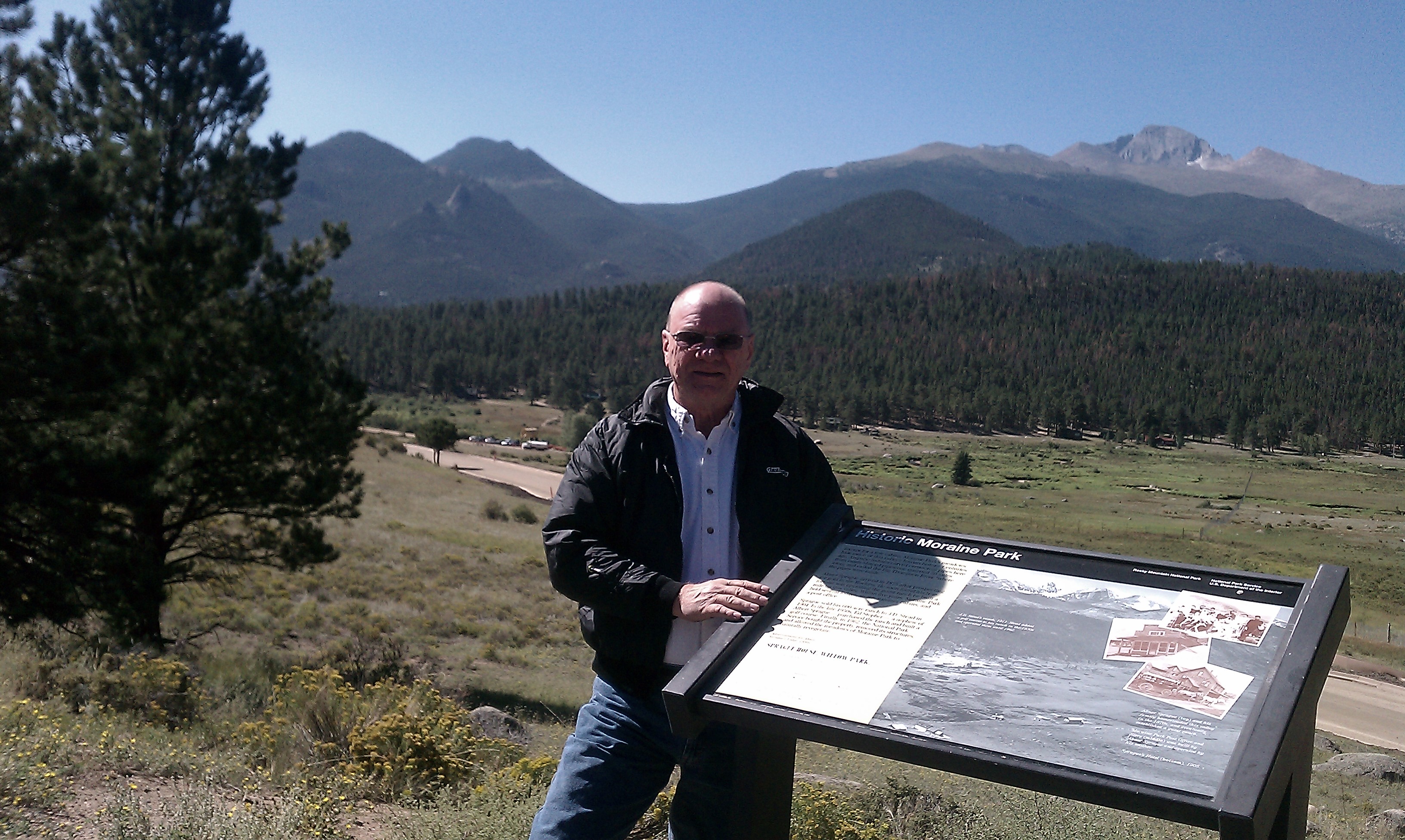
Steve Hauser was the prime mover for the Colorado Bucket List Ride.
The Park shows off the mountains to great advantage and all the Riders remarked repeatedly on the awesome beauty that literally met them at every turn. We stopped briefly at a visitors center, despite having its entrance road under construction and completely torn up.
On the way back to the main road Brian got caught up in some soft dirt on the shoulder and ended up in the ditch about three feet below the road surface. He kept his bike upright but the soft dirt wouldn’t allow for an easy return to the road. Four helping hands and a little Harley torque lifted the bike and it’s rider back to the road. No harm done, except to Brian’s pride. And it did give me something to write about.
We headed west through the park on US 34/ Trail Ridge Road, which goes over a pass at 13,200 feet, making it the highest paved through road in the United States. The road, built in the early 1930s to improve tourists’ visit to the Park, climbs 4,000 feet to its highest point. We stopped briefly at a visitor’s center near the top where the wind was blowing and the temperature was somewhere in the mid to upper 40s. Great views, though, because we were well above the tree line.
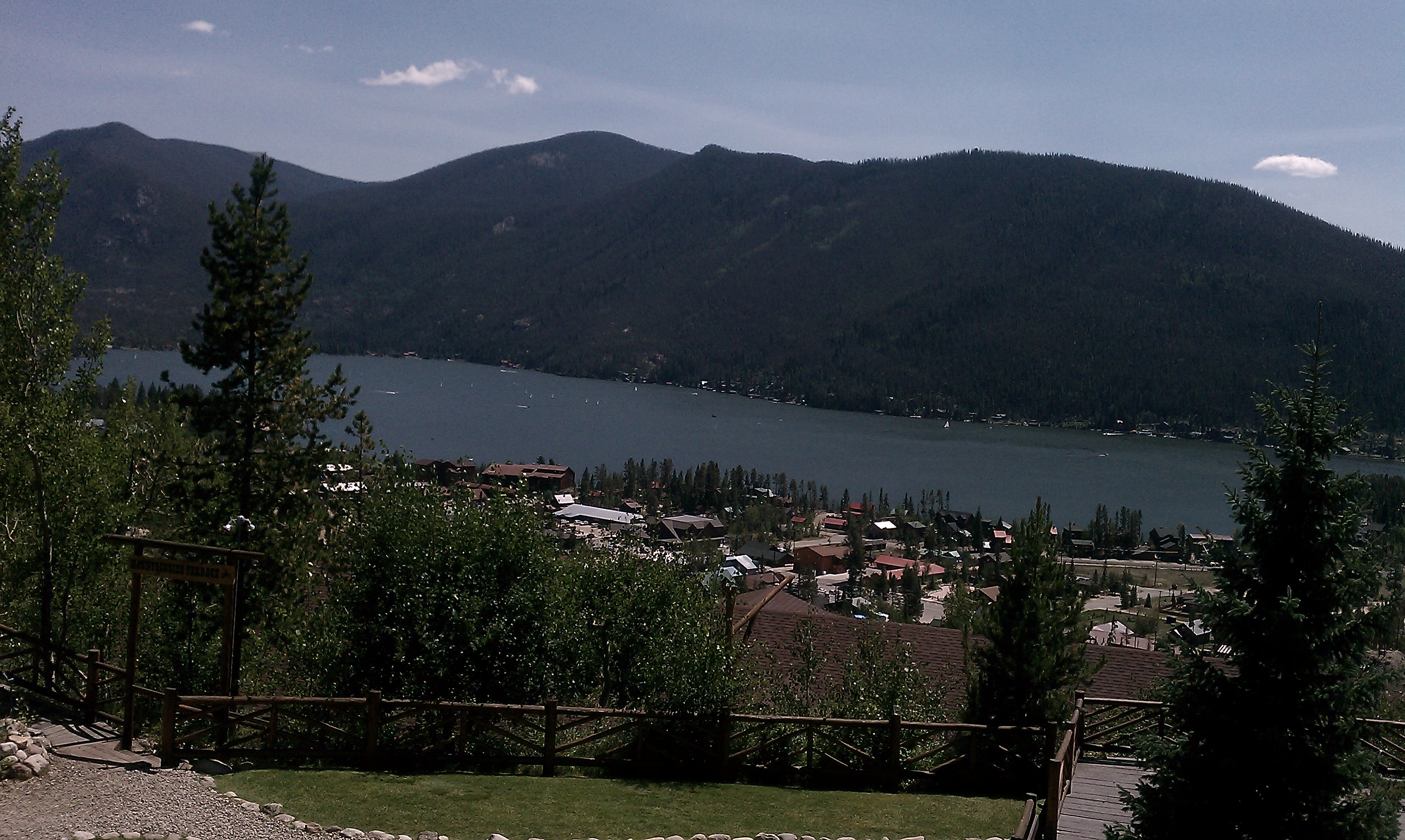
Our view at lunch at the Grand Lake Lodge
We went at a forced, leisurely pace down the mountains to the western side where we were still at 8500 feet when we stopped at the picturesque Grand Lake Lodge for a nicely done Sunday brunch. A short ride after lunch brought us to our hotel in Hot Sulphur Springs by 3 pm. Half an an hour later, seven of us were racing on the road at a much more aggressive pace up to and then down from Berthoud Pass (elevation 11,300 ft). I discovered pretty quickly that the 96 cubic inch Harley was not going to keep pace with the Hondas and BMWs but I didn’t lose too much ground. Today’s second ride definitely got the adrenaline flowing.
Tomorrow: Off to Basalt, south of where we are now.
“I can’t wait to get on the road again.”
Ride West: Day 17 Part Two Begins
Jon and I parted ways today in Walsenburg, Colorado, as he headed east toward Wichita and I turned north to Westminster (Denver) where I would meet up with the Twisted Riders, nine friends of Brian Brannon and mostly from Indiana.
Before we split up, Brother Jon and I had another great ride through New Mexico and Colorado, though it was one of the cooler rides we had with temperatures in the low to upper 50s for much of the morning. Because of the temperature, and only because of the temperature, we thought it wise to stop about two hours into the ride and warm up. So, we each devoured a huge slice of warm blueberry pie and a cup of coffee at 9 a.m at the Elkhorn Cafe in Chama, New Mexico. Good thing the pie was warm because the cafe was as cold inside as it was outside.
Scenic Highway 17 in Mexico and Colorado was a real treat for our final ride through the mountains. We rode through several National Forests and over a 10,200 foot pass and, at times caught sight of a vintage coal-fired, black-smoke-belching excursion train chugging along its tracks hauling tourists to Chama so they could ride back down again. I’m sure their’s was a pleasant ride, but I prefer two wheels not attached to tracks.
Our final 2,000 foot dive out of the Rockies put us in Walsenburg, which didn’t seem to have any particular redeeming qualities, though I suspect the people who call it home must find it appealing in an odd sort of way.
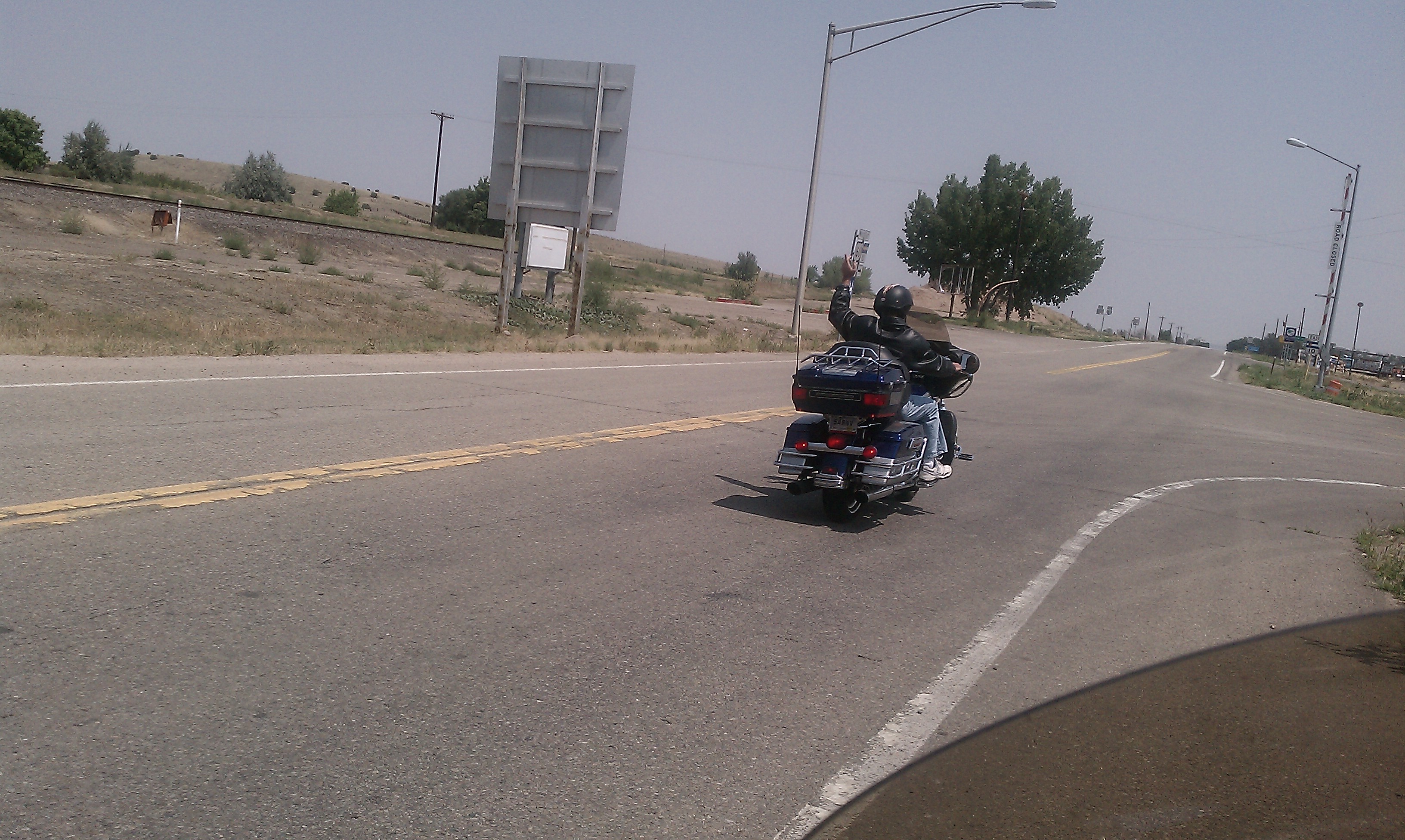 Jon had planned on going only a few hundred more miles and finishing his ride home Sunday, but he called a little while ago from Wichita to let me know that he rode the more than 700 miles and was home by 10 p.m. Amazing what feats of motorcycle daring do can be accomplished on a new tire. Jon had a long first day ten days ago and a long last day today, but I think he eight pretty good days in between.
I arrived in Westminster about 3:30, 20 minutes after the 10 Twisted Riders checked into the hotel. Quick introductions were made and we saddled up and made a lightening run to Lookout Mountain in Golden, Colorado, which overlooks the entire city of Denver spread out below and the beginning of prairie extending eastward to Kansas. It is also the burial site of Col. William F. (Buffalo Bill) Cody and his wife; they must have liked the view from the top, but that was before Denver had spread out like an urban ooze.
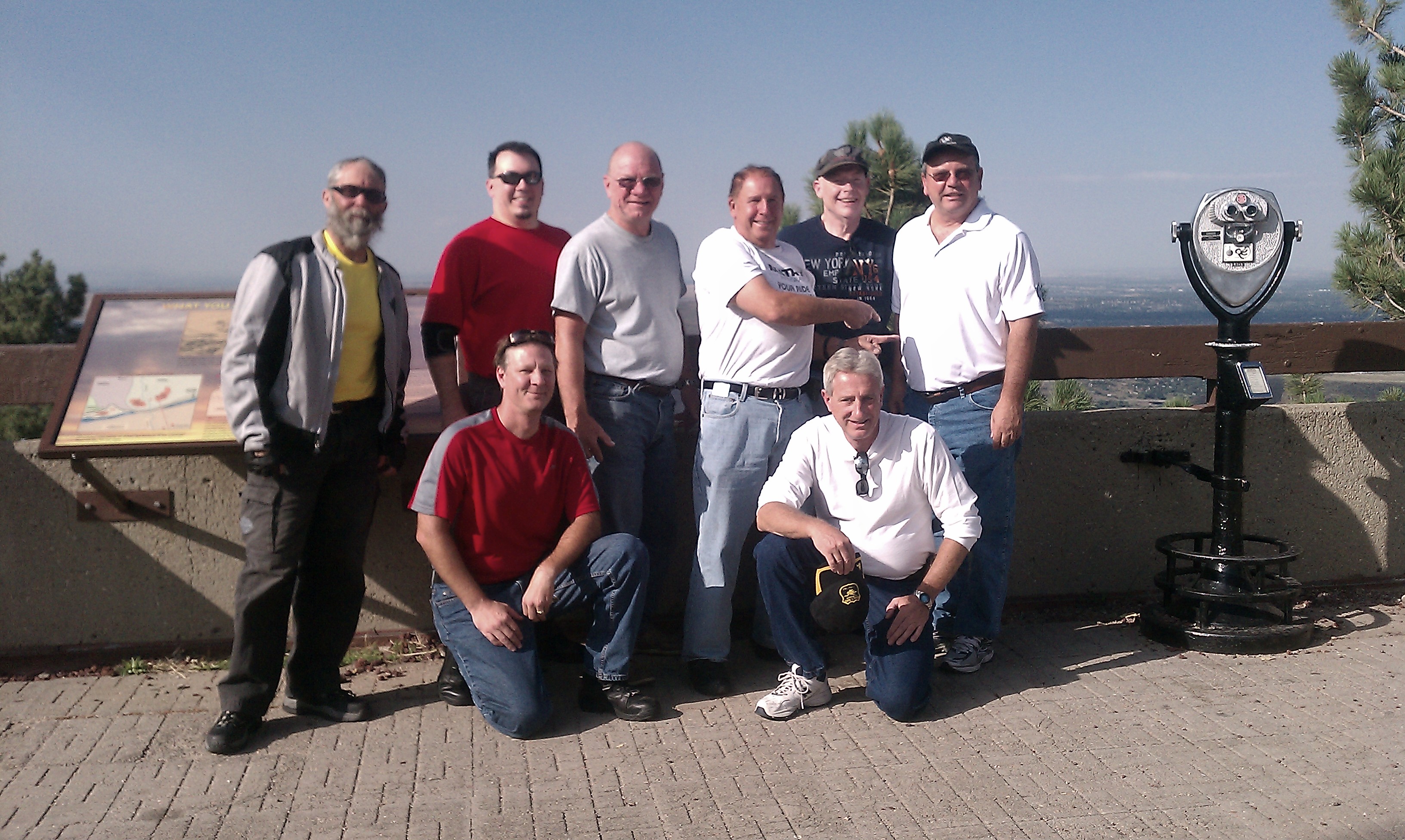 The short ride to Lookout Mountain was a good introduction for me to the type of riding we’ll be doing in the next week. Aggressive, but not over the top. It’s going to be another great week on the bike. If tonight’s raucous dinner at the Bonefish Grill is any indication, this group is going to be a lot of fun.
Tomorrow: Into the mountains (again) and through Rocky Mountain National Park.
Ride West: Day 16 To Bloomfield, NM
I was looking forward to seeing Canyon de Chelly National Monument in Chinle, AZ. Beautiful views and a chance to hike down the canyon to visit up close and personal where Cliff Dwellers lived 5,000 years ago and where people have lived continuously ever since. That stop would have been the last for Jon and me since we left Wichita nine days ago, since tomorrow we go our separate ways. The ride, I knew, would be through desert scrub with an occasional rock formation or canyon to see as we went racing by. Not one of the greatest rides of this tour, but a good one anyway.
The day started out well. Early breakfast and on the road by 7 a.m. But during a rest stop 100 miles into the ride, I glanced at Jon’s rear tire. I thought I saw cords where I should be seeing tread. I looked closer. 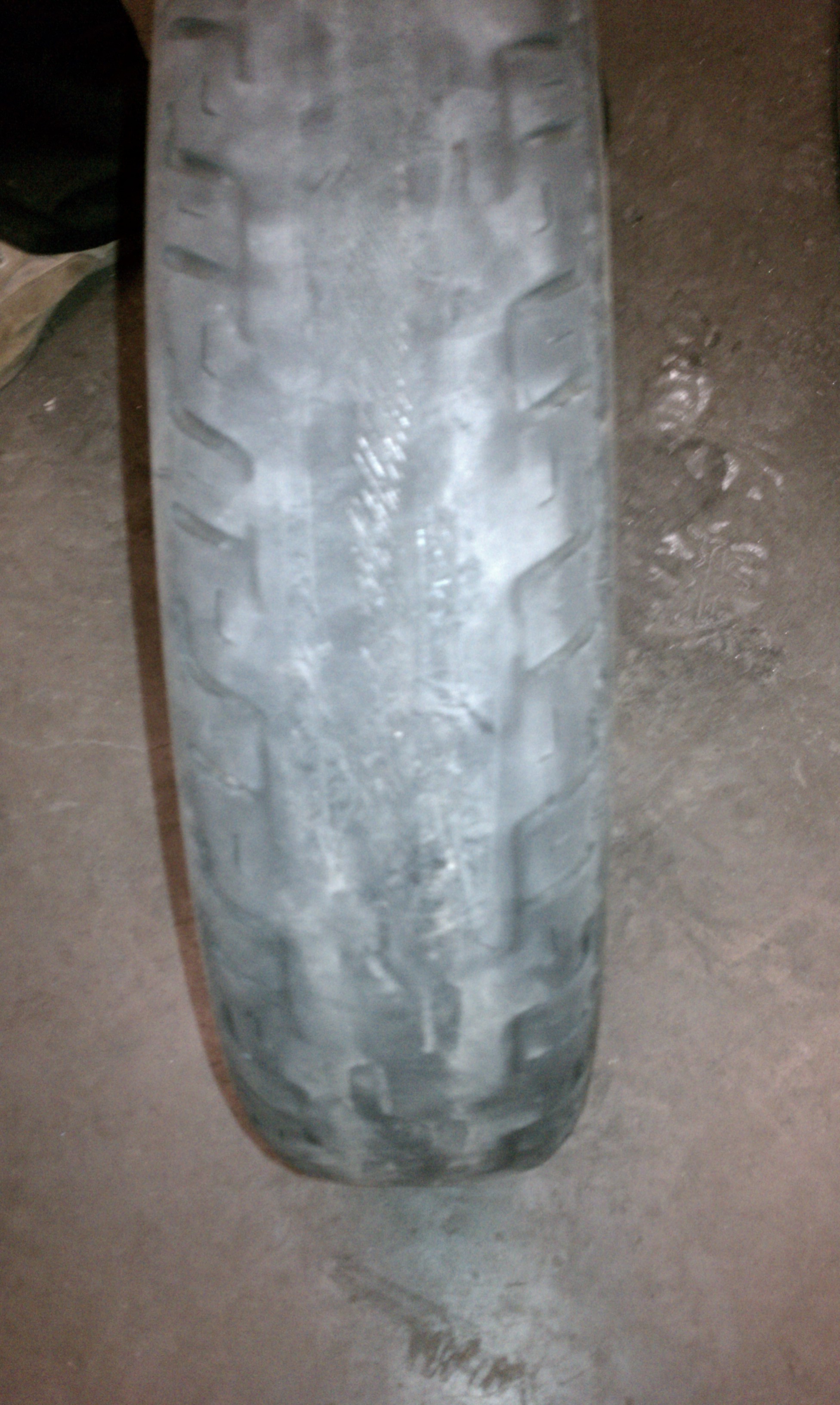 I saw cords where I should be seeing tread. Oh crap.
 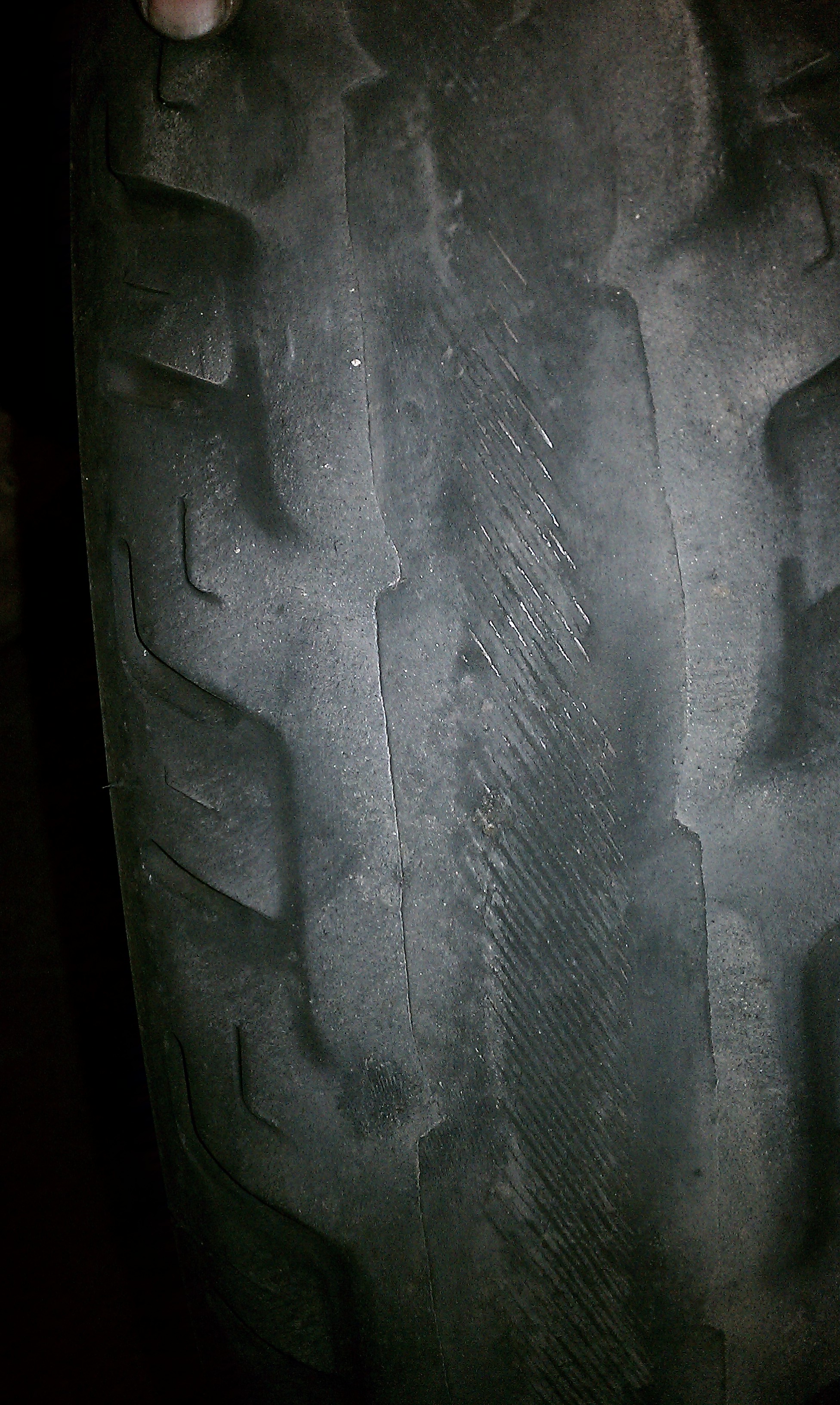 Jon was riding on a tire that was not just bald but had worn the rubber all the way off. And we were about 150 miles from the nearest dealership. And more than 50 miles from the nearest town of any size and we didn’t know what we would find there.
We decided in short order that the Canyon de Chelly would have to wait until another trip. I called the Harley dealer in Farmington, NM, and located a tire and told them we would try to get there by 2 p.m. And then we began our four-hour slow-speed ride to Farmington, keeping the speed to about 50 mph the whole way. At a gas stop, Jon checked the tire again and had serious doubts that it would make the distance. But we pressed on.
Finally, at 2:45, we pulled into the dealership and the tech installed the new tire. He was also kind enough to replace a turn indicator bulb and add air to the adjustable shocks.
All ended well, but it could have disastrous. A blown tire in the desert would be a problem. A blown tire on the Coronado Trail in the White Mountains yesterday could have been serious in the extreme. No harm done, and Jon learned a valuable lesson about checking his bike thoroughly before taking off on rides to the mountains. And for those of you reading this who ride, please do a thorough TCLOC before you get on your bike.
As for the ruins as Canyon de Chelly, they’ve been there for 5,000 years (though I guess they weren’t ruins when they were first built). They’ll be there the next time I’m in the area and I’ll hike down the canyon to see what’s there.
Tomorrow: Jon and his new tire head back to Kansas and I begin the second part of the Ride West as I head to Boulder to meet the “Twisted Riders,” a group of a dozen riders from the midwest that Brian Brannon rides with . Stay tuned.
Ride West: Day 15 Coronado Trail Loop Ride
Six years ago, riding the western states on my ’03 Road King, I found a road that will always be a Top 10 Ride: The Coronado Trail (US 191) in the White Mountains of Arizona. Since then, I’ve said that if I’m anywhere near that road I’ll ride it again. So, when I planned this year’s trip, I made sure it was on the itinerary.
Despite last year’s devastating fires in the Apache-Sitgreaves National Forests (the worst fire in Arizona’s history), most of the 90 mile ride from Alpine south to Morenci was through the lush, sweet-smelling mountain pine forests and high meadows I remembered. In the first 1/3 of the ride, though, we did see once-green mountain littered with the charred standing skeletons of lofty pines. It will take decades for the scarred forest to recover, or longer if drought conditions and warmer temperatures continue and grow worse as climate scientists predict they most certainly will.
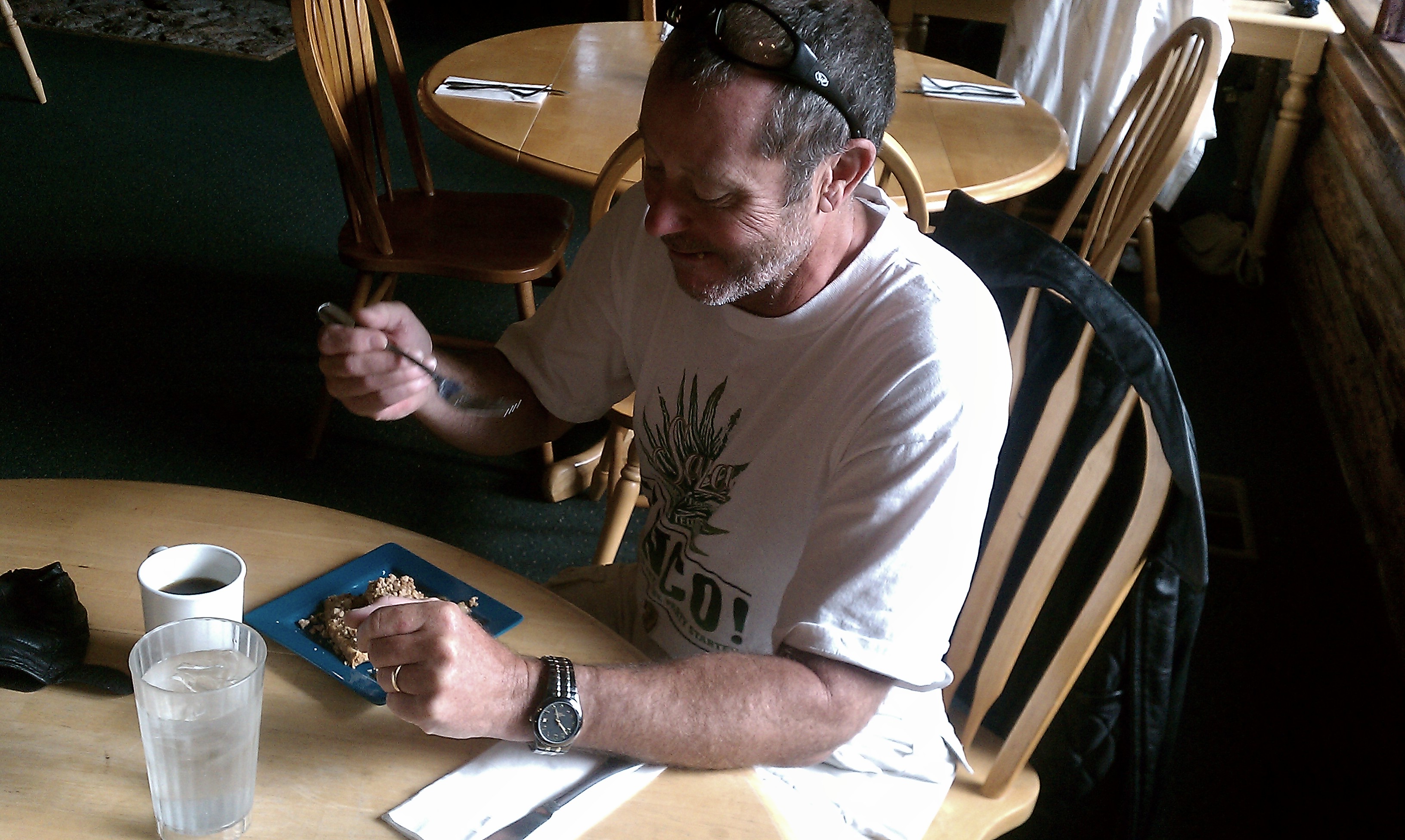
Yummmm. Pie.
About 9 a.m., an hour into our ride, we stopped for coffee at Hannigan Meadows Lodge and Cafe. (Coffee alone, however, didn’t seem to justify the stop, so we each had a generous slice of warm, melt-in-your-mouth Dutch Apple Pie.)
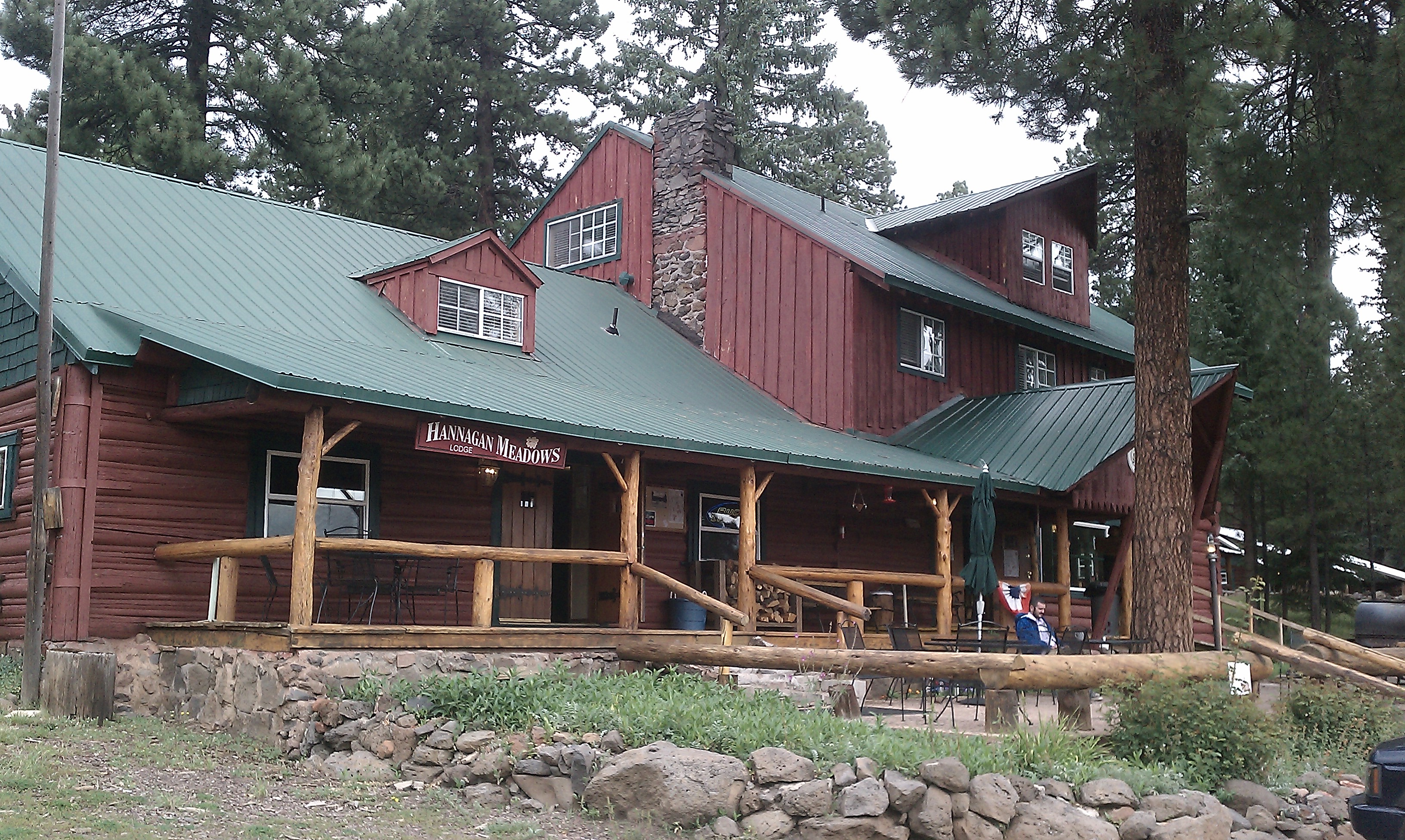 We talked with the waitress there about last year’s fire and she shared an album with hundreds of photographs taken of the fire and the firefighters whose courageous work saved the structures. To have been in the middle of that inferno must have seemed like descending to the depths of Hell. It’s hard to express how grateful the waitress and all who worked there were to save not only their jobs but the historic structures that would have been irreplaceable.
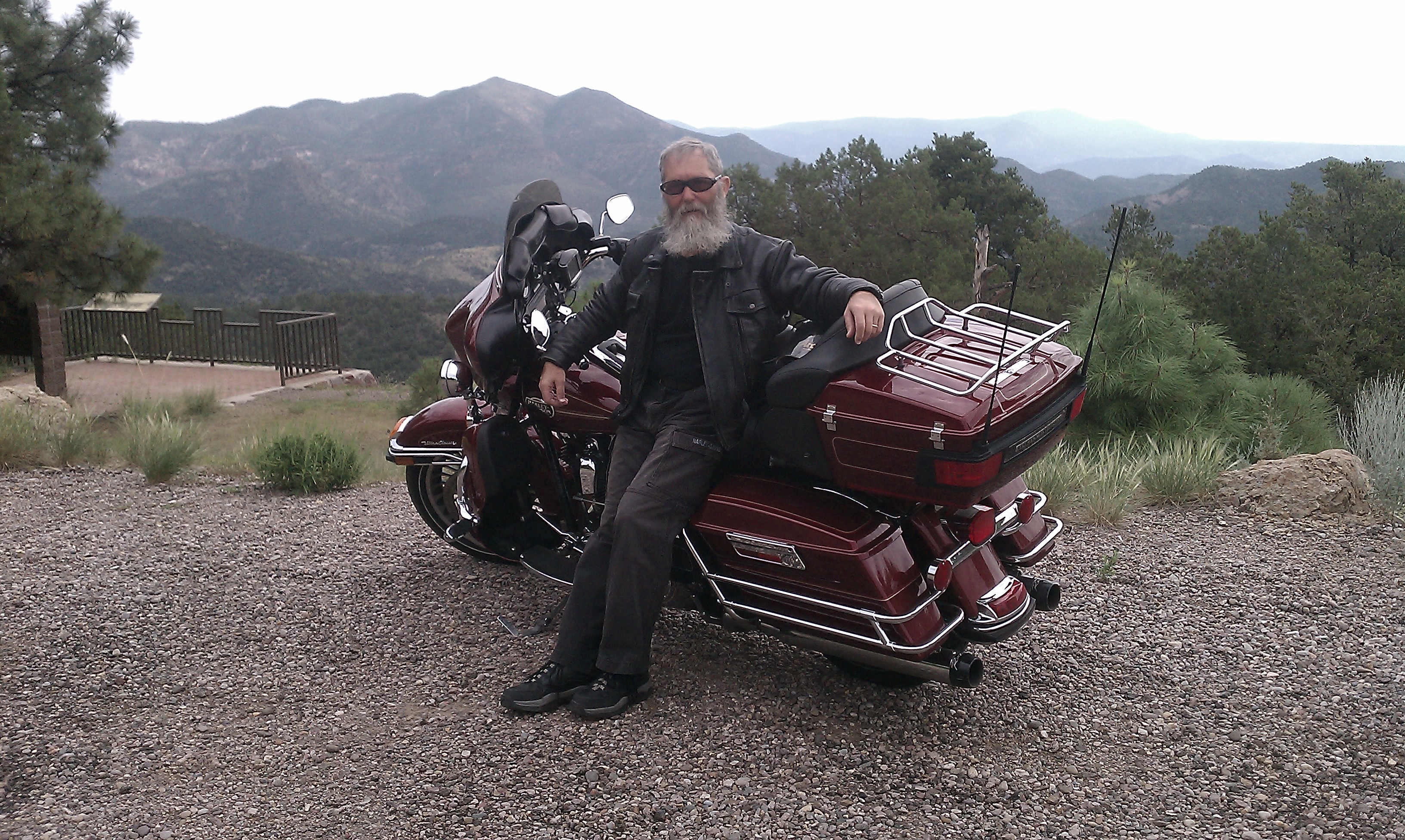 For more than two hours after our coffee break (OK, our pie break), Jon and I rode the literally thousands of twists and curves through the White Mountains on the Coronado Trail, the least-used US highway in the country. Until the early 1990s, that road had been designated US Highway 666 and given the sobriquet “The Devil’s Highway” because of an unusually high fatality rate in New Mexico. US Route 666 no longer exists.
 Some readers of this blog have ridden the Tail of the Dragon in North Carolina/Tennessee for 11 miles. Imagine a Tail of the Dragon that goes for 90 miles (with no Tennessee Highway Patrol) and you’ll get a feel for the Coronado Trail. I rediscovered today that when they mark a hairpin turn at 10 mph, it’s hard to take it at more than 20 and still have floorboards on which to rest your boots. Oh, and did I mention there are no guardrails anywhere along the road? The White Mountains are vast and beautiful, but you won’t see much of them riding on US 191 unless you pull off at one of the occasional turnouts. Your focus has to be constantly on the black pavement between the white and yellow lines or you’ll see parts of the mountain you don’t really want to see.
I’ve ridden the Coronado Trail twice. The next time I come to Arizona, I’ll ride it a third time.
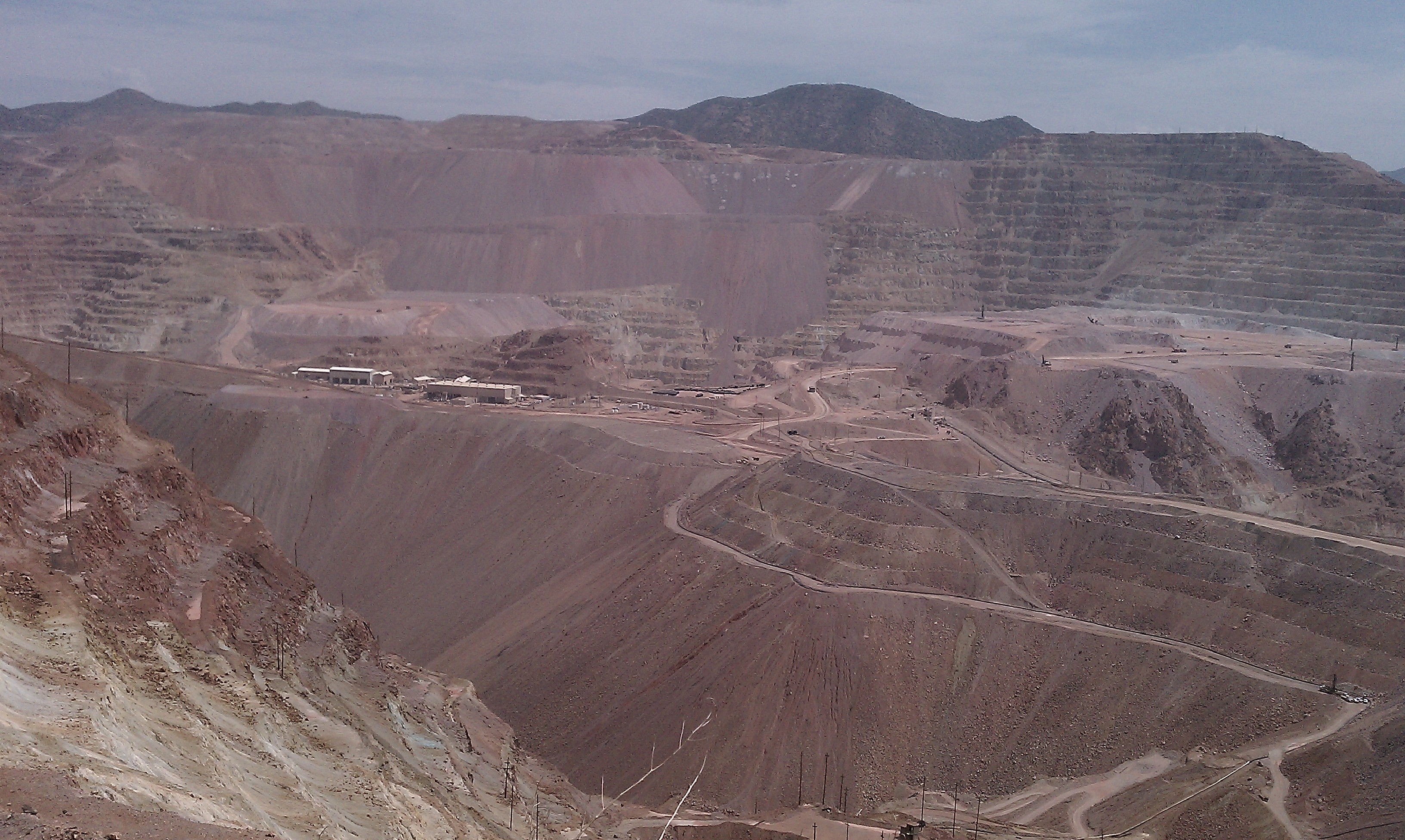 At the southern terminus of the mountainous Trail, the road opens up on the most amazing, and perhaps incongruous, sight: A huge, open pit copper mine that has ripped the tops and sides off several mountains for more than 100 years. It’s impressive. But it’s ugly. More than 2000 workers, some operating shovels the size of apartment buildings which fill trucks the size of houses, move millions of tons of rock and dirt to get to the blue gold buried beneath. It is what it is and if you enjoy electricity (passed through copper wire) you have to put up with what they do to the earth.
South of the copper pit and the company towns of Morenci and Clifton, we reached the southern-most point of our Western Ride and turned northeast for a short ride into New Mexico where we steered north on US 180 to complete our day’s loop. As with the ride on US 191, I wondered what we would see, since the Gila National Forest’s Whitewater-Baldy fire earlier this year had been almost as severe as the Arizona fire had been last year. As it turned out, most of the fire was east of where we were riding. The biggest concern now, it seems, is flash flooding which results when there is no undergrowth to slow the rain water down and allow it to seep into the ground. Already, many of the streams are clogged with silt and ash and the fish in them are gone. And so are many of the tourists.
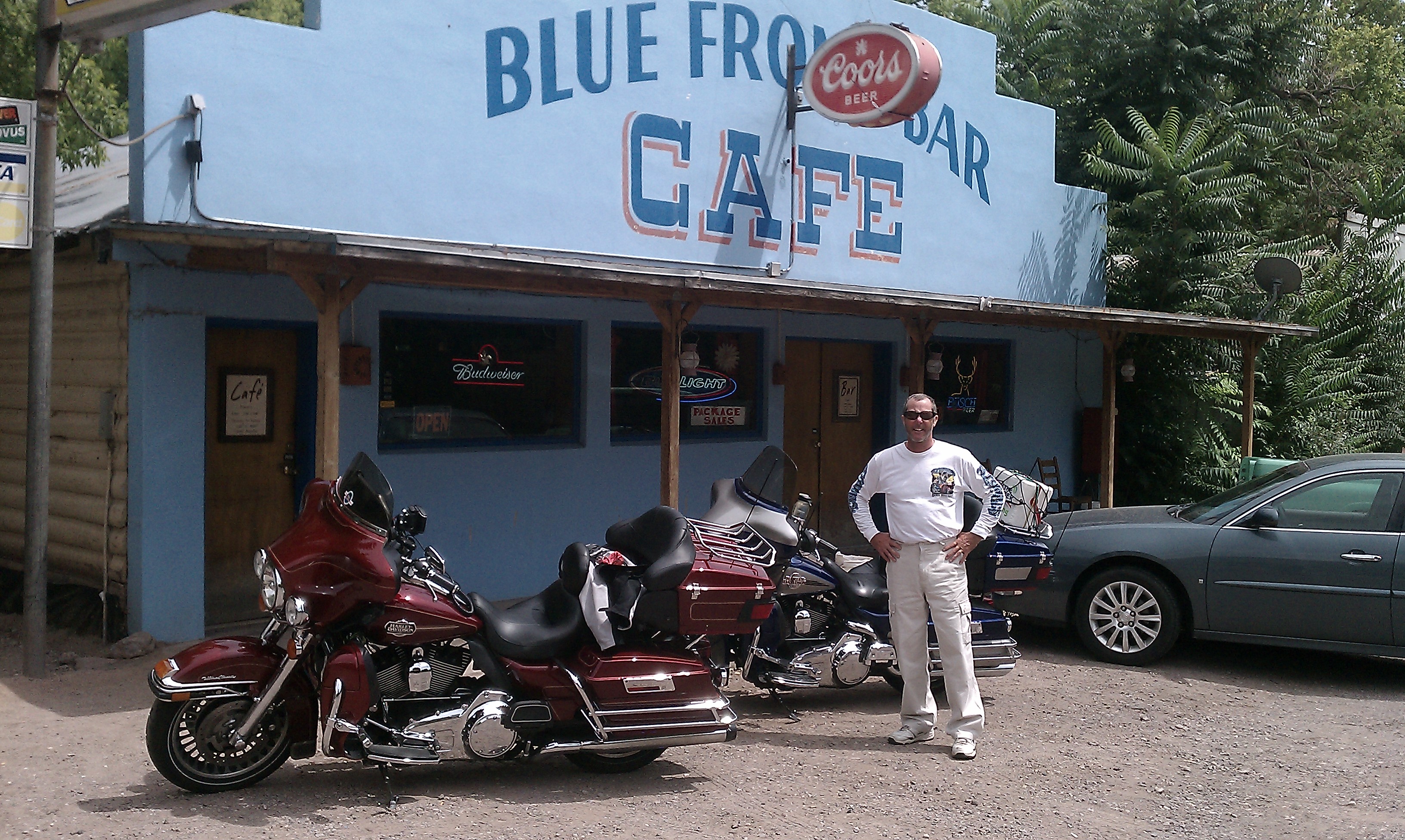 We stopped for lunch at the internationally famous (just kidding) Blue Front Bar and Cafe in Glenwood, NM. The cafe has the distinction of bridging a creek that runs beneath it. According to one of the locals, the cafe had once been smaller and was built between the road and the creek. When they expanded it, they just built the rest of it over the creek. It’s not spectacular, just interesting.
 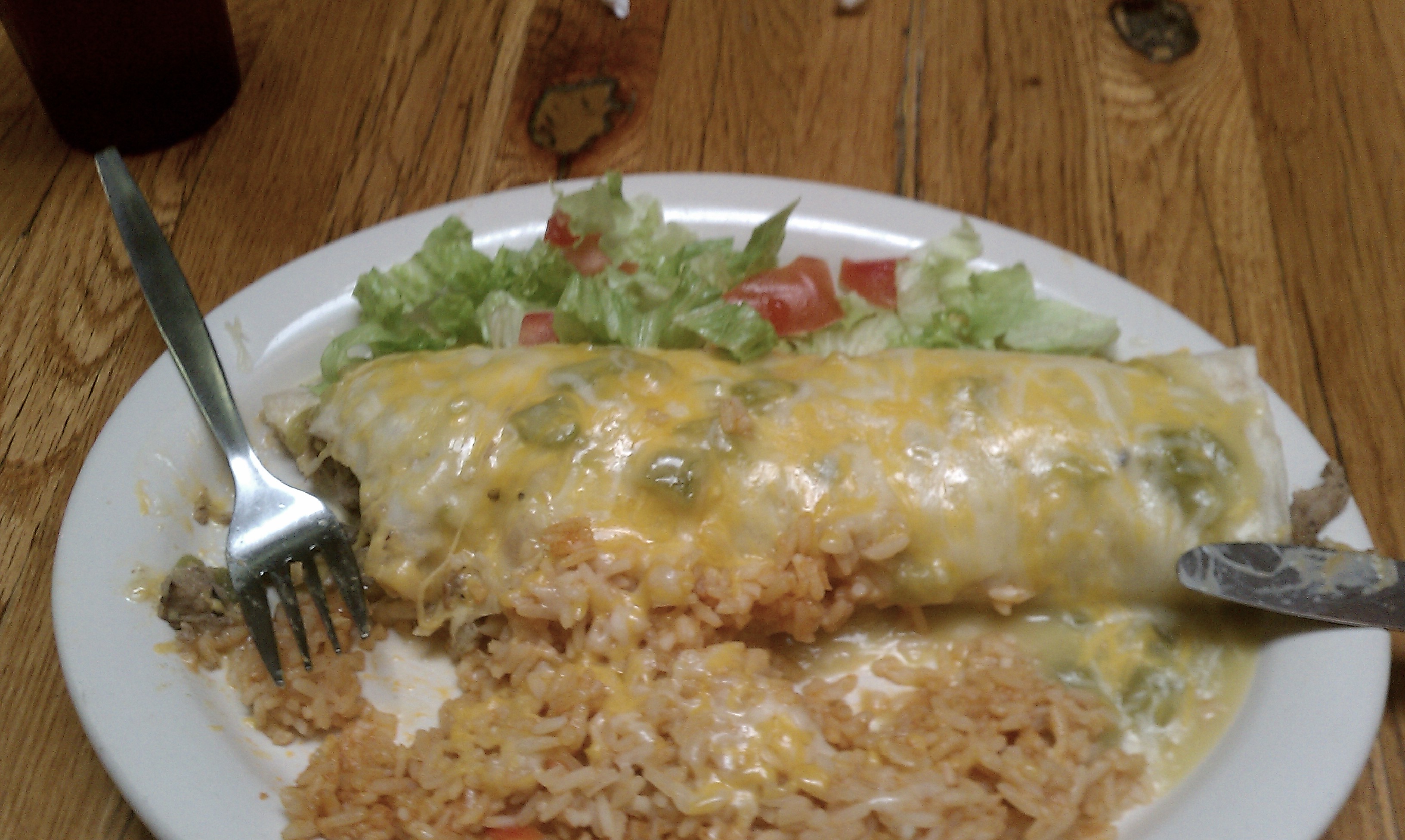 I ordered the Burro. I think that’s a big burrito or at least mine was. I ate it. All of it. But I was disappointed that I no longer had an appetite for the “Homemade Pecan Pie” scribbled on the menu board.
Sated and back on the road again, we saw rain ahead of us and stopped for wet weather garb, not knowing the extent of the rain. Five minutes later we were in light rain and five minutes after that we were in “can’t-see-the-freaking-road” rain and being blown around by winds which we couldn’t see either. Back to light rain five minutes later and then off-and-on rain for the 50 mountainous miles back to our starting point in Eagar.
If I had ridden no other road on my Ride West than the Coronado Trail, this year’s trip would have been a success. But, as faithful readers will note, all the rides have been good.
Tomorrow: Chinle and its ruins, 4 corners and New Mexico again.
Ride West: Day 14 to Eagar, AZ
Today had its highs and lows. High of 9,200 feet in the White Mountains. Low of 2,100 feet at Roosevelt Lake. High of 100+ degrees in the desert. Low of 60 degrees during the morning mountain ride. High of about 90 mph passing some law abiding citizens dutifully observing the speed limit. Low of zero mph sitting peacefully on my bike staring at the endlessly beautiful scenery.
Yes, it was another great day. Although I had ridden before on many of the roads I’ve been writing about, today’s ride, which included the 4,000th mile since I left home, was on all new roads to me.
We started by taking the Mary Lake Road south out of Flagstaff through the Coconino National Forest. What a way to start the day. Towering pines, cool temps, and gently twisting roads to get you going in this verdant, high-elevation forest. Continuing south on AZ 187, our route wound through the mountains and Tonto National Forest at elevations from about 8, 000 to 6,000 feet.
 Just south of Payson, however, the road was all down hill, taking us into the desert, domain of saguaro cacti and potentially punishing conditions. In an hour, we went from temperatures in the mid 70s to over 100 degrees. But even from the desert we could always see mountains nearby and knew that we would be back into them eventually.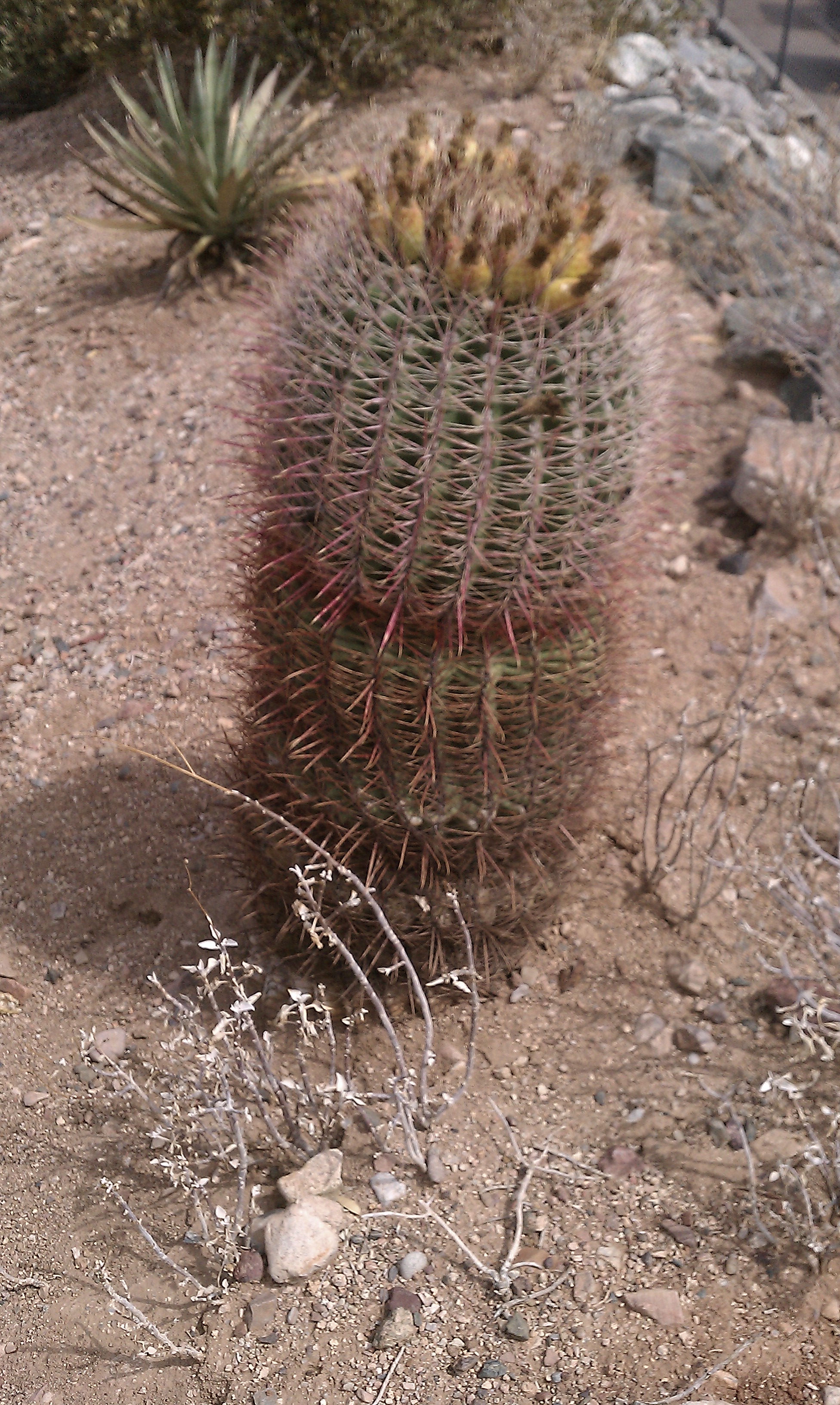
We stopped at the Roosevelt Lake Visitor’s Center (assuming correctly that it was air conditioned) and went through the interpretive exhibit. I love to learn new stuff. I learned that the Roosevelt Dam had been constructed in the first decade of the 20th century and was the first major project of the newly created federal Bureau of Reclamation. The dam impounds water from the Salt River and provides irrigation and hydroelectric power for much of central and Arizona. Currently the water level is at 50% percent capacity because of the growing drought. It took six years to build and was finished one year before Arizona entered the Union as a state. The project resulted in the creation of a small town where there had only been rocks, cacti and native Apaches before. This 450 foot high dam was constructed in the middle of the desert with labor largely imported from outside Arizona. Not that you’ll ever need to know this stuff but I learned it so I thought I’d share it.
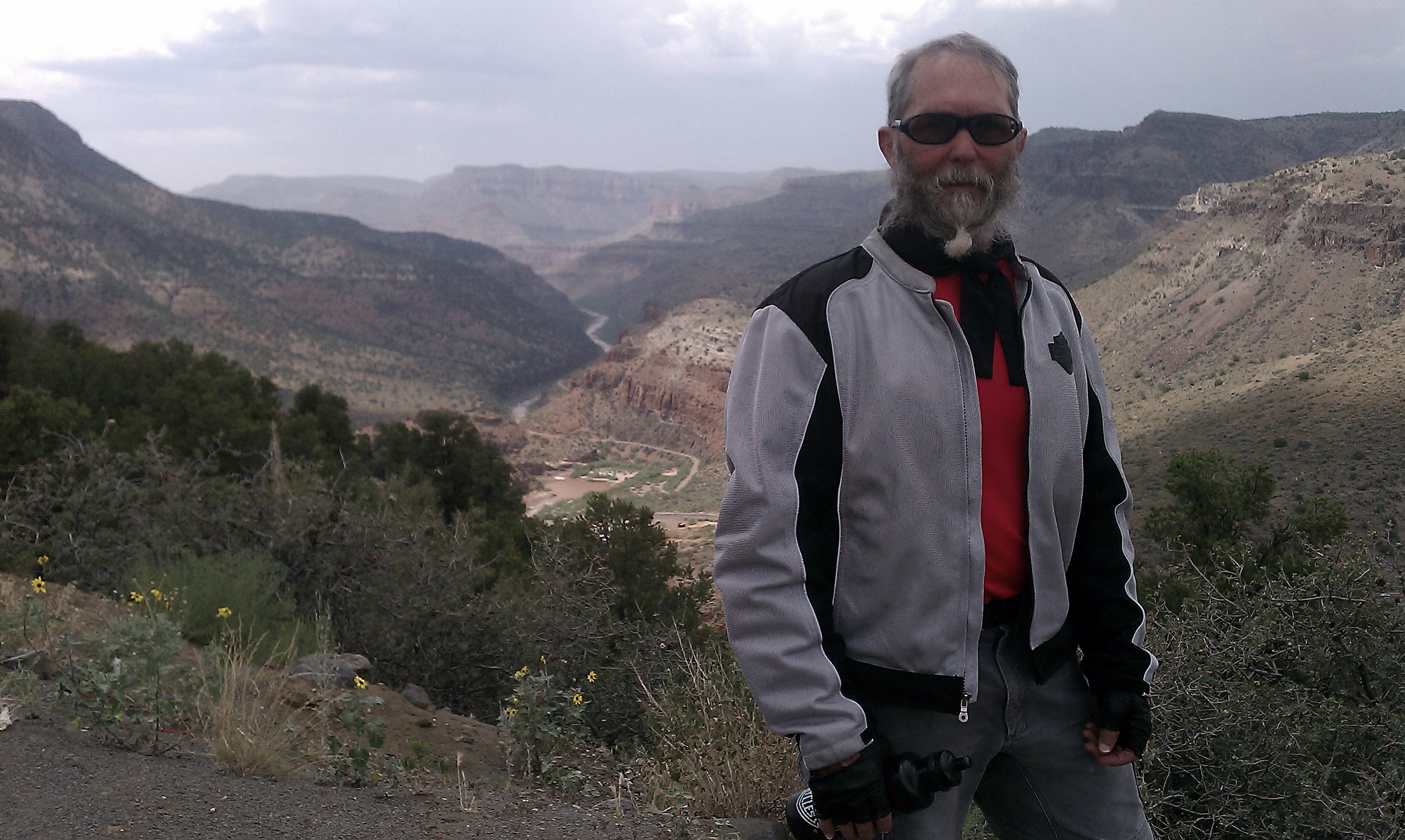
Salt River Canyon in the background
Today’s ride was in the form of a “V,” with the point of the V at Globe. After a good, authentic Mexican lunch we went north up the other side of the V, climbing again into the mountains. Once there we came on an unexpected treat: The Salt River Canyon. Although not nearly as impressive as the Grand Canyon, the Salt River Canyon does have a road that goes down one side and up the other. It provided great views of the canyon and, of course, twists and turns down the declivity and up the acclivity on the other side. The canyon depth was probably about 1500 feet, compared to the 5,000 feet of the Grand Canyon, but still pretty spectacular and a great ride.
We broke out our rain gear at one point as we rode through the Fort Apache Indian Reservation and the Apache National Forest. But the shower was brief and probably didn’t warrant suiting up. It was hard to tell how big the storm was and we wanted to make sure we didn’t get caught in the rain and then ride for several hours with wet, cold clothes.
We arrived in Eagar, AZ, after about 9 hours on the road. Since both bikes are Ultra Classics and it’s hard to tell them apart when they’re both brown, we washed them to return them to their original red and blue colors.
Tomorrow: A loop ride through the forest-fire scarred White Mountains in Arizona and New Mexico.
 hdriderblog