
Great Alaska Adventure: Exploring the Kenai
A light rain with temperatures in the low 50s at Seward this morning meant spending extra time suiting up to avoid the distress of foul weather. There’s a very specific order of operation for donning cold weather and wet weather gear, and if you miss a step along the way you have to backtrack to the point of the missed step and start again from there. For example, if you put on your rain pants and zip them down, snap the button at the bottom of the leg and fasten the stirrups under your boots and THEN remember that you haven’t put on your overboots, you have to back up and emend the process accordingly. I’ve never numbered the discreet operations involved, but maybe one day I will. I’m guessing there are about three dozen separate steps before you’re ready to fire up the bike and roll down the road. As many times as we’ve done it, I don’t think we’ve yet done all the steps in proper order the first time. Once properly dressed and protected against the unkind elements, though, the ride went well as we set off to explore the Kenai Peninsula.
As we started our journey north, saying farewell to Seward, Resurrection Bay and the surrounding mountains, I wasn’t sure where we would go during our relatively short trip (125 miles) to Soldotna on the western side of the peninsula, but I wanted to avoid making a direct trip to Soldotna and finding ourself with little to do and lots of time to do it in when we got there. I remembered reading about a small, out-of-the-way town on the southern side of Turnagain Arm named Hope and Marilyn and I set our course there. The route took us about 20 miles north of the highway junction we would have used to go directly to Soldotna before branching off to the northwest to the foggy shores of Turnagain Arm and Hope. We should always opt for Hope, when we can.
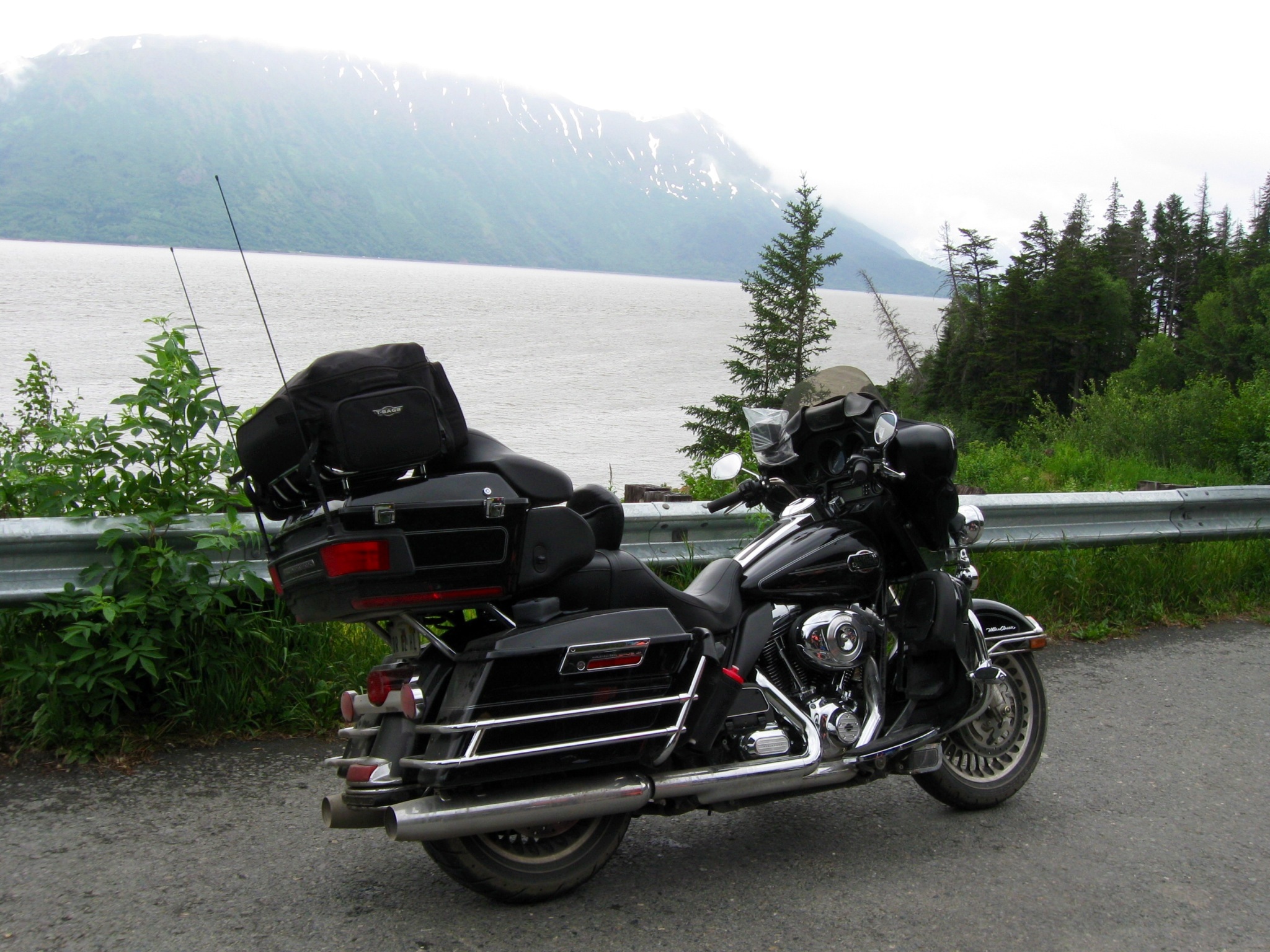
Always inspiring sights in Alaska.
The 17-mile road to Hope had some nice twists and turns that would have been much more exciting on dry pavement, but nevertheless offered the opportunity for gentle leans, even at slow speed on rain slicked asphalt. It also provided the never-stale, never-repetitious, always-welcome views of snow streaked mountains lunging skyward from the sea that seem to define much of Alaska’s sublime coastline. Even on a cold, rainy day with mist and clouds camouflaging the stony peaks (perhaps most of all on such a day) those views impart a sense of awe that make one pause and breathe deeply, absorbing the wild beauty of it all.
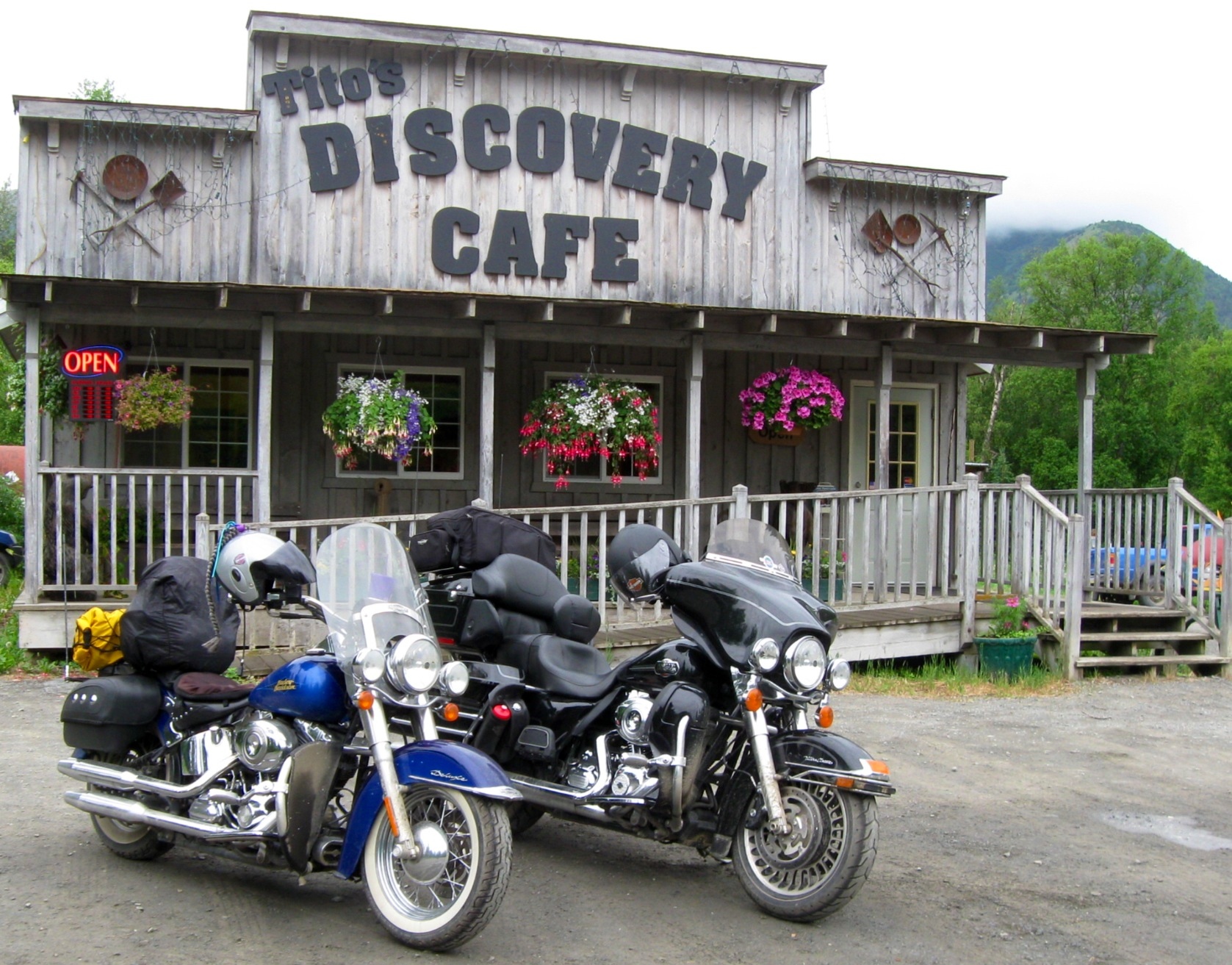
This was good Discovery.
When we arrived at Hope we turned down Main Street and discovered a few old buildings, a closed cafe and a dead-end into Turnagain Arm. We backtracked a short distance to a second eatery–The Discovery Cafe–we passed coming into town and, it being noonish, stopped for lunch. As we warmed up with a bowl of chili and finished with (you knew this was coming) a big slice of peach-blueberry pie, we began to learn a little more about Hope.
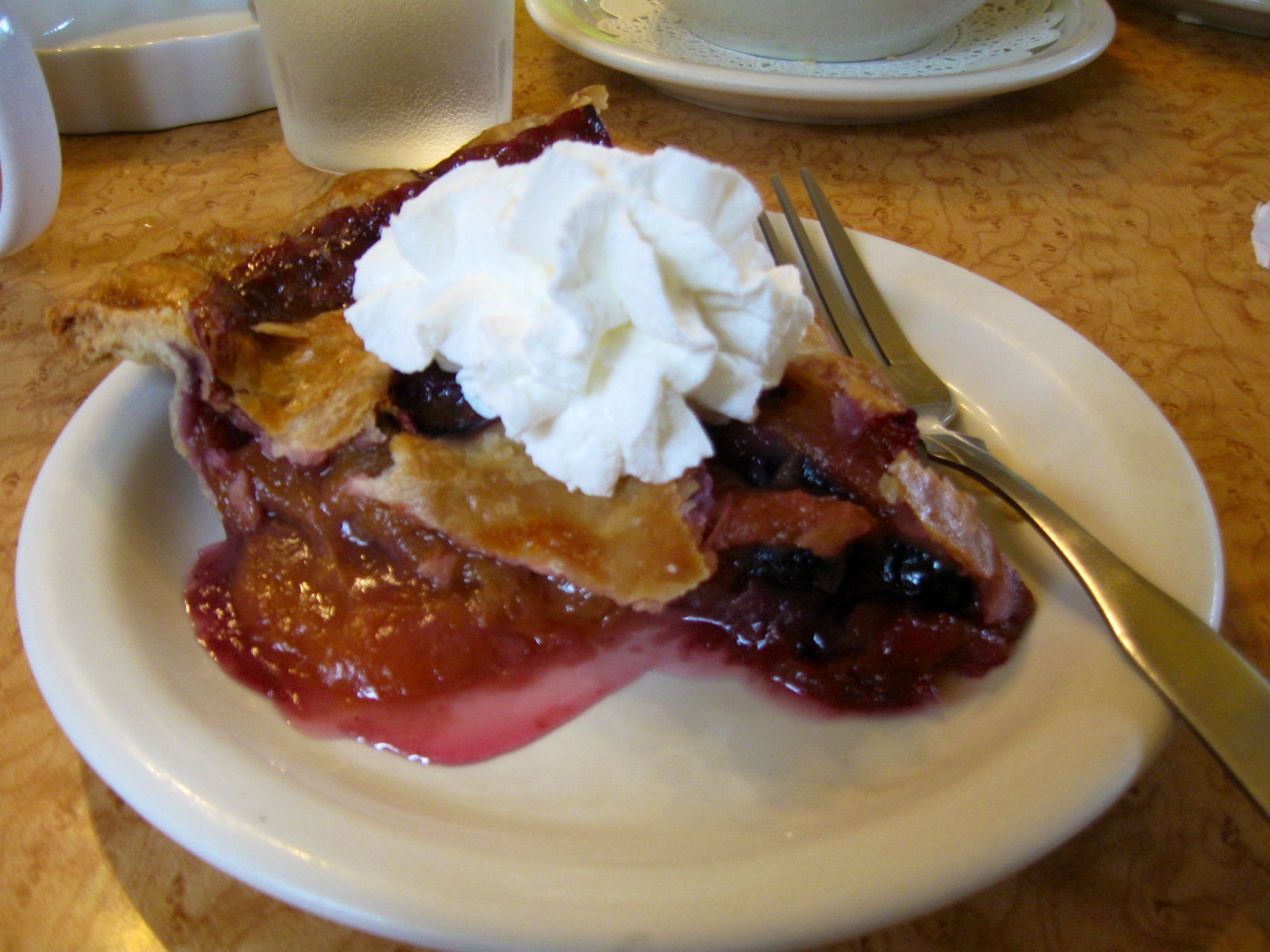
Another first for me: Blueberry-Peach
A map of Hope posted on the wall of the cafe showed that in my effort to avoid turning down a mudded road, we missed about 80 percent of Hope hidden in the trees. (Lesson: Never give up on Hope too quickly.) Leaving the bikes safely parked in front of the Discovery, we hoofed it through the trees to see what we could discover. A few hundred yards along a dirt road into the forest, we found several small cabins, a fix-it store, and, to my delight, a small local museum which we stepped into and back in time.
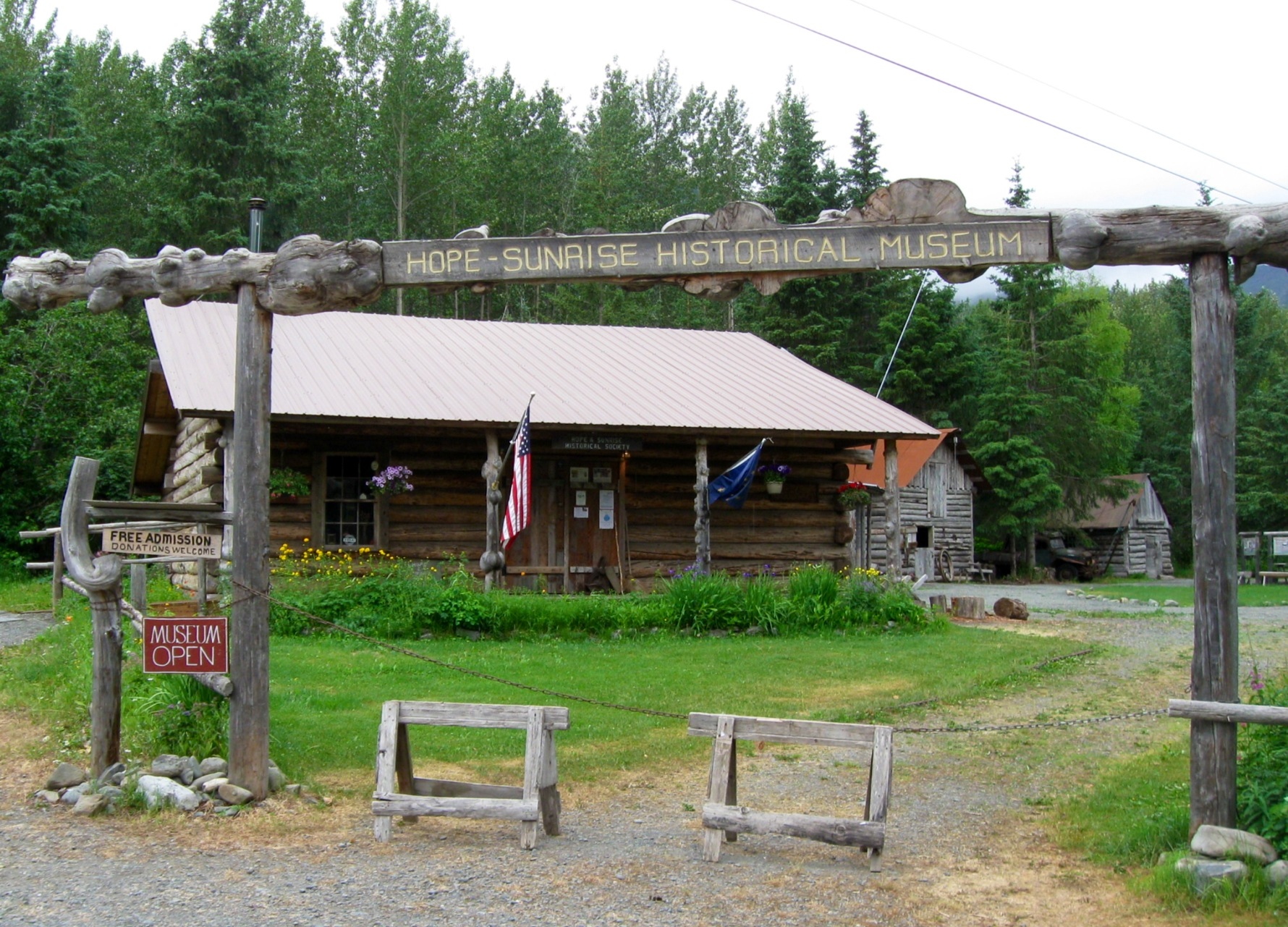
The Hope Museum keeps Hope alive.
The docent at the museum had answers to most of our questions as we perused the artifacts of Hope’s history but assured us that Billy-out-back would be a better source of information. As we were pondering whether to stay a while longer, Billy-out-back came in. And our real lesson in Hope began.
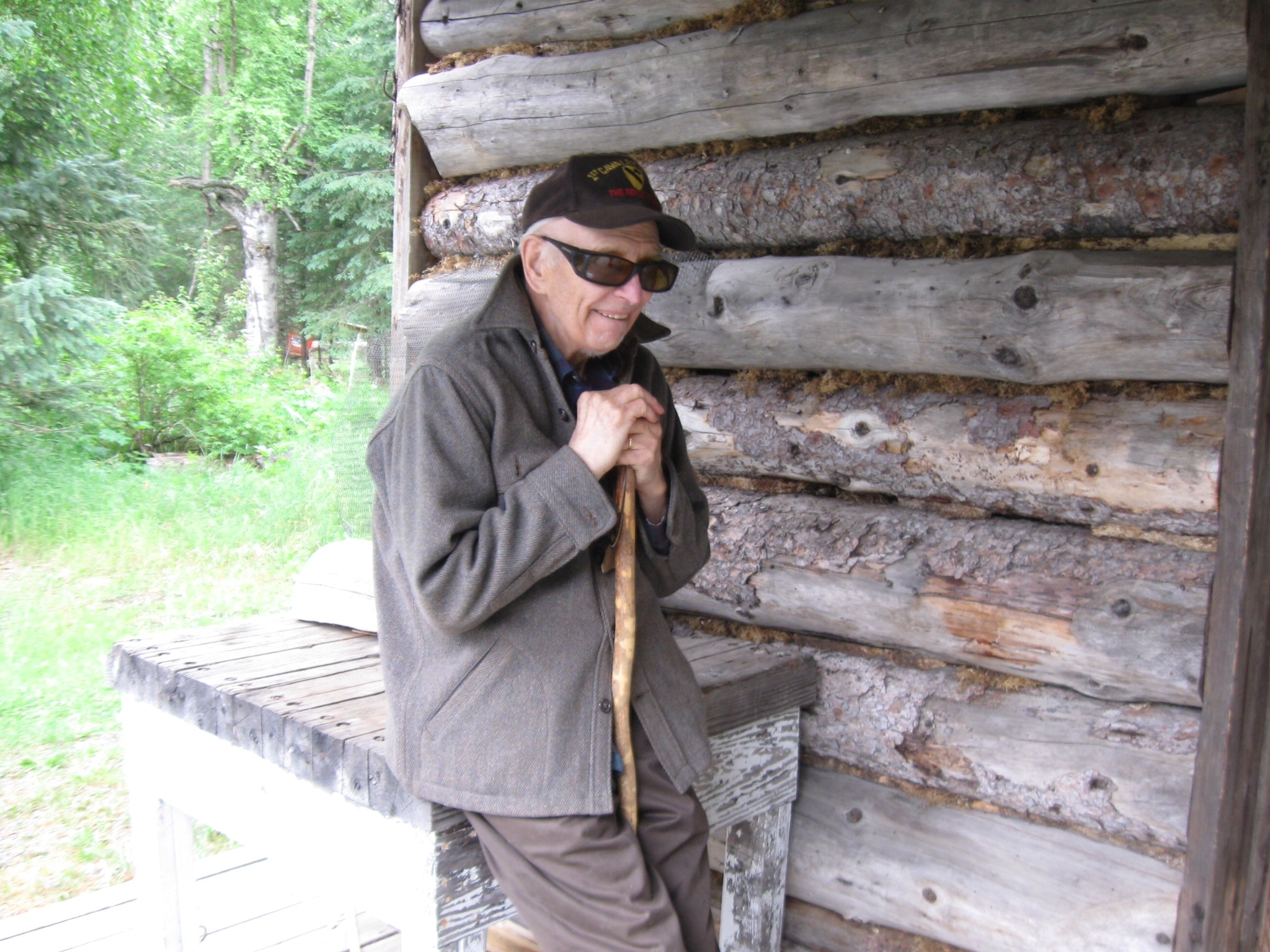
Bill Miller: Hope Historian
Bill Miller, an 88-year old, nearly blind, long-term resident of Hope, turned out to be a font of knowledge, not only about Hope but about gold mining in the area more than 100 years ago when Hope was born and christened in honor of the youngest resident miner, a 17-year old who sought to make his fortune in the Resurrection Creek mining district. Bill was there for the great Alaska earthquake on Good Friday, 1964, and he had stories about most of the people who lived in or near Hope for more than half a century.
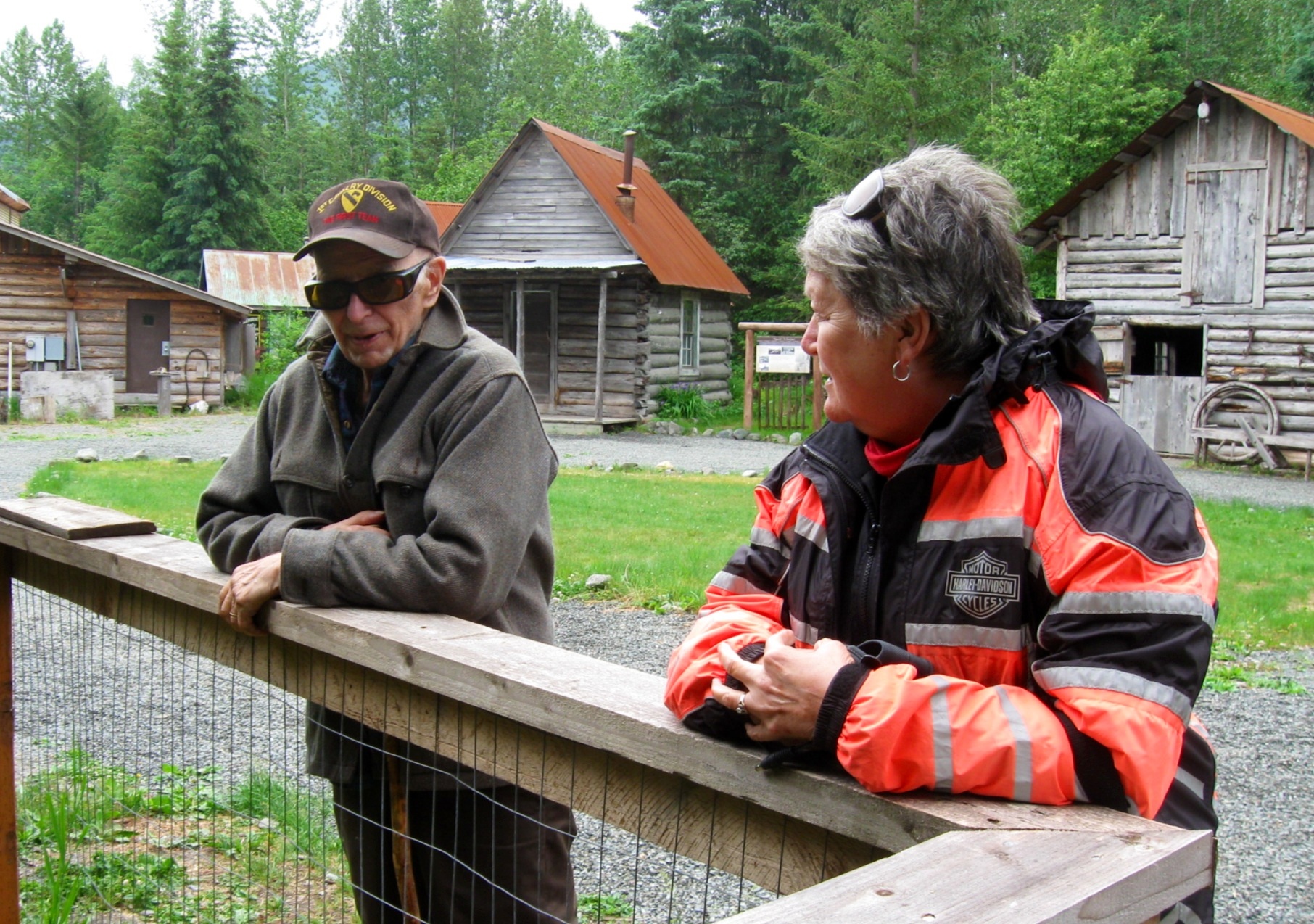
Bill Miller passes on Hope to Marilyn.
Bill Miller’s life for the past 30 or more years has been dedicated to preserving Hope’s history and several of its buildings that had been moved to the museum grounds and which he had reconstructed as necessary to save them from ruin and oblivion. Bill had done our little tour many times, it was evident, because though almost sightless he walked us to each building in the collection, opened the doors and told us the stories of the 1904 school house, the blacksmith shop, the miners’ bunk house, and a four-stall workhorse barn. Along the way, he told stories of moving the town inland half a mile following the earthquake because as the land sank, the tide rose and each year the town flooded twice at high tide. So the people moved the school, library, stores and houses. They were trying to keep Hope alive.
Hope is now home to slightly more than 150 people, though that number varies from year to year. This year three new families moved to town and several new babies made their appearance. And the new school, in danger of being closed for lack of students has a renewed lease on life.
There isn’t much to Hope. But it’s valuable to the people who call it home. And it’s valuable to those of us who believe that hope lies in the past as well as the future.
Tomorrow we’re headed for Homer and whatever we find along the way.
Great Alaska Adventure: Kenai Fjord National Park
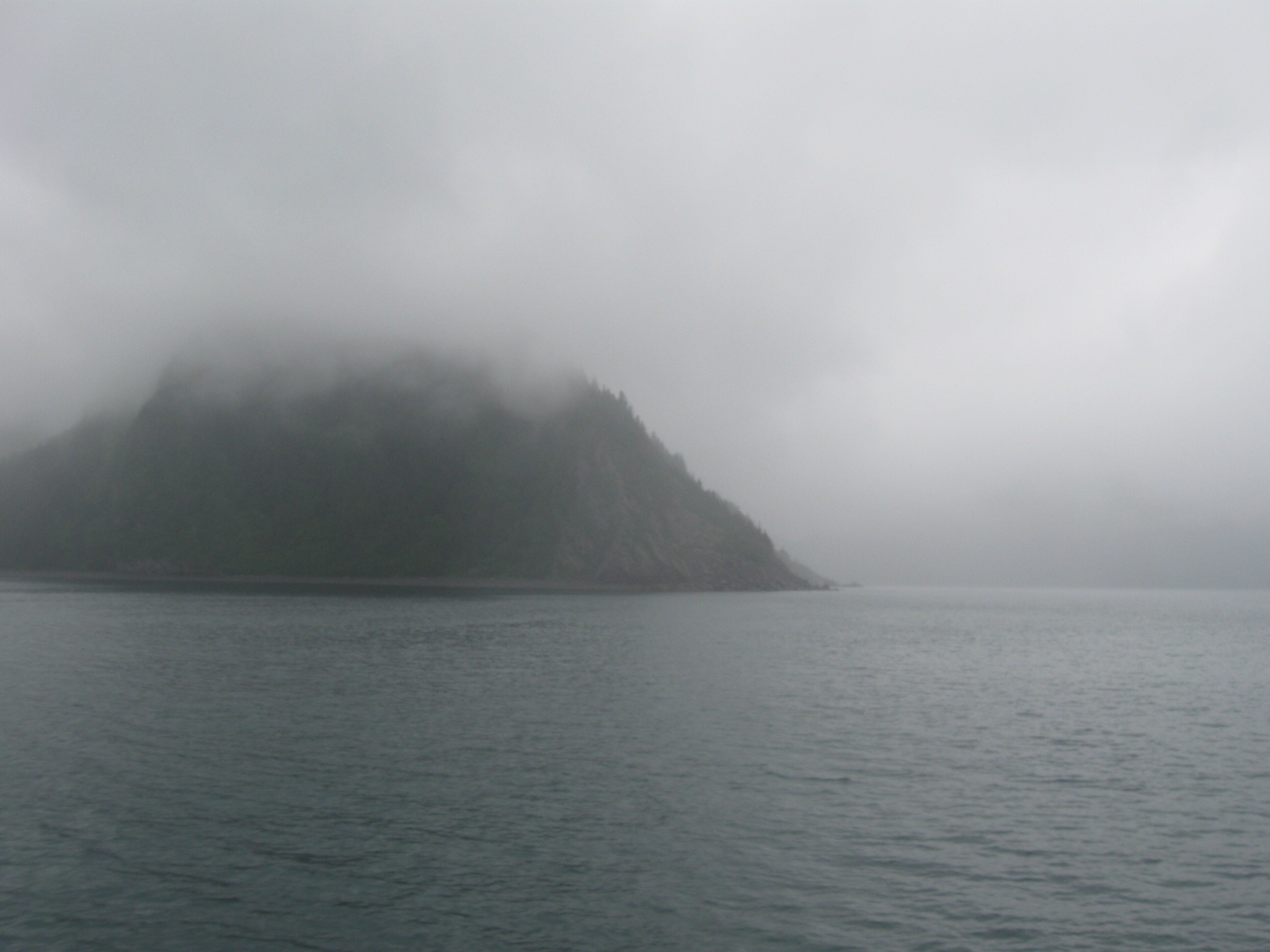
Foggy, misty, rainy. And still beautiful.
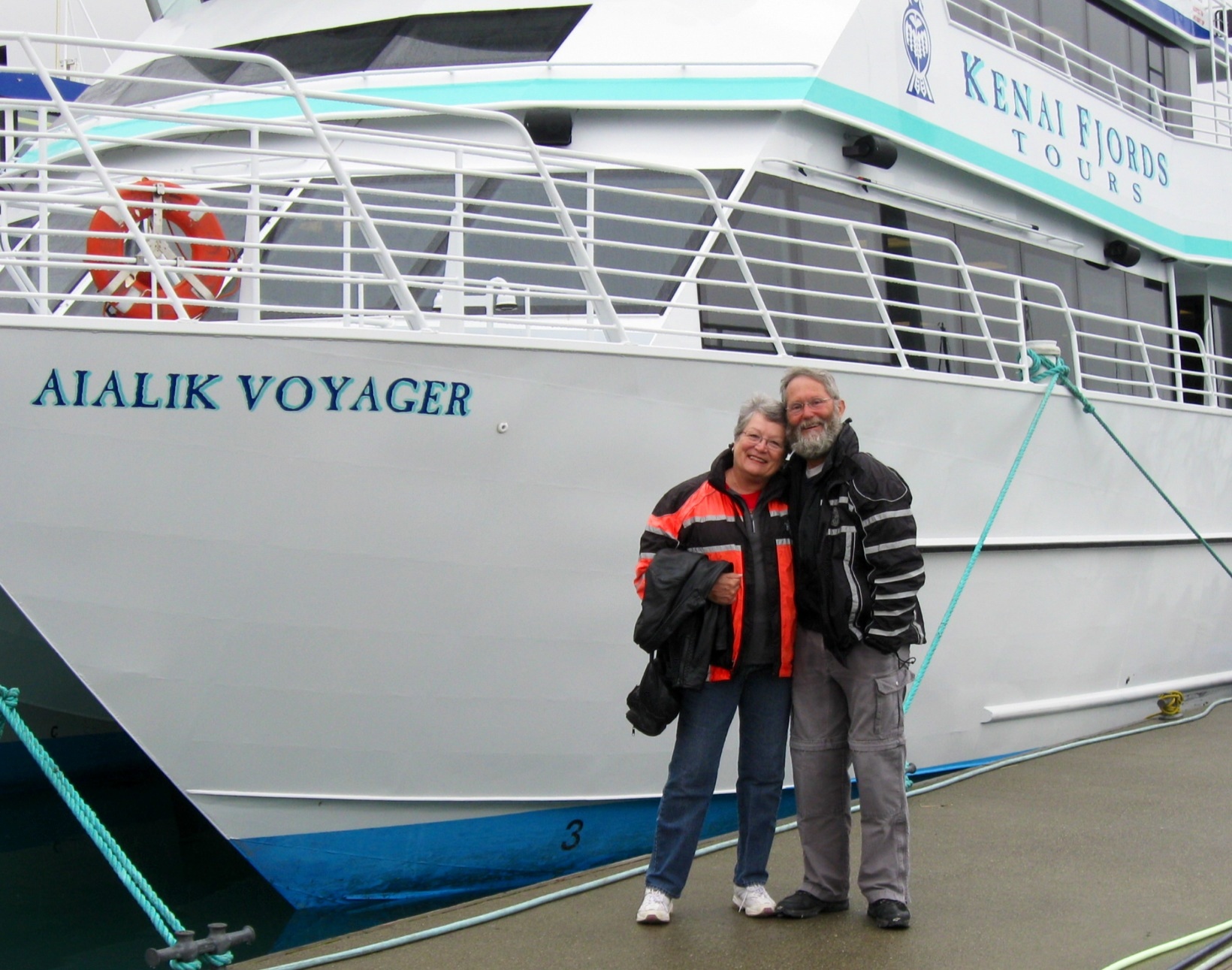
Today’s transportation out of Seward.
Today’s ride only went 95 miles round trip. And it took six hours. And it was on a boat. The Aialik Voyager, by name. And today’s numerous animal sightings were of the ocean-going kind.
After first ensuring we were not scheduled to sail on the SS Minnow, we signed on for a nautical tour of Kenai National Park and Kenai National Wildlife Refuge sailing out of Seward. The Aialik Voyager, a new catamaran owned by Kenai Fjords Tours could cruise at 26 knots (that’s 30 mph to you land lubbers) while allowing us to be warm and cozy inside with good service from the crew of three (plus the captain) but to go on deck when sightings were made. The warm and cozy was a good thing, because today’s temperature never rose above 60 degrees and at times dipped below 50.
The dramatic landscape featured sharp mountain-islands rising into the low hanging, ever present clouds. Early in the trip a misty, windy rain partially obscured the islands, but as we left Resurrection Bay and headed south into the Gulf of Alaska, the weather improved marginally when it quit raining. It wasn’t long before we had our first humpback whale sighting.
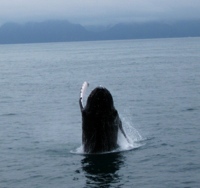
Humpback breaching with its 35-40 ton body.
Fortunately, the captain said, it was a happy playful whale that repeatedly slapped the smooth surface with its long dorsal fin or, even better, with it’s fluke. Every once in a while it would dive, disappear for 20 or 30 seconds then breach the surface, bringing the majority of its huge body out of the water and coming back down with a massive splash. The captain said that behavior is not seen often on the cruises because the whales are usually seen feeding, as were two other humpbacks we saw later in the day who dove, floated, dove again and floated again. The latter two were interesting. The first one was amazing.
We saw two different pods of resident Orcas (Killer Whales), the larger of which was close to the boat. We watched the black and white predators cleve the blue-green water for several minutes as they moved through their habitat hunting dinner. At the end of the stop, the 8-10 Orcas we had been watching began swimming in unison, rising to the surface, arching their dorsal-finned backs before a brief dive and then skimming along the surface again. It was like watching five-ton synchronized swimmers. Fascinating. The captain was able to identify some of them, but they all looked like Shamoo to me. By the way, Orcas are not actually whales. They’re the largest species of the dolphin family.
Between the whale sightings we also saw a pod of playful Dall Porpoises that swam back and forth across the bow wake like it was all good fun for them, frolicking for visiting Floridians. I wondered how you tip a porpoise for a good show, but I couldn’t come up with an answer. I think they do it for the fun of it. Just like riding a motorcycle
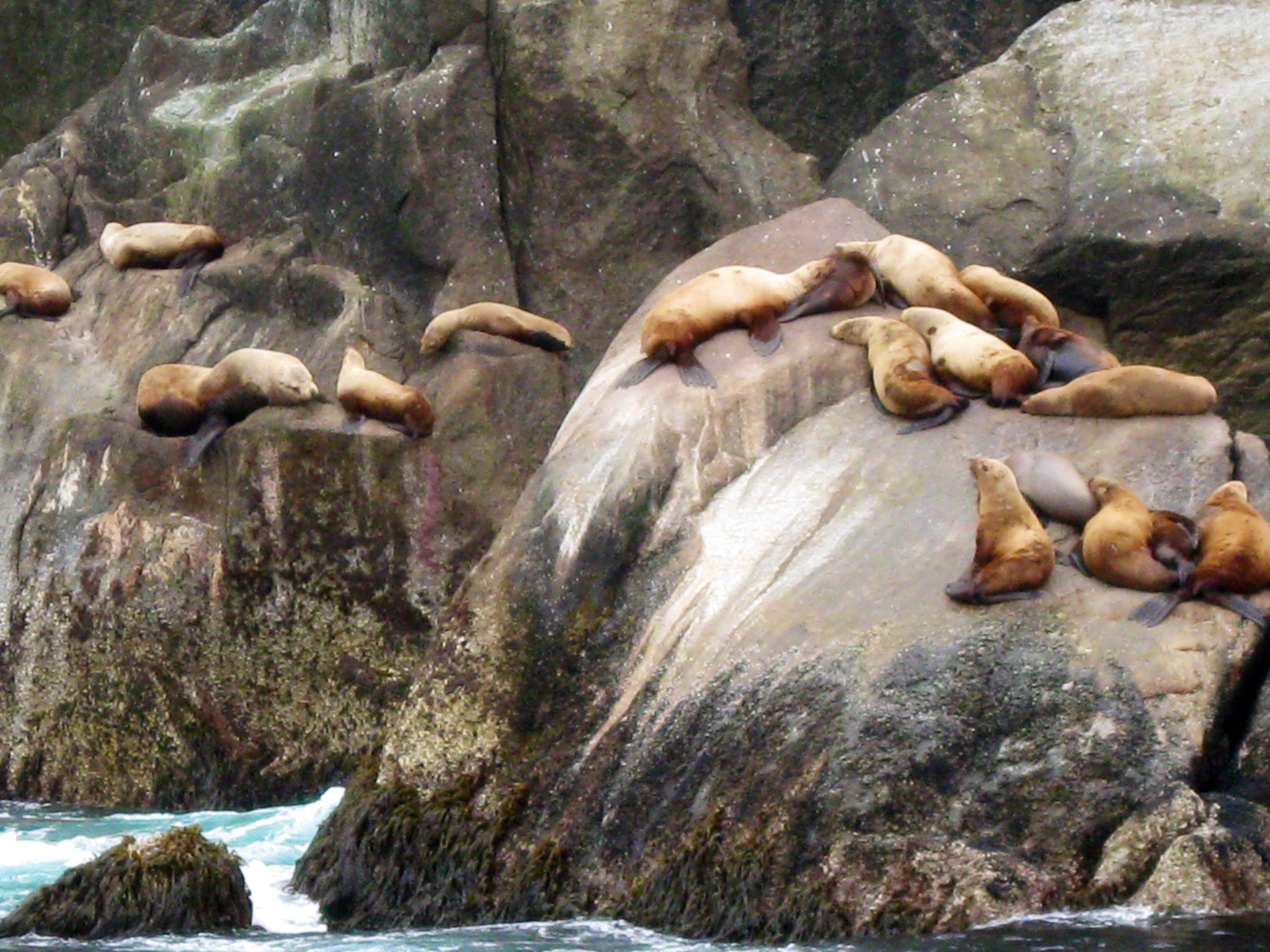
Stellar Sea Lions taking Sunday afternoon off and lounging on the rocks.
Less active, but interesting nevertheless, Stellar sea lions posed for the camera on rocks at the base of an inaccessible island, as did a half dozen seals at another location. And between the whales, porpoises, and seals, we watched colorful puffins attempt to land (and occasionally succeed) at their nesting areas high on the ledges of yet another stark rock island greenly capped on top by a small spruce forest.
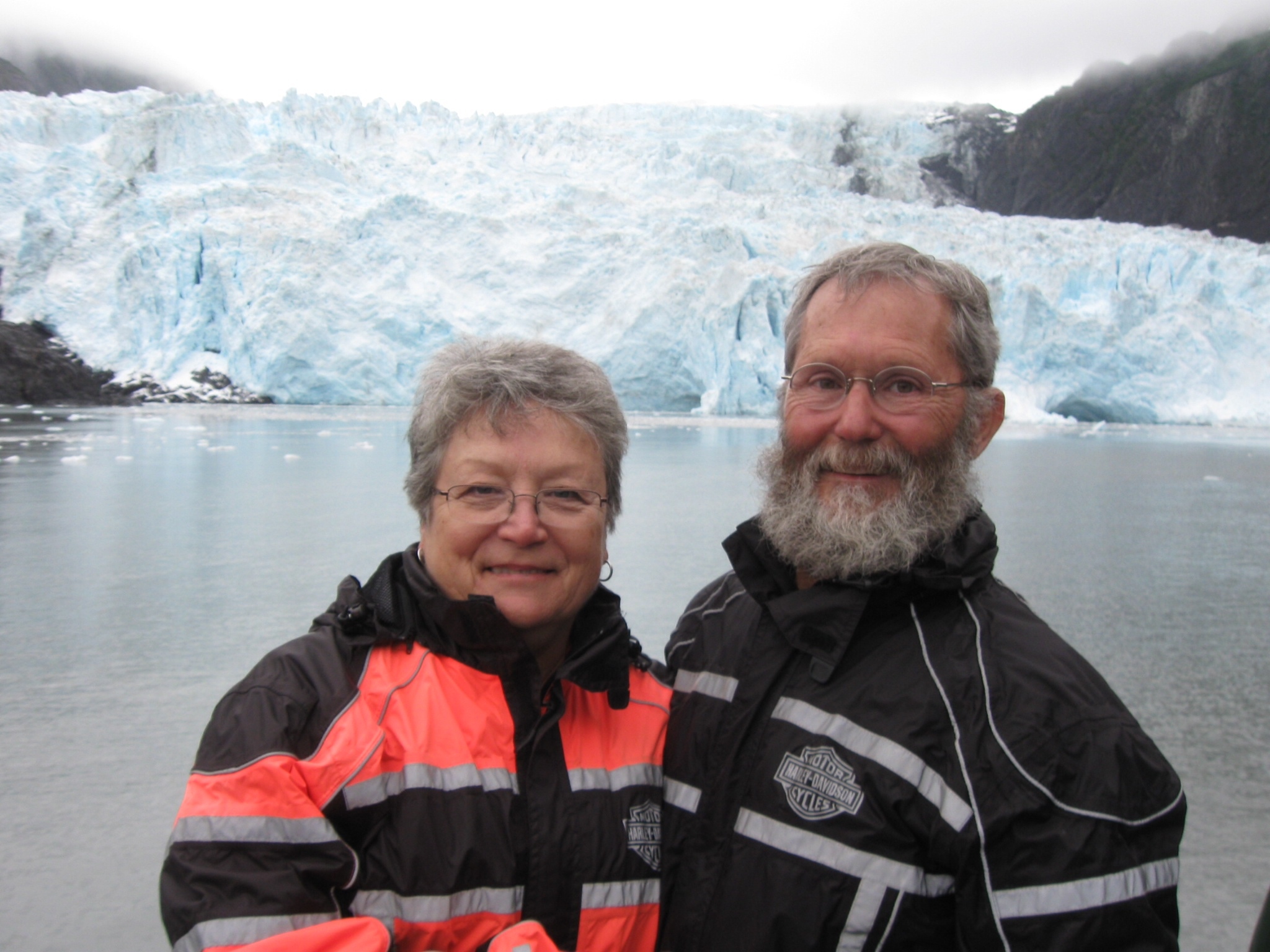
Adventurers at glacier’s edge.
Yesterday we walked to the edge of Exit Glacier. Today we boated to the edge (1/4 mile is as close as we were allowed to get) of Holgate Glacier, a part of the 700 square mile Richardson Ice Field. Exit Glacier is an extension of the same field. But Holgate Glacier was much bigger and much more dramatic as we floated soundlessly in the sound, listening to the living ice creak, grown and pop, continuing its relentless cycle of moving to the sea (at a glacial pace, of course) and breaking up.
Even small calving makes a great splash.
We even witnessed several small calving events as tons of ice broke off the front of the glacier and crashed to the water with a thunderous roar and a huge splash. We could see the small 3-4 foot waves created by the calving but were told that larger chunks can create waves 10-20 feet high when they separate and slide to the sea, which is why the boat maintained a safe distance from the glacier’s face.
The glacier was the last scheduled stop on the tour, but we did come dead in the water once more for the second humpback sighting.
Dinner again back in Seward. Marilyn is developing a high-priced halibut habit, but that’s all part of the adventure. It’ll be cold turkey for her once we’re back in Orange Park.
Rain in store for the next three days we’re on the Kenai, but we’ll brave the elements as best we can, heading to Soldotna tomorrow for a two-day stint that may include an excursion to Homer and a little fishing. At any rate, the adventure will continue.
Great Alaska Adventure: The Kenai
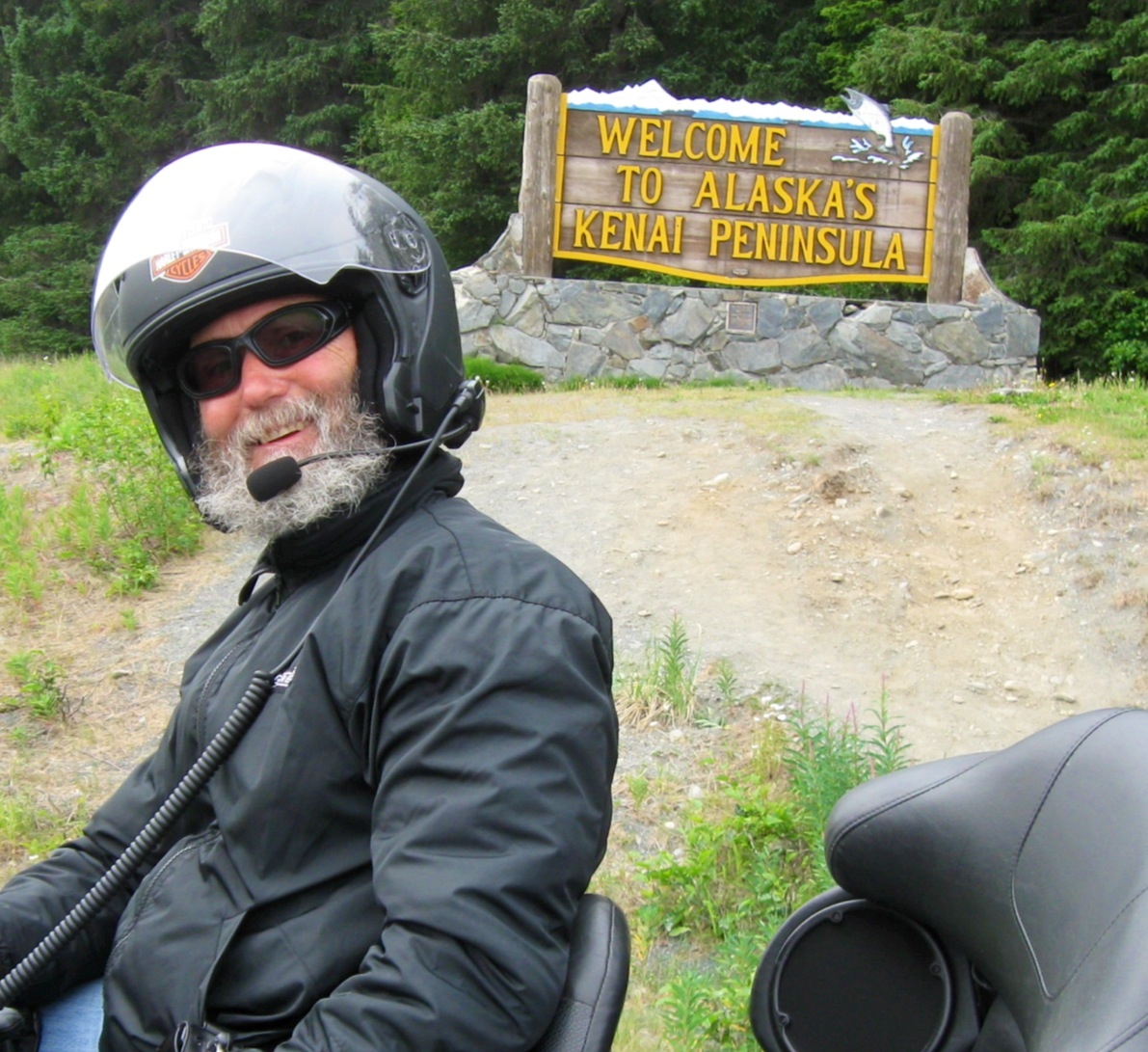
Made it to Kenai. The good times are definitely rollin’.
Kenai. Beautiful. The End.
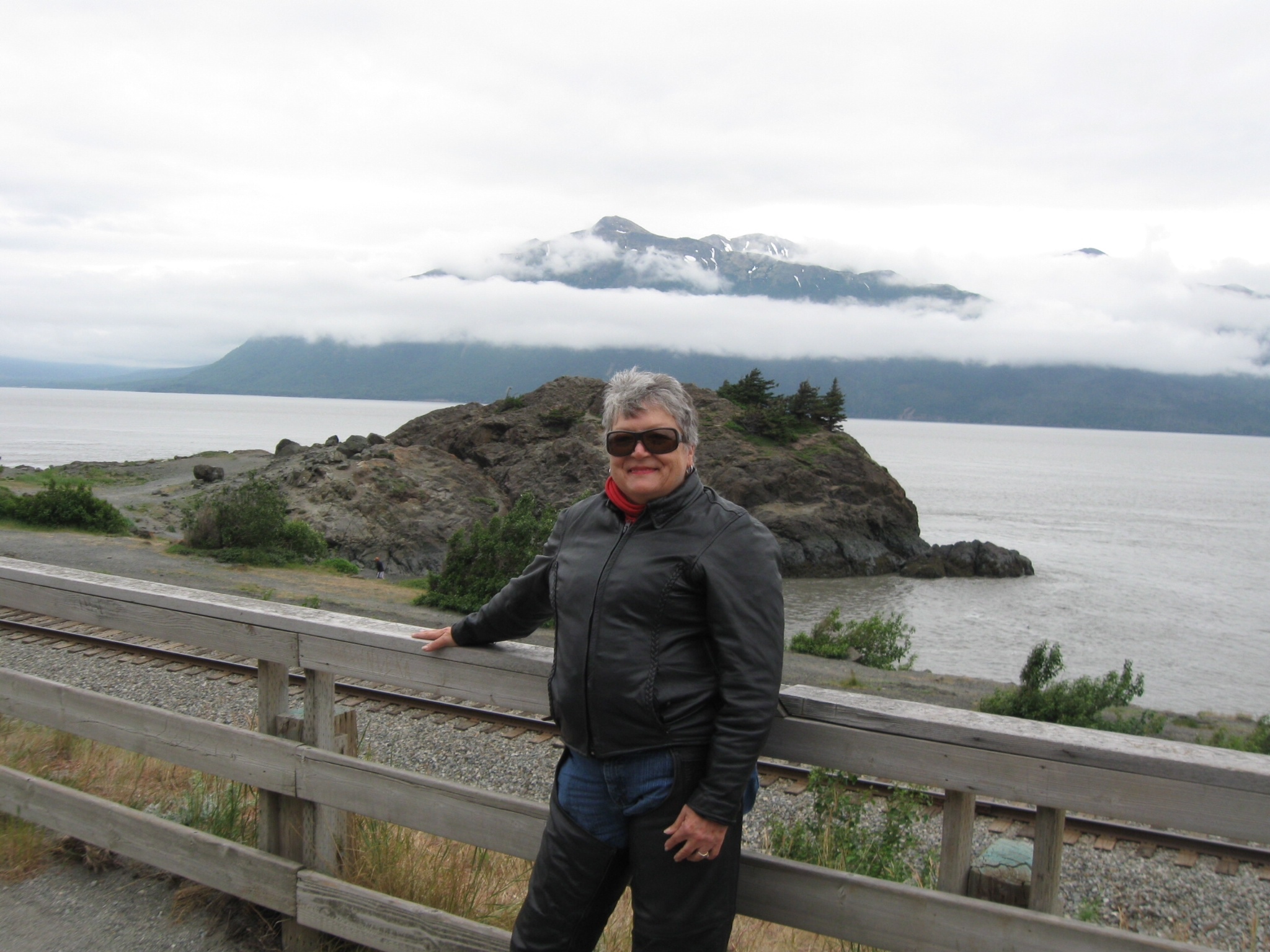
Turnagain Arm and the Kenai Peninsula on the far side make a perfect backdrop.
That could be the whole blog for today. A month after we embarked on the Great Alaska Adventure we arrived at Alaska’s Playground: The Kenai Peninsula. What a gorgeous country. As I expected, the day was overcast and low-hanging clouds obscured the tops of most of the peaks as we rode along the northern side of Turnagain Arm on the way to the Kenai. In some instances, though, the tops of the snow-streaked mountains reared majestically above the cloud layer. In some ways, I’m glad my introduction to the peninsula came not on a bright blue-sky day with plenty of sunshine. Today, I think, with cold and gray captured the essence of this spit of land on Alaska’s southern coast. The temperature probably didn’t climb above 60 all day. Properly dressed for the ride, Marilyn and I cruised along the mountain-framed highway, absorbing as much of the breathtaking beauty of Alaska as we could.
Portage Lake. Note the mini iceberg in the water.
We detoured to Portage Lake at the foot of Portage Glacier with the intent of going through the 2 1/2 mile tunnel to Whittier, but as I considered the time involved waiting for our turn to enter the tunnel and the risks for Marilyn taking her bike into the tunnel, we opted instead to visit the Portage Lake Visitor Center. The well done exhibits there helped us understand more about the land we were in and the animals (especially fish) that inhabit this wild place. Every time I visit a museum, a visitor’s center or even stop to read road-side information plaques, I learn more about and expand my appreciation for Alaska.
Just a hint of blue skies before clouds covered it.
There are so many things I won’t be able to see or do while I’m in Alaska for less than two weeks that I would like to do. Even though I planned this trip for years, when I finally get here I discovered how much there really is to see and do. I’ve said it in earlier blogs but I’ll repeat myself again tonight: I’m coming back. And probably more than once. And maybe even in the winter (but not on a motorcycle). I’m so much in awe of this place. The pitiful pictures I take and the weak words I write don’t do this place justice. But when you see me coming back again and again, you’ll know how special this place is. To me. And apparently to thousands of other damn tourists who clog the roads, trash the roadsides and drive up the price of food and lodging. I suspect true Alaskans have mixed feelings about those of us who intrude from the lower 48. They like our tourist dollars but they probably aren’t as thrilled with what we’re doing to their Alaskan slice of paradise.
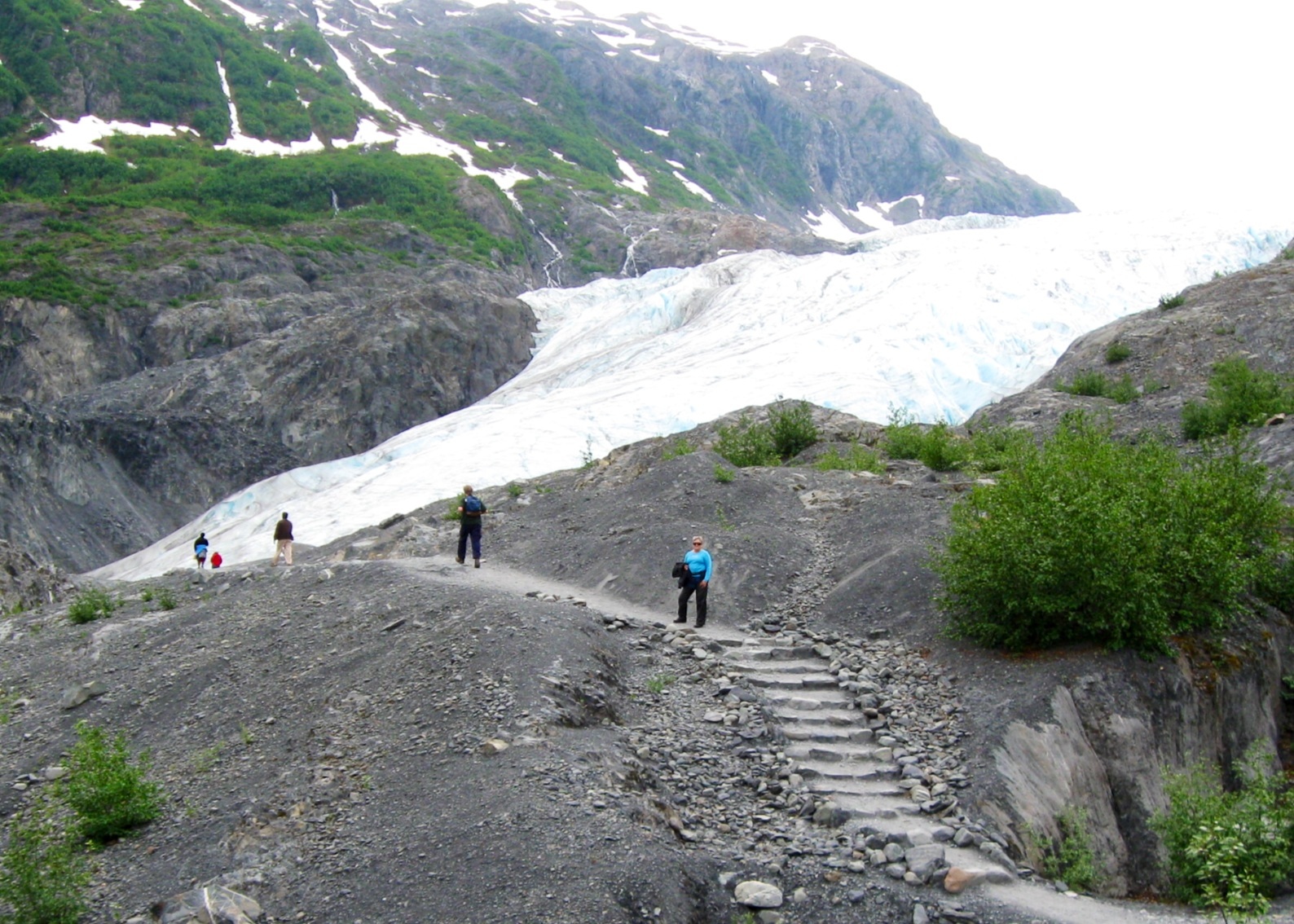
Marilyn (blue shirt) conquers the mountain on the way to Exit Glacier.
On the way to Seward, our destination for the day, we took a second detour, this time to Exit Glacier. I had hoped to walk on the glacier but after a 40 minute climb up a wooded then rocky mountainside we could only approach but not actually get on the glacier due to large crevasses, heavy melt-water, and the danger of unstable ice. I’m not sure how big the mountain was we climbed, but when Marilyn returns to Orange Park, her version of the story will no doubt place this mountain second only to Denali in the entire state of Alaska. Seeing the glacier up close was worth the climb and learning that it’s receding faster than my brother Kent’s hairline was eye-opening. In about 100 years the glacier has shrunk to 3/4 of its early 19th century size and the rate of melting has been documented and has been increasing in the last couple decades. Future generations will almost certainly not have the opportunity to see the Alaskan (and other) glaciers that have been around for tens of thousands of years. That will be a shame.
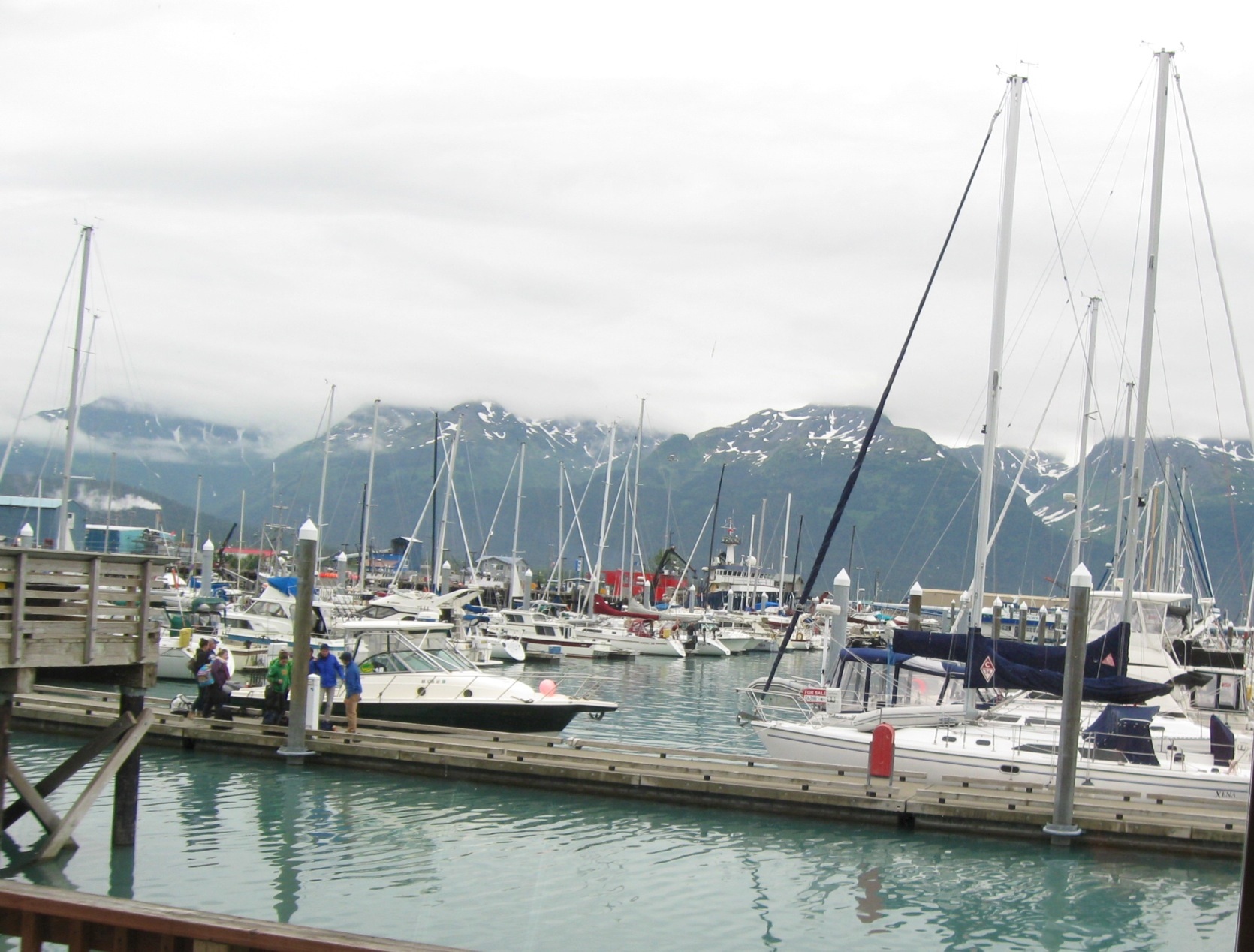
Small boats and cloud-enshrouded mountains were our dinner companions.
We arrived in Seward for our two-day stay hungry and ready for fresh seafood in this fishing port town. We weren’t disappointed by the suggestion made by the motel clerk who checked us in and directed us to Chinook’s for dinner. All the fish they serve is Alaskan and it’s fresh. Yesterday my salmon and Marilyn’s halibut were happily minding their own business in their native habitat and today they satisfied our fishy dietary cravings. We very much appreciated their sacrifice on our behalf. Not only was the dinner the best we’ve had in a long time, but the scenery outside the floor to ceiling windows next to our table added an ambience not found at most McDonalds or Taco Bells. A glass of Jack Daniel’s Single Barrel and two delicious Washington state wines were the perfect beverage accompaniments. Aaahhhh, life is good.
Tomorrow we’re not riding, but will be on a cruise going to several glaciers in the Kenai Fjords National Park while whale watching and checking out other marine creatures. Man does not live by Harley alone, after all.
Great Alaska Adventure: The Alaska I Expected
A gray, overcast day greeted us as we stepped outside to load the bikes this morning, a lugubrious beginning to a day that developed into the Alaska that I had expected but had not yet encountered. I had hoped that as we went south, beyond the Alaska range we would be able to turn around and see a clear view of Denali (aka Mt. McKinley) in all its vertical snow-covered glory. But it was not to be.
We didn’t have far to go today, only 250 miles to Anchorage, so we allowed ourselves a relatively late start (8:30 a.m.) in an effort to catch-up on the lost ZZZZZZZs that resulted from working on yesterday’s blog at midnight. We stopped for gas about 12 miles into the day’s ride and Marilyn realized she left her preferred drinking cup back at the hotel. Bad news was I had to go back and get it. Good news was I went back to get it by myself, which meant that I could, at last, put a little pace on the bike. For the first time since we left Orange Park, I pegged the speedometer at 30 mph over the speed limit and leaned into some nice curves along the Nenana River, a tributary that helps form the eastern boundary of Denali National Park. I think I may hide Marilyn’s cup every morning. I imposed the standard throttle restriction on myself the rest of the day and putted along at slightly under the state mandated speed limit like a good boy.
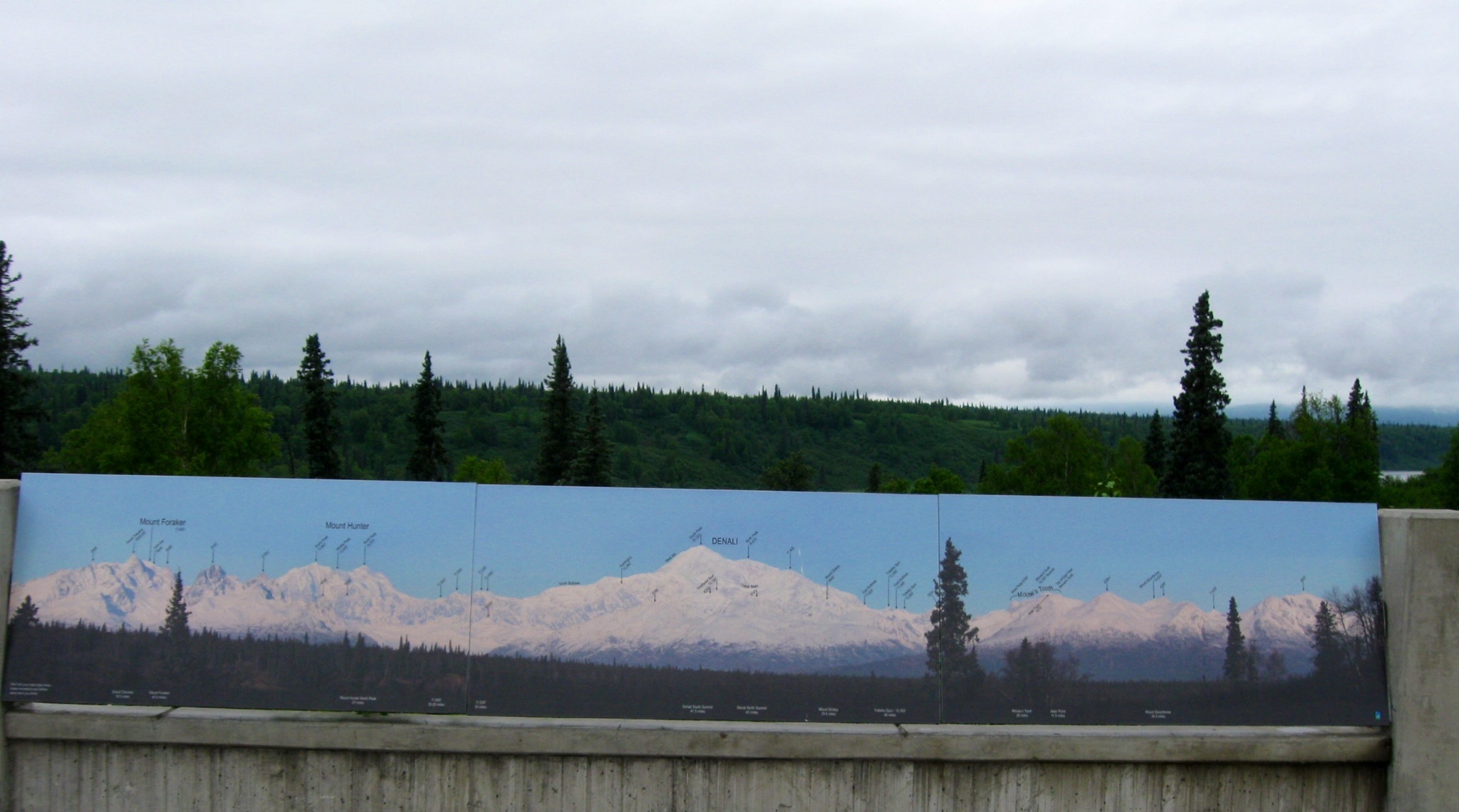
Bottom half shows what I wanted to see. Top half shows what I actually saw.
A few miles south of Cantwell, at about the spot I expected to begin to see a view of “the high one,” the temperature dropped from about mid-60s to mid 50s and we began to get rain. We quickly found a wide spot in the road and pulled in to suit up as the rain began to get heavier. We managed to don our Harley Davidson rain suits without too much trouble and took the time to put on heated jacket liners to replace the leathers. Marilyn had used hers on several occasions, but this was a first for me. What a treat! Thanks Brian for the loan. A liner of my own is in the cards when I get back from this trip. The rain would turn to mist, then clear, then back to mist, then rain again for about 100 miles before the precipitation finally stopped. But the skies stayed gray and overcast the rest of the day and, after temperatures in the 90s two days ago in Fairbanks, we never saw the 60s again after 10 a.m. today.
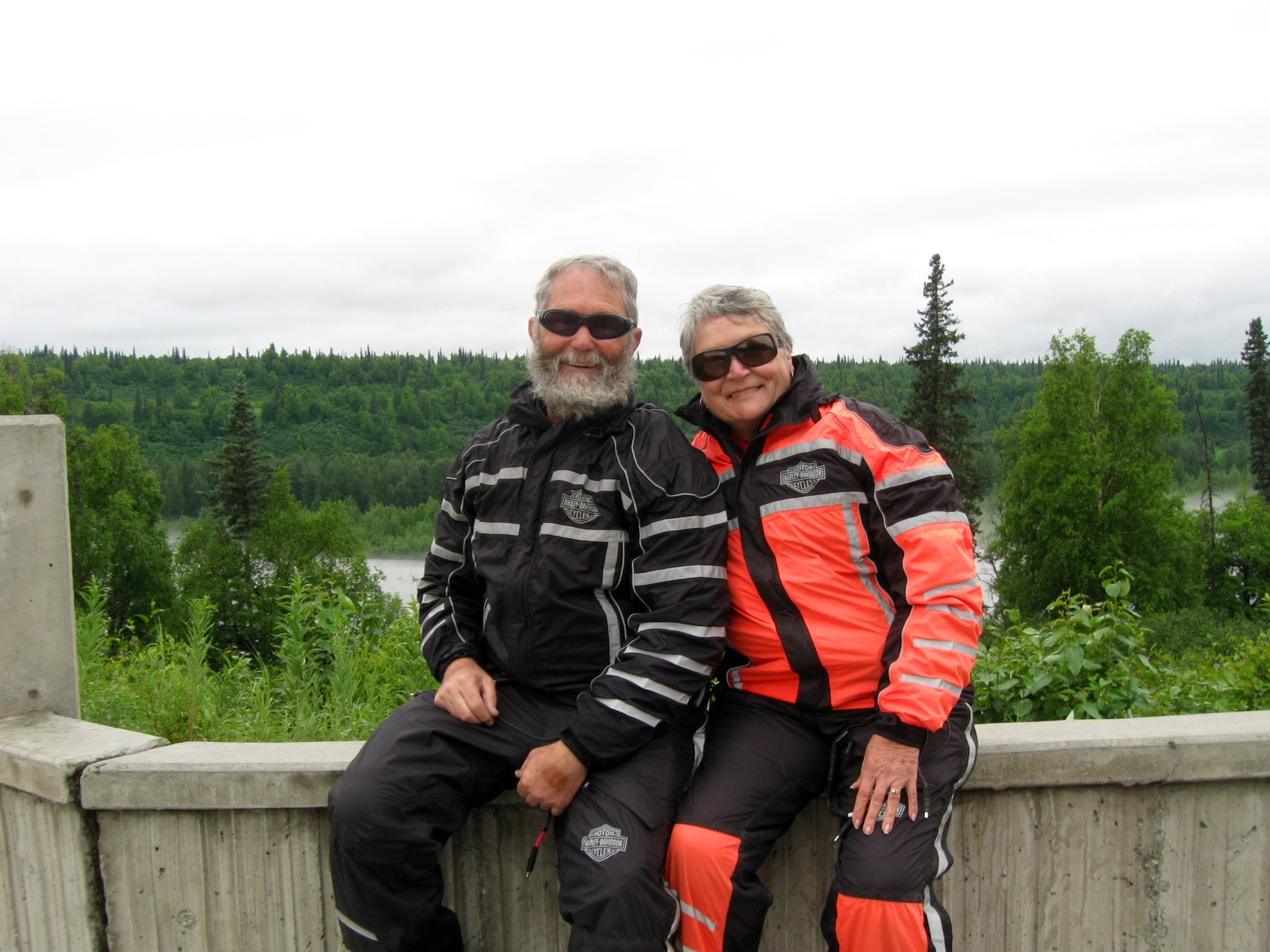
Uniform of the Day: Foul Weather Gear
But I was’t surprised or disappointed. I had heard and read that the southern part of central Alaska is like this frequently in the summer and that travelers to Alaska should therefore appreciate the blue sky, 70-degree days all the more. I know they’re lurking nearby and expect to enjoy them some of the time we are on the Kenai.
Since I didn’t have a chance to enjoy the wonders of Denali on a clear day, we took advantage of the final break in the rain to back track 15 miles on the Talkeetna Spur. Talkeetna is both a tourist town and the take-off point for flights to the glacier where many of the Denali climbs begin. I would like to have had time to spend an hour or two in the town just walking around, but I needed to get to Anchorage by six because I wanted to pick up the headset parts for Marilyn’s helmet that had been shipped by J&M Audio to Alaska Leathers. I made the pick up in time and managed to replace the wires and cords I needed to resume bike-to-bike communication tomorrow. There still seems to be a buzz during transmission, but I will try to work on that in the next day or two.
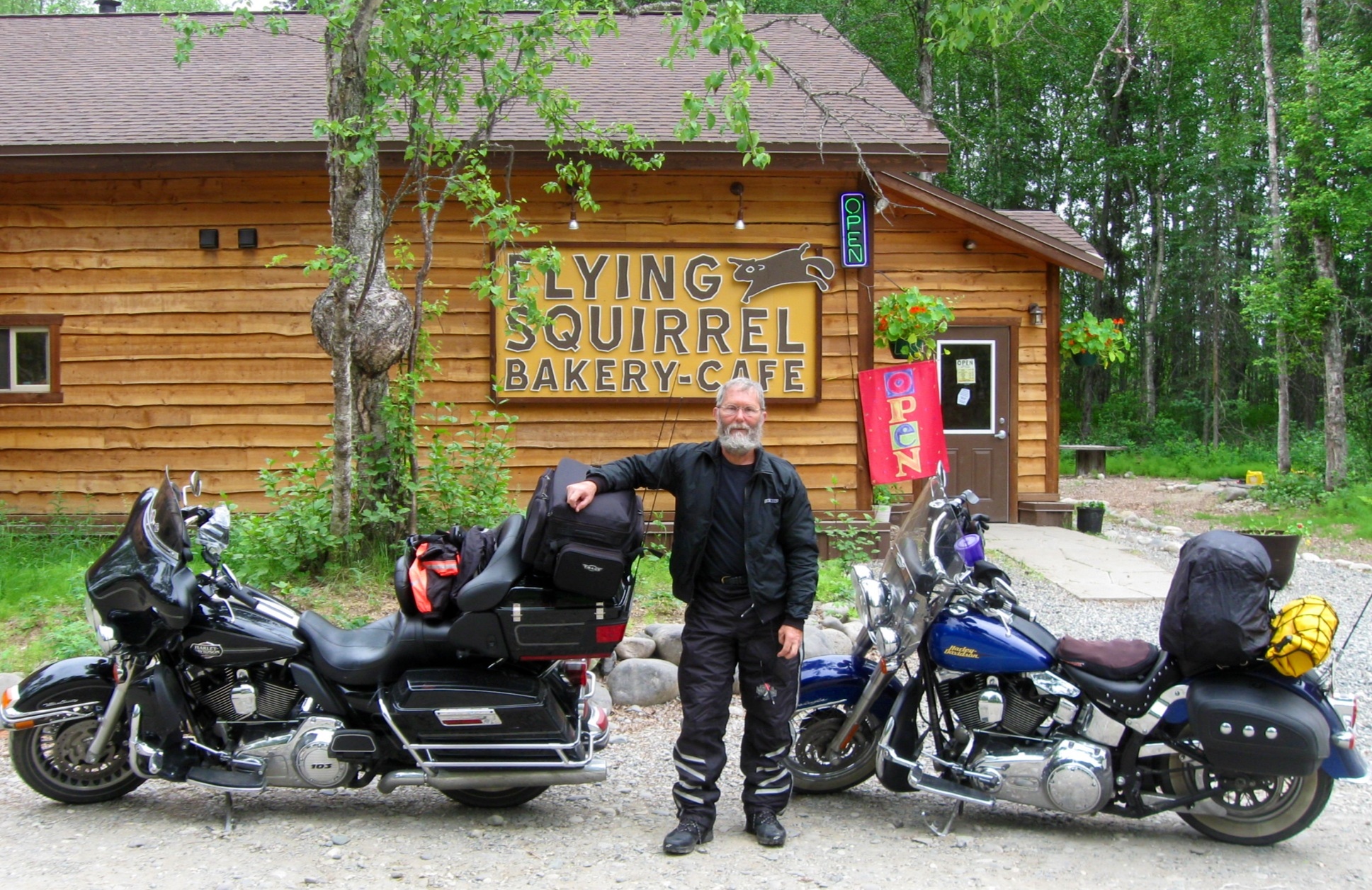
Flying Squirrel Bakery-Cafe
While in Talkeetna, we dined at the all-organic Flying Squirrel Cafe and Bakery. Good sandwiches on freshly baked bread, chili made with organic beef, and a slice of chocolate peanut pie, naturally made with organic peanut butter. Good coffee and really nice people. I like finding those kinds of unique eateries.
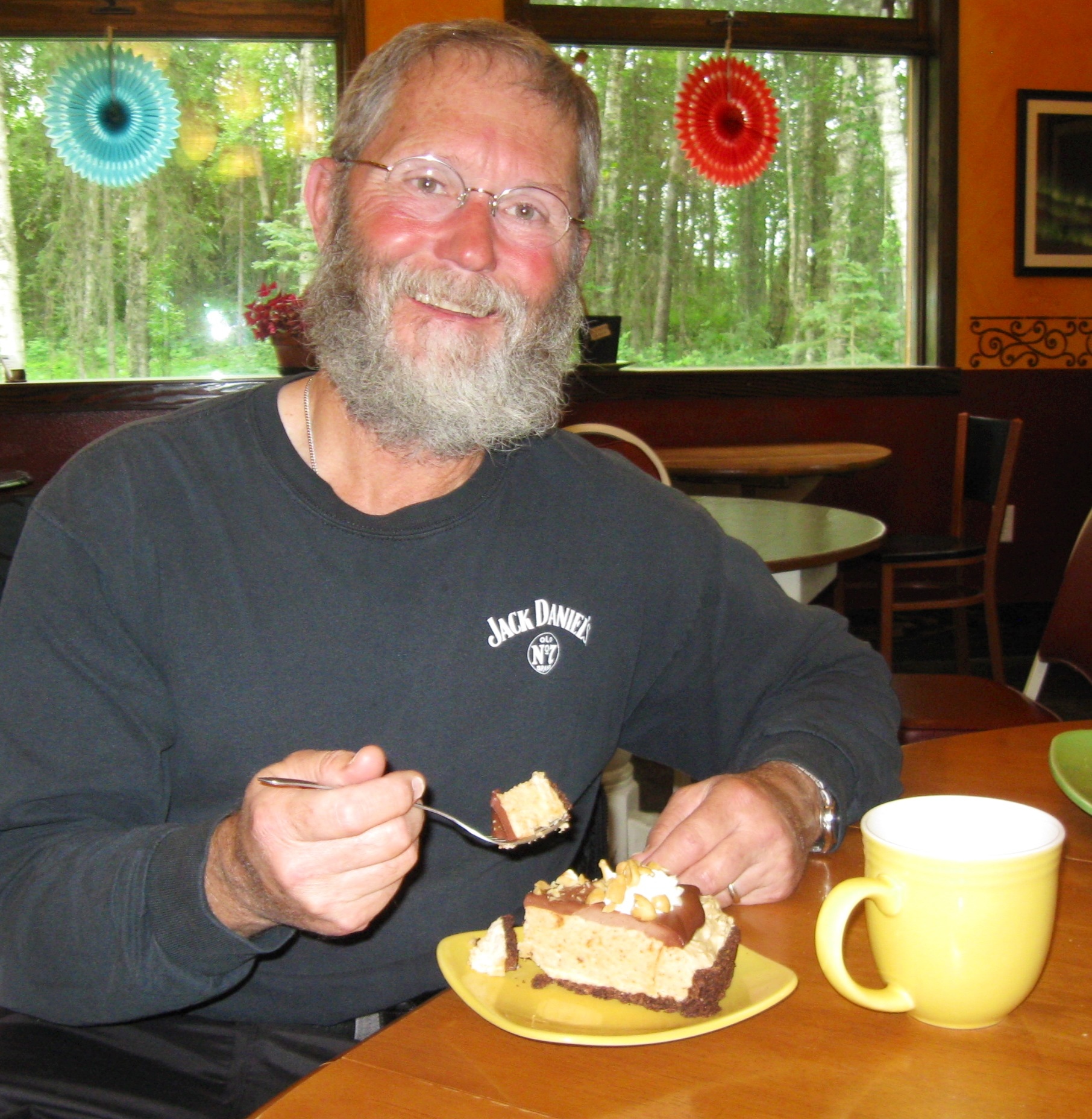
Peanut Butter Pie–another pastry first for me.
Other than the cold and rain, which, while uncomfortable, wasn’t too bad since we were properly prepared for both, the ride was good except for the obligatory muddy, seven-mile stretch of road construction, punctuated by several ominous “Especially Dangerous for Motorcycles” signs. Slid around a little in the mud but kept the bikes moving and upright. The two hours I spent two days ago cleaning the bikes seems pointless. I think the only clean motorcycles in Alaska must be in garages or on showroom floors.
I saw three moose today (Marilyn saw two of them), including one that was trotting along the side of the road, obviously wondering if that instant would be a propitious time to make a 90 degree turn onto the asphalt trail being used by two rumbling interlopers. Fortunately, she decided to maintain her straight-ahead course until after we passed. Did you know that 700-800 moose are killed in Alaska each year by cars. The total number of moose/vehicle collisions is of course, much higher. Moose antlers are impressive, especially when mounted on a wall above a fireplace, but as a whole I think moose are the ugliest ungulates in the forest.
Tomorrow we head for Seward for the first of four days on the Kenai Peninsula. It looks like the rains will be limited in Seward over the weekend, and we’re hoping to go on a glacier cruise in the Kenai Fjords National Park and Prince William Sound. Looking forward to an active next four days but only limited riding.
Great Alaska Adventure
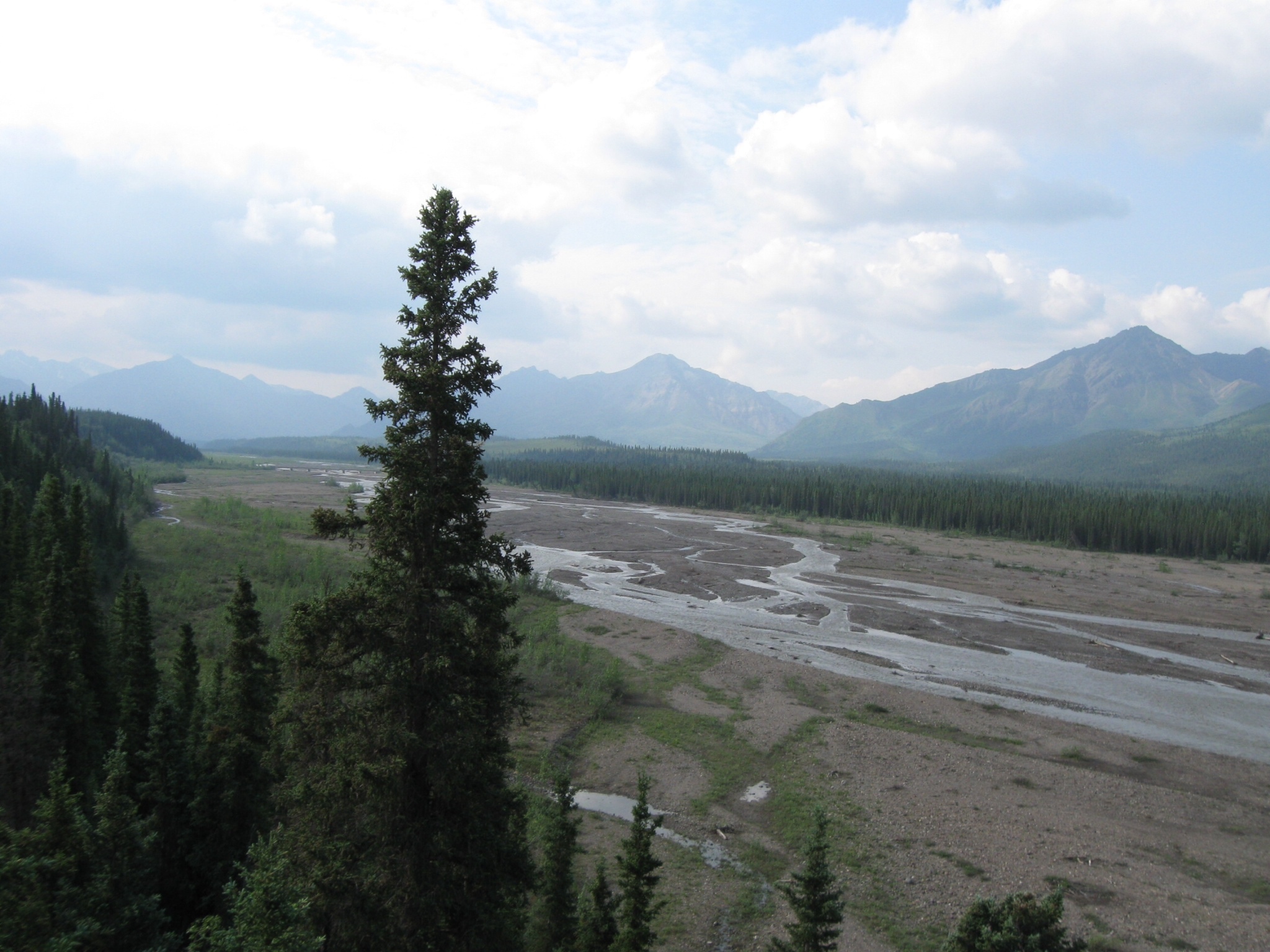
On the park road inside Denali National Park
A short ride from the Nord Haven Hotel in Healy this morning took us to Denali National Park and Preserve where we spent 11 hours riding a shuttle bus in one of the last true wilderness areas in North America. Denali was first created as a National Park in 1917 and was substantially enlarged in 1980 with the addition of several wilderness areas that have severe restrictions on human activities, including taking private vehicles into the park. It’s the third largest park in America and contains the tallest mountain in North America: Denali to Alaskans and Mt. McKinley to the rest of the world.
We learned today that a concerted effort is underway to officially change the name of the mountain to Denali since President William McKinley had nothing to do with Denali or Alaska. Denali means “high one” to native people in Alaska. It should, since its peak is more than 20,000 feet above sea level. The 100th anniversary of the first ascent was June 7 and a group of climbers, including relatives of the first men to reach the peak, are currently retracing the original route.
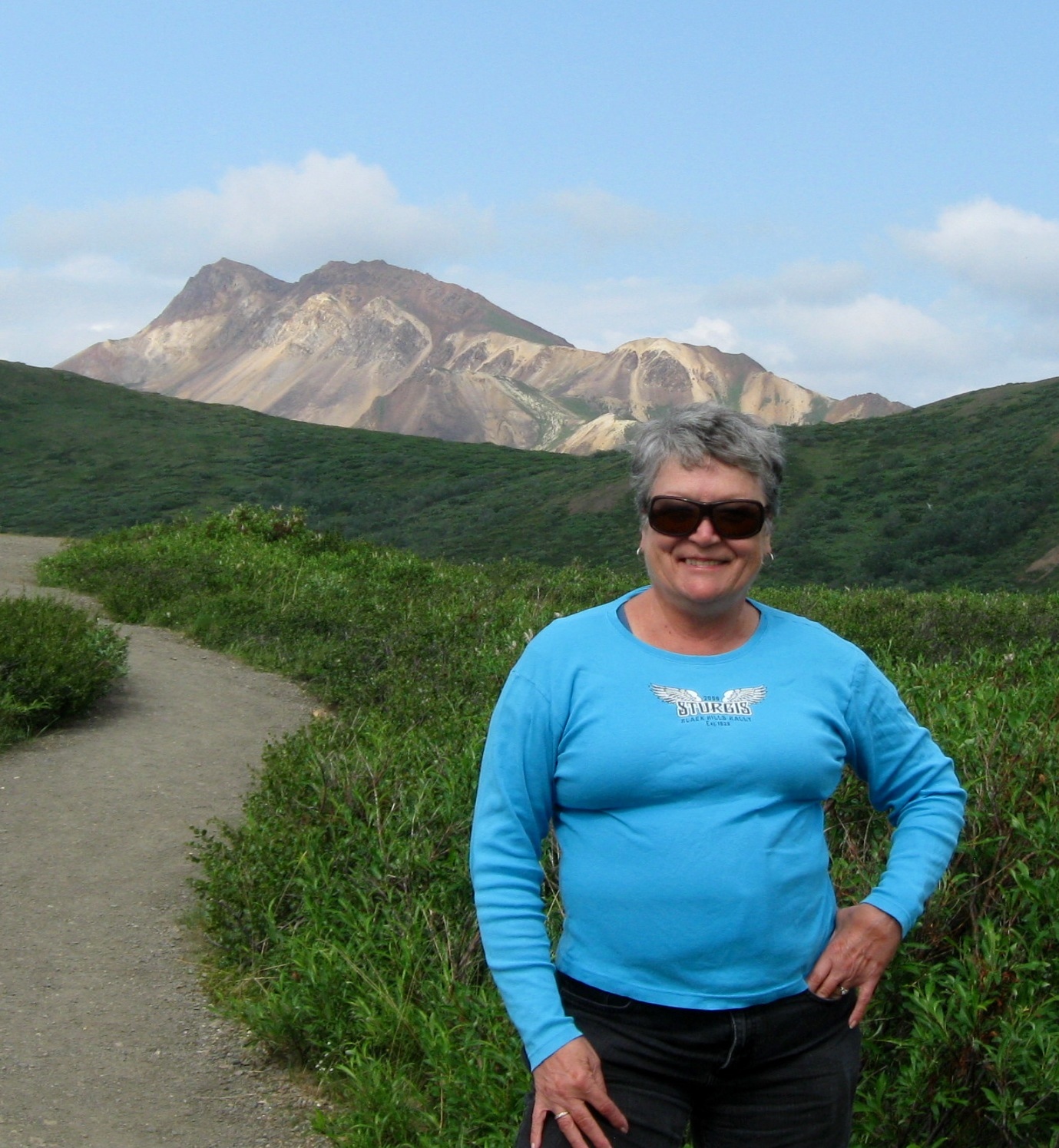
Beautiful subject matter.
Unfortunately for us, clouds enshrouded Denali, as they apparently do to about 90% of the people who visit the national park. The mountain, it seems, has its own weather system and it’s often very windy and cloud covered, which makes the 1,200 or so ascent efforts each year difficult. Only 50% of those who try make it to the top.
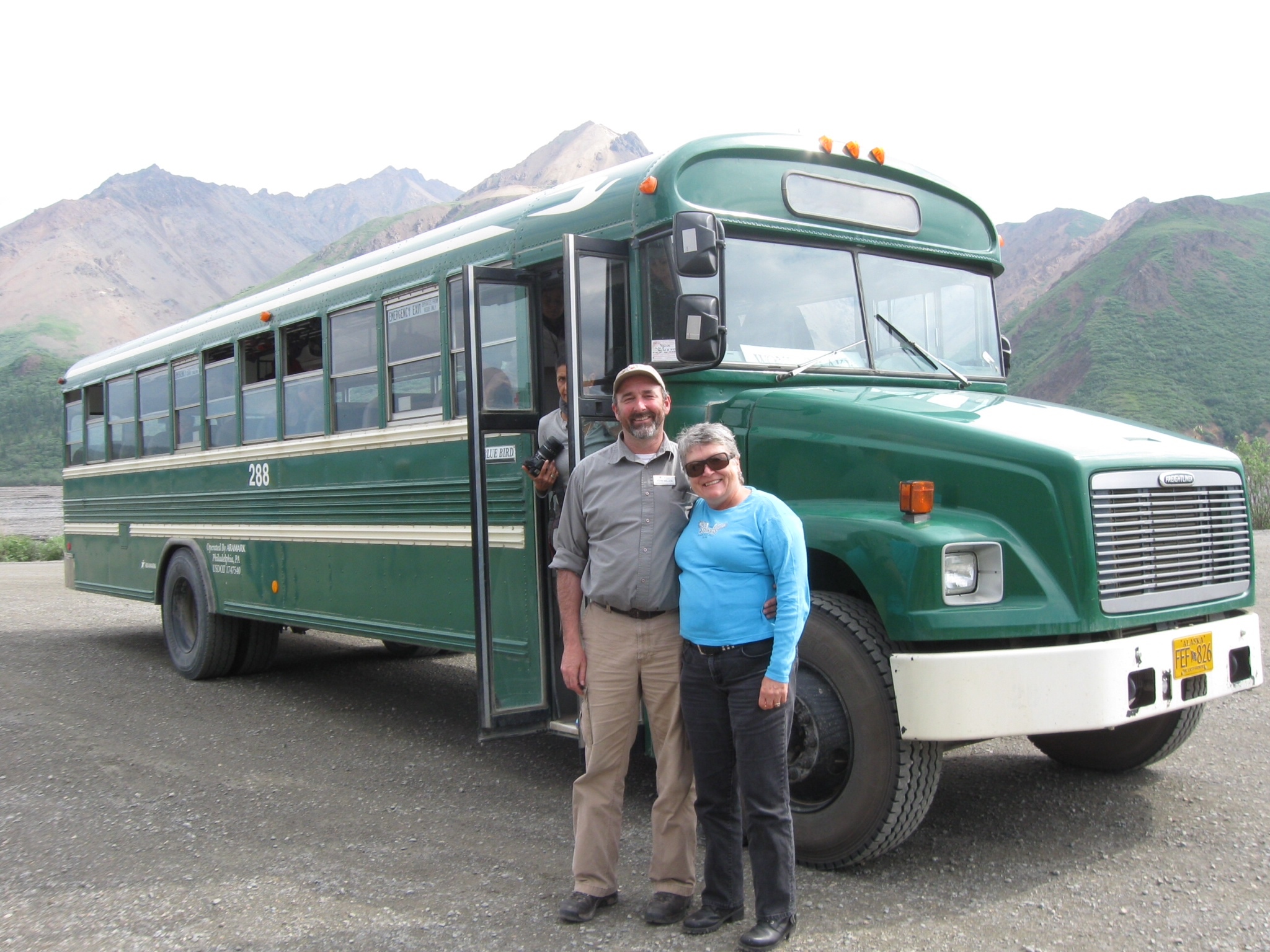
Marilyn and her new best national park friend John Miller
We were fortunate today to have a very knowledgable driver who also served as a tour guide. I doubt that most shuttle bus drivers are as well versed or passionate about the park as John Miller, and his constant stream of information and stories and his willingness and ability to answer questions made the trip a truly great experience. John believes in the effort to keep Denali National Park (DNP) as wild as possible and frequently reminded us to make very small footprints while we were visiting this unique national treasure. He works for the Anchorage school system as a safety officer during the year, but his knowledge of the flora and fauna of DNP and of the the history of the park should earn him a spot as a DNP employee. He was that good.
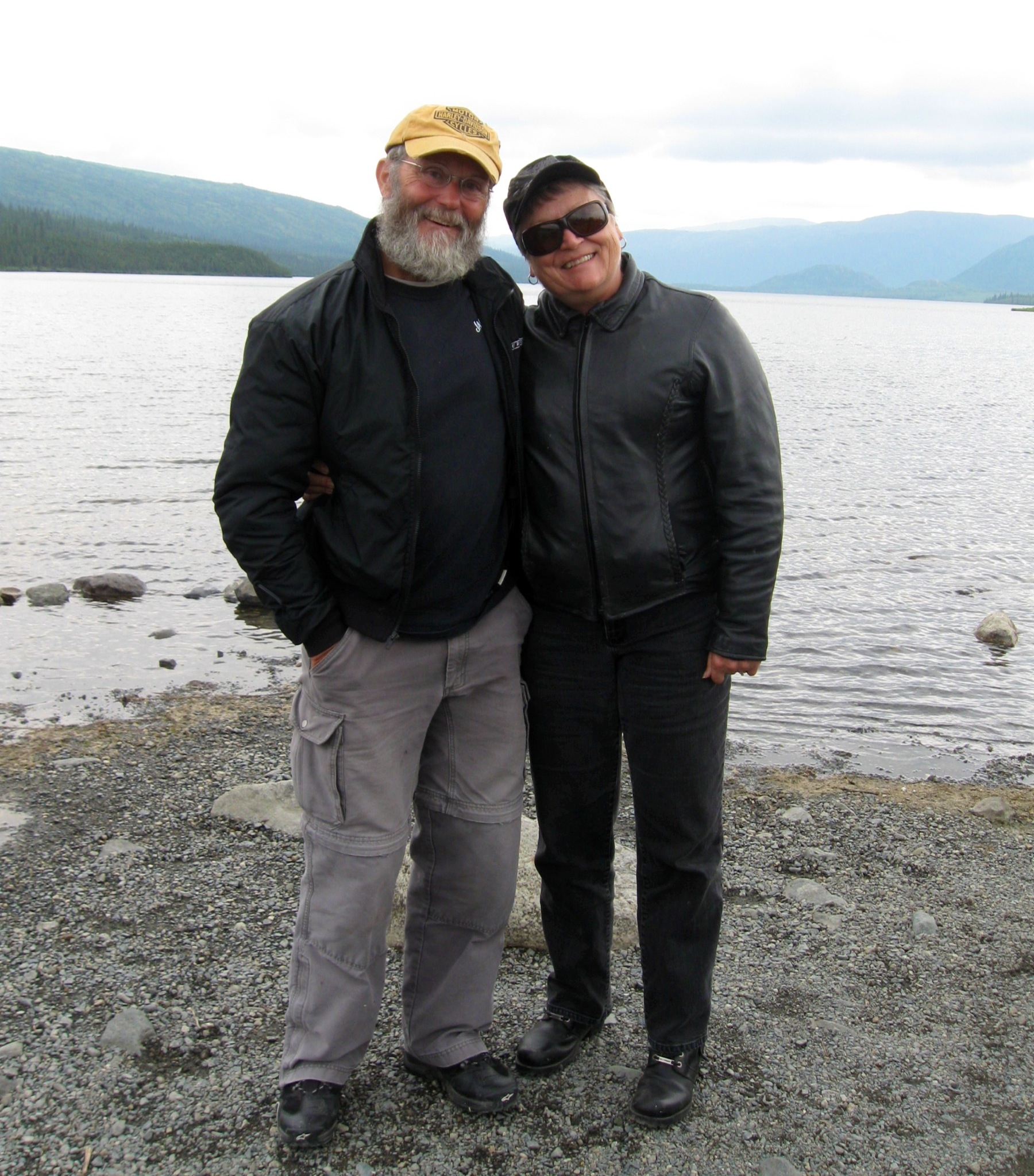
Wonder Lake at DNP was full of mosquitos!
The goal of all bus trips through the park is to see as many animal inhabitants as you can spot, to take in the incredibly beautiful mountains of the Alaska Range (including Denali) and to gain an appreciation for the importance of DNP as a refuge for humans as well as animals. We did all three.
The constantly changing but constantly wild landscape provided a panorama of distant mountains miles away and the smallest wildflowers that had to be greeted on their own micro level. Glacier-carved valleys provided an ever present reminder of the power of nature and the age of the earth. These valleys often stretched for miles across gravel beds lined with rapidly moving rivers.
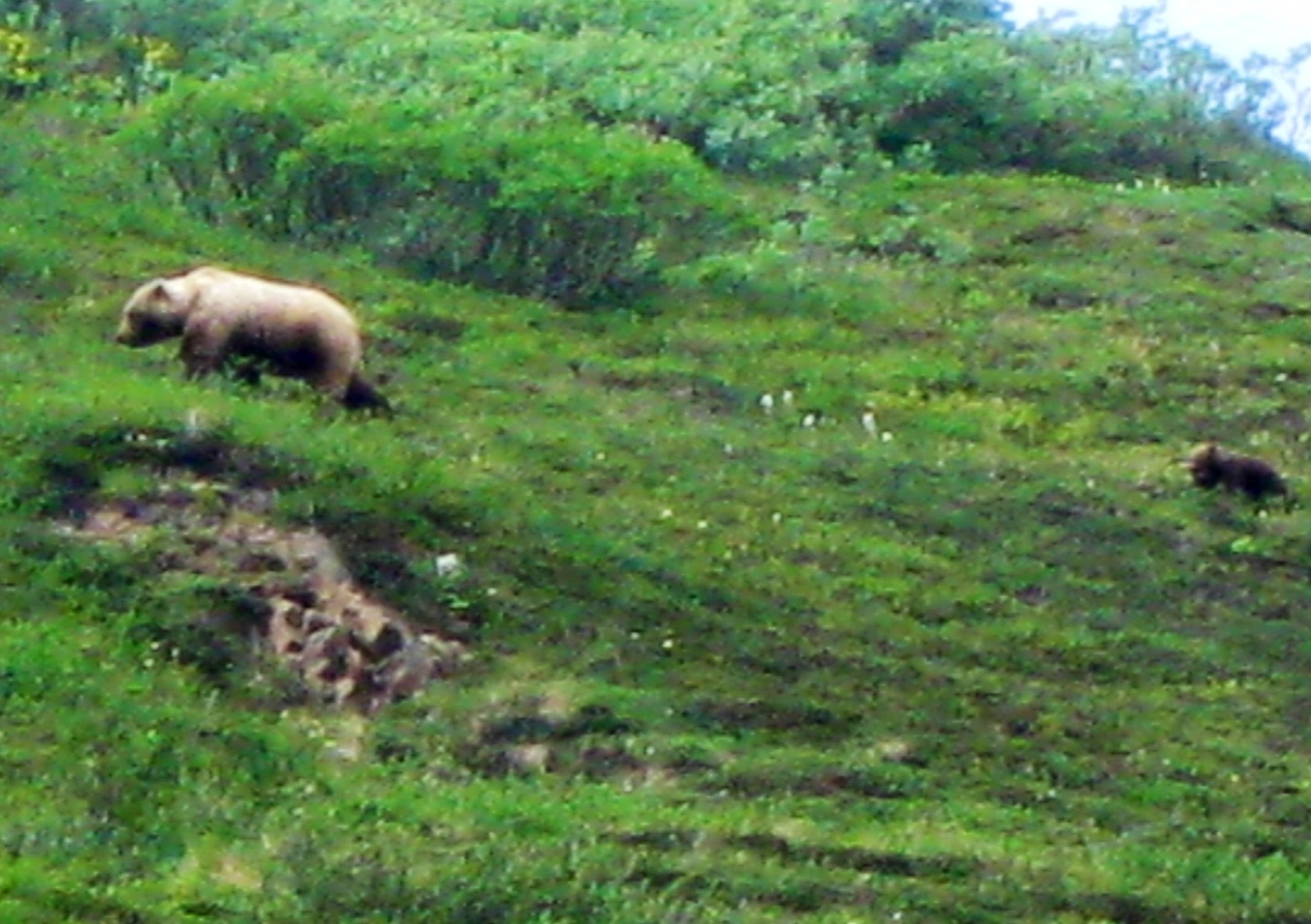
Mama grizzly is chased up the hill by one of her two cubs.
Animals? Oh, just three or four moose, a sow grizzly bear and her two new cubs (referred to as “springers” since they were just born this spring), another huge grizzly, several caribou, Dall Sheep, various birds and waterfowl. John Miller said it was a good day for this time of year, especially the opportunity to spot the sow and cubs, his first such sighting this year. I wish I had a better camera with a longer lens because some of the sightings were several hundred yards away and my cheap camera doesn’t do justice to what we saw. But it will have to do. (The advantage to my camera is that if I drop it while shooting pictures from the bike and it gets smashed by a passing 18-wheeler, it’s not a big loss.)
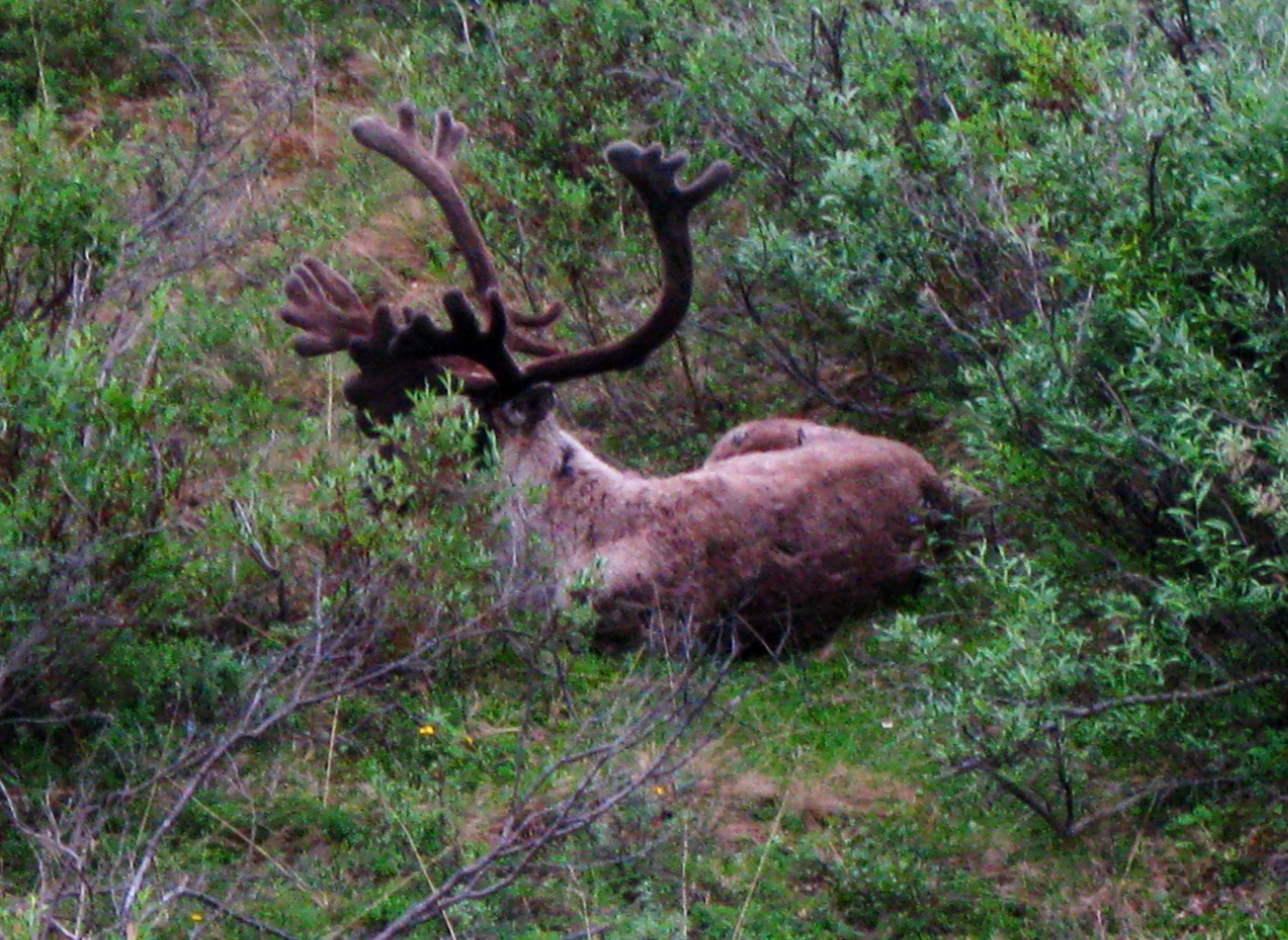
This caribou was laying down but check out the rack.
The shuttle trip we took traveled about 85 miles into the park, 15 miles of which were on asphalt and the remainder on gravel roads carved into the sides of tundra-covered hills and mountains. I would not have wanted to take the bikes down that road, and Marilyn probably would not have gone on the bike, so it was nice to be able to let someone else do the driving (and the talking). It was a round-trip tour, and since we looked out one side of the bus going and the other side coming back, it was like a 170 mile trip. It took 11 hours with about an hour and a half of non-driving time to stop and walk around.
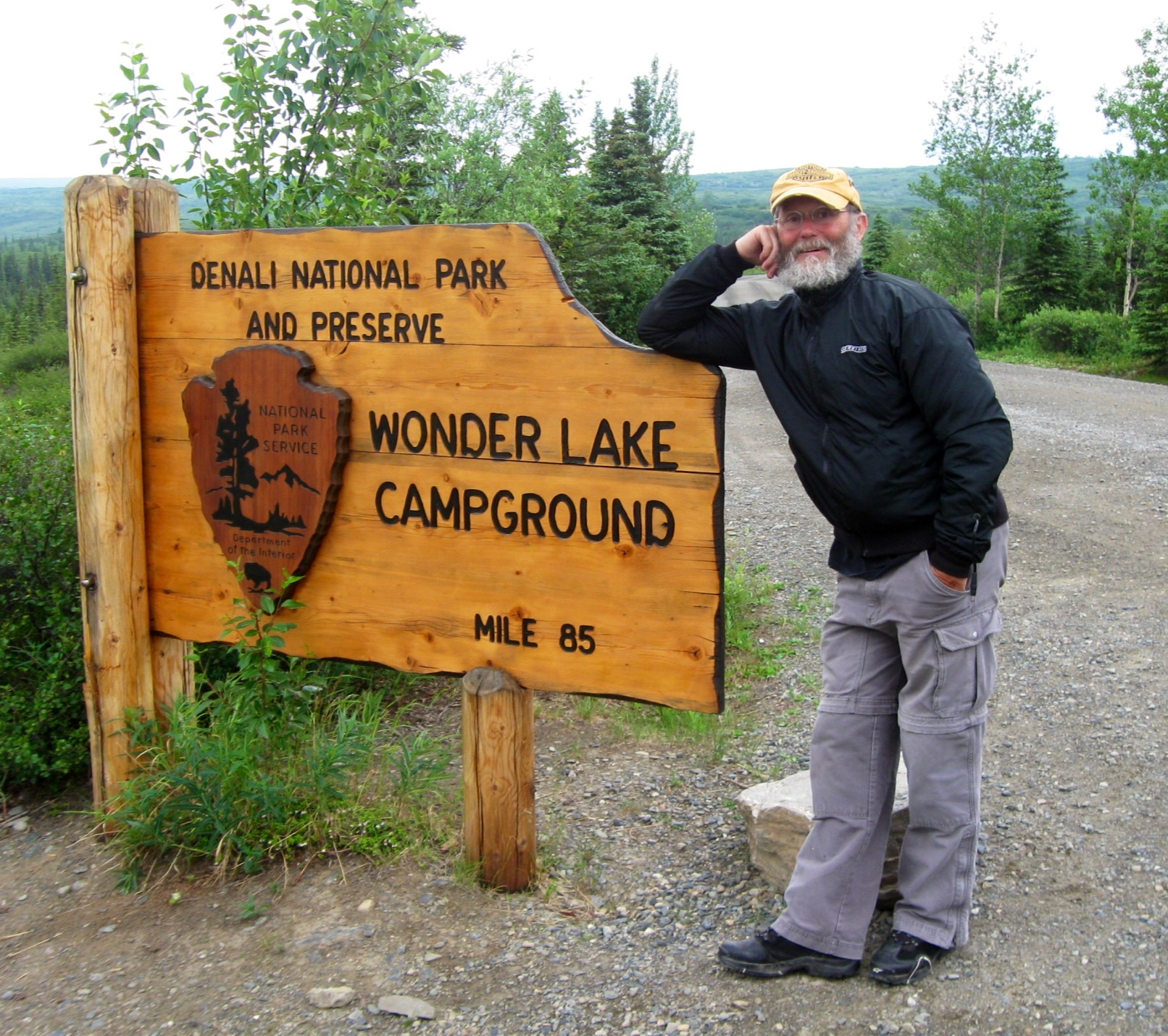
Wonder Lake was the end of our road.
The weather turned out much better than I expected, since I had expected rain. We had partly cloudy skies for the first part of the trip and complete cloud cover with occasional drizzle for the rest of it. But there was also some smoke in the air from forest fires and by the time we returned to our starting point at 8:15 p.m. the smoke was pretty heavy.
I’m glad I’m planning a return trip (or two) to Alaska. DNP is one of the places I’d like to be able to spend three or four days instead of just one. I’ve hiked and camped in mountains in Tennessee, North Carolina, Colorado, Wyoming, California and Oregon. But I believe DNP is unique, in part of because of the dedication to keeping it as wild as possible yet still allow humans to touch its humbling presence. I’d like to see Denali (Mt. McKinley) on a clear day and would love to explore some of the (disappearing) glaciers in the park. I’d love to climb/hike some of the smaller mountains. And I’d love to walk through its forests and feel at peace. I’ve said this before on this blog but I’ll say it again: I’ll be back.
Tomorrow, on to Anchorage.
“I can’t wait to get on the road again.”
Location:Healy, Alaska
Great Alaska Adventure: We’re Two Again
Hanna had a 6 a.m. flight, so that meant 4:30 reveille to get her to the airport and through screening where the biggest issue seemed to be a small can of body mousse. Once assured it would not bring down the plane, the TSA screener let her pass. She’s now safely back in Bloomer with her friends.
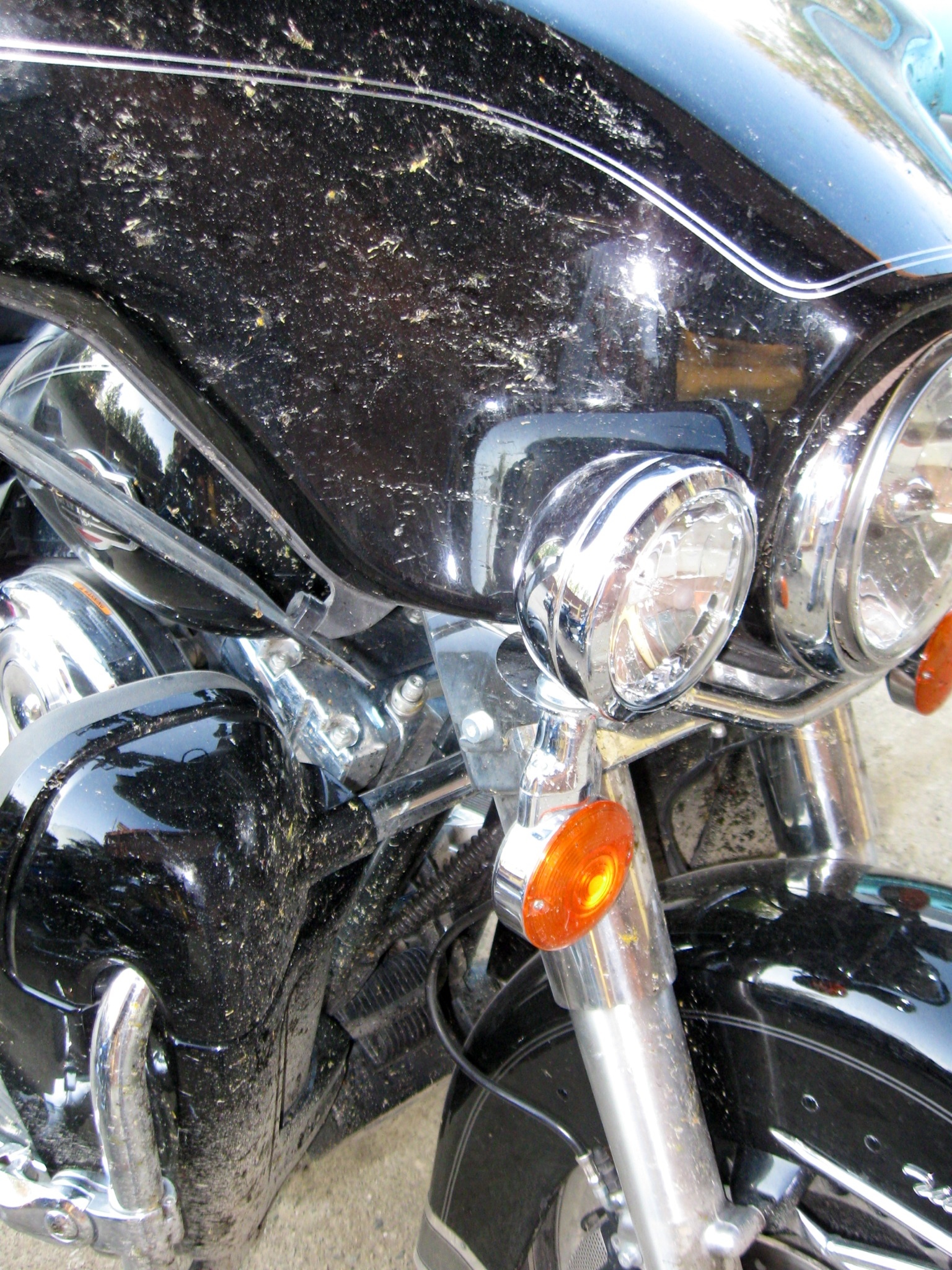
Five days on the Alaska Highway.
I took advantage of a short riding day and an early wake-up to clean five days of Alaska Highway grime off the bikes. I was hesitant to do it for fear that I would discover that my new bike is now VERY USED. It is. Small chip in the fairing, several scratches and caked on mud in places I’ll never get clean again. I washed them both and did what I could, knowing that more road construction undoubtedly lay ahead. And it didn’t take long. On the Parks Highway to Denali this afternoon we drove into 10 miles of construction and another close-up view of a pilot car. Word of advice: If you’re thinking of coming to Alaska and buying a new bike, do it in that order. Better yet, borrow a friend’s bike for the trip.
There’s much to see and do in and around Fairbanks, but we only had time for one excursion and headed to the University of Alaska’s Museum of the North. What a great facility! We browsed for almost four hours and probably saw less than 25% of the collections and galleries. But the sections we saw were first-rate. The museum first opened in 1929, only 12 years after the University was chartered and first showed a collection of native displays and paleontological finds. It’s grown dramatically over the years and is now housed in an impressive, architecturally superb building specifically designed to show off the outstanding collections.
We visited one gallery of art by Alaska artists. Most of the paintings focused on real people, real places, and real scenes that gave a good feel for the land and its inhabitants. No abstractions here. It was a small collection, but a great introduction to the museum.
We also took in a 30 minute film on the Aurora Borealis that gave a solid scientific explanation of Alaska’s colorful wintertime night skies. It’s only been in the last 50 years that scientists have determined the relationship between atmosphere, magnetic fields, and solar winds that produce the shimmering green and sometimes red lights 50 miles above the earth’s surface. Turns out that Fairbanks is just about the perfect spot to view the muted pyrotechnic displays.
But the real heart of the museum, at least for us today, was the gallery that tries to convey a complete picture of the 49th state by displaying side-by-side artifacts such as prehistoric mammoth bones, a menagerie of taxadermied wild life, native cultural historical and craft displays, gold mining, oil production, and a general history of Asian and European influences since the 17th century. I’ll let some pictures I took show what I mean:
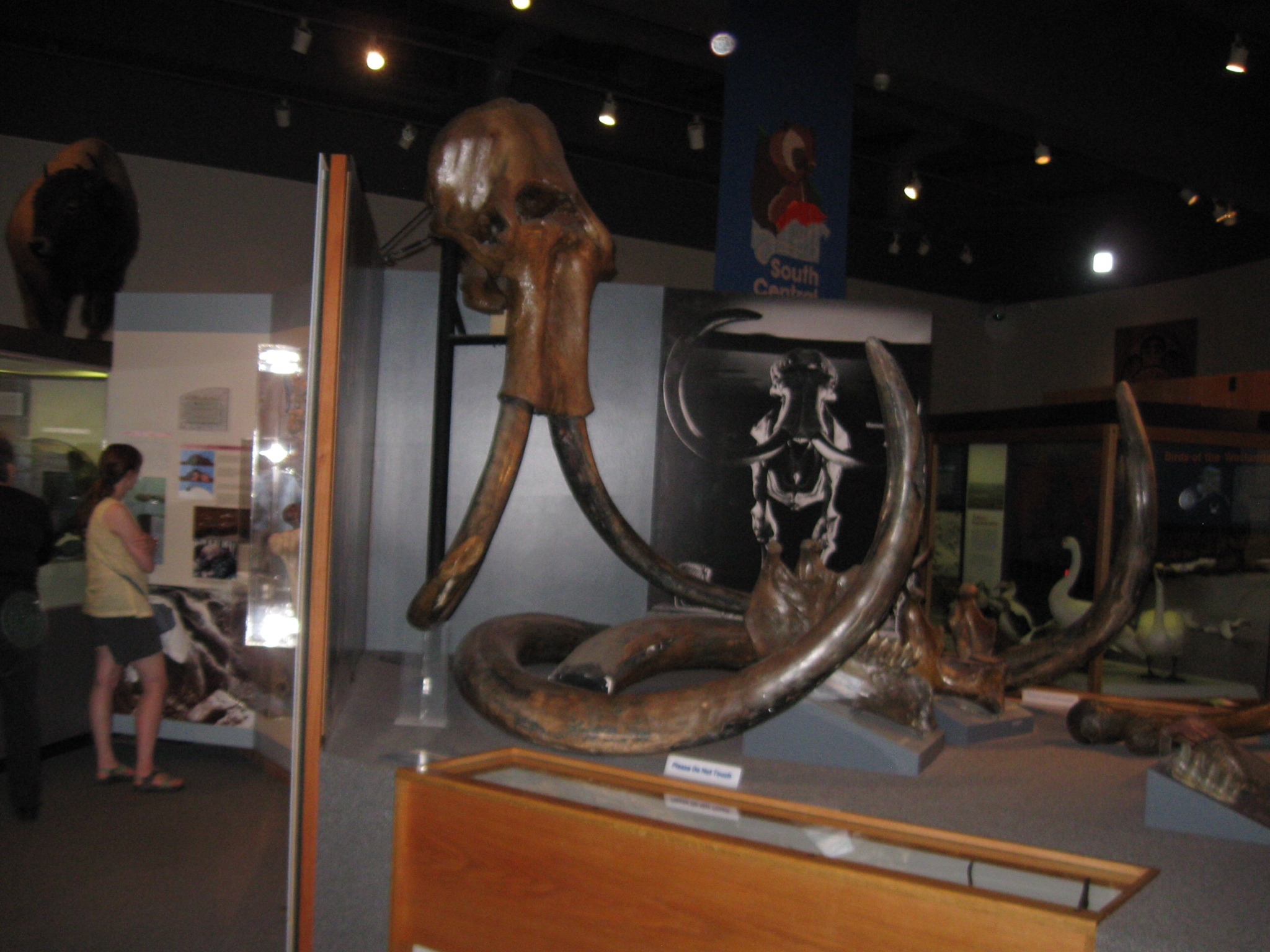
Pre-historic mammoth bones
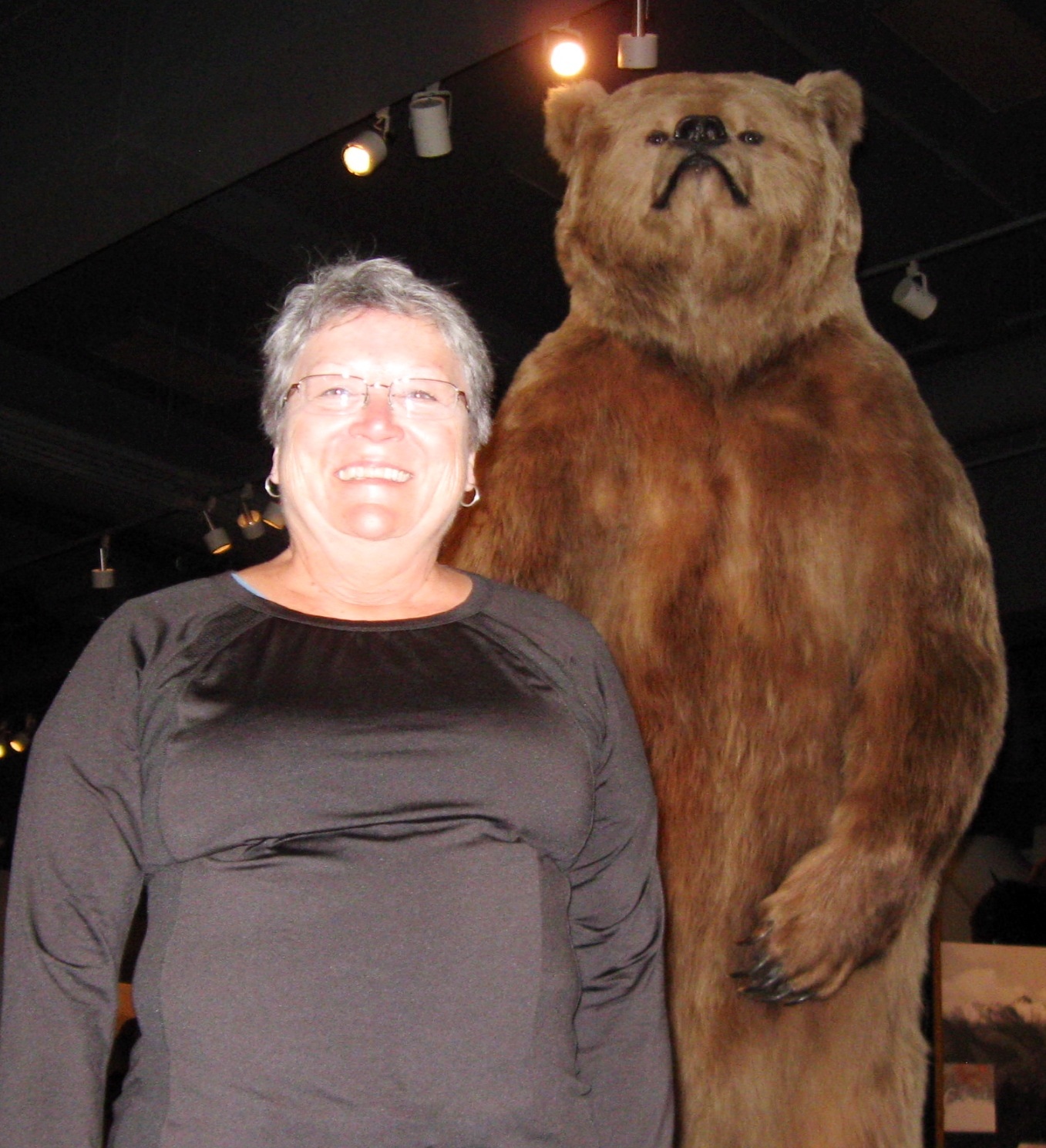
Marilyn and Otto
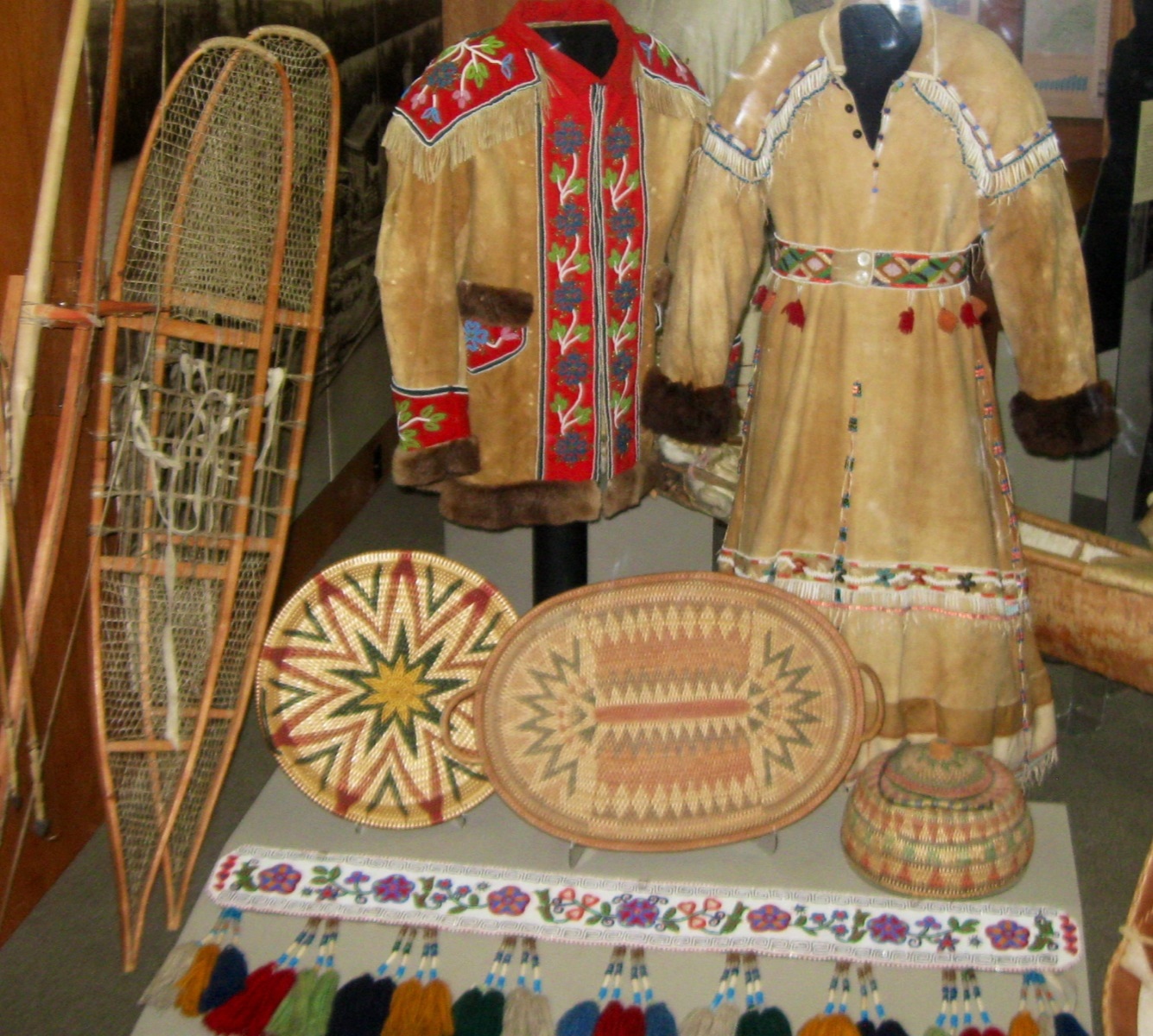
Native art. Detail and handiwork is amazing.
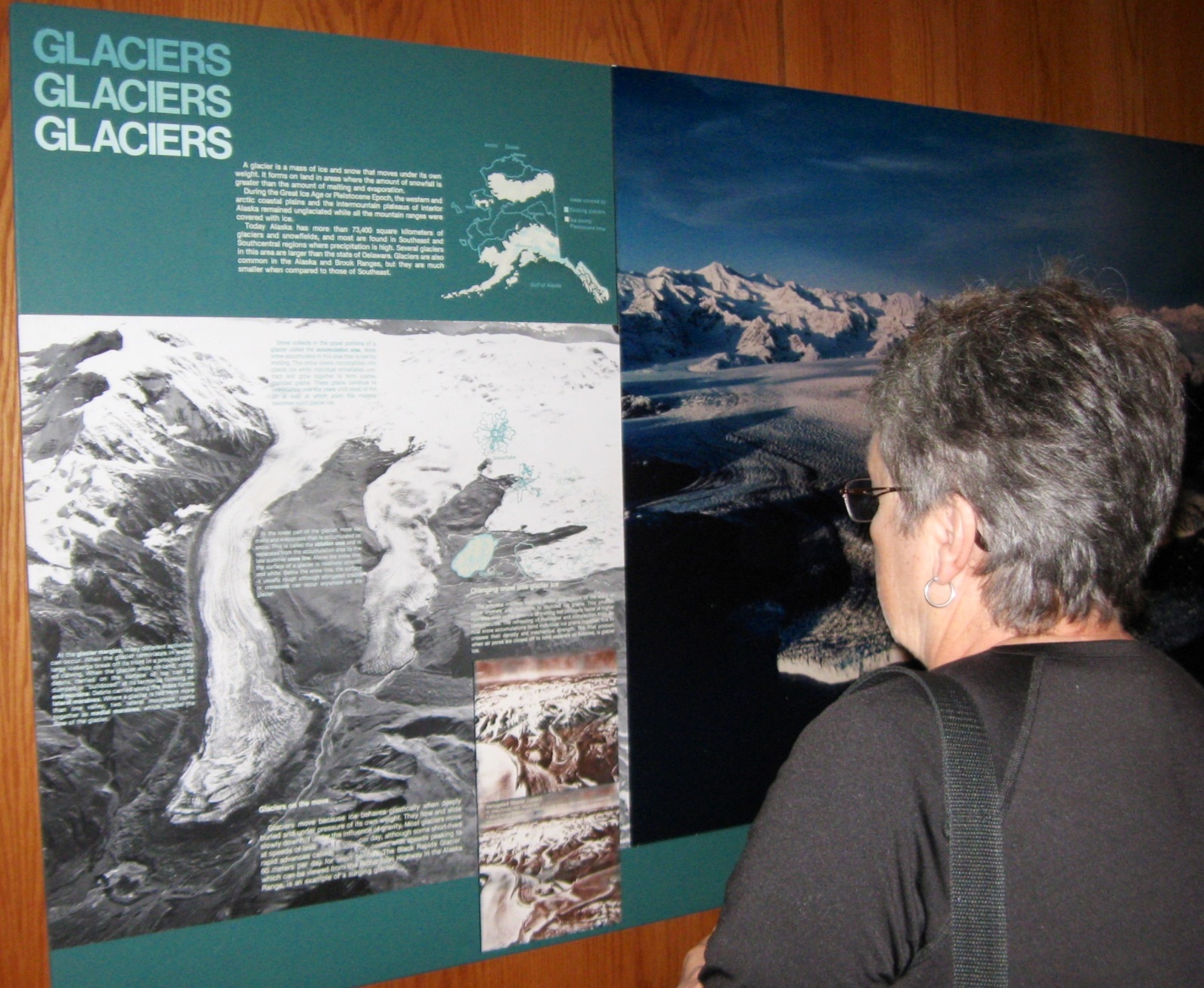
Did you know glaciers can move up to 60 feet in a day?
The Russians departed when they sold Alaska to us in 1867 but left behind an important legacy.
For those of you who need “cute.”
There were a lot more pictures but this gives you an idea of what an eclectic display it is.
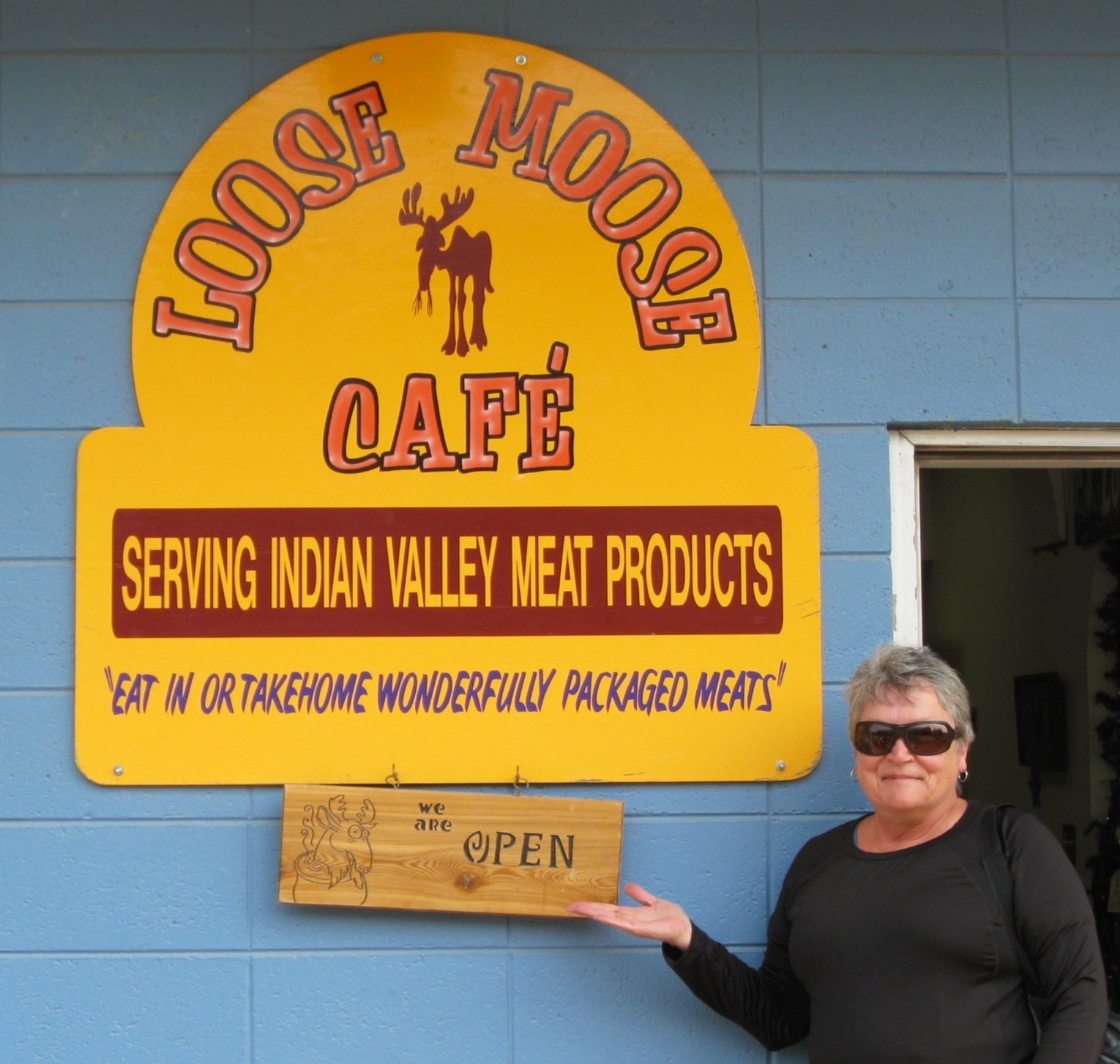
Loose Women Like the Loose Moose.
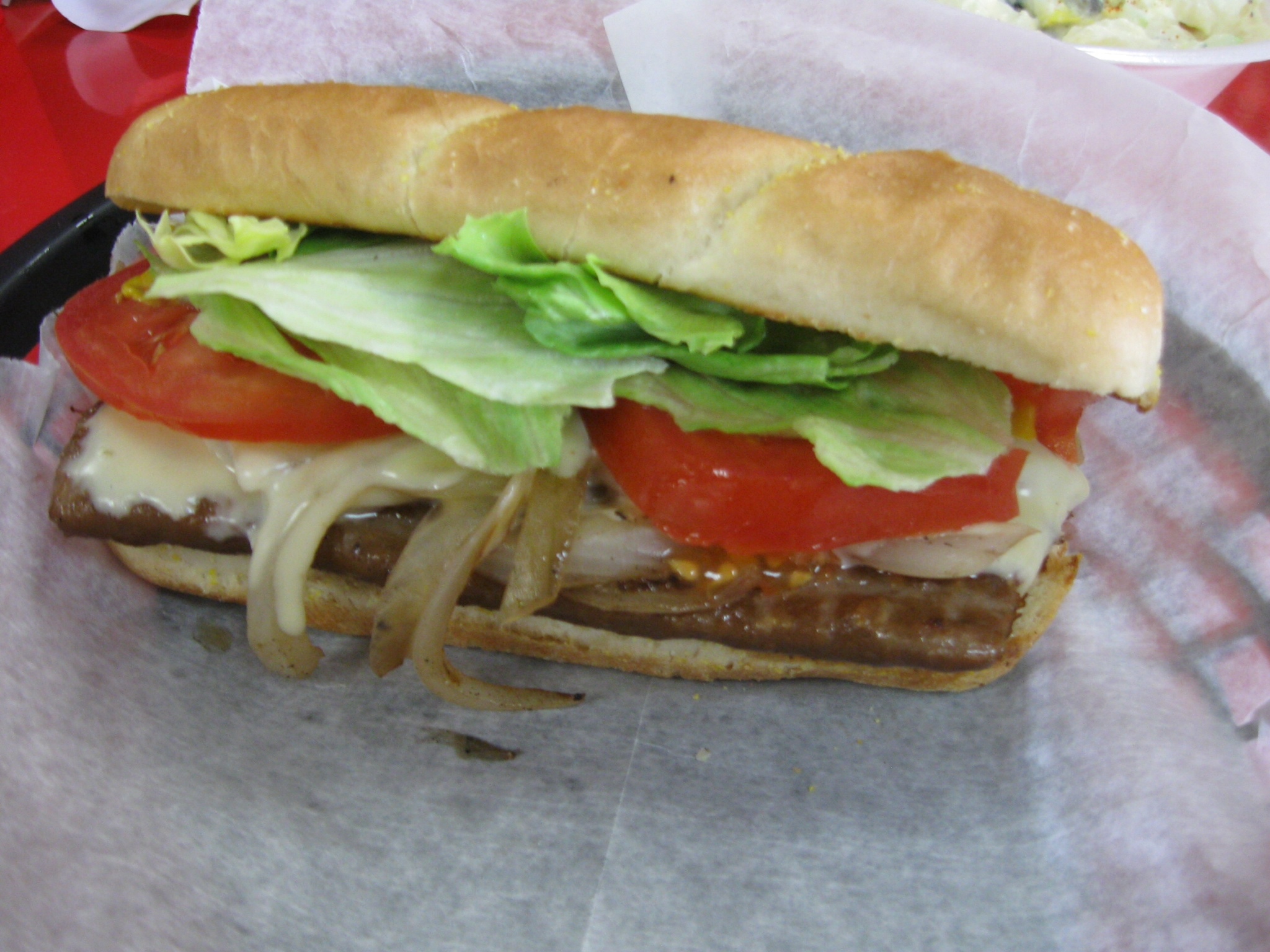
Caribou for lunch? Of course.
Late lunch took us to the Loose Moose about a mile from the University. I liked the name and wanted to see what was on the menu. One item on the menu was reindeer hot dogs, which Marilyn selected. As for me I ate the best caribou steak sandwich I’ve ever had. Well, actually it’s the only caribou steak sandwich I’ve ever had, but it was tasty.
After lunch we rode 113 miles to Healy for the night. Several forest fires meant some of the best views were obscured, but the ride was pleasant.
Tonight’s Pie Report: Bumbleberry a la mode. And that was my entire dinner.
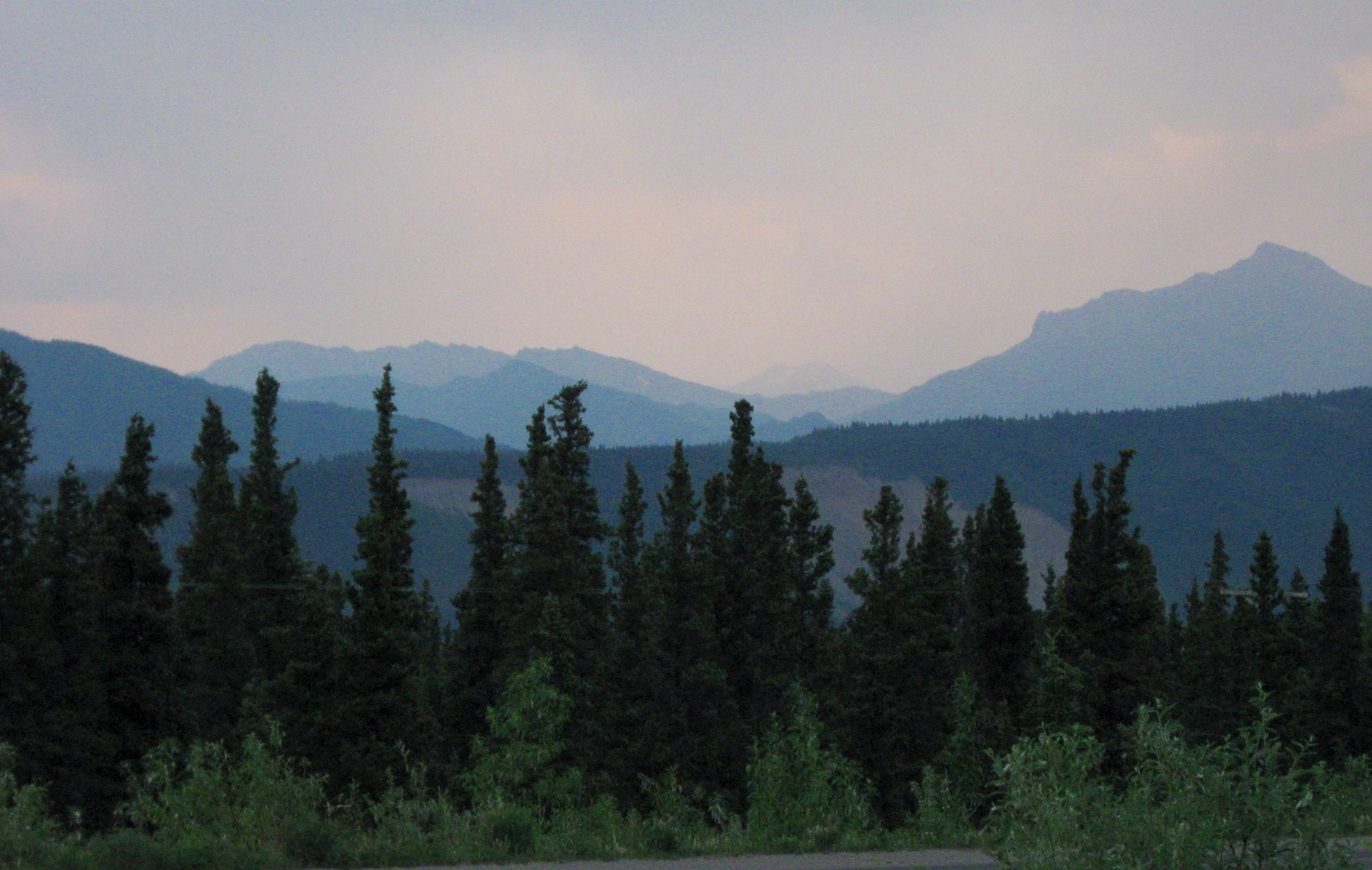
Smokey Mountains, but not the Appalachians.
One final picture shows the color-changing effect of smoke in the mountains
Tomorrow: Denali National Park and Mt. McKinley if the weather’s clear. But the forecast calls for 40% chance of rain, so it doesn’t’ look good.
Great Alaska Adventure: We Made It!
Twenty-seven days ago, Marilyn and I set out for Key West on Day One of our Great Alaska Adventure. Today, grime-spattered but determined, we rolled in to Fairbanks. Our journey is about half done. The trip odometer on the Ultra Classic shows 6,122 miles. We should have slightly more miles on the return trip since we’re going to explore parts of Alaska on the Kenai Peninsula and the Denali National Park as well as taking a longer return route along the western side of the Canadian Rockies.
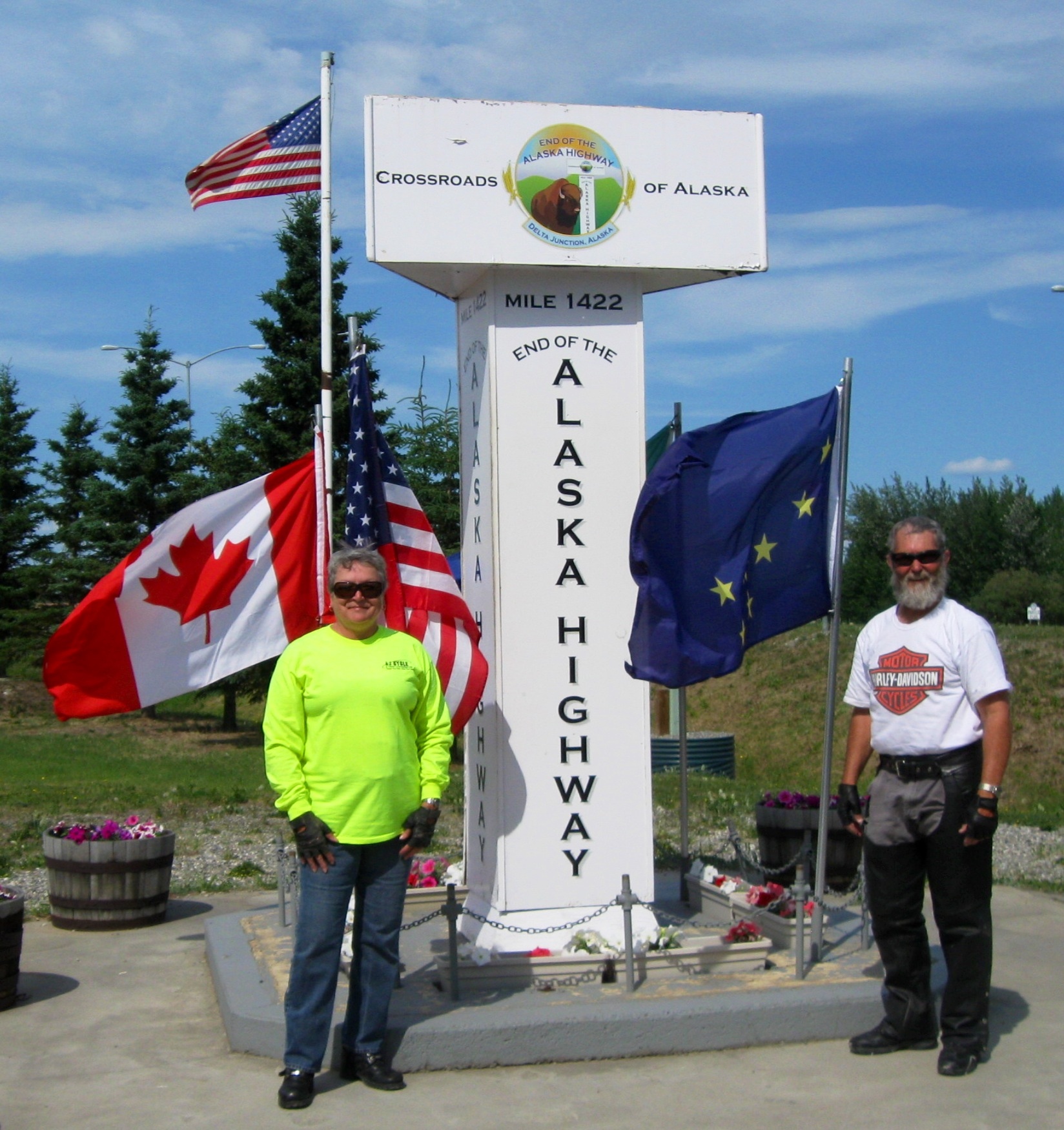
End of the road. Or end of the Alaska Highway.
In the process of reaching Fairbanks, we also covered the entire Alaska Highway, an adventure in itself as rough roads, construction and extensive sections under repair make the ride dirty, dusty, muddy, bumpy, rocky, slippery and dopey. Forget the last one. That’s either one of the Seven Dwarfs or the ride planner for this Great Adventure.
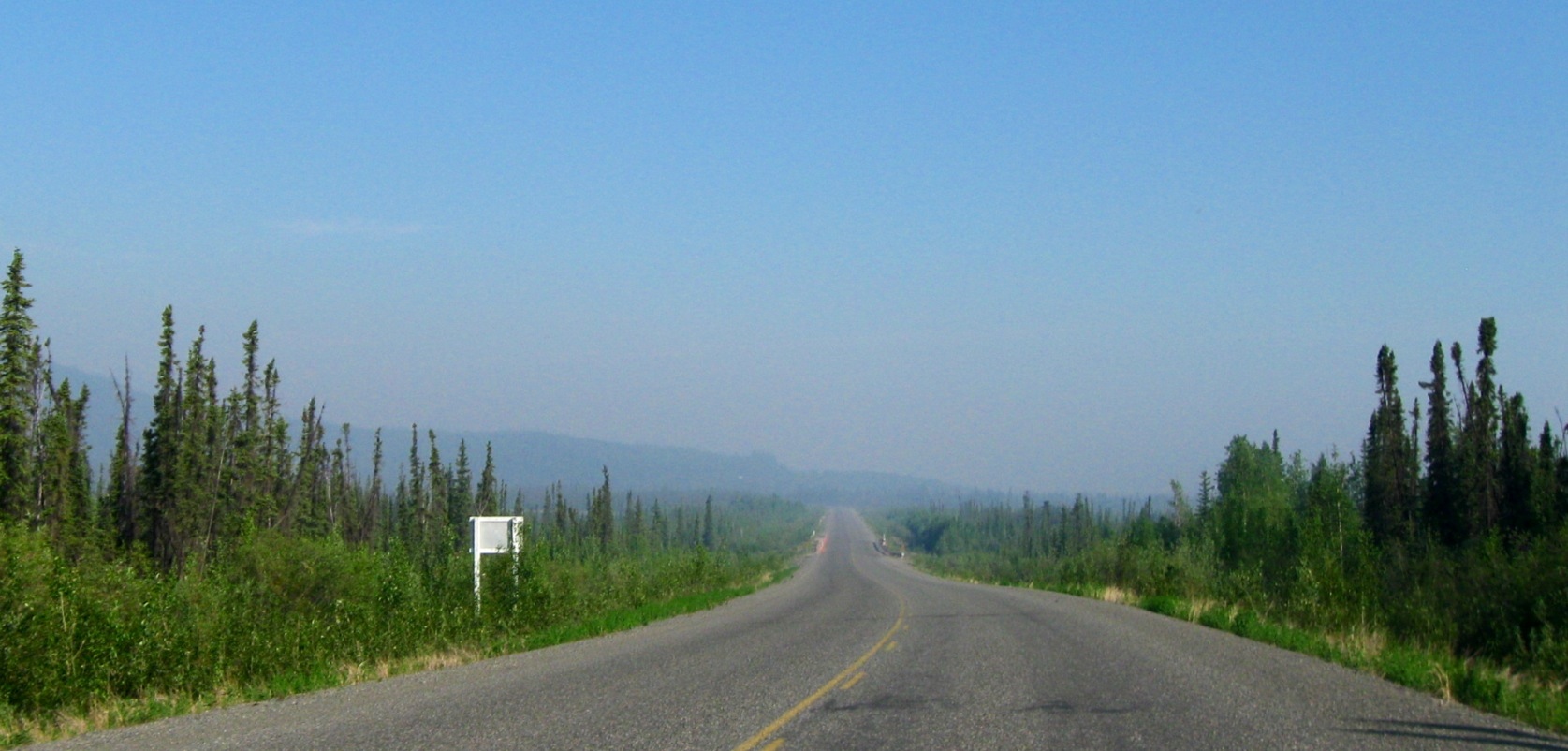
Smokey welcome back to the U.S.
We woke up this morning to the smell of smoke in the air and suspected it was from fires we had seen in the distance yesterday. It was. As we closed in on the Canada/U.S. border, a brown haze filtered the distant mountains and spread through the valleys below. I’m not sure how serious the fires are (I suppose this time of year they’re all serious) but they didn’t affect our ride except for obscuring our gorgeous mountain views until after we crossed the border and left the land of loonies and toonies and liters and kilometers.
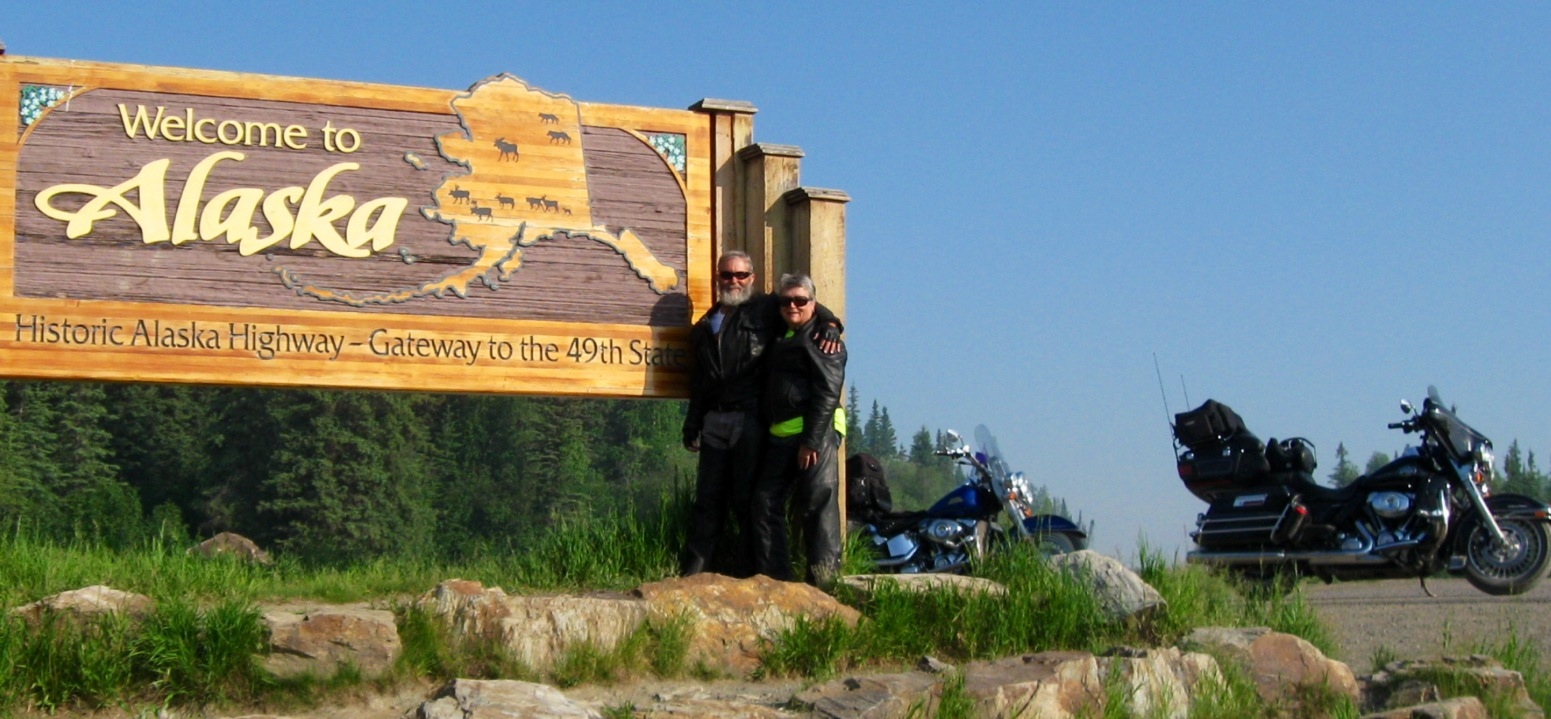
Back in the USA
The border crossing was uneventful, except when the sharp-eyed young border agent noted that neither of the elder persons in the threesome had signed our passports and that they were, therefore, not valid. Fending off visions of a federal conviction and hard time at Leavenworth, I complimented him on his perspicacity for observing what five previous agents at five previous border crossings had missed. My moll and I each signed our signature-naked documents and were quickly on our way safely on U. S. soil with a friendly wave from the observant officer.
We had been told the Alaska section of the Namesake Highway was much better than the previous several 500 miles or so had been, and the reports–much to my delight–were right. The Alaska section is not without its gravelly repairs and dusty construction and the occasional bike-launching frost heave, but it was a welcome improvement from the Canadian section. The final 20 miles of road in Canada from near Beaver Creek to the border was under serious repair by a veritable army of orange-vested construction thugs and we spent nearly 30 minutes following a pilot car through a construction battlefield. When others of you join me for my next Alaska ride, perhaps your experience may not be as fraught with road gremlins as ours has been, thanks to the efforts of the hard-working road crews. Huzzah for the Road Crews.
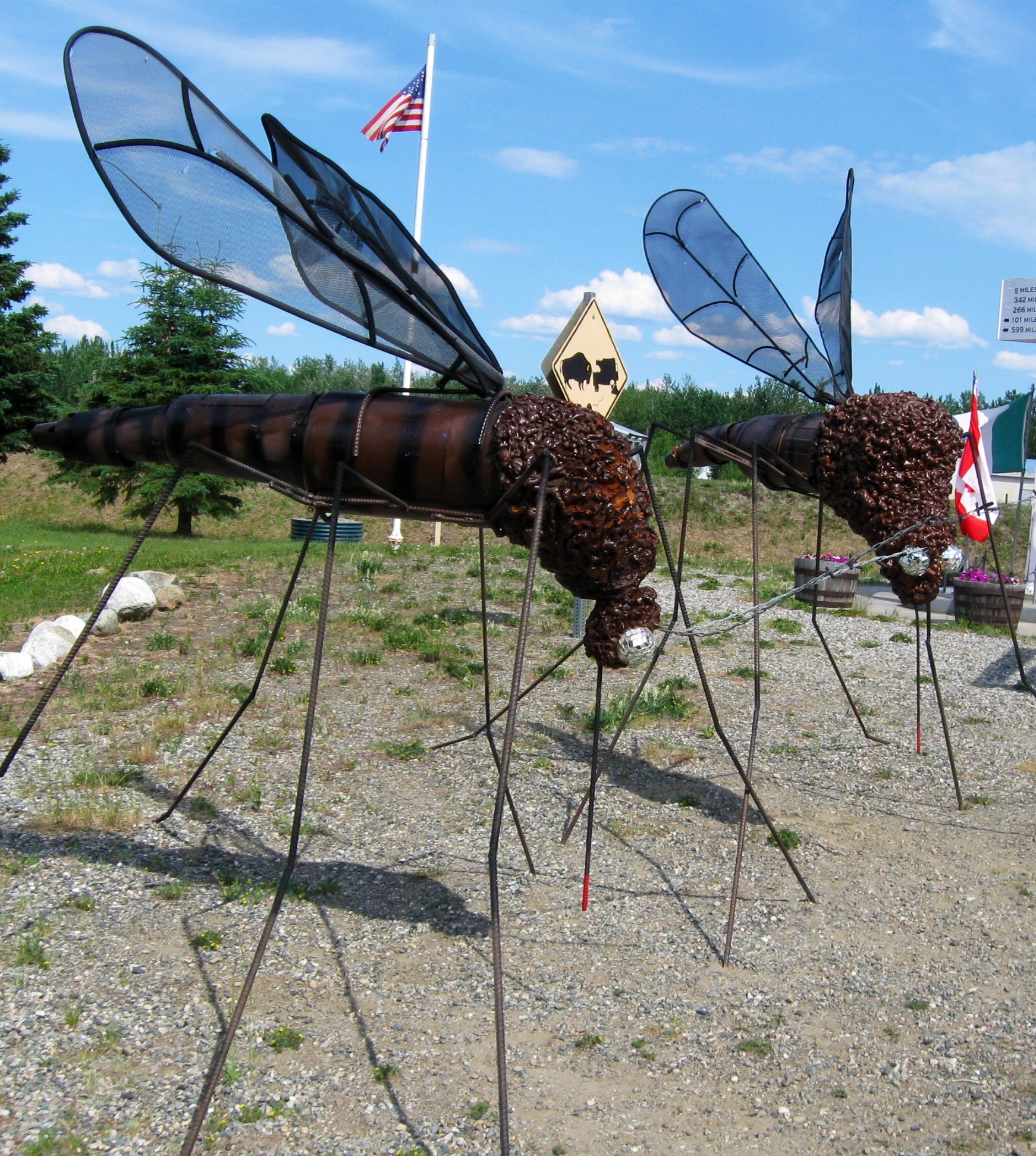
The Alaska Native Air Force
Friends had warned us of the voracious insect population in the northern climes and special friends had even provided a trap and a knife with which to defend ourselves in the event we encountered DEET resistant critters. We have been pestered by the pests for the last week or so, but managed to hold our own and escape with only a few crimson welts and a modicum of scratching. I’m the least bothered of our troupe. I think I found something better than DEET. Mr. Jack Daniel’s Old No. 7 Chigger Potion. Anyway, attached is a picture of a couple Giganticus Mosquitocus.
As I write this, it’s 80 degrees in Orange Park and 84 in Fairbanks at 9 p.m. That’s down from a high in the low 90s. Sure glad I brought the heated gloves and jacket liners for Marilyn and me. The trip’s not over and I may still get a chance to try Brian’s loaners out. Doesn’t seem right to go to Alaska and suffer under a heat wave. But I’ll take that over rain any day.
Tomorrow Hanna wings her way to cheese country and Marilyn and I head for Denali National Park and Mt. McKinely. One final note for today. After I checked in to our two-star hotel, I walked across the street to The Outpost, the northernmost Harley-Davidson store in the U.S. and bought a spotlight to replace the one destroyed by Chip of the Seal clan. The gravel now has a shiny new target.
Great Alaska Adventure: Last Day in Canada (for a while)
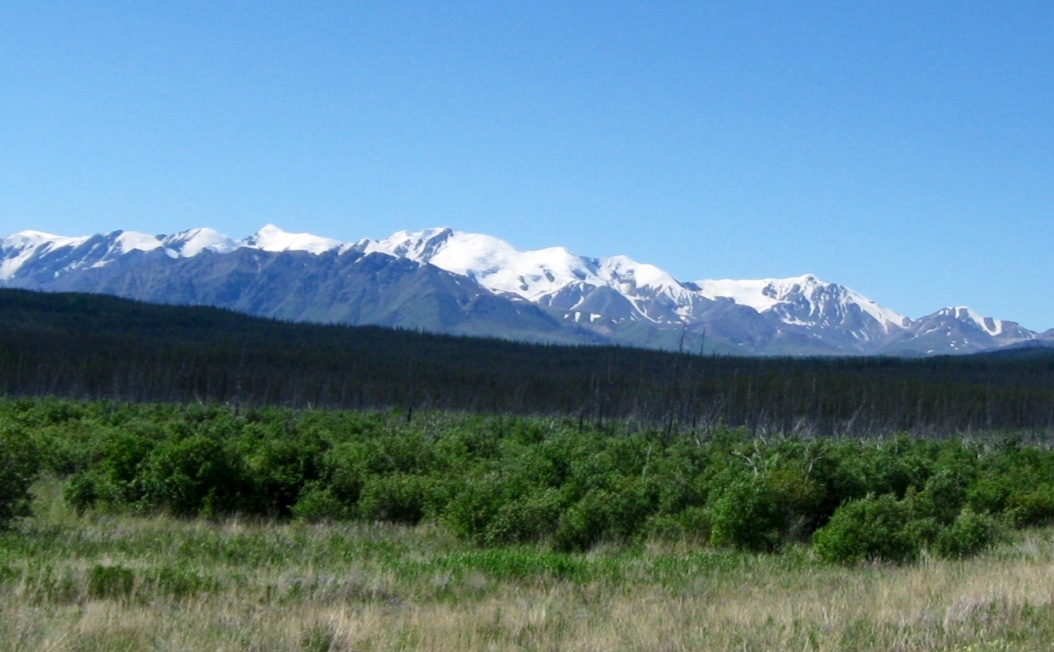
Kluane National Park
As we left Whitehorse this morning surrounded, it seemed, on all sides by mountains, I wondered how much better the scenery would be down the road. I didn’t have to wait long to find out. The further west we went the bigger the mountains got until, instead of just having patches of snow on the slopes, the peaks were completely covered in snow. Some of the mountains we rode by today are the tallest in Canada and the Kluane National Park, which we rode in for a while, has the largest non-polar ice sheets in the world. Spectacular views, eh? You bet, eh? Right on, eh? (Still practicing my Canadian even though we leave the Dominion tomorrow.)
Most of the ride was on good or at least decent roads today, but toward the end of the ride (north of Destruction Bay to Beaver Creek) we encountered what was easily the worst roads of the Great Alaska Adventure so far. Based on my reading prior to leaving on this adventure I knew we were getting close, but this was our first encounter with serious “frost heaves,” where the road surface moves vertically several inches during the winter, leaving bone-jarring ridges or tire-grabbing depressions that tend to separate rider from seat. Even keeping the speed down to 40-50 mph, when you hit some of those dips or rises, it can shake various parts loose. From the motorcycle, too.
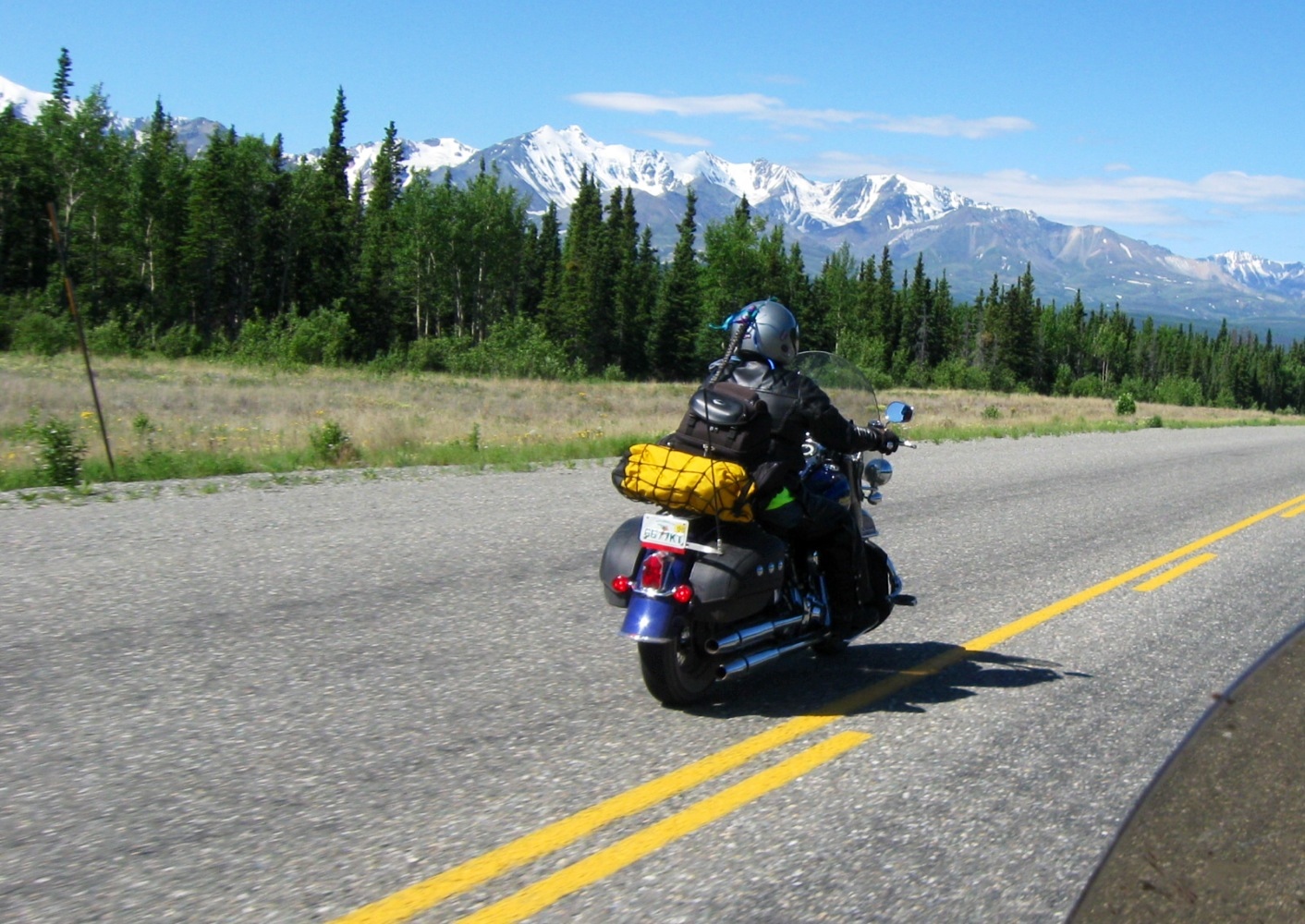
Marilyn on the road in the Yukon.
Marilyn, still recovering from bruised (cracked?) ribs two weeks after her parking lot fall, had a couple of pretty painful encounters with the frost heaves, but continued to motor on, impressed with the scenery if not with the road.
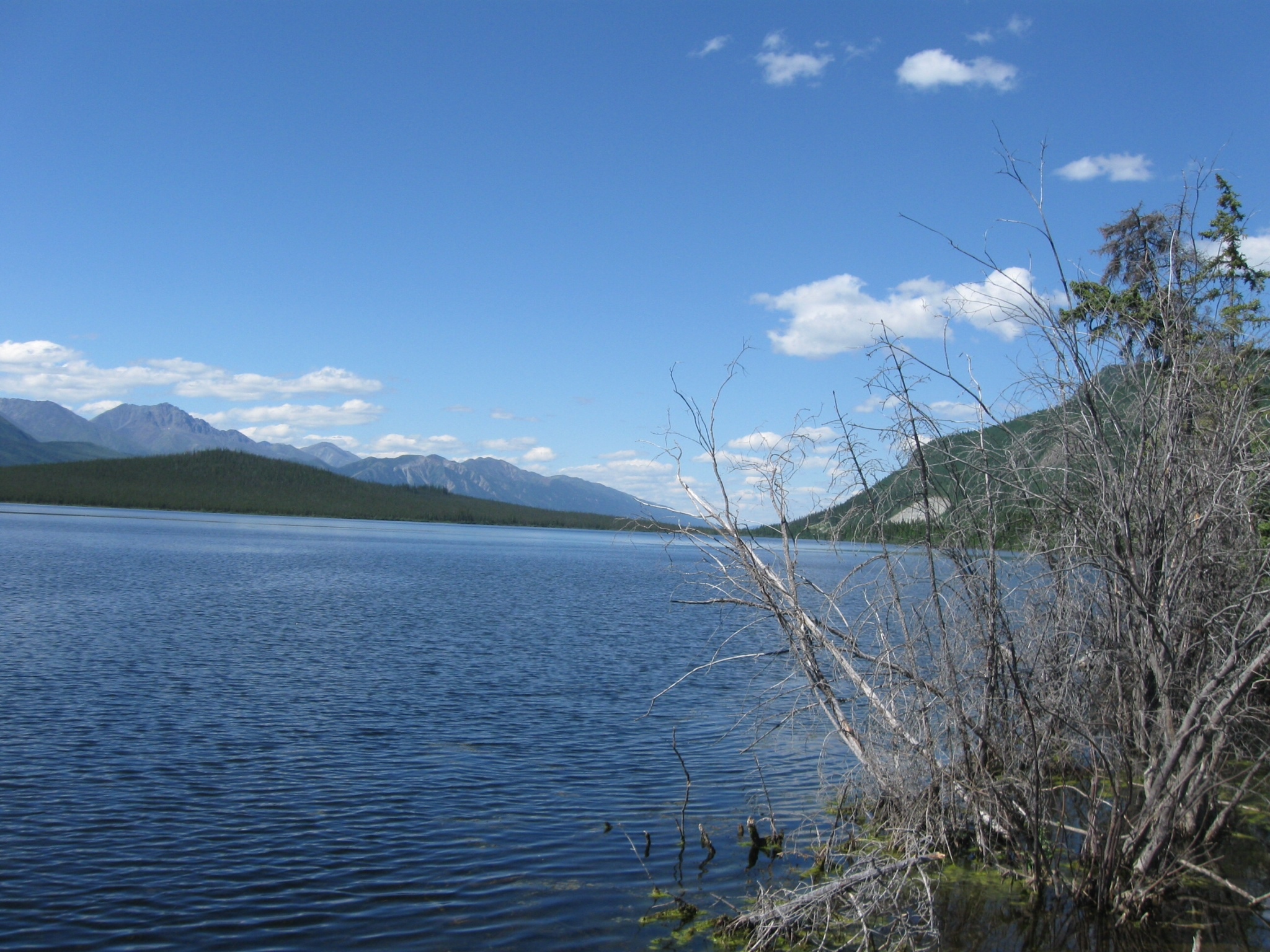
View from the lake shore
In addition to watching the majestic mountains, we also putted along the longest lake in Yukon Territory, Kluane Lake (pronounced klu wan ee), which stretches for 40 miles, most of it bordered by the Alaska Highway. Gorgeous riding and, since we were following a shoreline, a few twists and turns were thrown in to make the ride even more enticing.
This morning’s pie stop at a bakery in Haines Junction, 100 miles into the ride, became instead a cranberry scone/cinnamon roll stop. But tonight, dining at Buckshot Betty’s where we’re staying, I finished off the meal with a huge slice of raisin pie. I’d never had raisin pie before. It tasted a lot like raisins. Go figure.
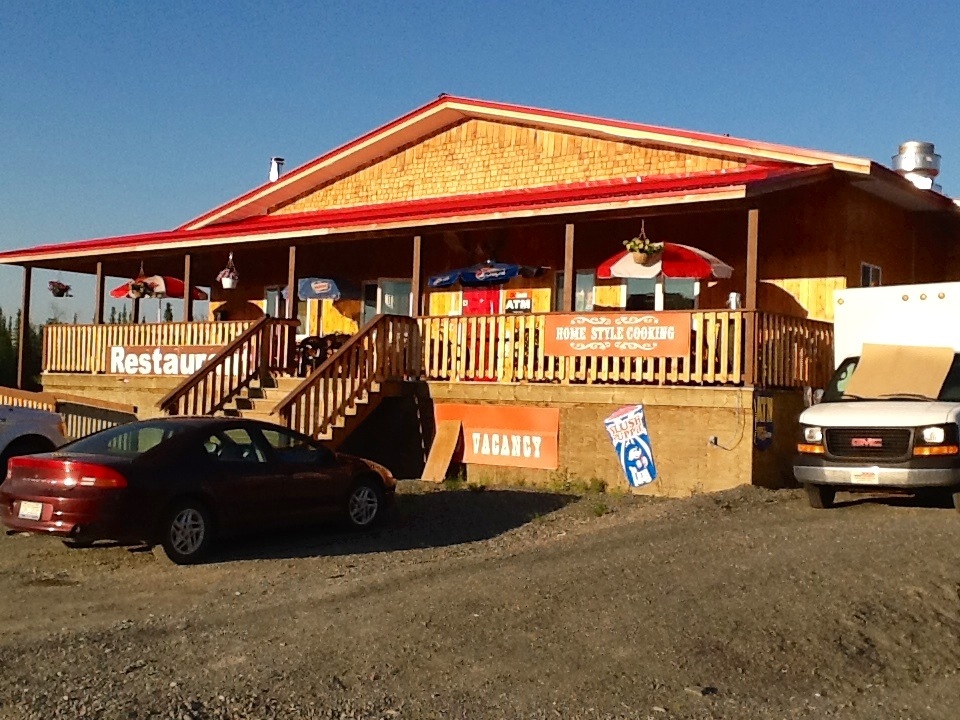
Buckshot Betty’s at 10:15 p.m.
I had wanted to stay at Buckshot Betty’s since I first ran across the name a couple years ago and made my reservation about six months ago. There are only four cabins and we’re in the deluxe model, complete with a stoveless kitchen and non-code wiring. I love it. Even has antlers over the door.
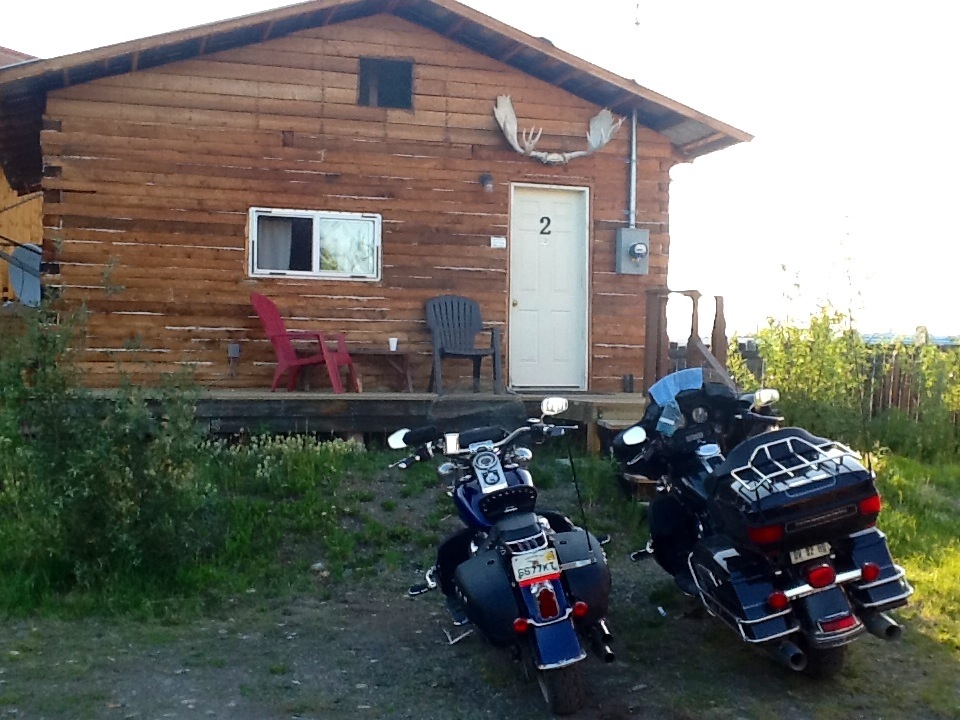
Our cozy cabin at Buckshot Betty’s.
We’ve met Buckshot Betty but she’s been busier than a beaver at a woodcarvers convention and haven’t had a chance to talk much with her. She pretty much runs this place by herself, rides a little black motor scooter, drives a back hoe and welds for fun in her spare time. And bakes raisin pies, among other tasty deserts. This place has a lot more character than the Ramada Inn we were at for the previous two nights.
One final note for tonight: Tomorrow we enter Alaska and the next day Hanna is flying back home to Wisconsin to be with friends and do what 18-year olds enjoy doing. It has been an interesting experiment in cross-generational bonding.
Great Alaska Adventure: Cultural Festival in Whitehorse
Festival Logo
Today was a play day in Whitehorse, Yukon Territory. We looked through a list of local events and came across the adaka Cultural Festivalat the Kwanlin Dun Cultural Center in the heart of downtown. Advertised as “A Celebration of Yukon’s Diverse and Distinctive First Nations Arts and Culture,” it fully lived up to its billing.
Marilyn and I went but Hanna decided to stay in the hotel all day rather than spend time with her grandparents. She doesn’t appear to be having much fun on the Great Alaska Adventure. It could be a long trip. Or not.
But Marilyn and I had a great time, beginning with a free “Community Feast” of slow cooked roast beef, baked Arctic Char, potato salad, pasta salad, drinks, and triple berry crumb-something for desert. They fed everyone who showed up. And the festival itself was free, too. I really like these people.
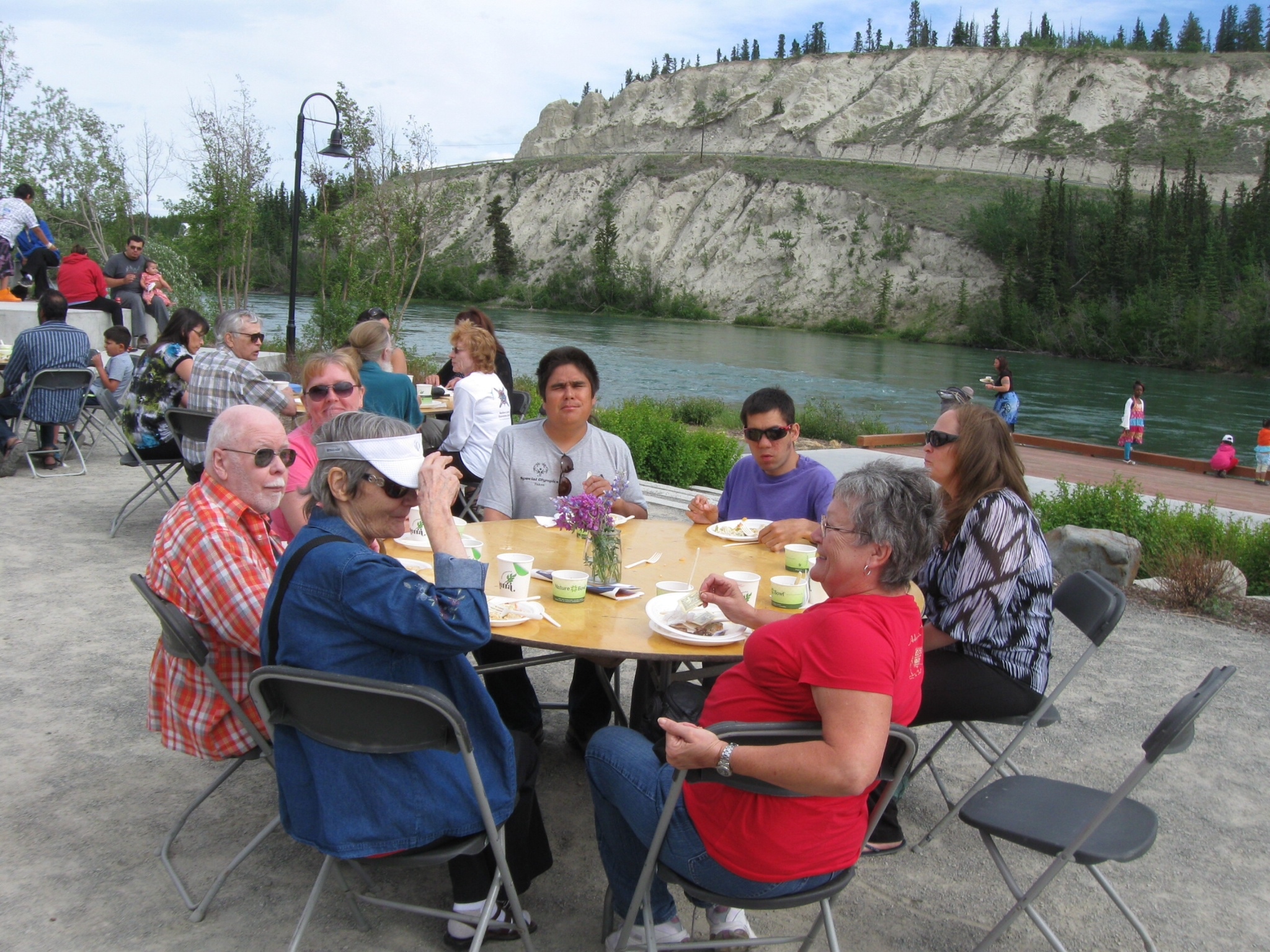
Lunch at the adaka Festival
We joined several folks at an open lunch table and, in addition to enjoying a good lunch, enjoyed our conversations about living in Yukon Territory. Everyone at the table said they mostly get used to the 22 hour days in the summer and the 22 hour nights in the winter, though they did admit they slept more in the winter than the summer. And the gorgeous–abeit short–spring, summer and fall, make the very long winter worthwhile.
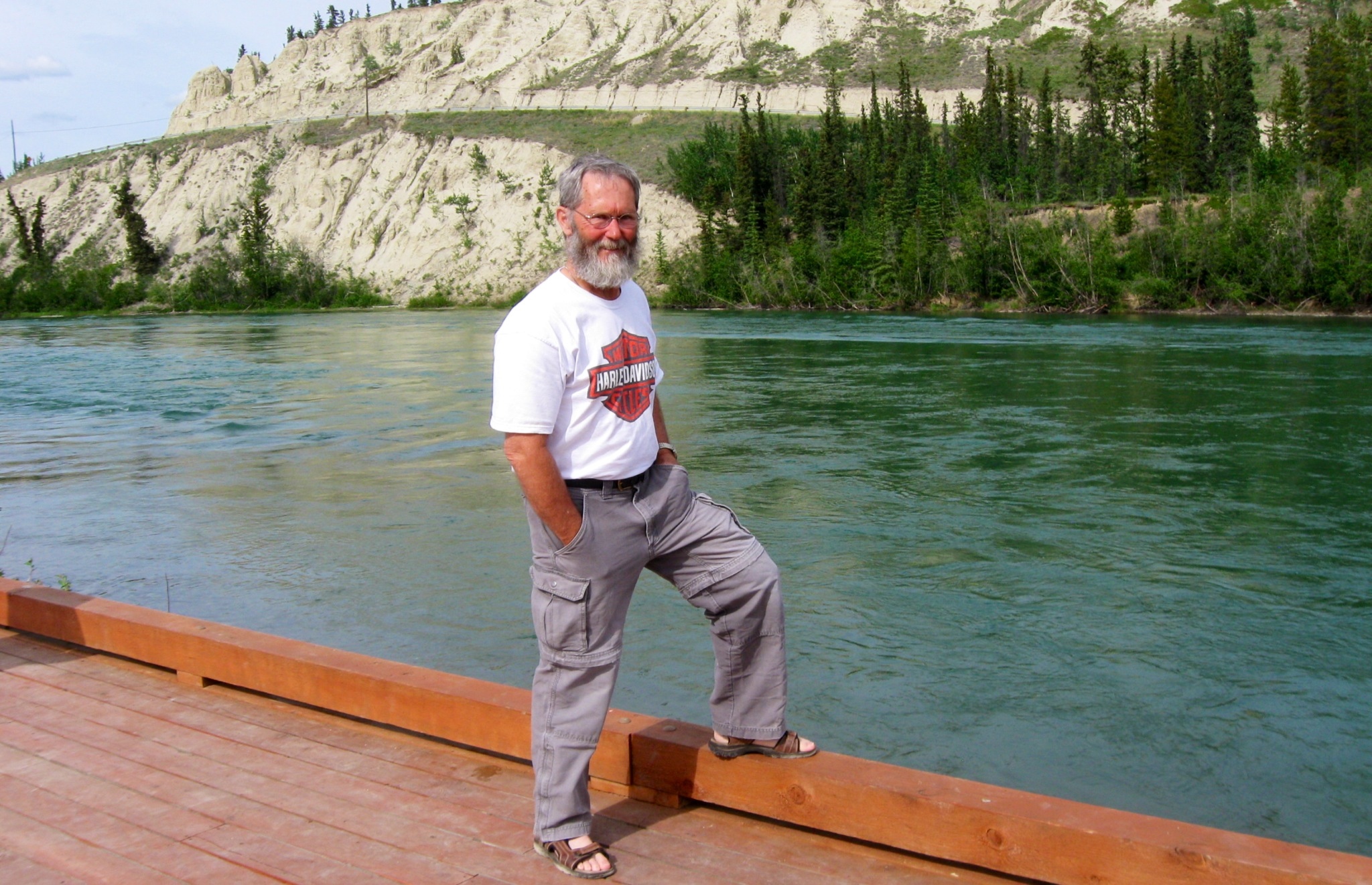
On the banks of the Yukon River
The Kwanlin Dun Cultural Center, poised on the banks of the fast-flowing Yukon River, is a beautiful facility with an art galley, art studios, class rooms, and a large performance/meeting hall. In addition, three large temporary tents on the grounds housed several dozen artists who demonstrated their traditional techniques, offered hands-on help in learning the skills involved, and were all very friendly and as interested in us as we were in them.
Work of Art
The juried art work in the gallery was a mix of traditional crafts such as wood carving, beading and moccasin making and non-traditional work such as oil painting. All of the work was beautiful but impractical to buy on a motorcycle trip and a little out of our price range, though I really had my heart set on a $15,000 hand crafted wooden box. Almost all the artists were members of one of the Yukon First Nations tribes, including the Tlingit whose specific cultural center we stopped at yesterday in Teslin.
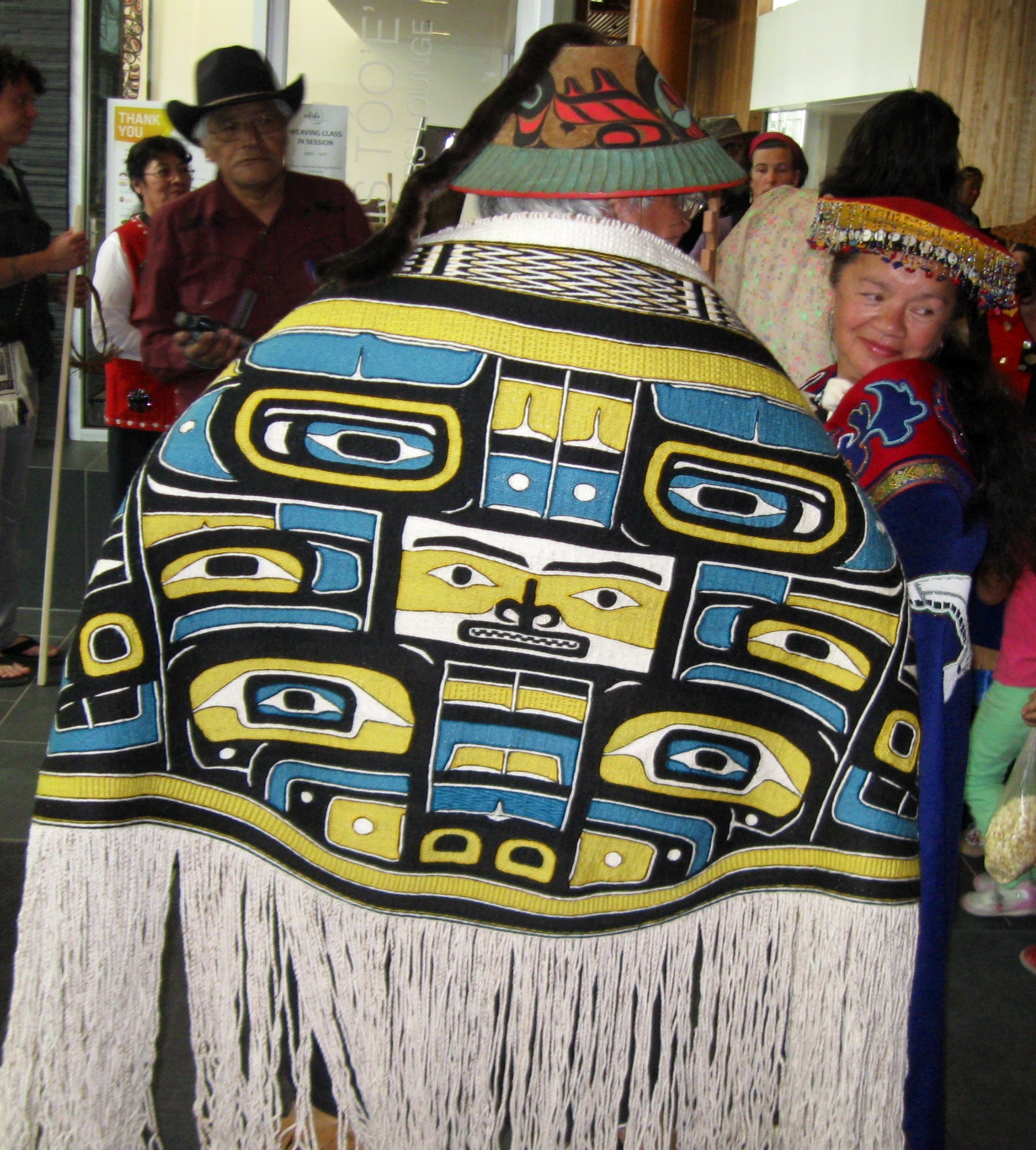
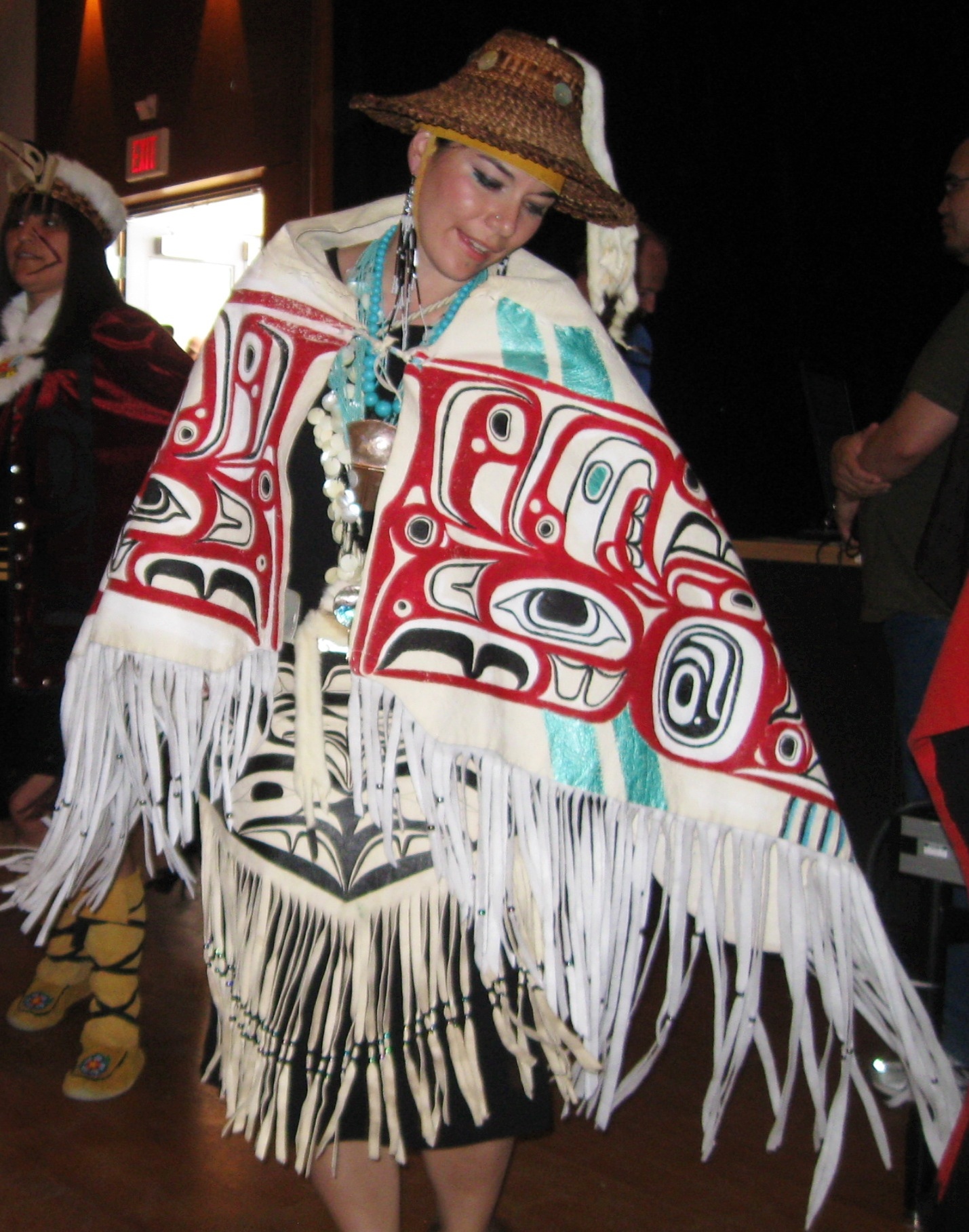
One of four new robes
But the multiple highlights of the day came from listening to a dozen groups sing and drum and watching them dance. Their regalia was always interesting and often downright remarkable with intricate beadwork and designs on hand-cured caribou or moose hides. I’m going to post a few more pictures than usual to show some of the gorgeous costumes worn by the singers and dancers. One of the first performances on the agenda was the “dancing” of four new robes painstakingly created by weavers who are very much honored in their tribes. The robes/blankets tell a story, usually about a family, and are passed on from generation to generation.
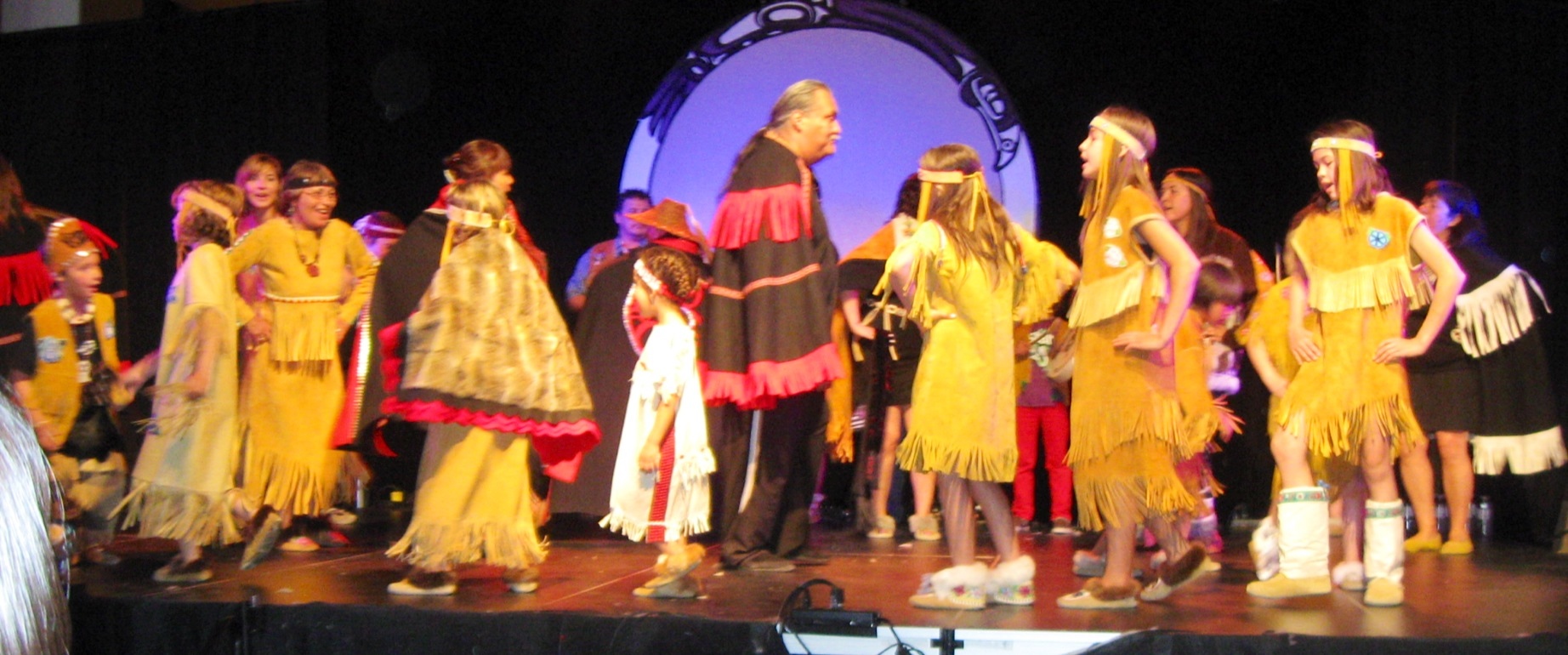
Young and Old keep tradition alive
What was most interesting today, to me at least, was the constant reference to “passing on traditions” to the next generation. They value their young people and honor their family roots and their elders.
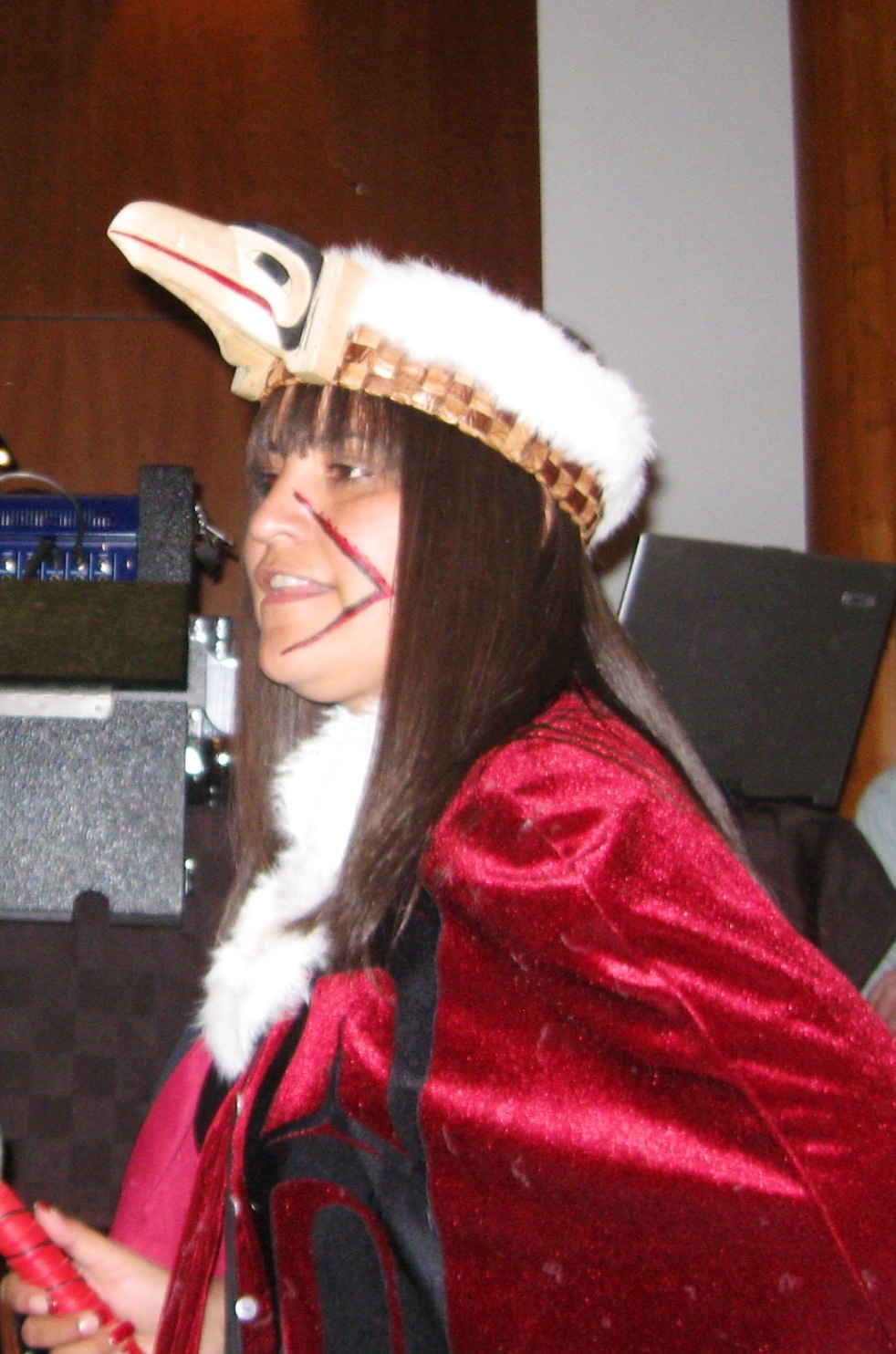
Remarkable regalia
There is a great effort, as evidenced by this festival, to preserve and pass on the language, the stories and the way of life that sustained these people and their ancestors for thousands of years but which all seem to be disappearing under the onslaught of Global Cultural Change as rapidly as glaciers are disappearing under the onslaught of Global Climate Change. I wish it could be otherwise, but I think traditional cultures and a livable climate are both on the way out.
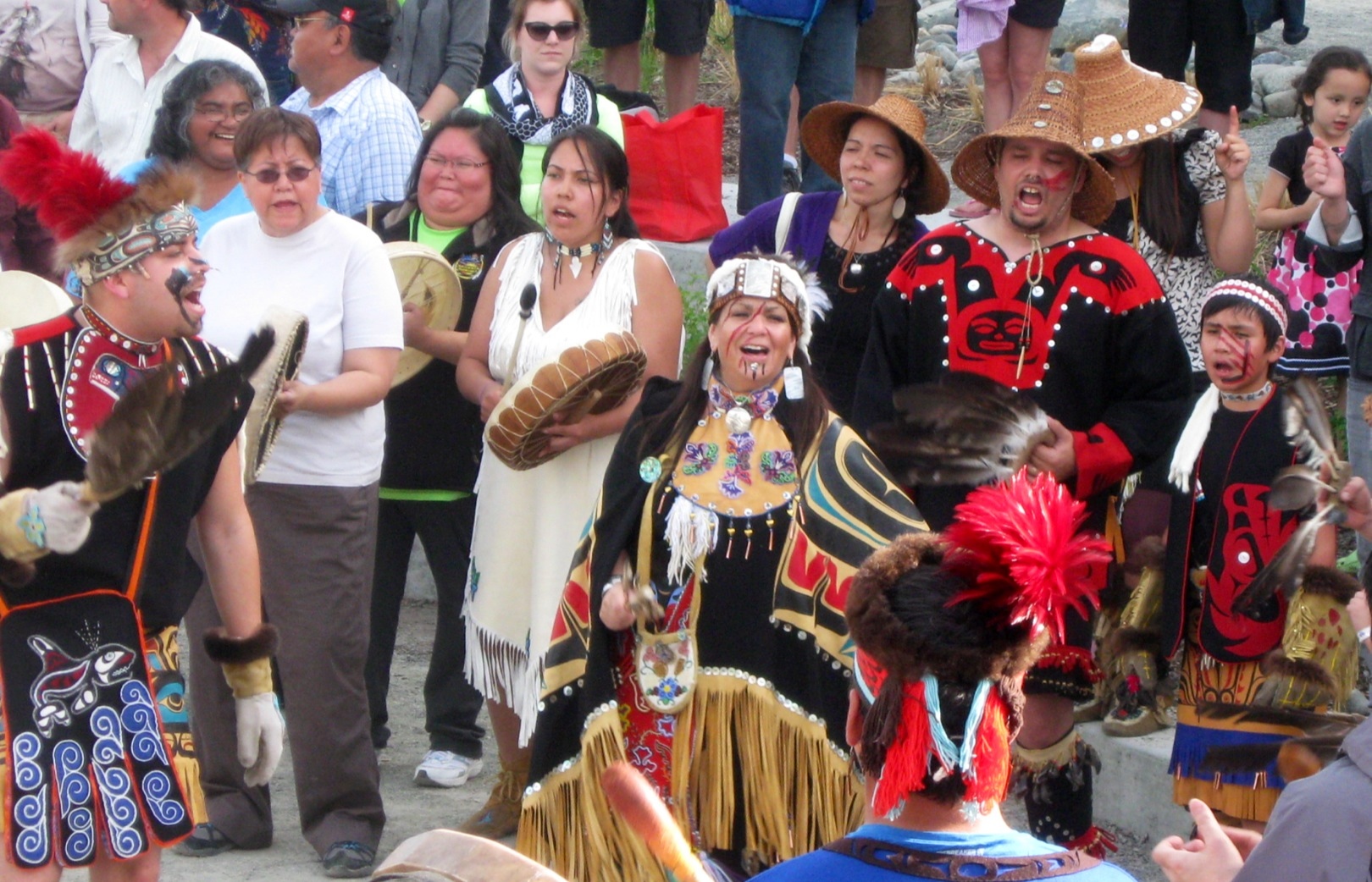
The woman in the white dress sang the eagle prayer.
I’ll relate one more goose-bump raising detail from today’s event. At the very end of the on-stage performances, the final group of singers/dancers led everyone outside to a fire pit for an all-community drum circle and singing. At one point, a woman who had done solo work inside for one of the groups said she was going to sing an eagle prayer. About two minutes into her song, fingers started to point into the cloudless blue sky where an eagle soared in the air high above the Yukon River. It was amazing to behold. I’ll let you judge if it was just coincidence.
Tomorrow we continue toward Alaska through the Yukon Territory with a stop for the night at Buckshot Betty’s in Beaver Creek.
Great Alaska Adventure: I Love Riding in the Mountains
Yesterday we arrived late and tired at Watson Lake, so we didn’t visit the world-famous sign post forest. This morning on the way out of town, we stopped by the greatest collection of “I was here” memorabilia in the world. No one knows for sure how many signs, license plates, road markers and other assorted markers are hanging in the forest because the number grows every day as more people leave something that marked their presence at a particular place. But some estimates go as high as 100,000. I believe it.
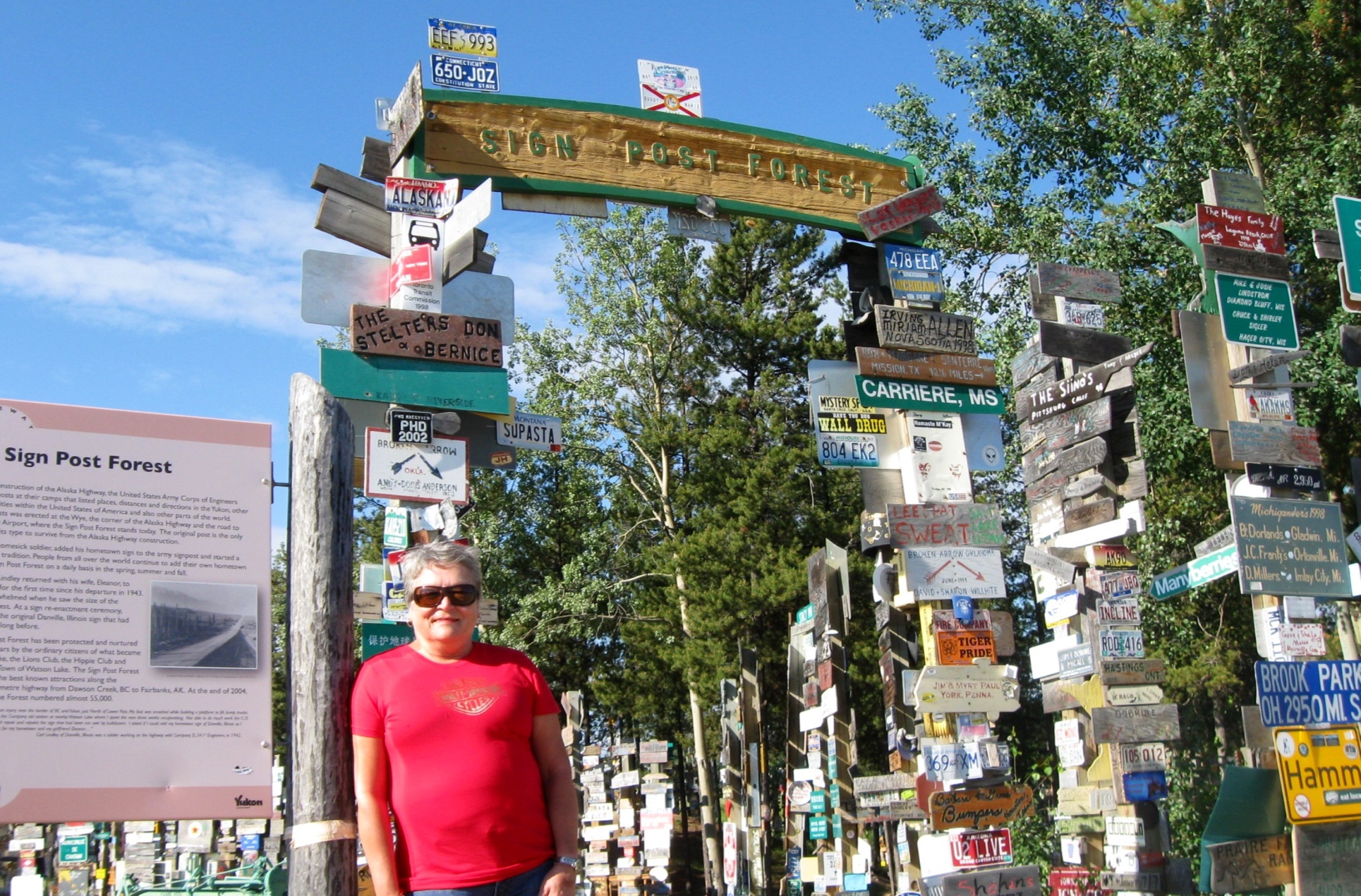
World Famous Sign Post Forrest
For those unfamiliar with the sign post forest, here’s a little background. When the U. S. Army was blazing a path through the Canadian and Alaskan wilderness to build the road on which I’m riding these days, a particularly forlorn GI Joe added a sign to a post with distance markers to various points along the under-construction highway. Only his sign was for his hometown of Danville, Illinois. Soon several other soldiers followed suit and there were dozens and then hundreds of additions. The soldier’s simple beginning is now home to as many as 100,000 signs from every state in the union and probably a hundred foreign countries. Some have a town’s name. Others have the name of the person who left the sign. Most have both.
It’s one of the most famous and visited attractions on the Alaska Highway. I didn’t leave a sign, but I may someday on a return trip. I know I was there and you know I was there, but I’m not sure I care if an untold number of strangers read my name among thousands of others. It’s a great tradition and no harm is done by adding another sign, but it seems little more than 100,000 voices crying in the wilderness.
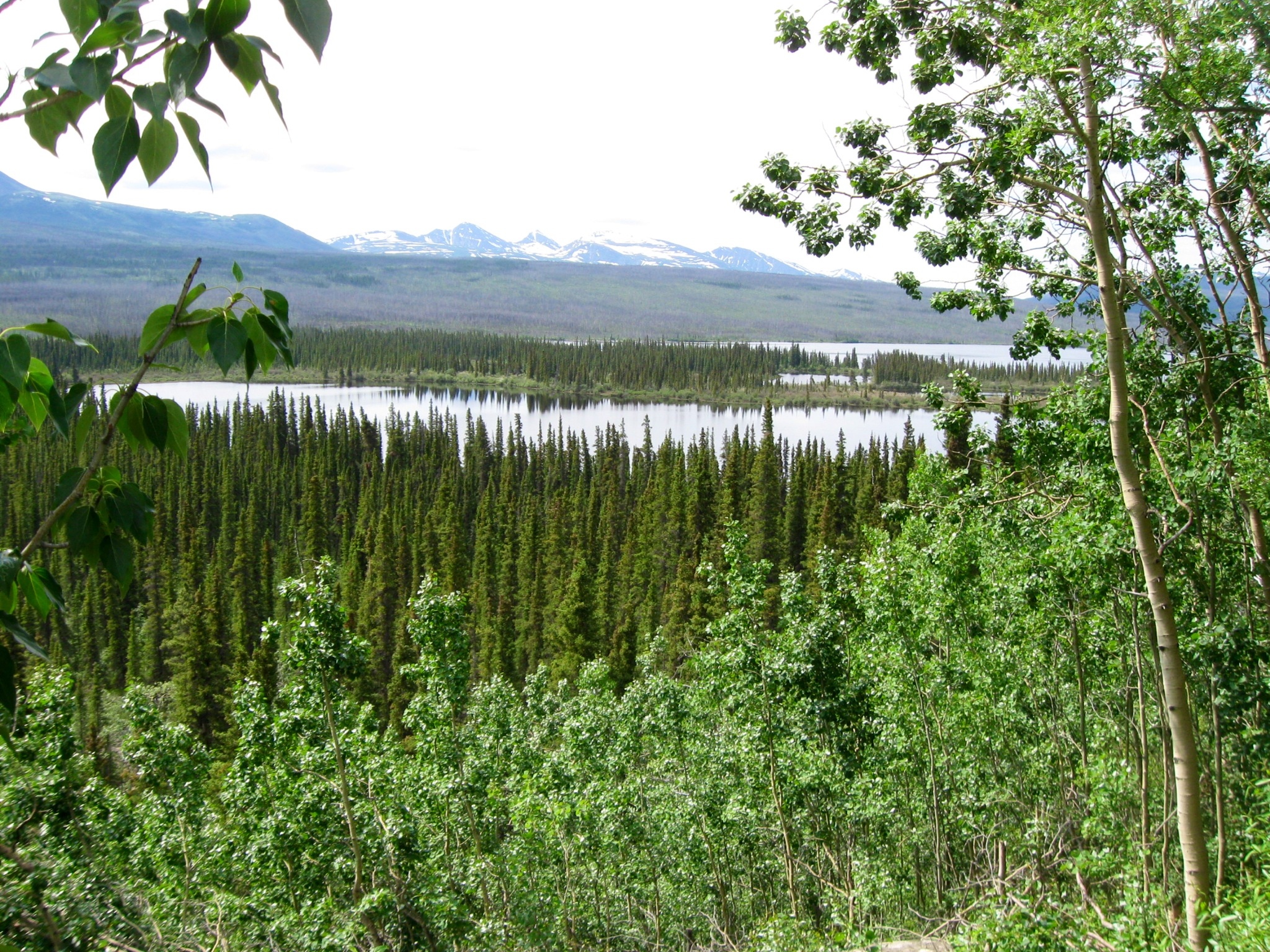
Yukon Rockies in the distance
When we left Watson Lake we were back on the highway surrounded all day by mountains. We didn’t actually ride any twisties today, but hour after blessed hour I sat back with the wind in my face (and the occasional dust cloud fathered by Chip Seal) and took in an amazing panorama of snow-covered peaks, lush green forests, rapidly-flowing crystal clear creeks and rivers, mirrored-surface lakes and a mostly blue sky that made the perfect backdrop to the ride. I have already decided I will be back. And more than once. The Alaska Highway isn’t the only road in the Great North, and I want to explore more of them. Anyone up for the ride? The ride, perhaps, of a lifetime? There’s history to be learned and explored, relics of the two-legged and mechanical kind to be encountered, and an immense wilderness teeming with living things that will make you feel small yet very connected to universe.
Daily Pie Report: I stopped for morning pie at a ramshackle roadside eatery that had been recommended by a bearded gent in another ramshackle roadside eatery, but I came up empty handed in my quest for crusted satisfaction and settled for a homemade banana nut muffin. Undaunted, I pressed on to lunch where I snagged a piece of homemade apple pie and snuck a bite or two of Marilyn’s blueberry slice. It was good, but nothing to write home about. Except that I just did.
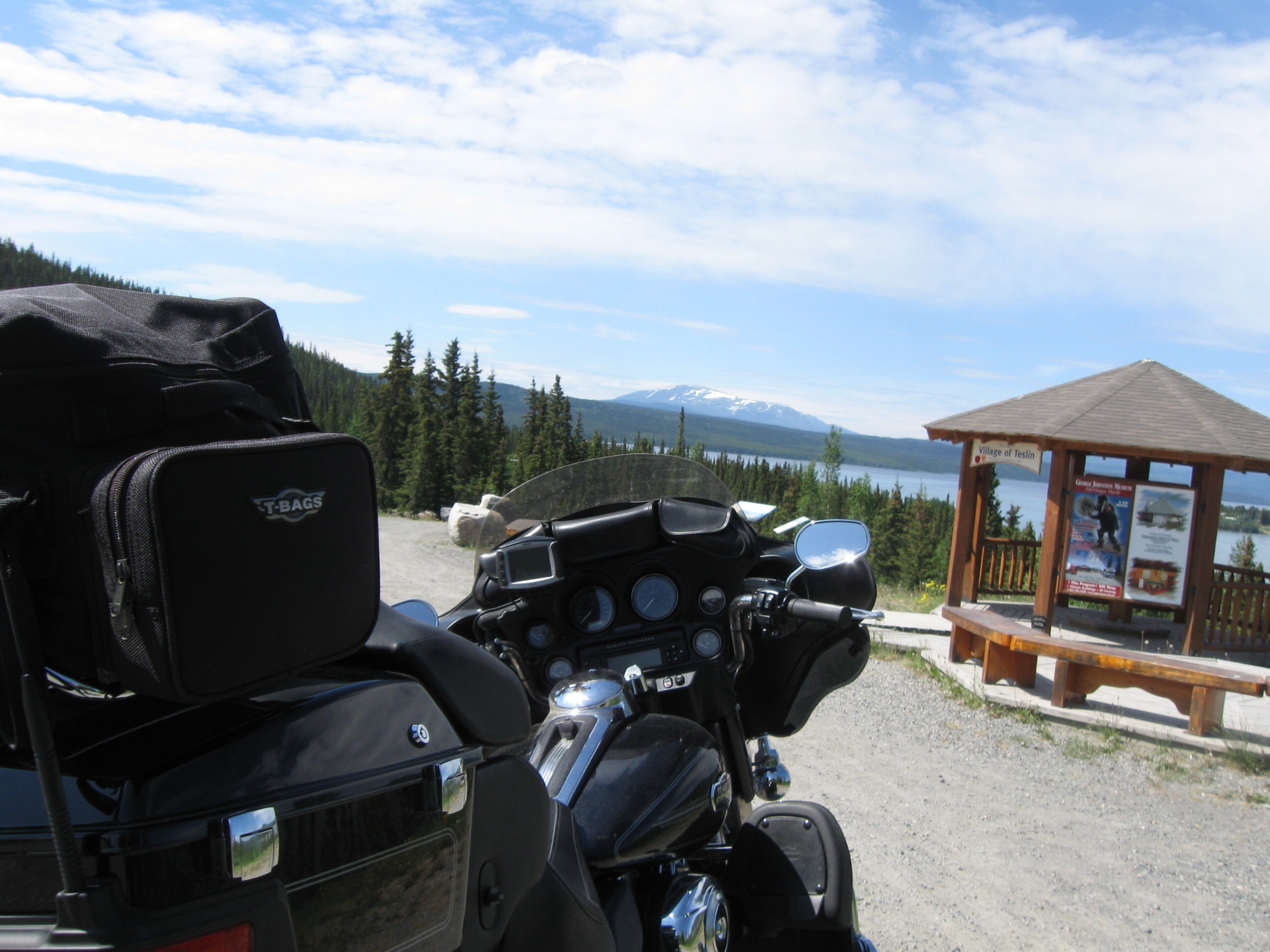
Teslin Lake and 2,000′ Grated Bridge
Lunch was in Teslin, site of a 2,000 foot grated metal bridge over Teslin Lake. It’s the longest bridge on the Alaska Highway. Once Marilyn motored from the east end to the west end, she admitted it wasn’t as nerve-wracking as she had been building it up to be all morning. I missed a photo op as we went over the bridge, so I backtracked while lunch was being fixed and took a typical tourist shot of the bridge.
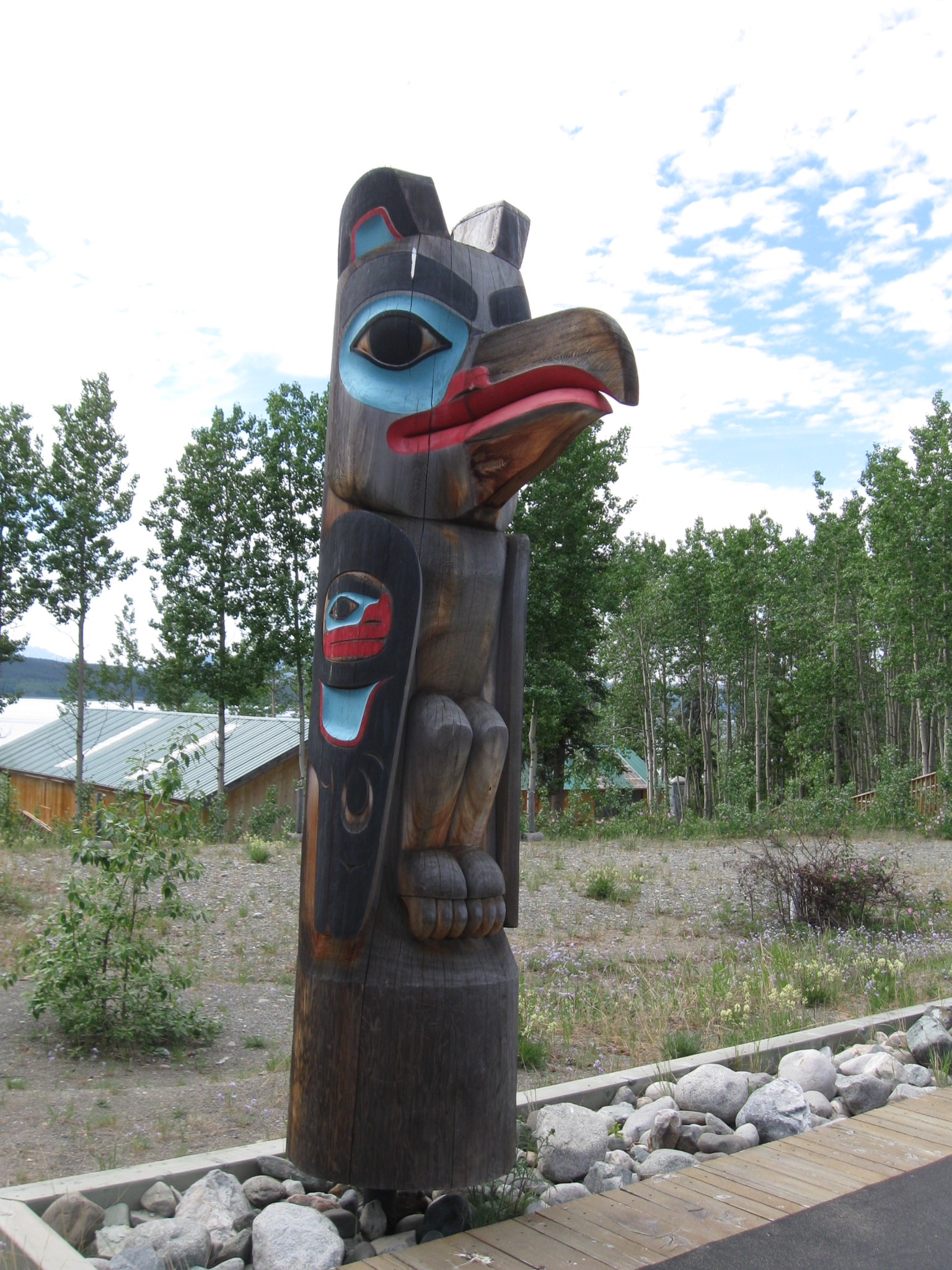
Raven Clan Totem Pole at Teslin Tlingit Heritage Center
Teslin is also home to the Tlingit Heritage Center where we spent an hour learning about one of the First Nations group’s history over the past 200 years. The Teslin Tlingit (pronounced “Kling it”) are also known as the Inland Tlingit to distinguish them from ancestors who live in the Juneau area. Their traditional ways, like many native peoples, are being diluted, changed, or destroyed as a result of inevitable contact with outside cultures. In the Tslingits’ case those alien forces included Russian traders in the 19th century, Hudson Bay Company traders in the late 19th and early 20th century, and finally the presence of thousands of soldiers and new opportunities to make money during the building of the Alaska Highway. We spoke with an elder woman who was at the center making beautifully beaded footwear about passing on traditional arts. She said she learned from her aunt and she’s trying to teach young Tlingit girls, but they don’t have much interest in the traditional ways. Inevitable, I suppose, that native cultures are subsumed by more powerful outside forces, but it will be a shame if all the traditional ways are lost.
We finished up the ride to Whitehorse, YT, by about 5:30 and checked in to a pretty shabby Ramada Inn. This place has seen better days, but seems clean enough and had an attached tap room where I could savor the local brew: Yukon Gold, advertised as “A Beer Worth Freezing For.” Tomorrow we’re going to take a day off from riding and see what Whitehorse has to offer besides Yukon Gold.
 hdriderblog