
Newfoundland/Labrador Day 18: Off the Road and On the Water
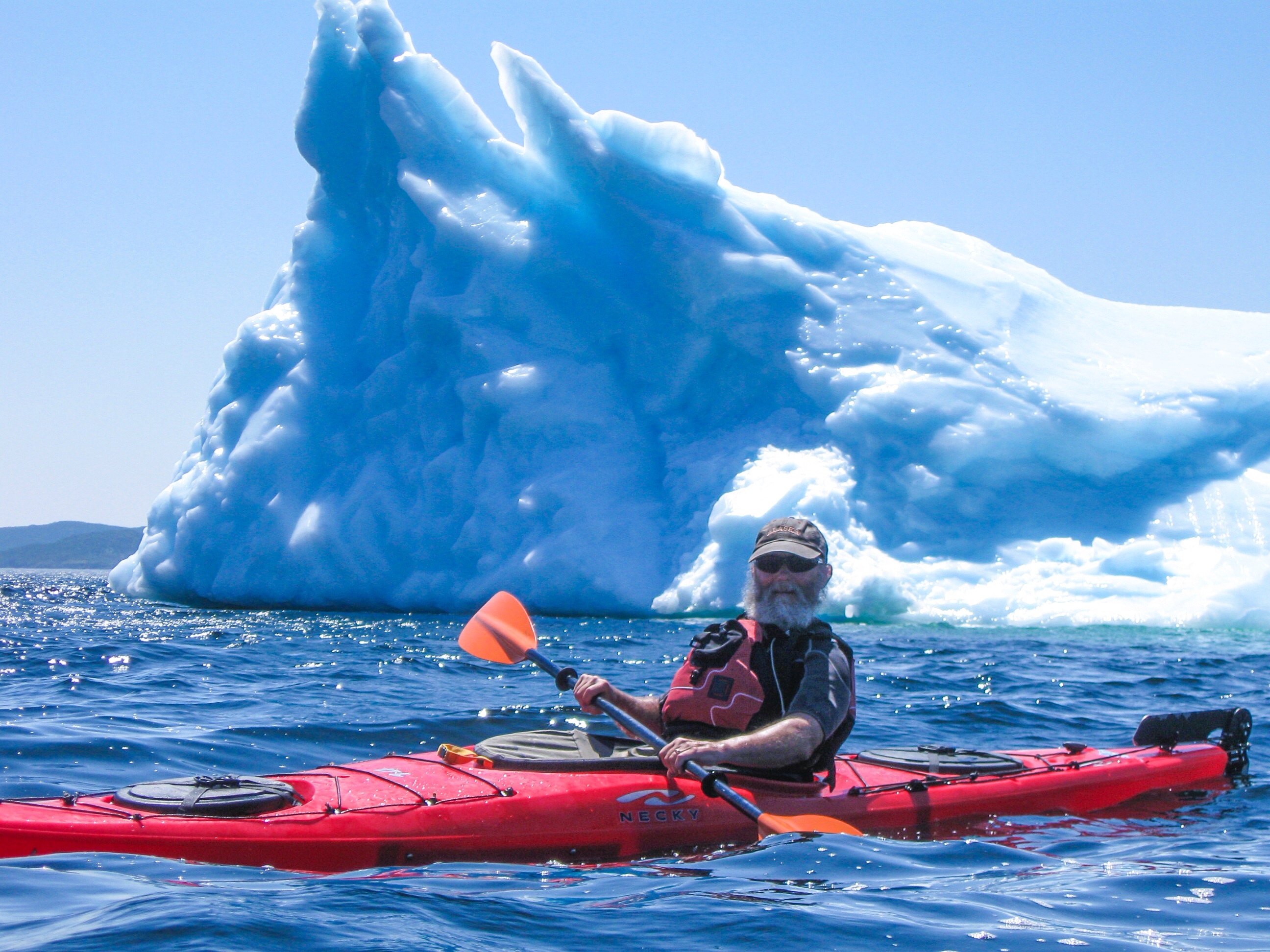
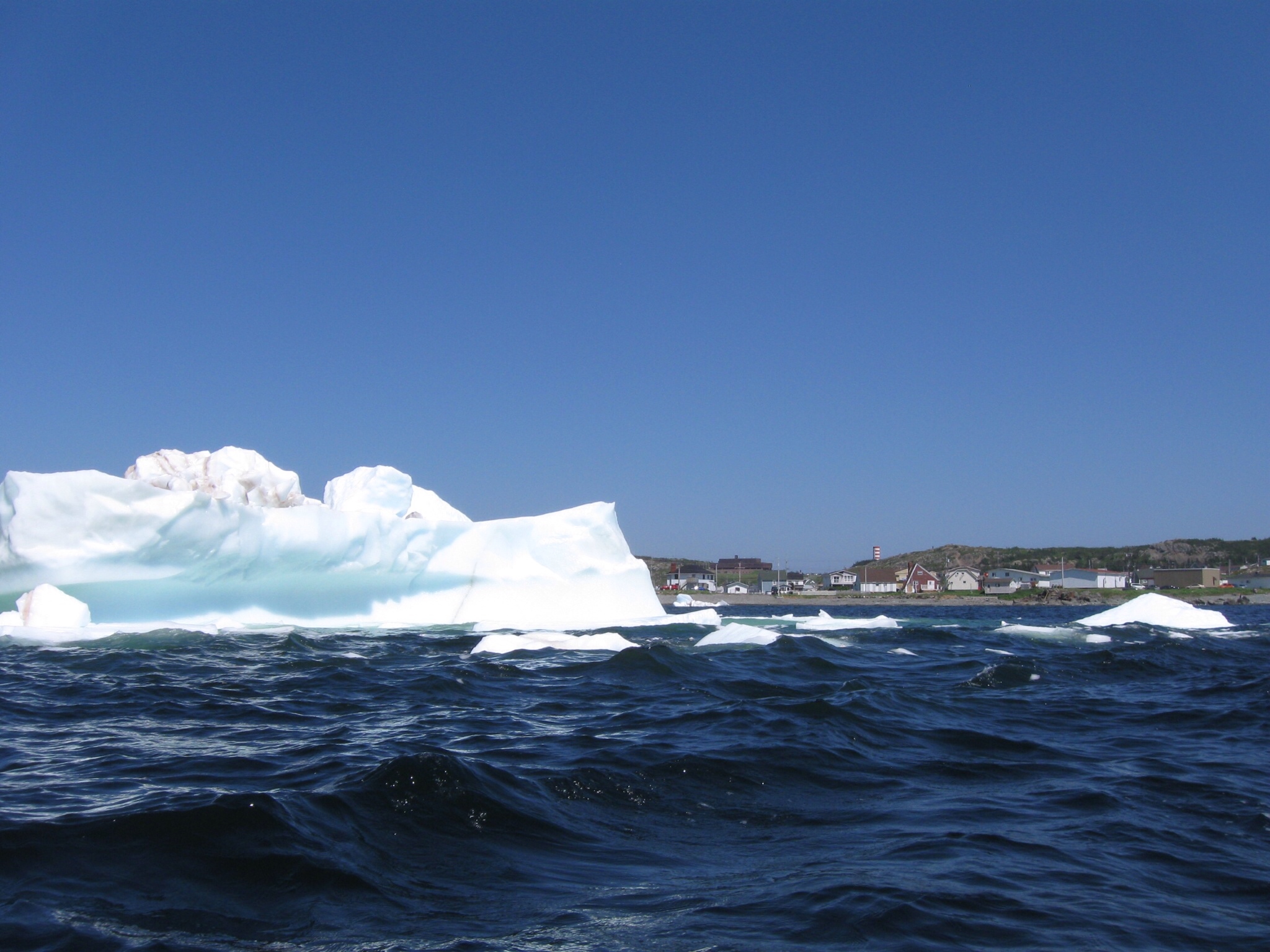
This was the first iceberg we visited.
Some days on the road stand out above others, even when you’re not actually on the road. Today was one of those days. I went to another museum this morning and it was interesting, but that’s not what made the day special.
Today I checked off “kayaking among icebergs” on my bucket list. What a blast! I went to one of the local kayak/zodiac boat tour operators and was the only one there so I had a one-on-one guided tour by Mitch, a 20-something kid who was guiding for the summer while he figured out what he wanted to do with his life. Nice kid and pretty laid back.
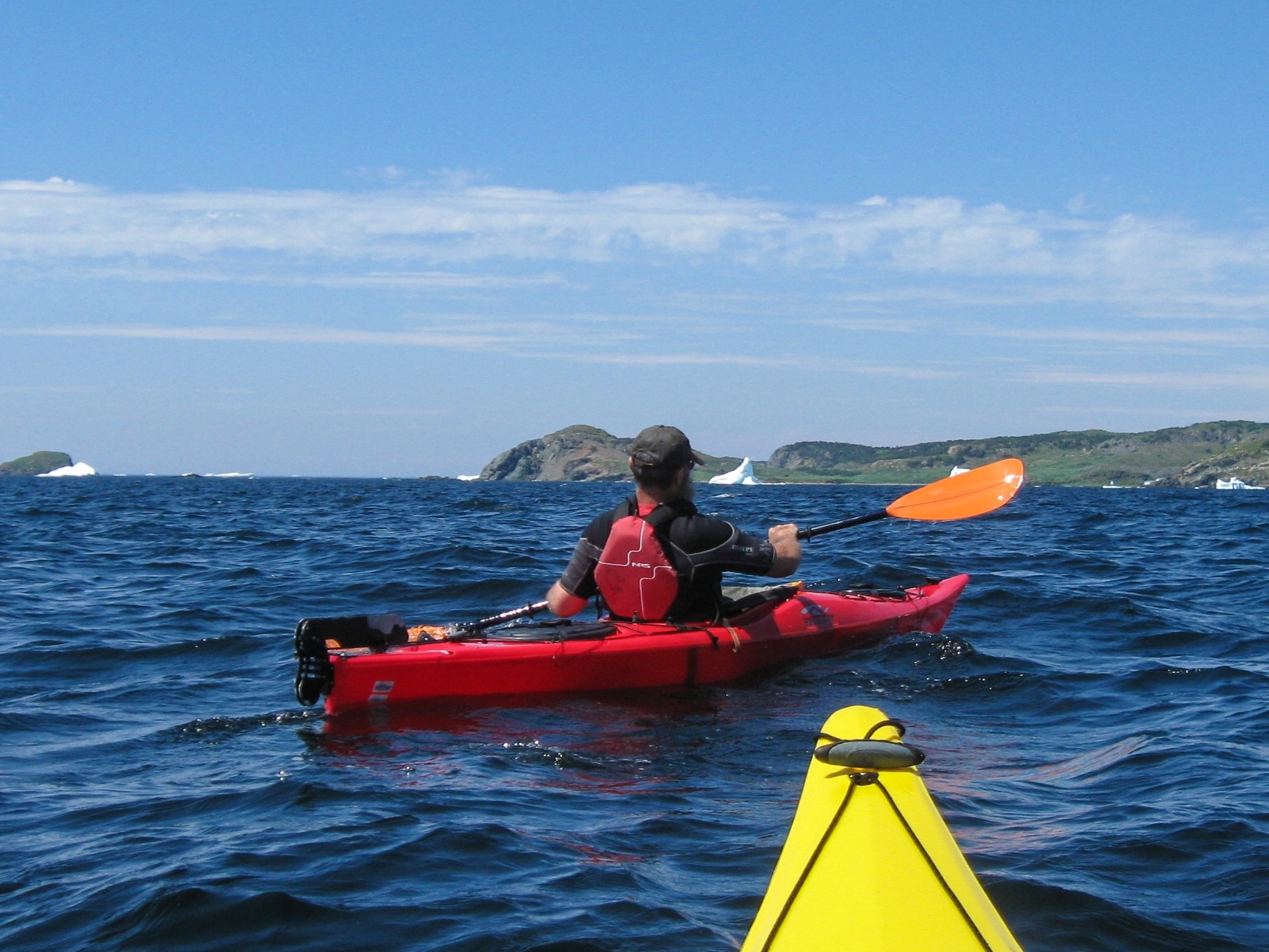
Not hard to find icebergs here.
I got suited up in the appropriate kayaking gear and we headed out of the harbor and onto the open seas where the icebergs were. The wind was up a little when we got outside the harbor, but not enough to turn us back so we continued to paddle out to the bergs. They’re amazing from the shore but unbelievably awesome from up close. The colors, the texture, the constantly changing shape as you circle around them made for a great on-the-water experience.
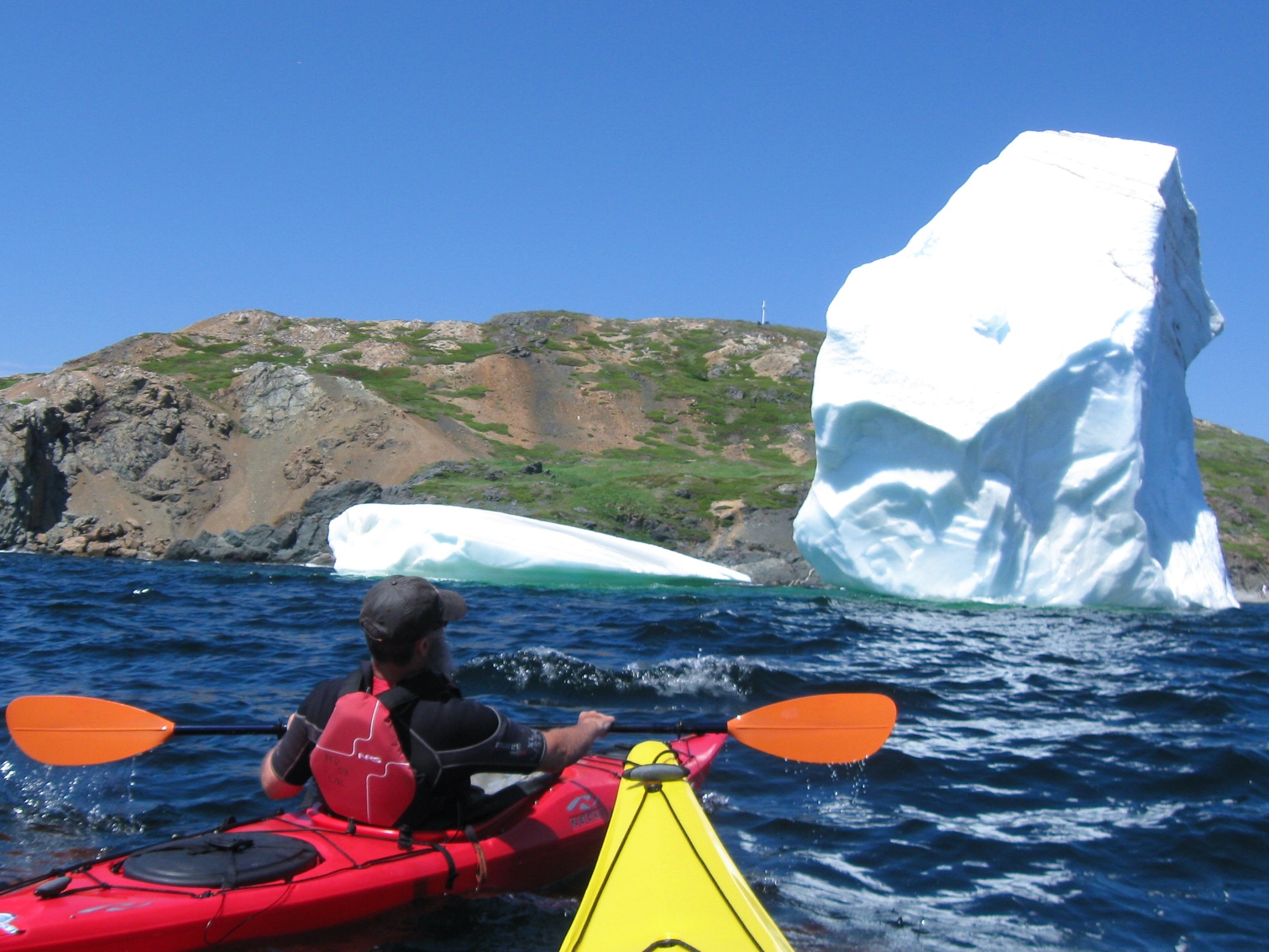
Probably 80-100 feet tall.
I knew going out that we wouldn’t get right next to them because they can break or flip at any time and would easily swamp our little kayaks. We generally stayed about 20 yards away, maybe a little further from the bigger ones.
Each iceberg, as one circles around it, becomes dozens of different icebergs as the light reflects differently and the shape constantly changes as you change perspective.
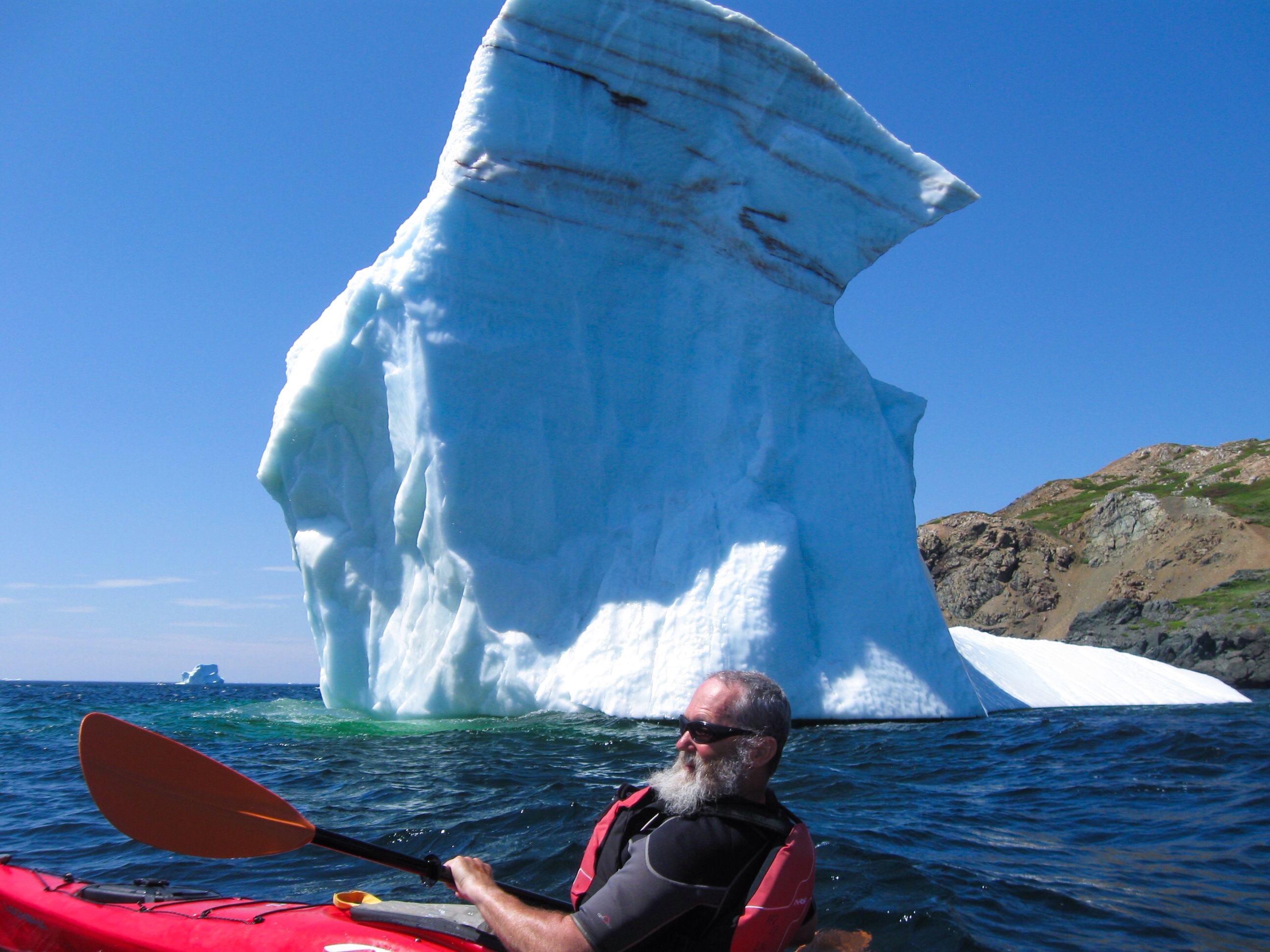
Check out the brown streaks.
I gave Mitch my (old) camera to take pictures for posterity and to remind everyone what you can do when you’re retired. We paddled out to one of the bigger ones that was pretty well out to sea, with the plan of coming back toward shore (with the wind at our backs) and seeing some of the others. One of the bigger ones was streaked with brown/red stripes that I’m pretty sure were the result of volcanic eruptions from Iceland a few years ago, though it could have been any airborne dust that settled on the Greenland glaciers as they were forming.
This berg was considerably larger about 1 minute earlier.
As we positioned ourselves between two large bergs to take a picture, we heard an explosion-like sound behind us and knew what it was. It was an iceberg breaking up. We turned to see which one and about 4 seconds later the berg closest to us lost about 1/3 of its surface mass as the ice came crashing down into the water. It set the kayaks rocking some: exciting but not dangerous. But if we had been right next to the berg as it broke up, it would have been a serious situation. Mitch, who’s been guiding in Twillingate for only two weeks, said he’d seen another break up last week but from a distance. He said he’d never been this close to one and said it was as exciting for him as it was for me.
The wind continued to pick up and we headed back for the harbor, picking up a small piece of 15,000 year-old ice for me to cool my Jack with for the next couple of days.
The iceberg kayaking was one of the adventures I had really hoped to have on this trip, and today’s experience was better than I expected. Being up close to these massive ice cubes was cool, but the break up was something special.
I’m going to hear some local Newfie music tonight but probably won’t add to this blog when I get back because it will be late. I may, though, as I sip my iceberg-chilled Jack.
Watch out for falling ice and I’ll do the same.
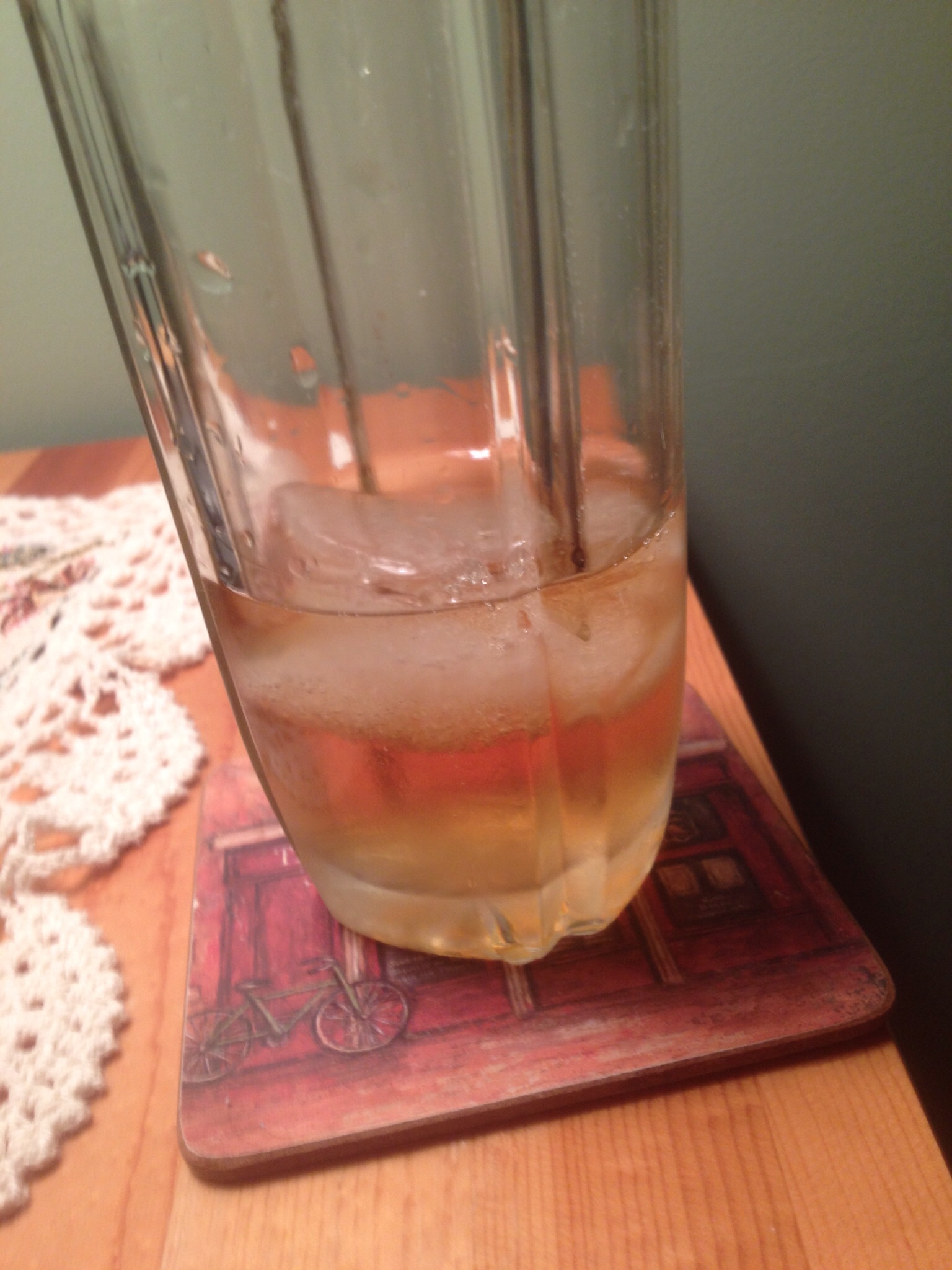
Best ice for the best sippin’ whiskey.
11 p.m. Addition: I just returned from a first-rate musical performance by a local singer and her two guitar accompanists. It was an order of magnitude better than the dinner theatre entertainment last night. She has a great voice and a very wide repertoire: Blues, folk, traditional, bluegrass, country and her original songs which were as good as any of the others. Bought a CD that will keep me entertained on the road. (I found a link to a YouTube video of her singing lead on a song she wrote for a group of women–The Split Peas–that she sings with. Click here if you’re interested in hearing her.)
Now I’m going to close the evening with a sip of Jack over 15,000 year-old ice. Life is good.
Newfoundland/Labrador Day 17: Lighthouse, boats, and local entertainment
A full day in Twillingate is a full day. Icebergs, lighthouses, museums, a winery, and dinner theater.
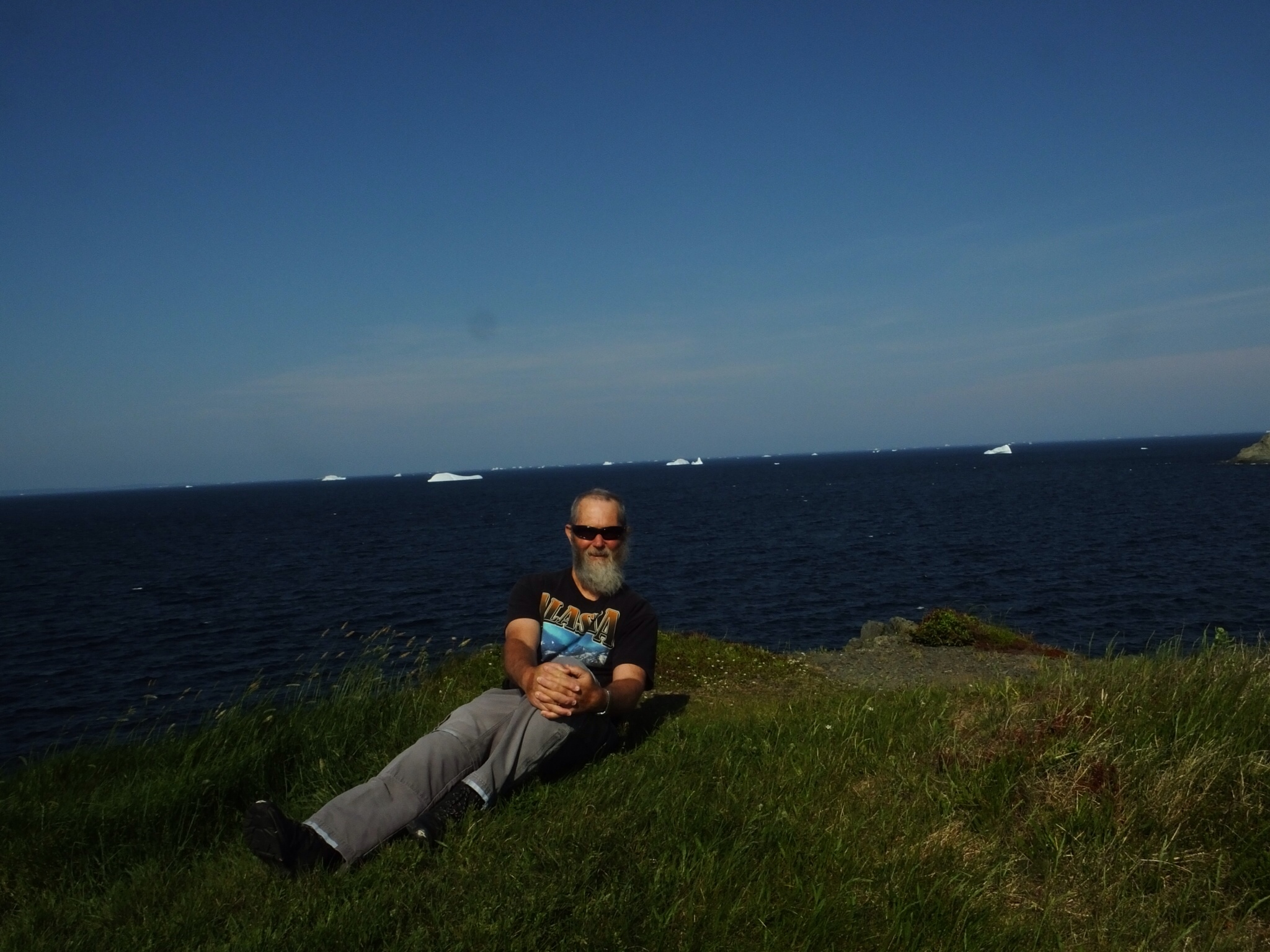
Icebergs everywhere.
While Twillingate is still a fishing community, it has made significant efforts to cater to a growing number of tourists who arrive via the relatively new causeway which connects it to the mainland. When commercial cod fishing was effectively ended by government decree in 1992, Twillingate began to redefine itself as a tourist destination, in part by claiming to be the “Iceberg Capital of the World.”
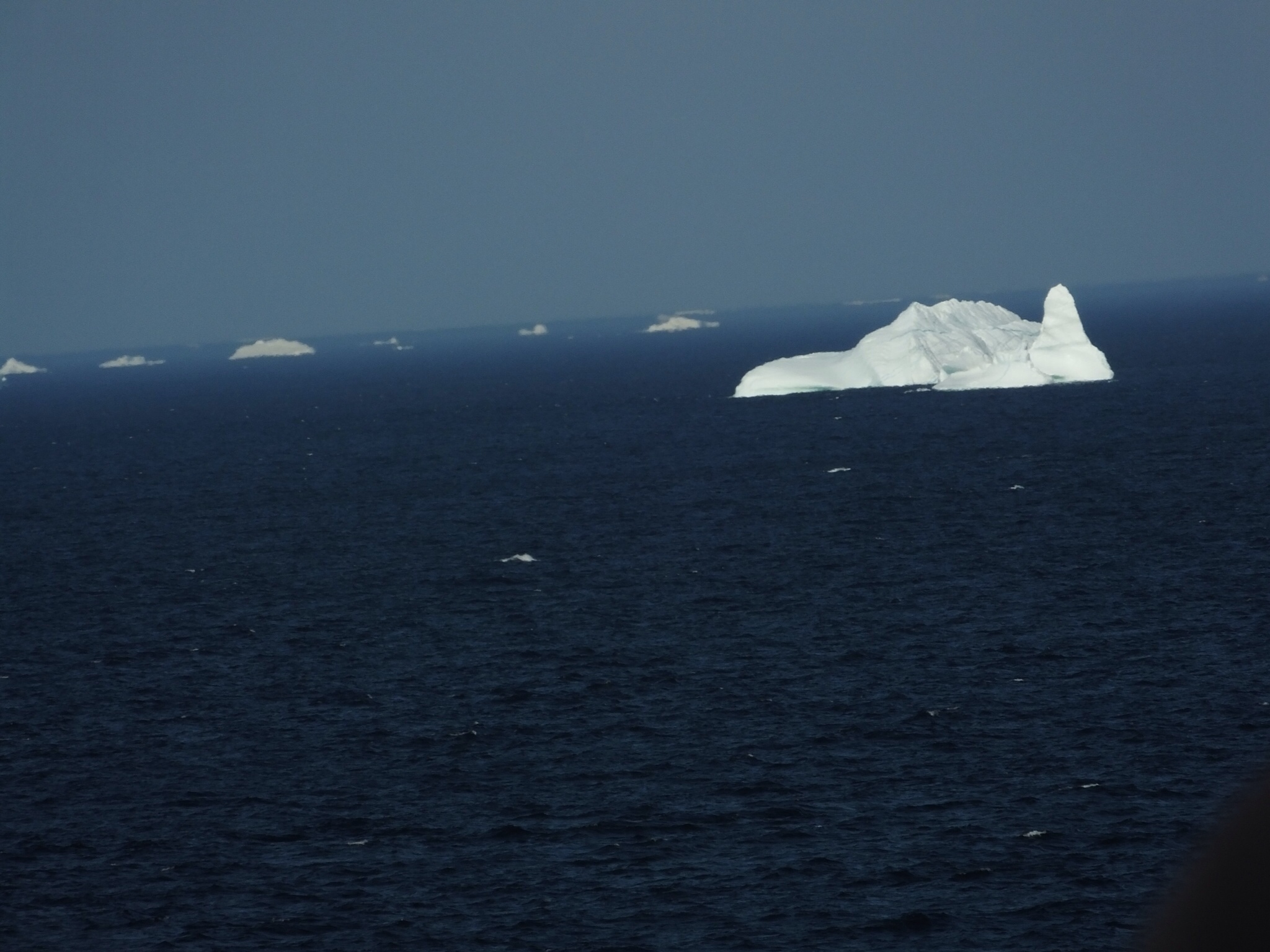
That will chill a lot of Jack.
If what I saw again today is any indication, the little village in the cove may deserve that title. Everywhere where I went on the island today icebergs of all shapes and sizes could be spotted, some almost next to the shore and others far out on the hazy horizon. Hundreds of floating ice islands is an amazing sight, though everyone says that this year’s crop of icebergs is above normal. They also say that as Greenland continues to warm dramatically and shed its glaciers, a “normal” iceberg year in Iceberg Alley will be far above the “normal” of 10-20 years ago.
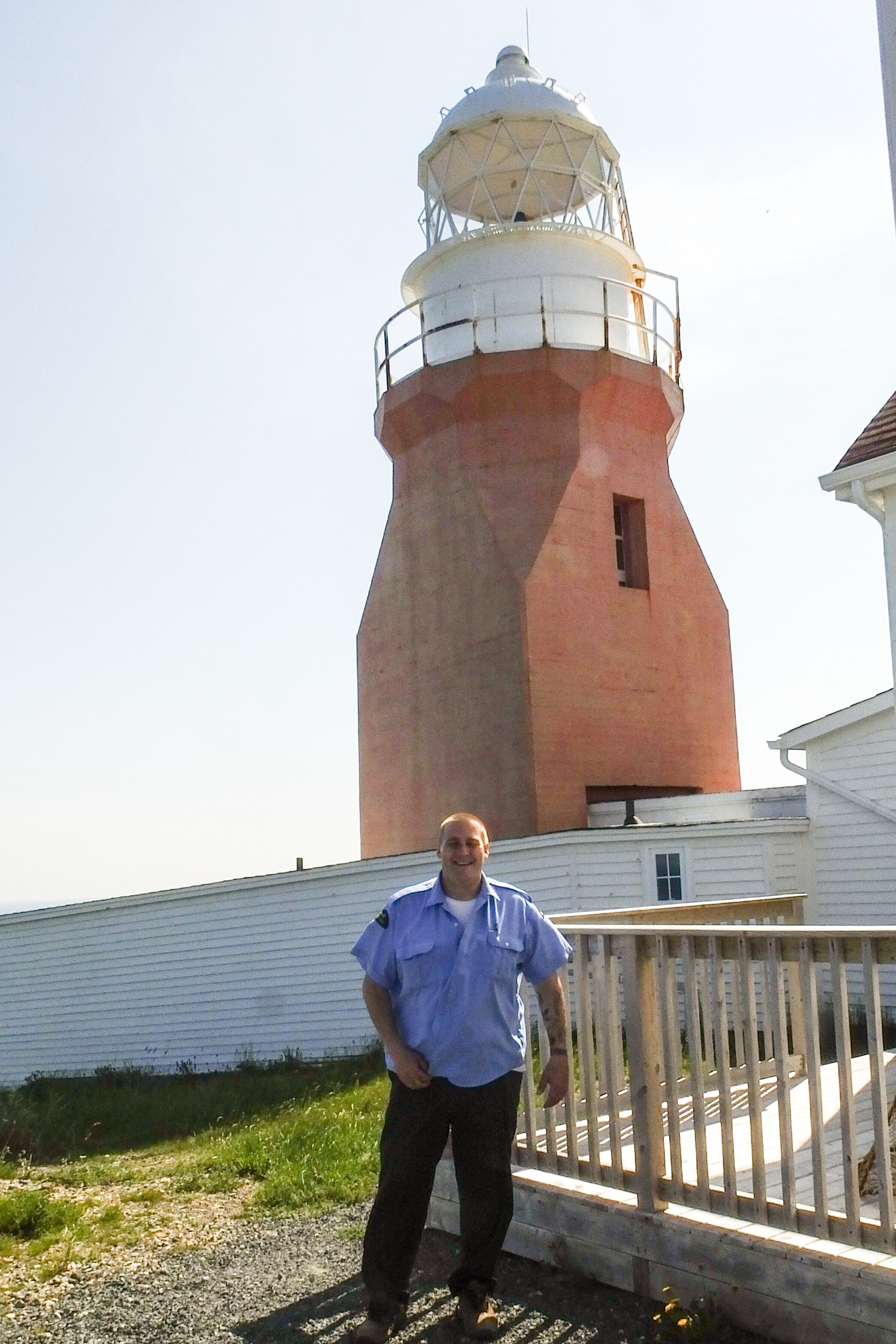
Dennis was my source for all things lighthouse.
I went back to the lighthouse I saw yesterday because I wanted to see the exhibits inside. As luck would have it, as I was getting ready to go in the lighthouse I struck up a conversation with the Canadian Coast Guardsman who is the only staff currently at the lighthouse. Dennis (an easy name to remember) had been born and raised in the area and had returned a couple years ago as a lighthouse tender. Heavily tattooed and wearing his uniform with a decidedly non-military nonchalance, he explained that he is one of two tenders who work 28 days on and have 28 days off and work a 40-hour week. The lighthouse and fog horn are automated and maintenance is largely farmed out to the private sector. His job, he said, was to monitor the emergency band radio when he was at his office. The rest of the time, the lighthouse is on its own. He explained several lighthouse facts to me: Each lighthouse has its own distinct light and foghorn signal. The number of light sweeps per minute and the duration and frequency of the fog horn are different for each station. We talked for about half an hour and I knew a lot more about lighthouses when we finished than when I arrived.
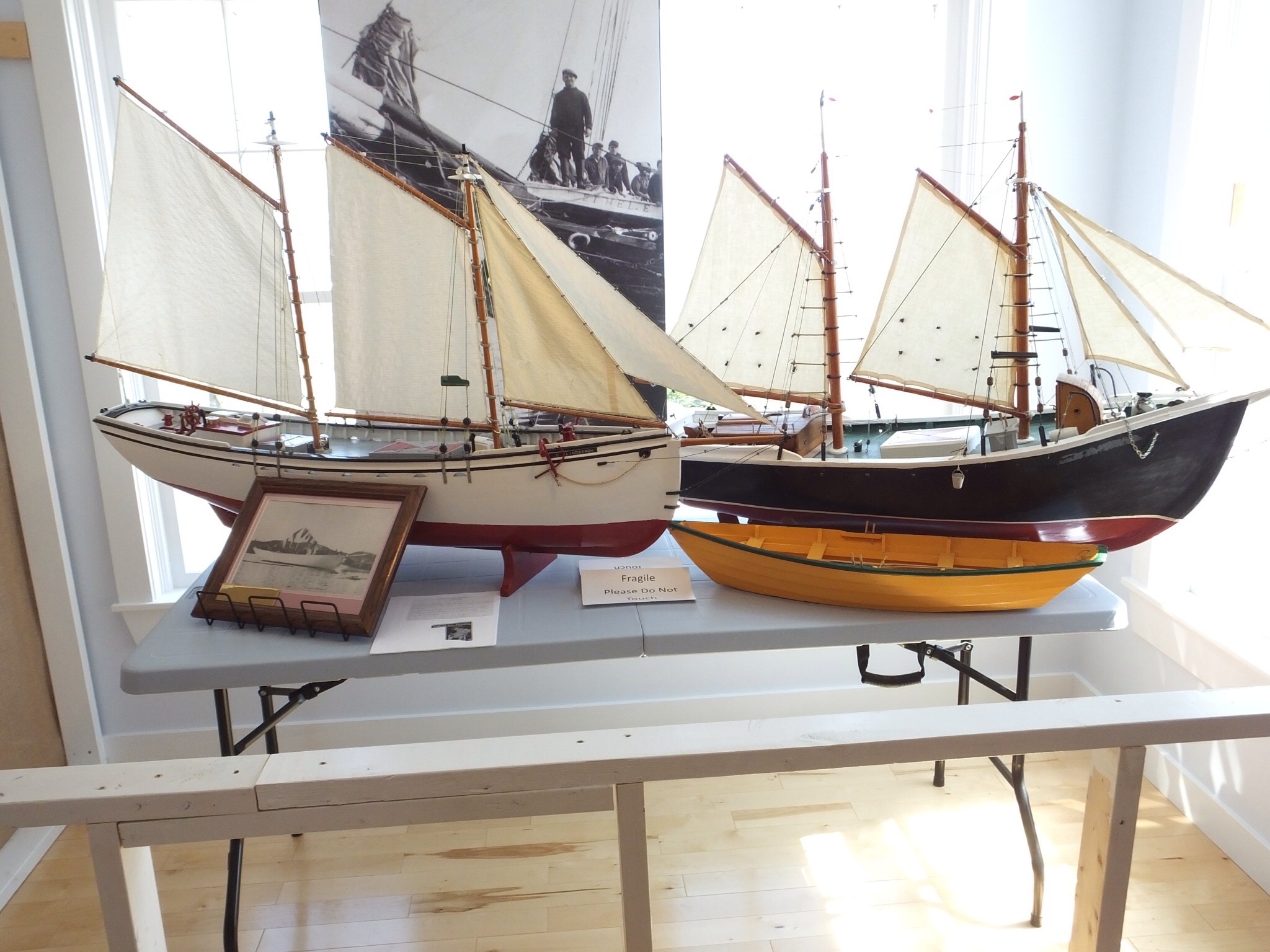
Three of more than a dozen model boats.
All the buildings on the site except the lighthouse tower and Dennis’ office were sold a few years back by the Canadian government to the town of Twillingate for $1.00 for them to use as a museum as long as the new owners maintained the property. Good idea. Rather than simply recreate a “lighthouse keeper’s” museum, the town and the historical group that run it decided to gut and refurbish the main structure and create a proper museum with changing exhibits. The current exhibit features boats and boat-building over the years, beginning with pre-European Indians and continuing through the demise of handmade wooden boats and the growth of fiberglass boats. I hadn’t thought about how important boat building was in a fishing culture nor how different each boat could be based on its specific use and the boatbuilder’s special skills. I learned about kayaks and canoes, dories and punts and schooners and cruisers. The exhibit was well-done and the underlying theme bemoaned the loss of vital, historic boat-making skills with the advent of fiberglass and the end of commercial cod fishing in Newfoundland. There are, however, a small group of craftsmen dedicated to preserving and carrying on the art of boat building mastered by their fathers, their grandfathers and their great grandfathers.
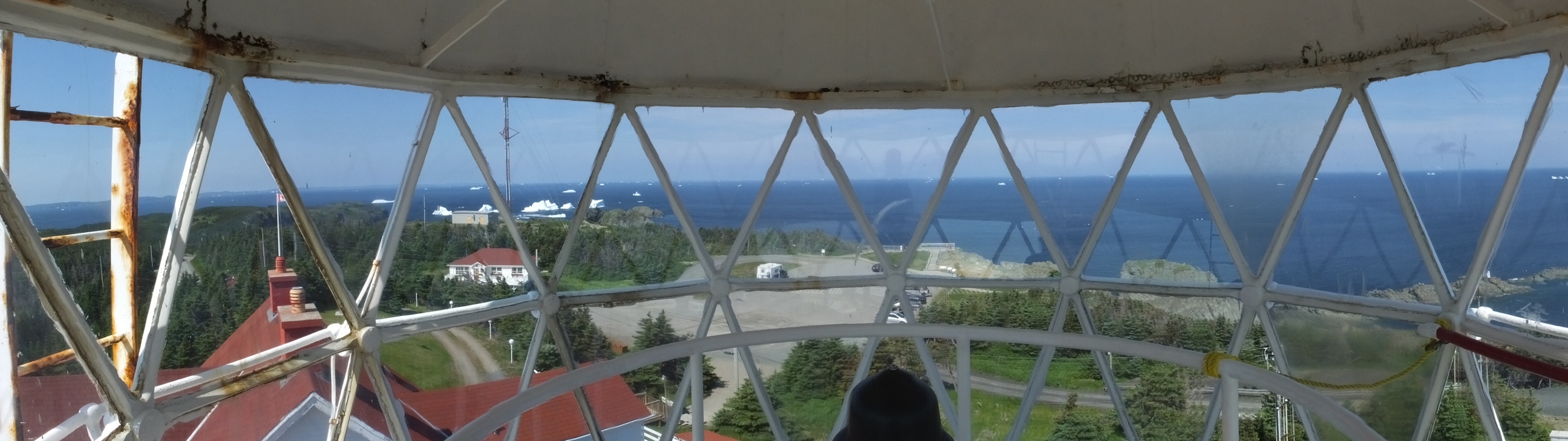
120 degree view from the lighthouse.
I climbed the relatively short lighthouse tower and saw, as the Coastie said I would, a panorama of most of Twillingate island and many islands, bays and coves beyond. And LOTS of icebergs.
One minor glitch today on the motorcycle following the lighthouse visit. It wouldn’t start. Wouldn’t even turn over. But I had plenty of power from the battery. I tried the alarm override PIN # I had set up to bypass the fob, and it started up. So it must be the fob, but I just replaced the battery about 2 months ago. I returned to my B&B a spare fob was stowed in my pack and it started the bike. But then the other fob appeared to be working as well once the second one reset the system. Will keep my eye on it. Fortunately I had some practice a few months ago starting the bike when I didn’t have a fob, so that came in handy, Brian.
I went to one of the docks where kayak tours were available but the cautious entrepreneur said it was much too windy to get out on the sea today. Maybe tomorrow. If no kayaking, I’ll probably take a zodiac boat tour of the icebergs. I want to get up close and personal and get some ice for tomorrow night’s glass of Jack

Twillingate to work hard to maintain ownership of this bear.
Another local museum on the other side of the island was more in the nature of a typical local museum with an eclectic collection, including a polar bear that was shot and killed in 2001 when it wandered through town. I actually learned about cod fishing, curing, salting, packing and shipping. That knowledge probably won’t come in too handy, though, since I’m retired and don’t plan to take up cod fishing. But, hey, you never know.
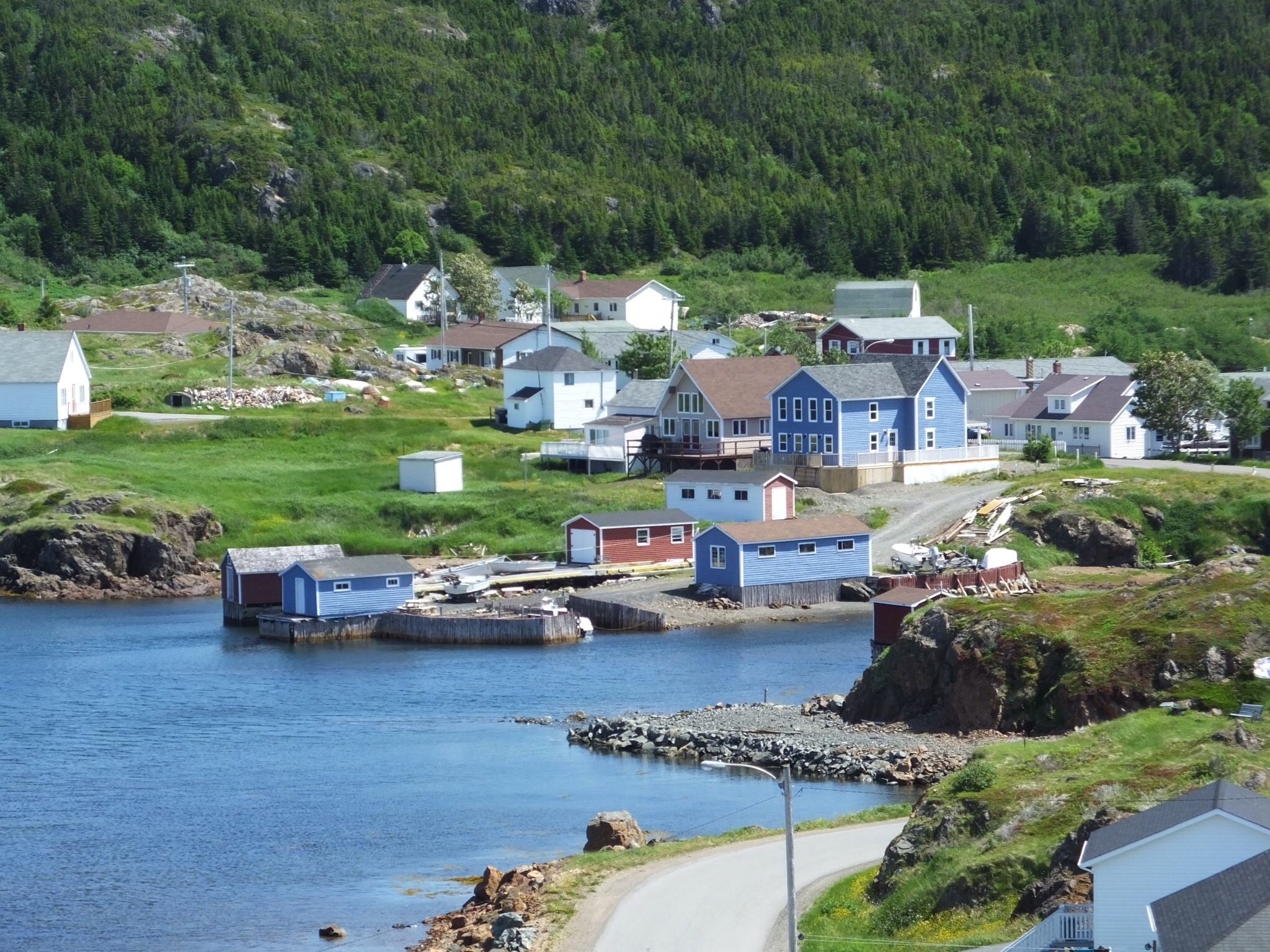
Part of Durrell on Twillingate Island.
There are no grapes grown on the island, but there is a winery nevertheless where they use local berries to make fruit wines on the premises. I picked up a small bottle of Moose Juice which Marilyn and I will share on my return unless it breaks inside my luggage before then in which case I’ll probably just chew on my socks and shirts until the flavor’s gone.
Dinner theater tonight to end the day. It was fun but not over-the-top fun. Some singing and skits using local talent. Best part of the evening was table conversation with dinner partners, one of whom had been born in Newfoundland and spent 50 years sailing the seas on various vessels and could tell me more about cod fishing to fill in the gaps left by the museum. Cod tongues may be in my dining future.
I’m hopeful I’ll get on the water somehow tomorrow. Forecast is still calling for 70% chance of rain of Sunday which will have an impact on any riding plans I have.
More pictures on Flickr. Click here.
Watch out for the polar bears and I’ll do the same.
Newfoundland/Labrador Day 16: Forests, History & More Icebergs
The Newfoundland/Labrador adventure is half over. Today is day 16 of what I expect to be a 31 day ride and, so far, it’s been all I expected and more. The weather has been good: I’ve only needed rain gear 3 out of 16 days and the next two days are supposed to be sunny. Then Newfoundland will probably get hit with what’s left of hurricane Arthur, though I think it will just be two days of rain and some 35-40 mph winds. The second of those two days is a travel day for me to the next B&B south of St. John’s but I think I’ve ridden in worse rain than what’s in store Monday.

One of the arms of the cove at Botwood.
Today’s ride was uneventful on good roads (The TransCanada Highway (TCH)) most of the time and the scenery was nice but not spectacular like Gros Morne. Miles and miles of forests, which often blocked the view of the small mountains and numerous lakes and streams along the way. The highway doesn’t have a wide shoulder and there’s usually not a good place to stop and take pictures. I was frankly disappointed that I didn’t see a moose. But I still have more than a week left on the island to capture (digitally of course) of the ugly ungulates.
A WWII vintage PBY parked at Botwood.
After riding for about two hours I saw a sign indicating a heritage center at the next exit, so I braked hard, made the exit and headed down a secondary road looking for whatever the sign referred to. About 10 miles down the road and one turn onto a dead end, I came upon Botwood, which turned out to be a small town on a good-sized cove of the Atlantic Ocean. As I pulled up to the Heritage Center, the first thing that caught my eye was a great big plane parked next to it. Maybe there’s something here, I thought.
One man’s donation to the Heritage Center
I entered the Heritage Center and paid my $4.00 entry fee to a matron who seemed unsure if the fuzzy biker in front of her was lost or really wanted to see the museum. A young student interpreter, hired under the largess of a government grant, said he would show me around. Lead the way, says I. It was exactly the kind of local history museum I’m fond of: Hints of professionalism, evidence of thousands of hours of volunteer commitment and mostly collections of what ever local collectors wanted to donate. Nevertheless, these museums are a microcosm of the communities in which they exist and I love to go learn about the people who lived, worked and died in those communities.
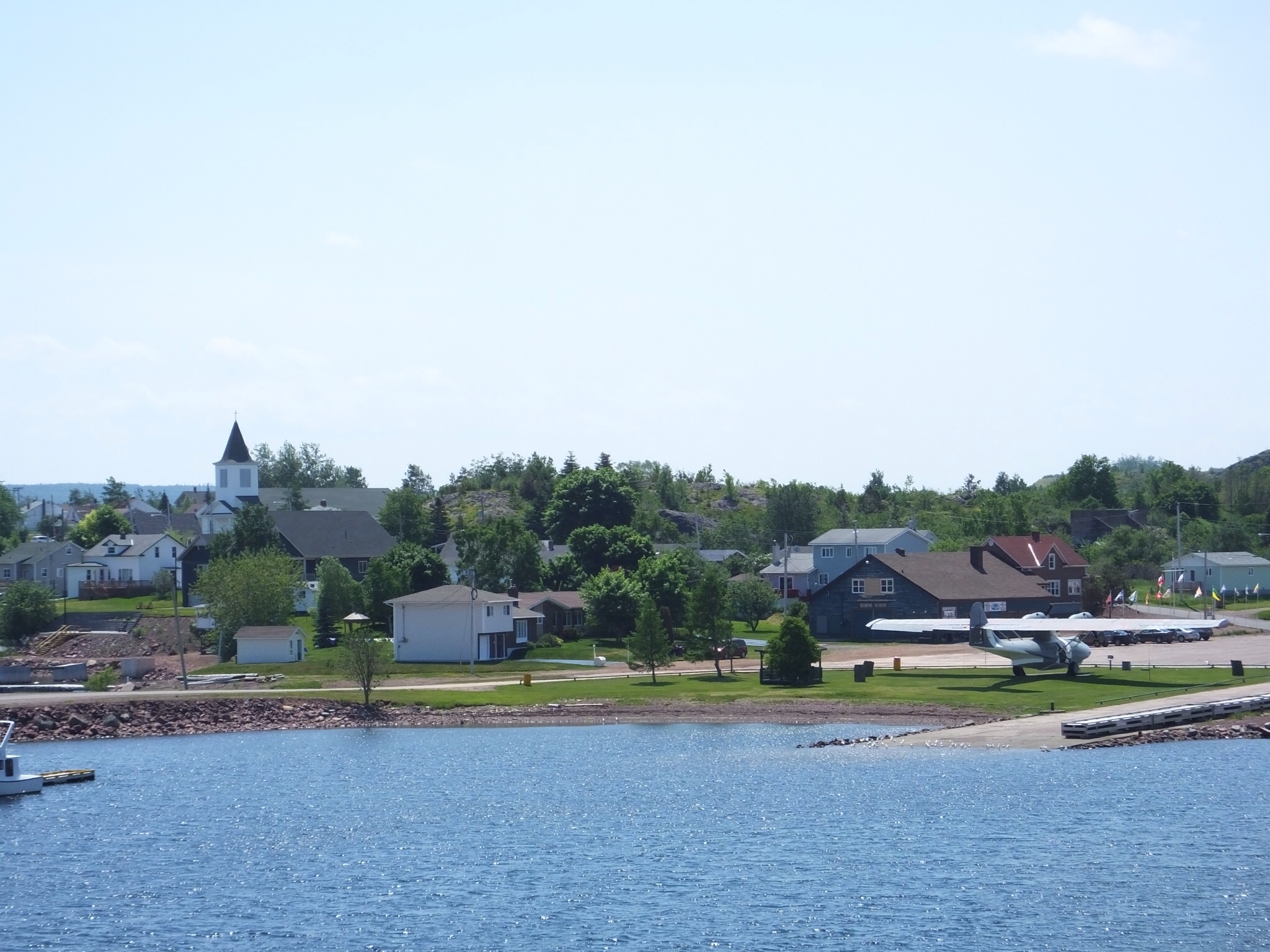
Part of Botwood. Note plane and heritage center.
Botwood, as it turns out, has the deepest natural port in Newfoundland, capable of handling some pretty good-sized ocean-going vessels. All those forests I had been riding through for the past two hours had been logged extensively in the last 100 years and most of those logs went by a newly constructed (in 1898) narrow-gauge railroad to Botwood to be shipped to ports around the world. The railway, the longest of its kind in North America, ceased operating in 1988 with the final completion of a modern highway system and extensive logging roads for trucks.
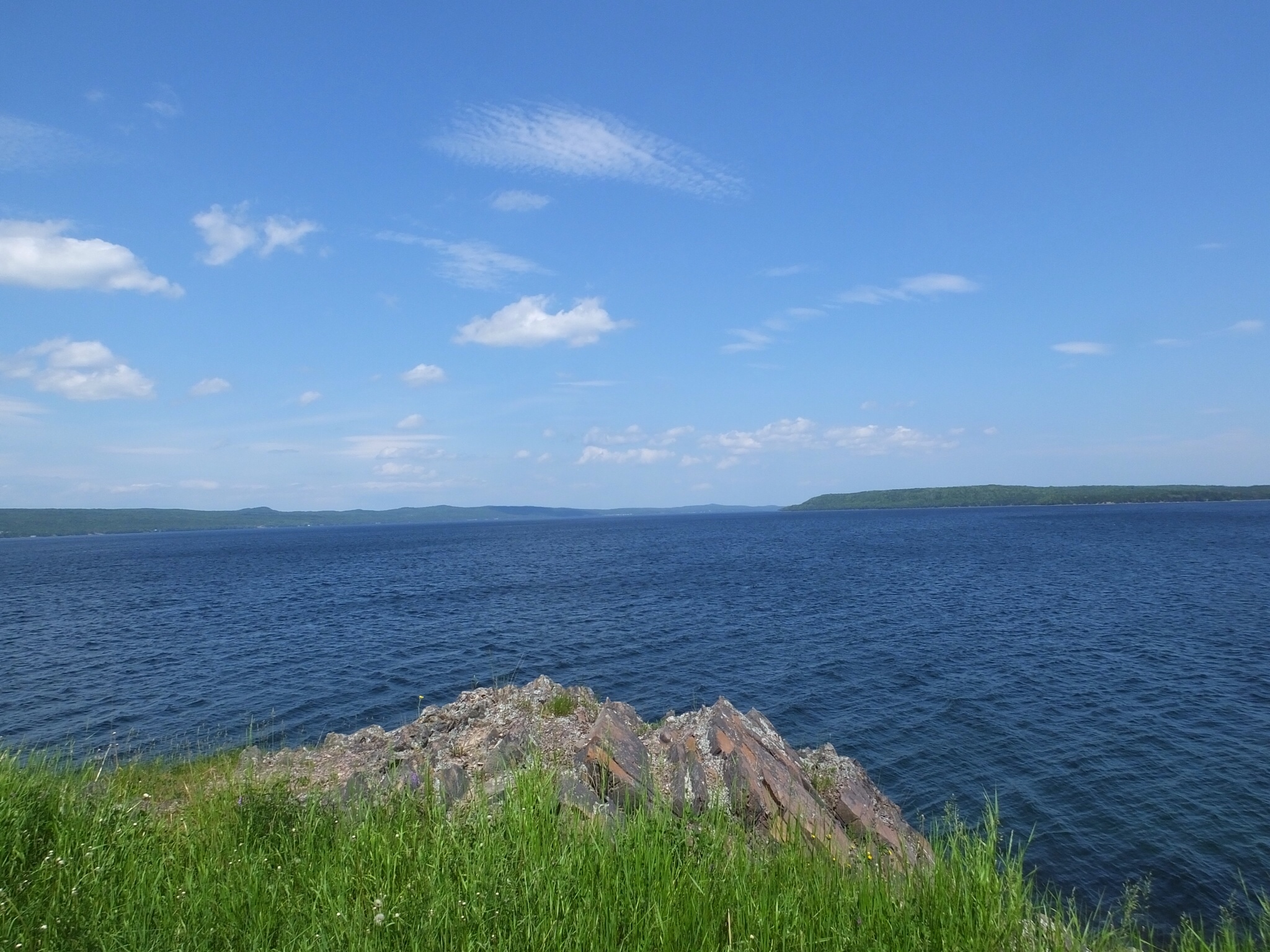
Canadian soldiers scanned the skies and the waters from here.
Botwood also played a key role in the defense of Canada and North America during WWII. The building that now houses the heritage center had been built by the army as a primary radio relay station and the harbor served as a runway for seaplanes that hunted German submarines. A small nearby island had been converted into an anti-aircraft gun emplacement and the island had been hollowed out to hold ammunition. The particular plane in front of the building had not been in Botwood, but PBYs just like it had been. But before Botwood was used as a Catalina and PBY base, it had been the starting point in 1939 for the first trans-atlantic passenger flight (12 years after Lindbergh piloted the Spirit of St. Louis to Paris).
Finally, the museum revealed that the community had also been an important ship building center during the 19th century and many of the artifacts were of the kind that would have been used to build those ships.
As it turns out, the 20-mile detour was a good one for me and added to my storehouse of never-to-be-used-again historical trivia. But I had fun.
After an hour and a half of discoursing over the history of Botwood and a short hike out to the anit-aircraft island, I was on my way again to Twillingate.
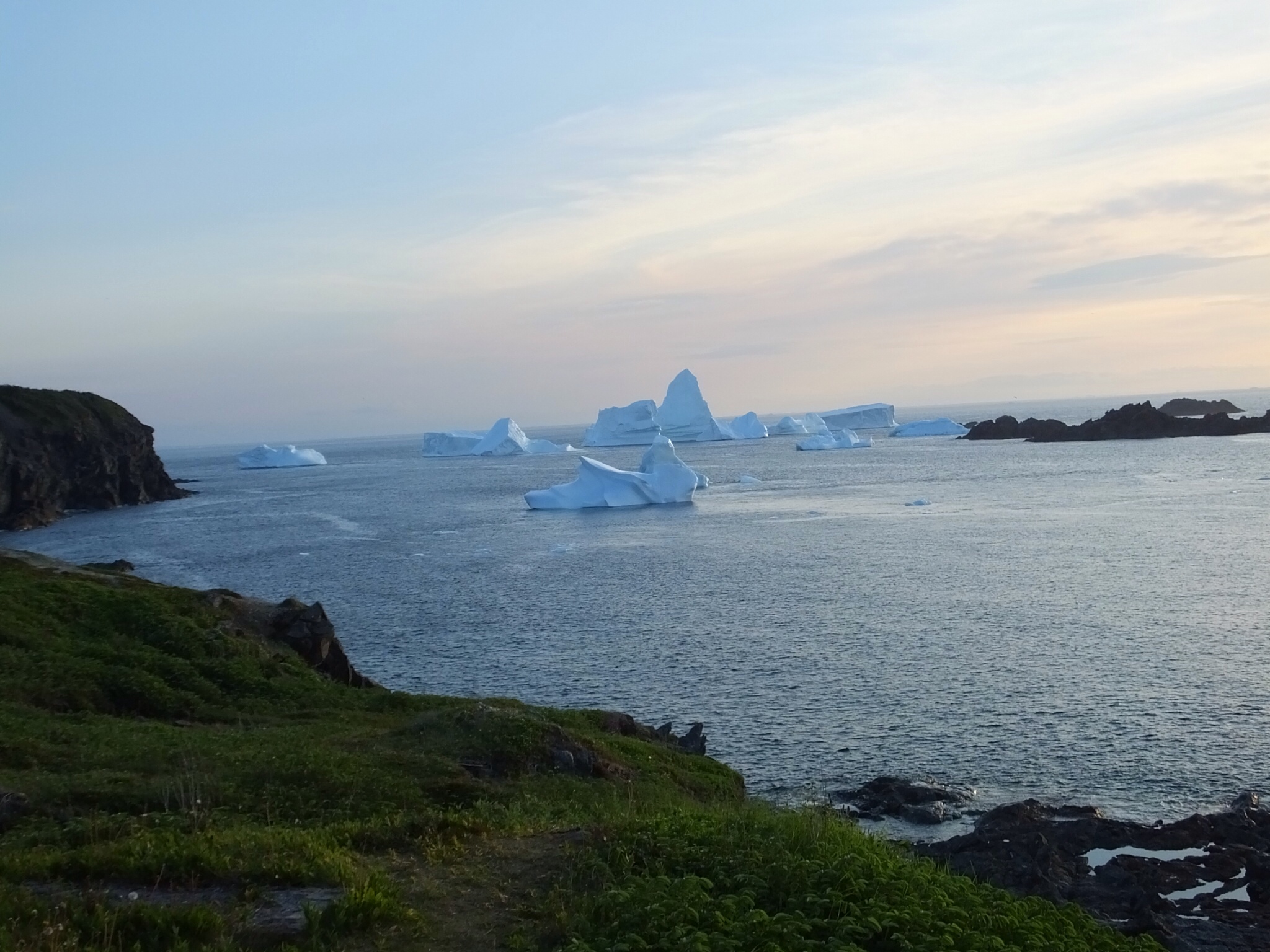
Iceberg graveyard in Twillingate.
Laundry and bike needed to be washed but laundry came first. Maybe I’ll wait for Hurricane Arthur to wash the filthy Ultra Classic. It’s almost as dirty as it got last year on the Alaska highway. Almost.
After more seafood and no pie for dinner, I took a quick tour of the island (Twillingate is an island, by the way) and came on a whole herd of icebergs. A flock of icebergs? Covey? Pack? Don’t know what a bunch of them are called, but they were everywhere. Some big, some small. Some grounded, some floating. But all melting, meeting their doom in the waters of Newfoundland and the coves of Twillingate.
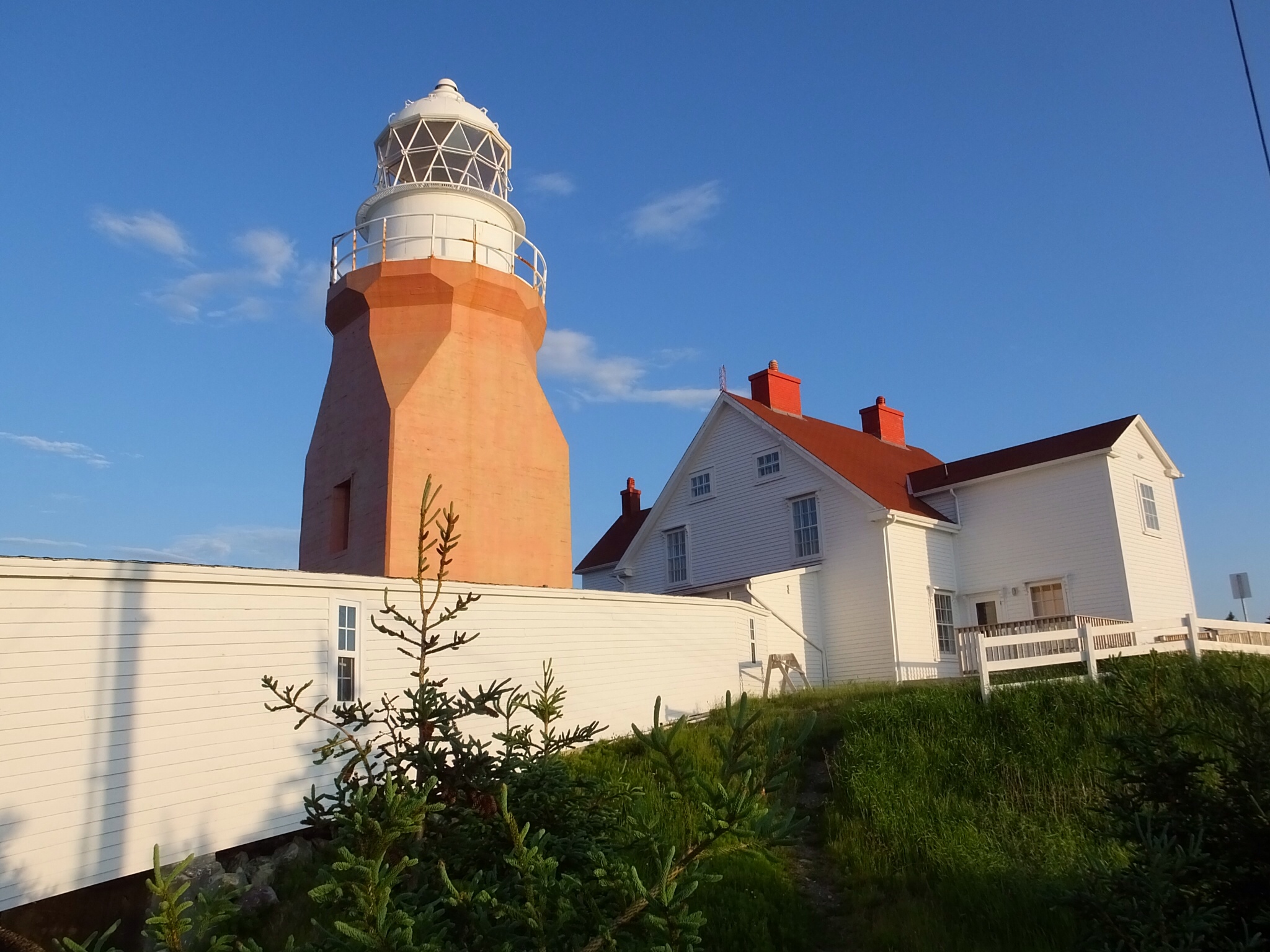
Lighthouse on Crow Head, Twillingate Island.
I also found the lighthouse I knew was here somewhere. Not particularly tall, but an interesting design. The interpretive center was closed by the time I got there, but I may go back sometime in the next three days while I’m here. Tomorrow I’m going to check into some kayak possibilities and maybe go whale watching and take in a Beothunk (extinct Indian tribe) exhibit. I missed one musical performance I hoped to see (they only played tonight and I was too late) but there are some other local musicians playing Saturday night so I may try to go to that event.
Hope everyone has a good Fourth of July tomorrow. Look out for errant pyrotechnics and I’ll do the same.
More pictures on Flickr: Click here
Newfoundland/Labrador Day 15: Back to Newfoundland
On travel days there often isn’t much to write about and on travel days in the rain and fog and wind there seems to be even less to occupy my typing fingers.
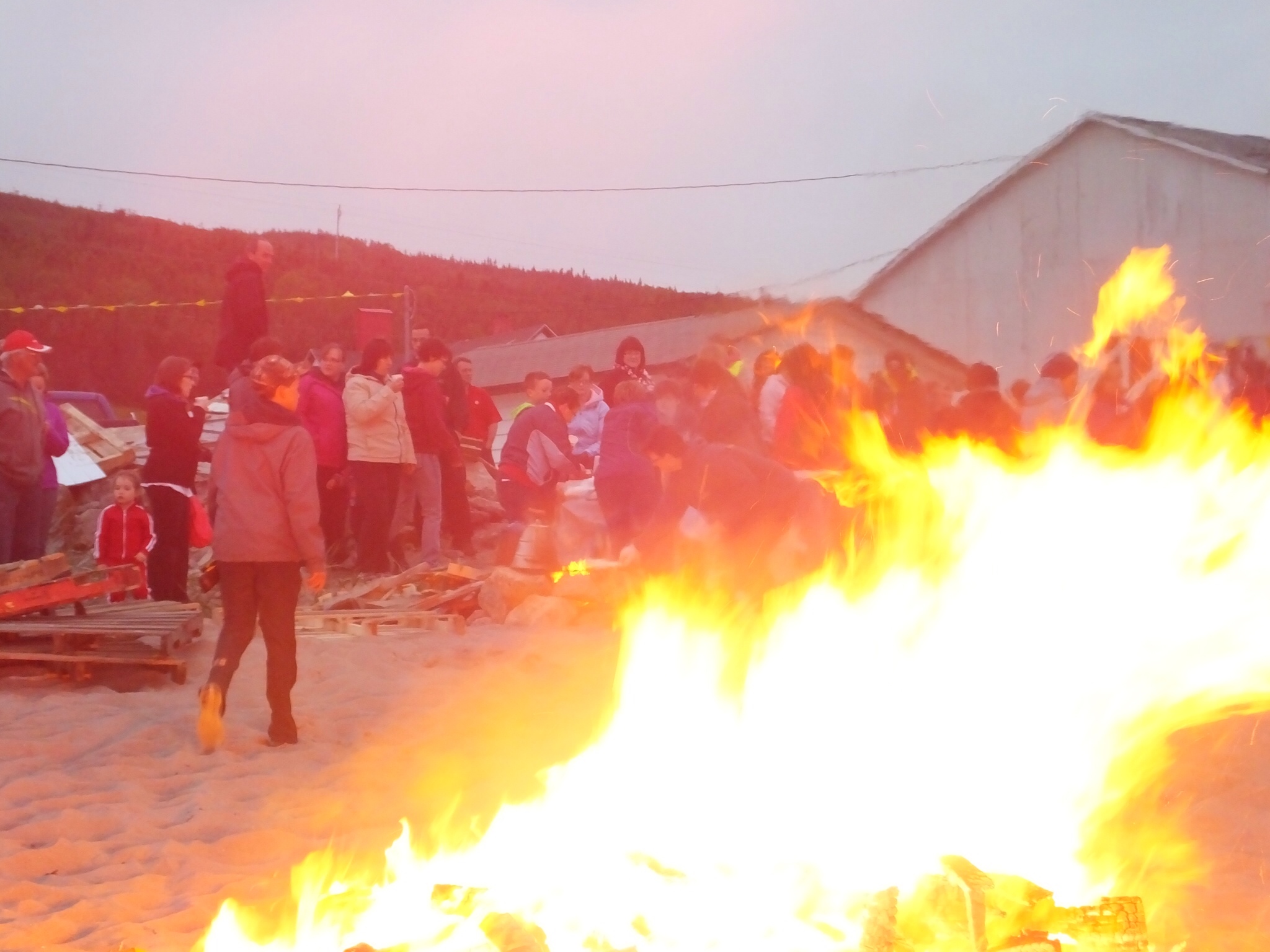
Townspeople gather at the Canada Day bonfire.
What I can do, though, is relate last night’s events that occurred after I posted the blog (early for a change). After participating in the Canada Day revelries in Red Bay, I thought my Canadian patriotic fervor had run its course. But no. I was wrong, much to my delight. The town of Fronteau had its traditional come-one-come-all evening bonfire and fireworks celebration and it just so happened that the festivities took place just across the road from the historic B&B where I was staying. So I and several other B&B guests strolled over and joined the fun. It was as small-town traditional as you can get.
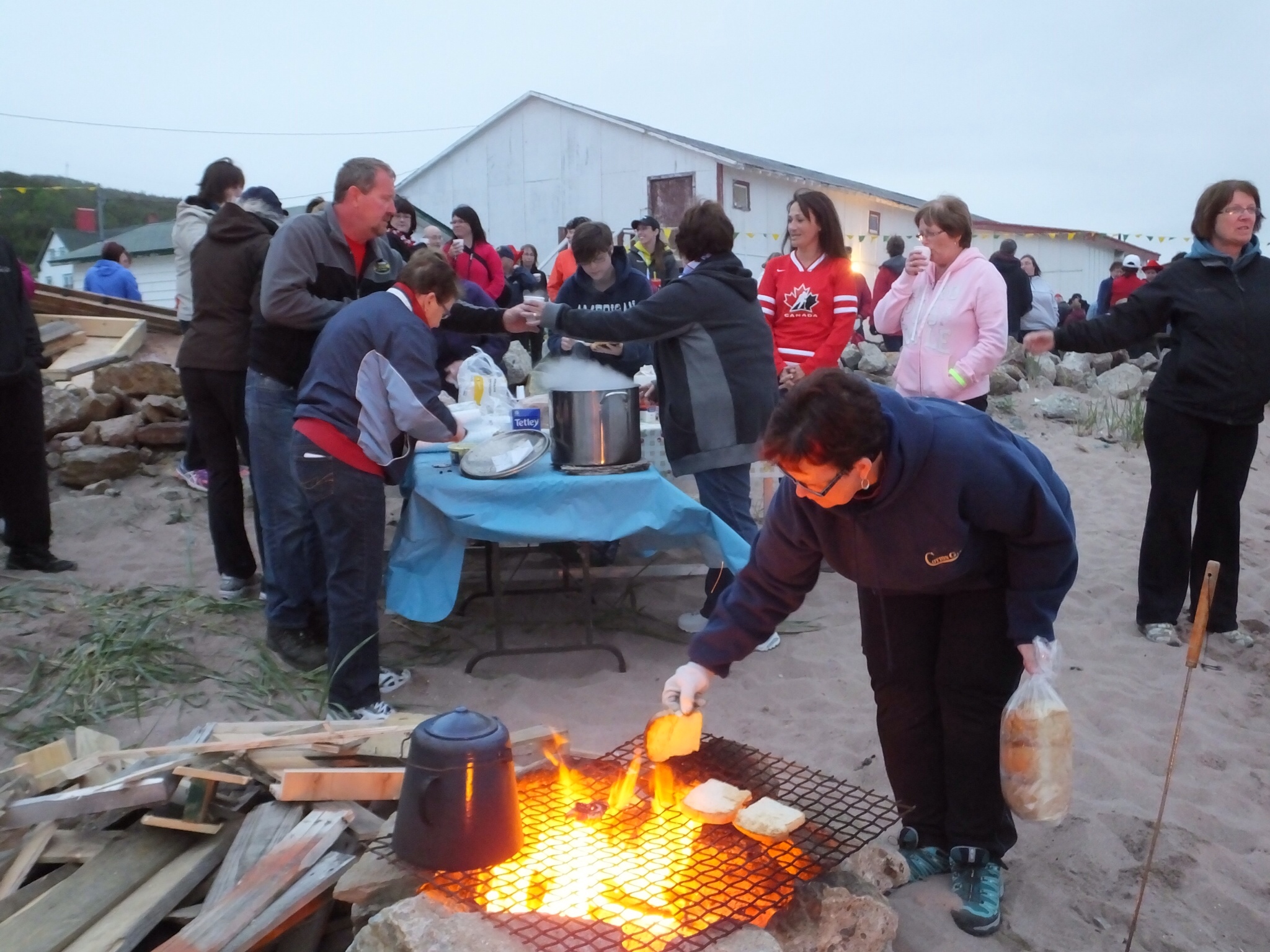
The ritual burning of the toast.
Residents had gathered wooden pallets into a pile that was stacked well above my head and just as dusk was setting in, they set some of the ablaze. For the next two hours they added more pallets every time the roaring flame began to burn down. But wait, there’s more.
They also had another small fire going where townswomen were toasting bread, then smearing it with butter and encouraging everyone to have toast and homemade jam with tea (or hot chocolate). I chose the partridge berry jam and it went quite well with the burnt toast. But wait, there’s more.
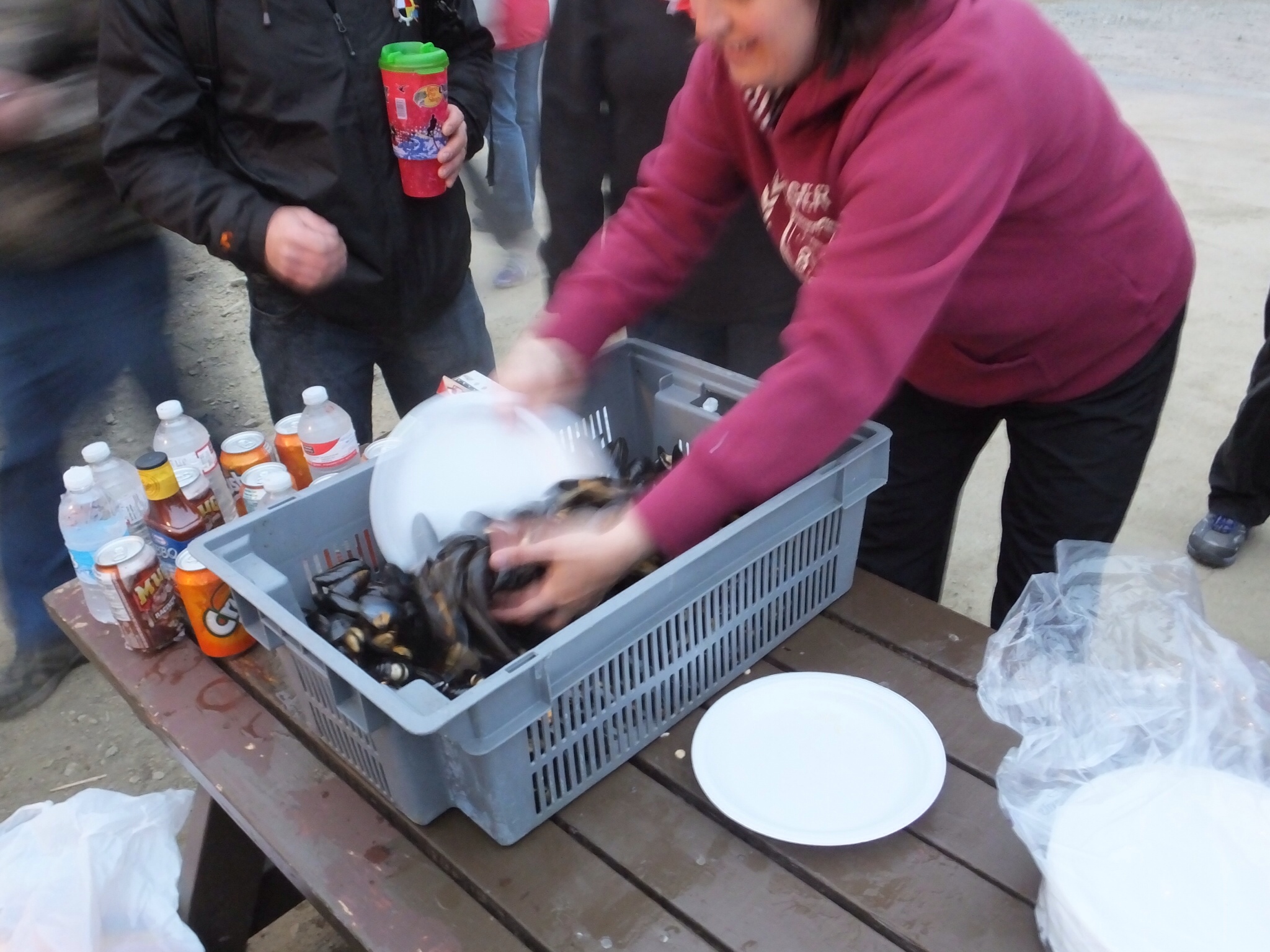
Mussels, mussels, and more mussels
The men folk, when they weren’t talking hunting or fishing, were steaming vat after vat of mussels and grilling a small fish called a capelin, which they carried in large pans to a serving table where more townswomen served huge plates of the seafood delicacies. Not wanting to hurt their feelings, I tried a mussel. Then I tried about 20 more which made me a piker compared to the multiple plates some of the folks were eating in a Canada Day feeding frenzy. I missed the capelin, though. And throughout all this, the townschilden were engaged in age-appropriate play: wandering away from parents (ages 2-4), running around the fire (ages 5-12), ignoring the opposite sex (ages 13-14), flirting with the opposite sex (ages 15+). But wait, there’s more.

They lit up the night. Ooooh. Aaaaahhhh.
About 11 p.m., when the only light available was from the bonfire and the cooking shed, the pyrotechnics began with a couple of half-hearted Roman candle bursts and concluding 10 minutes later with a crowd-pleasing, multi-rocket, star-bursting, cascading firefalls finale.
Last night’s activities seemed better to me than any extravaganza about to be put on at great expense in cities across the United States on July 4. Those of us who “weren’t from around there” were made to feel at home, and we joined in the celebration with mussel-eating gusto and a real sense of common pleasure. Community rituals are growing more rare, yet they are crucial to maintaining a sense of self and communal identity in a complex and confusing world. Small towns across Canada (and the United States) may be struggling to survive adverse economic fortunes, but there is a very real reason why I hope they succeed in their struggle. That reason was in full evidence on the beach at Fronteau, Labrador, on Canada Day night.
So, Happy Canada Day, everyone, and Happy Fourth of July, too.
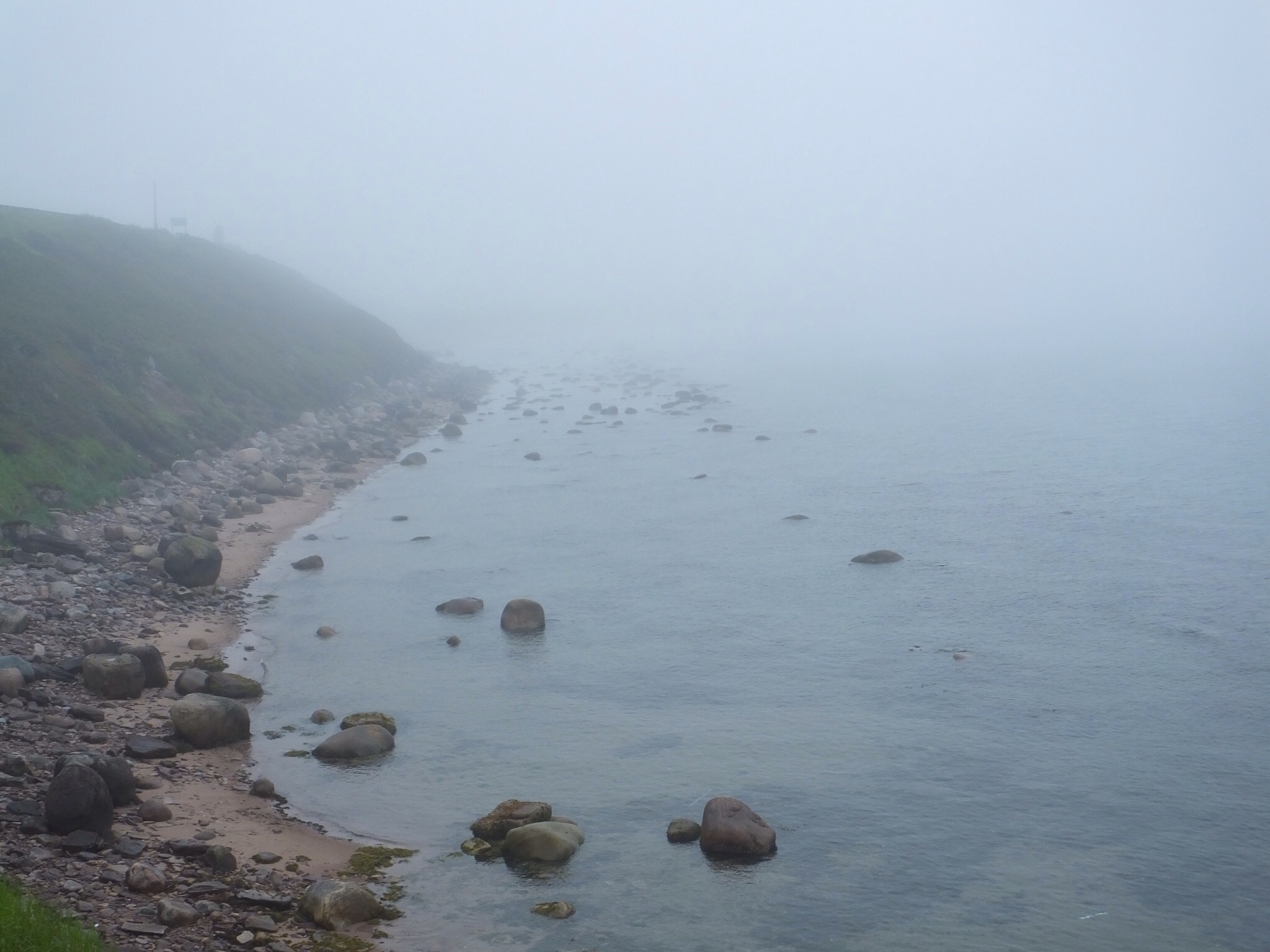
Foggy Labrador shore
I woke this morning to fairly heavy rain and thick, hanging fog and 50 degrees, which meant I wouldn’t do the on-the-road sight seeing in Quebec I had planned. Instead, I suited up in rain and heated gear, said goodbye to my gracious host at the Genfell Louie A Hall Bed and Breakfast, and putted slowly through the forlorn mist to the ferry landing about 15 miles away at Blanc Sablon. There, I waited through the mizzel until the ferry arrived, disgorged its automotive load, and then swallowed up the cars, truck and lone, filthy motorcycle waiting in the que for their turn to enter the belly of the beast. The boat ride back to Newfoundland was considerably rougher than the ride to Quebec/Labrador two days earlier, though my vast nautical experience 45 years ago in the Naval service of our county served me well as I kept my breakfast where it belonged while others were losing theirs.
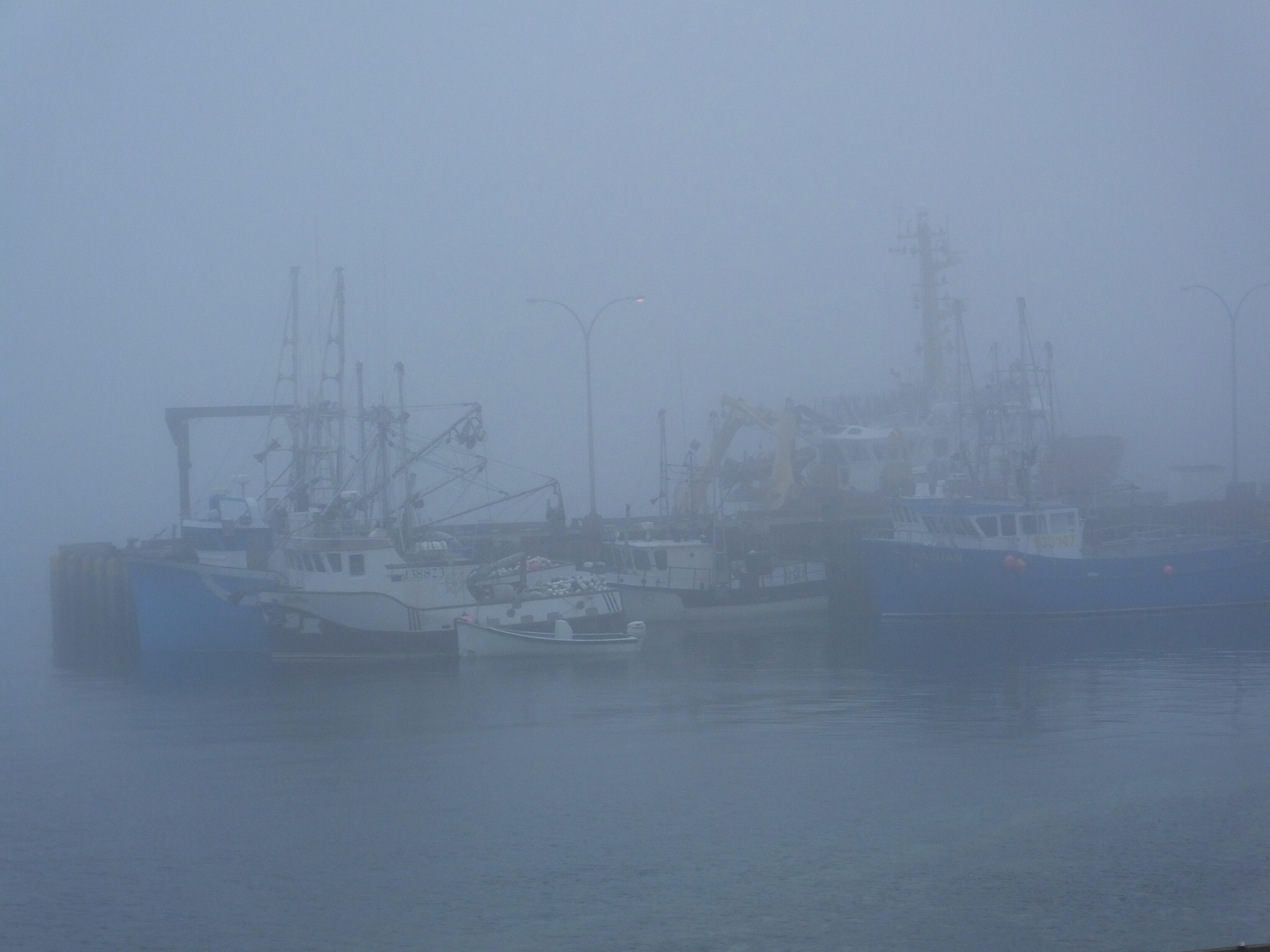
The ferry is hidden by the fog.
The rain had stopped when we landed in Newfoundland but the fog was still there and the wind, blowing south across the cold Labrador Strait, had gained in intensity and made my ride down the western Newfoundland finger more exciting than it otherwise would have been. Imagine trying to dodge potholes while an unseen hand grabs your handlebars and tries to countermand your efforts. But by the time I approached Deer Lake, my current location and site of the Lakeview Bed and Breakfast that really does have a view of a lake, the winds had been blocked by the Gros Morne mountains, the clouds had begun to part and I could see blue skies and the sun peacefully setting over the mountains. Not really a bad day after all.
Tomorrow I’ll travel east to Twillingate. (Twillingate, Twillingate, Twillingate, Twillingate: I like the sound of that town. That’s why I chose it as my next destination. That and the fact that there appears to be multiple historical and adventurous things to do there.) I can’t wait to get on the road again.
Watch out for the slick spots and I’ll do the same.
Newfoundland/Labrador Day 14: Whaling, Lighthouse & Canada Day
First, a question: If I go to Labrador, pick something up and bring it back, does that make me a Labrador Retriever? And if so, will someone adopt me, take me home, let me up on the furniture and feed me treats? Just wondering.
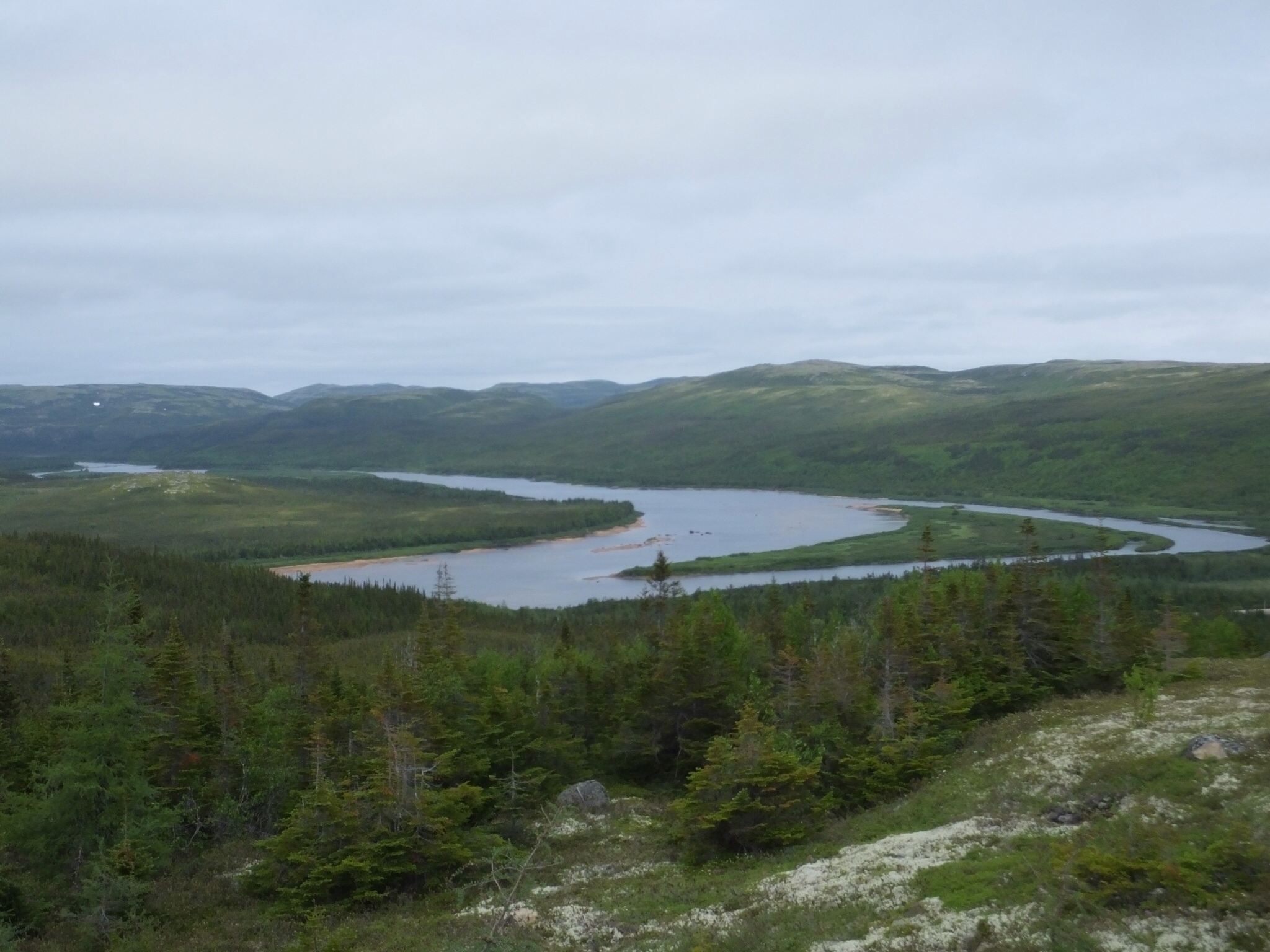
They refer to this as “The Big Land”
The paved road in this part of Labrador is only about 50 miles long, so I knew I wasn’t going to get in a lot of riding today. But the riding I did do was through some starkly beautiful country and the cold, early-morning fog that perched on the mountain tops added to that rugged beauty. It was cool (cold?) this morning with temperatures in the low to mid 40s but heated gear fended off any chill there might have been as I rolled carefully down the road peering through the fog looking for potholes and large critters.
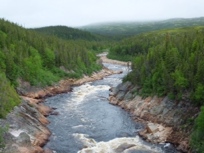
The Pinware river attracts salmon and the men who (try) to catch them.
I paused briefly along the way at the beautiful Pinware River, where a substantial number of frustrated fishermen had determined again today that the Atlantic Salmon had still not started making their way upriver. There was not a line in the water but they were properly attired in their waders, netted hats, and plaid shirts just in case their aquatic prey began their upstream swim. Since they probably fish all the time in waters like these, they may have been immune to the scene that riveted my attention. Fast water coursing whitely over boulders stretching through multi-green colored trees to the distant mountains like a liquid snake kept me staring for sometime, wondering why the fishermen didn’t just sit a spell and take it all in with a deep, satisfied breath. Maybe they did after I left.
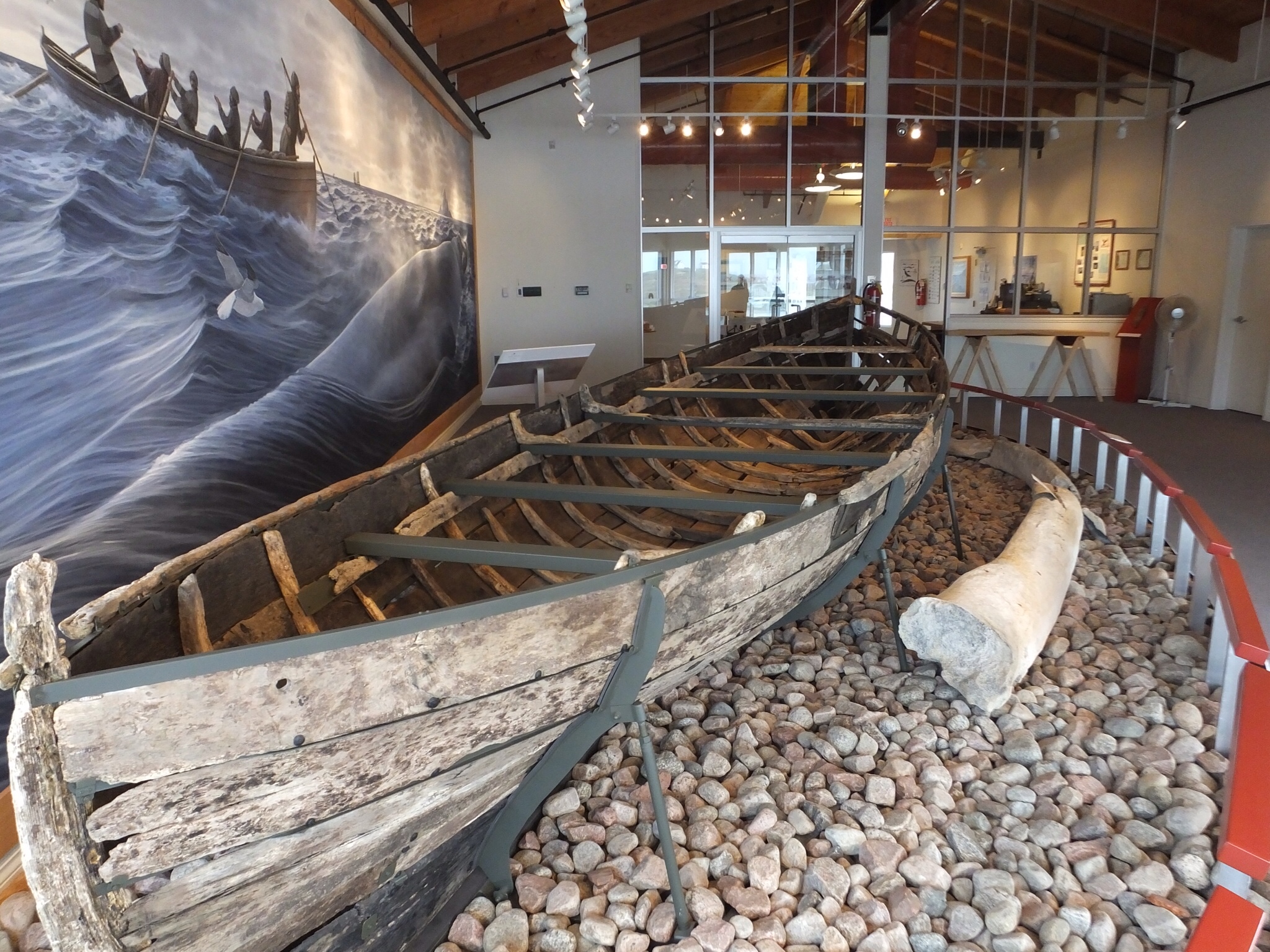
A Basque whaling boat called a chalupa. More than 400 years old.
On down the coastal roller coaster road I went until I ran out of pavement at Red Bay. The road, of course, continued to Goose Bay to the north, but it was 250 miles or so of dirt and rock and definitely was not part of my itinerary. Instead, I wound my way through the small village until I came to what I was looking for: The Red Bay National Historic Site featuring the archaeological discovery and preservation of a 16th century Basque Whaling Station. About 50 years ago, a researcher in the Basque region of Spain came on some documents that indicated a whaling station had been in this area and that find led local archaeologists and park officials to begin looking for evidence on land and, more importantly, underwater because of the belief that a large Basque ship had sunk in the Red Bay harbor during a storm.
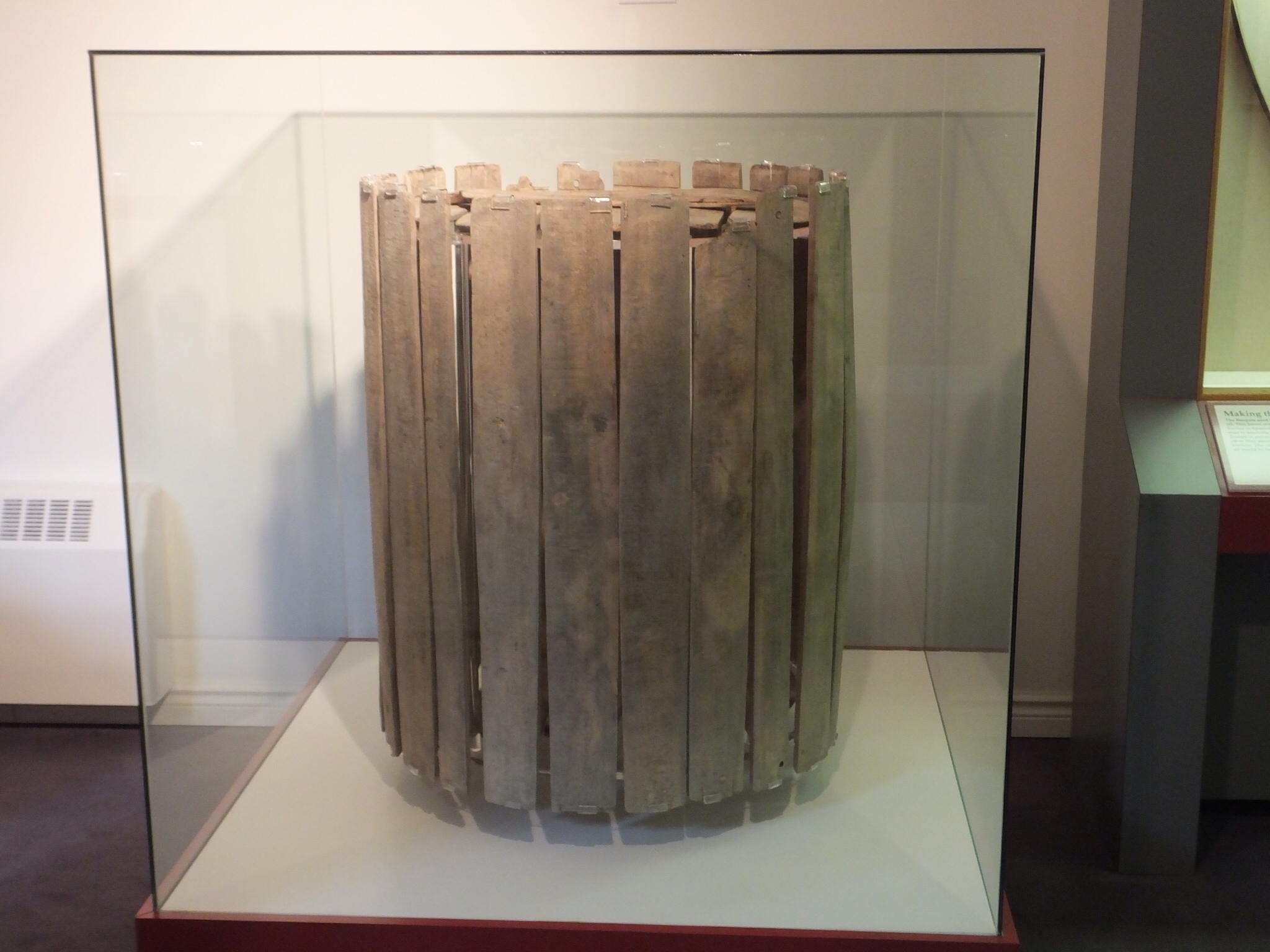
About 450 years ago this barrel was full of whale oil before it went down with its ship.
The land-based artefacts such as distinctive red roof tiles and the locations of large ovens for rendering whale blubber into oil were discovered fairly quickly and in short order, divers located the best preserved ship of its kind in the world and began efforts to carefully, a piece at a time, salvage the rare underwater find. As a result of their efforts, Parks Canada created another fantastic visitor’s site that explains how the first commercial industry in the new world had been established, run and then collapsed. Red Bay today has only about 150 residents; when the Basque were there almost 500 years ago the summertime population was probably close to 1,000.
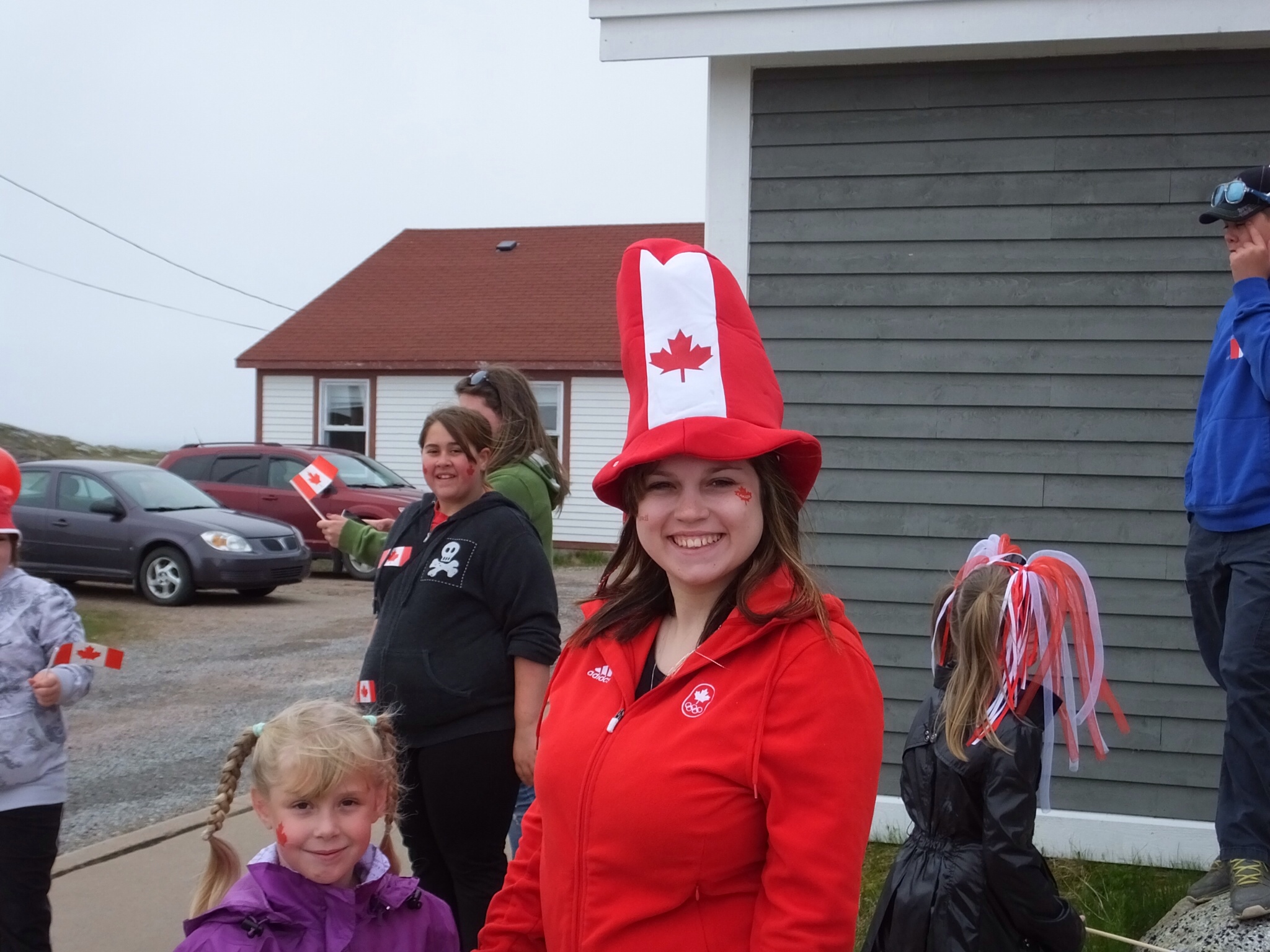
Does this shout Canada Day?
As a bonus to my trip to the Historic Site, I watched and even participated in the annual Red Bay Canada Day Parade and Celebration. Up the road came the firetruck (a chevy pickup) with lights flashing, followed by four boys on bicycles, a dozen or more eager children waving small Canadian flags and wearing Canada Day Hats and streamers in their hair, and their parents bringing up the rear in a headlight-glaring automobile procession. Once the parade reached the site, the head ranger lowered the red and white Maple Leaf ensign, then raised it again as the gathered revelers sang O Canada, then everyone moved inside to sing Happy Birthday to their native land and eat a cake decorated with a strawberry maple leaf. A good time was had by all, including me.
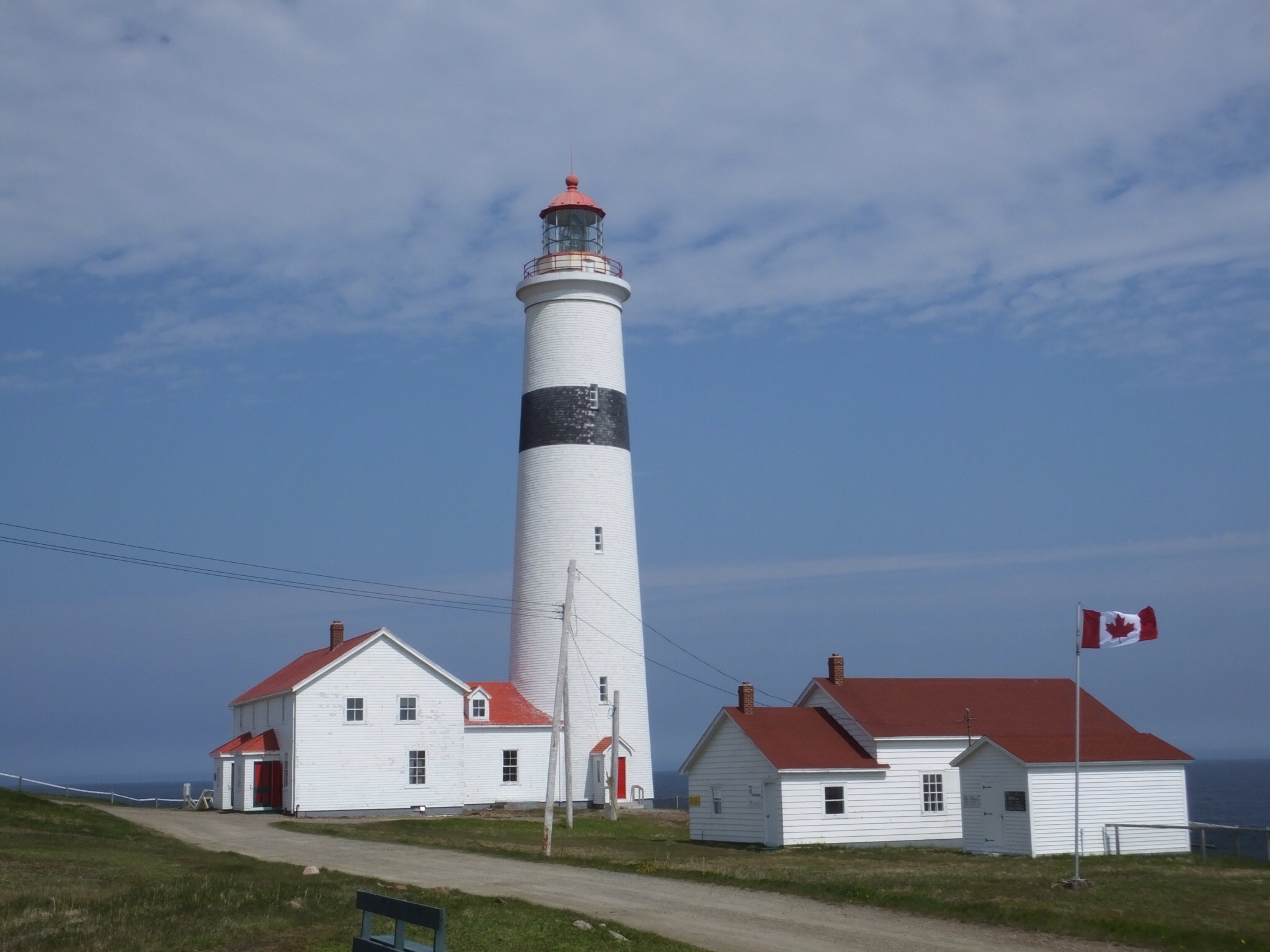
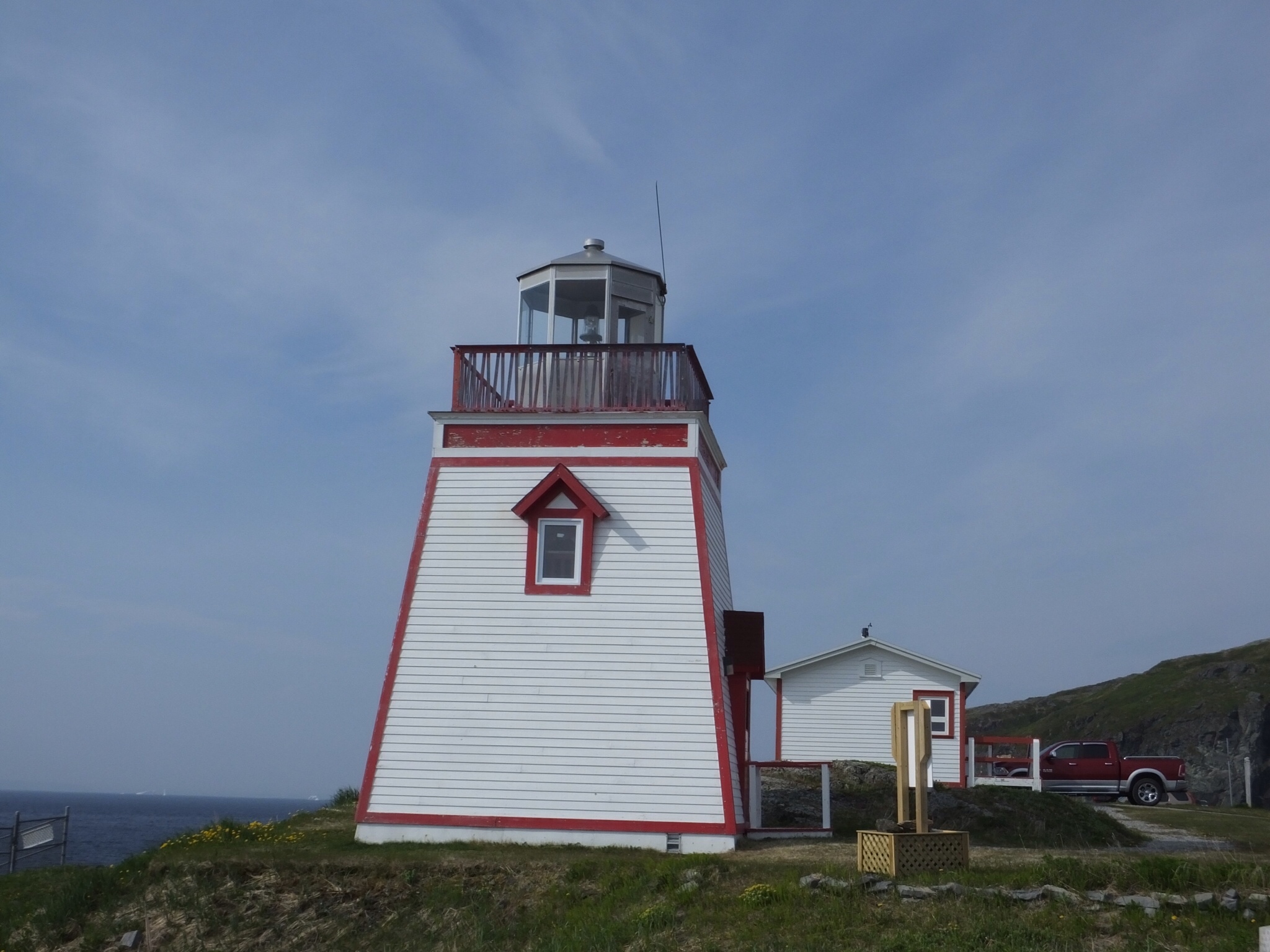
2nd tallest lighthouse in Canada.
On my return trip to Fronteau where I’m spending the night, I stopped at another lighthouse (just to make a friend even more jealous). This one, built in the 1850s with six-foot thick walls to withstand winds clocked at more than 140 miles per hour, is the second tallest lighthouse in Canada at 109 feet and still operates to warn passing ships not to get too close to the shore that, over the centuries, has claimed hundreds of boats and ships, from small fishing trawlers to British Navy destroyers. The lighthouse keeper’s house, attached to the lighthouse, is open to visitors as is the tower itself, all the way to the very top where the modern fresnel lens sends a bright beam miles offshore. When I was at the top today, the wind was howling strong at 30-35 miles an hour. I would not want be there in triple-digit winds.
At the lighthouse they had gathered and displayed an impressive collection of map reproductions of the Labrador Straits going back more than 500 years. It was there that I learned how Labrador got its name. It’s from the Portuguese “lavrador” which means small land holder and is attributed to an early Portuguese explorer. And all this time I thought they had named it after a water-loving dog. Who knew?
Pie report: Another slice of bakeapple by a different chef. Same result: yummy.
Tomorrow, the ferry returns to Newfoundland with me and my iron steed aboard, and I head for the central and eastern portions of the big, friendly island. I can’t wait to get on the road again.
More pictures on Flickr: Click here
Watch out for rocky shoals and I’ll do the same.
Newfoundland/Labrador Day 13: Icebergs, History and Labrador

O Canada
While I’m writing this the evening of June 30, many will read it July 1. So, Happy Canada Day, eh? We’re celebrating the 1867 Act of the British Parliament which joined three colonies (Newfoundland, Nova Scotia and Canada (Quebec and Ontario) and created the federated state of Canada. Click here
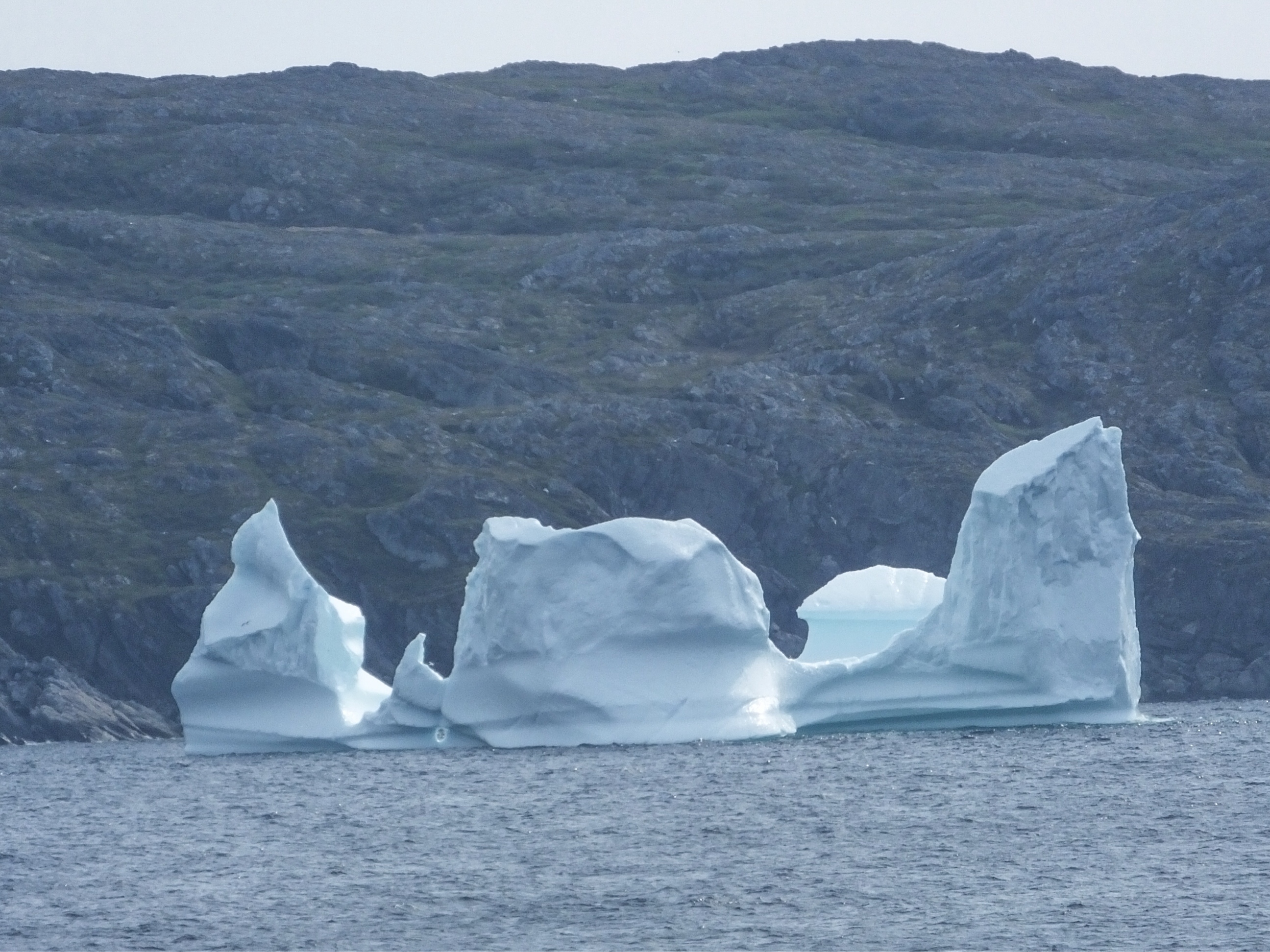
Off the coast near St. Anthony
Today was a day of icebergs for me. I had seen some yesterday, but saw a lot more today. St. Anthony’s, at the northeastern tip of Newfoundland’s western finger, is at the heart of what’s called iceberg alley where many icebergs come to finally melt away in the many coves and inlets along the Newfoundland and Labrador coasts. Most of the icebergs I saw today probably calved (broke off) glaciers in Greenland more than a year ago and then slowly made their way south on the cold Labrador current. This year and last have been banner years for iceberg watchers and scientists say the trend will continue as Greenland continues to shed its ice cover at an increasingly rapid rate due to climate change
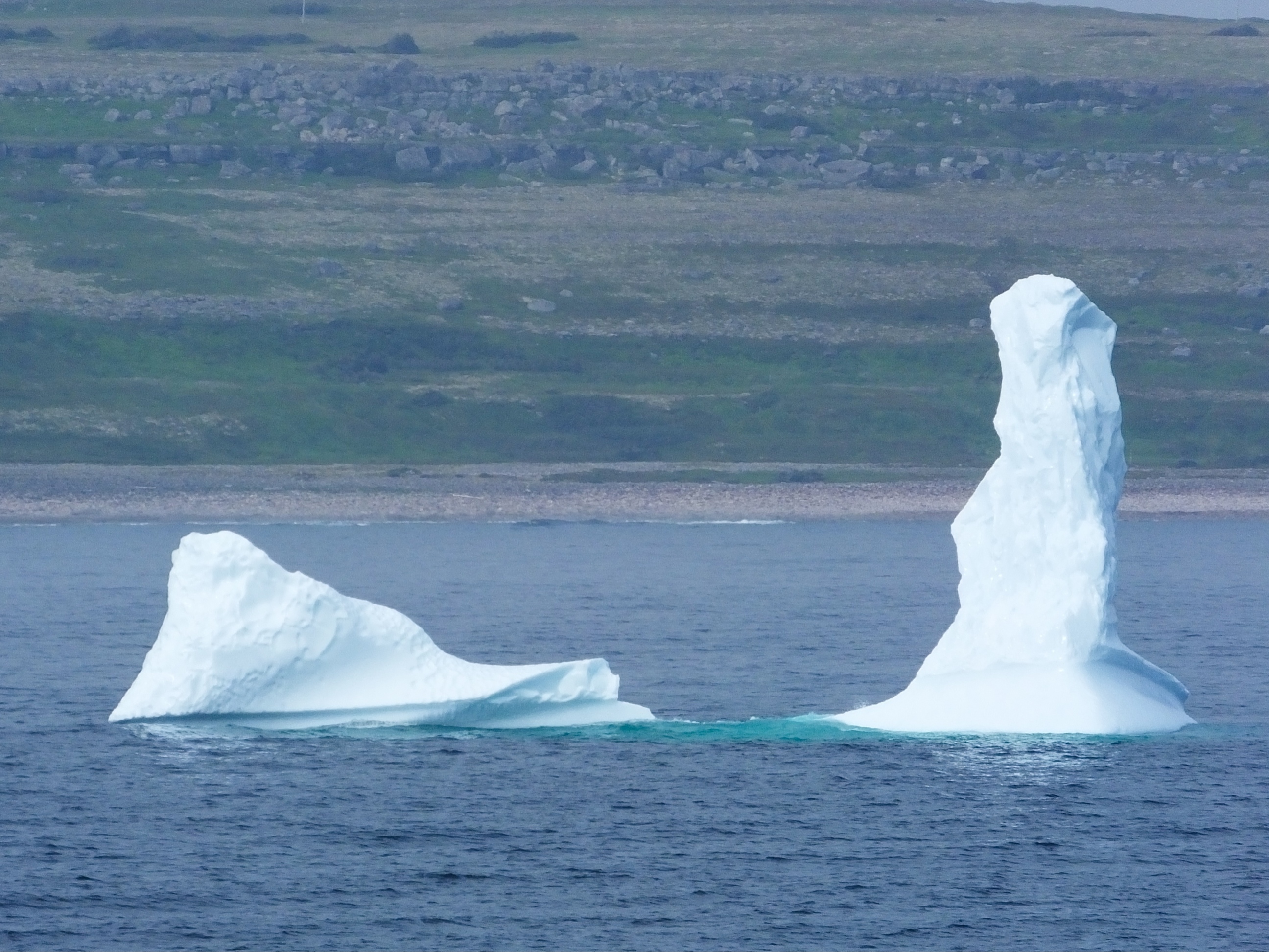
Off the coast of Labrador
I had generally pictured icebergs as mountain-shaped blocks of ice, but what I saw today dispelled that. They clearly come in all shapes and sizes and wind and waves melt them to ever-changing shapes (but almost never like a pointed mountain). It was hard to estimate how large the ones I saw were, but they seemed to range in size from a tractor-trailer to a half a city block. And, of course, most of their bulk is underwater
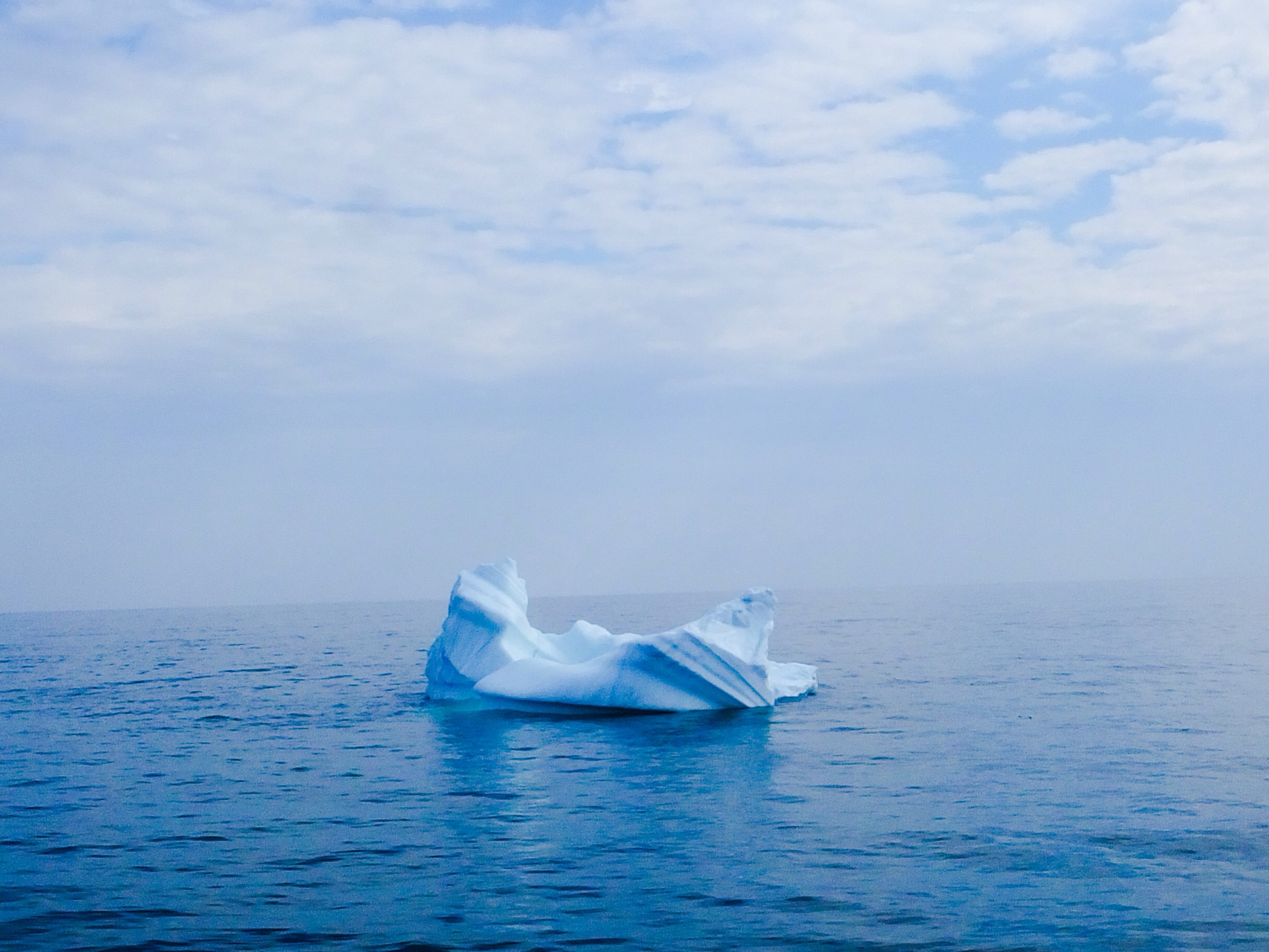
Off the coast of Labrador
As they melt, the water that runs off them into the ocean is some of the purest water in the world, having been frozen 15,000 years ago when there were far few pollutants in the air. I would like to have chopped off a piece to put in my glass of Jack, but those who know icebergs say you generally shouldn’t get that close to them, unless their grounded near shore. Out at sea, they continue to break apart and flip over, and anyone in the vicinity is likely to get tossed into the frigid Atlantic waters.
I also saw icebergs on the 1 1/2 hour ferry ride aboard the Apollo from St. Barbe, Newfoundland to Blanc Sabon, Quebec. Blanc Sabon is only about two miles from Labrador, but that’s where the ferry lands. Some days on the ferry you also see whales. Some days you don’t. Today was a “don’t.” No whales sighted from the ferry, but I definitely expect to see the behemoths of the deep later this week and next week when I’m on the eastern side of Newfoundland.
At Fisherman’s Point in St. Anthony
Before I left St. Anthony for the two-hour ride in the rain to catch the ferry, I stopped at a local museum that honors one of the great pioneers in medical care in Newfoundland and Labrador: Dr. Sir Wilfred Grenfell. Grenfell first arrived in 1892 as a 23-year old physician and missionary to serve the then unserved population of tens of thousands of cod fishermen and the their families. He traveled by boat, by dog sled and by foot to reach his patients and his potential converts. He raised money to build hospitals and nursing stations all along the Labrador coast the northern and eastern arm of Newfoundland. He recruited other doctors and nurses. Then he started an orphanage, a school, a cooperative store, industrial workshops and more. His work was institutionalized with the creation of the International Grenfell Association, a non-profit organized to expand and continue his work. For his efforts in medicine, social work and education he was knighted in 1927.
I spent more than an hour at the museum and still didn’t see all the parts of the historic Grenfell properties in St. Anthony’s and didn’t take any pictures at all (mainly because I would have been taking pictures of pictures).
Now the plot thickens: When I made my B&B reservations four months ago, I picked on in Labrador called Grenfell Louie B Hall Bed and Breakfast. As it turns out, the house I’m in as I write this served as a nursing station and stopover for traveling physicians in the 1940s and 50s before there were any roads build in the area and the nurses who would have staffed it were recruited by the International Grenfell Association. I haven’t spoken much yet with the owner/operator of the B&B, but she has decorated the house with artifacts from years it was a nursing station. Tomorrow I hope to learn more about the house and it’s history
Rugged, rocky coast
Today was only the third day out of 13 on the road where I had to put on rain gear and even the rain I rode through wasn’t too bad. But it’s about 20 degrees cooler today (low to mid 50s) than it has been my first five days in Canada. I think this is far more typical and its actually what I expected to see. Tomorrow the temperatures should be about the same after overnight lows in the low 40s, but I don’t think it’s going to rain.
Off for another ride along a rugged coast tomorrow to the end of the pavement in Labrador, then turn around and come back after a stop at an historic site dedicated to whaling and yet another European influence. I don’t know about you, but I’m having fun.
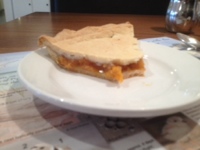
No apples in bakeapple pie.
Before I sign off, I have to give another pie report. Tonight it was bakeapple pie. Like partridgeberry, bakeapple was new to me, too. While I was enjoying the sweet, orange, seeded fruit pie, I did a little research. First, it has nothing to do with apples as one look and one bite will tell you. The name, it turns out, is an Anglicized version of the French “baie qu’appelle” which means (roughly) “What is the name of this berry?” It also turns out that while the name bakeapple is unique to Newfoundland/Labrador, the berry is not and is actually called the “cloudberry” in other boggy parts of the world. Anyway, it was another good addition to my pie arsenal.
Keep dodging those potholes and I’ll do the same.
Newfoundland/Labrador Day 12: A Little bit of History
My decision not to try to ride to St. Anthony’s and back to Cow Head today, but instead to find a room in St. Anthony’s and only make a one-way trip was a good one. It allowed for a much more leisurely ride and the chance to stop at several locations that I otherwise would have missed. And they were not places I would have wanted to miss.
In addition to hiking (check that one off my list) and kayaking (yet to be accomplished) I also wanted to take in some historic sites and museums of Newfoundland/Labrador. Today, when I was not riding, was devoted almost exclusively to that and the history I explored goes back a very long way.
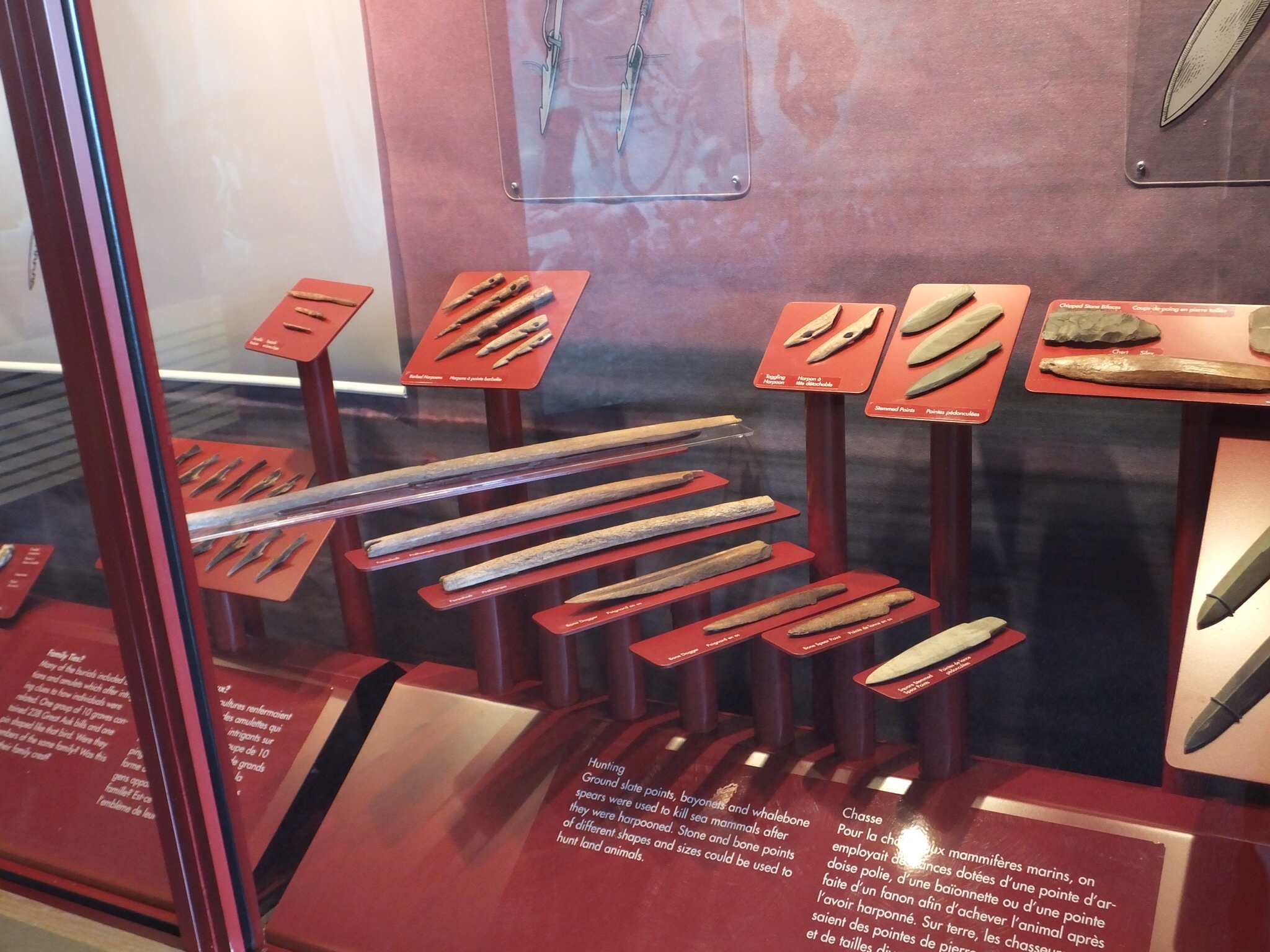
Exhibit at Port au Choix
One of the bonus stops I would have missed was the Parks Canada interpretation center at the fishing village of Port au Choix (pronounced port aw schwa) which has been inhabited off and on for more than 6,000 years. In addition to the European settlers who currently occupy the site with their brightly colored fishing boats and their ubiquitous lobster traps, the limestone spit of land that juts defiantly into the Gulf of St. Lawrence has been the home of the Maritime Archaic peoples (5,000-6,000 years ago), the Groswater and Dorset Paleoeskimos, (2,000-3,000 years ago) and the more recent Indian relatives, the Beothuk.
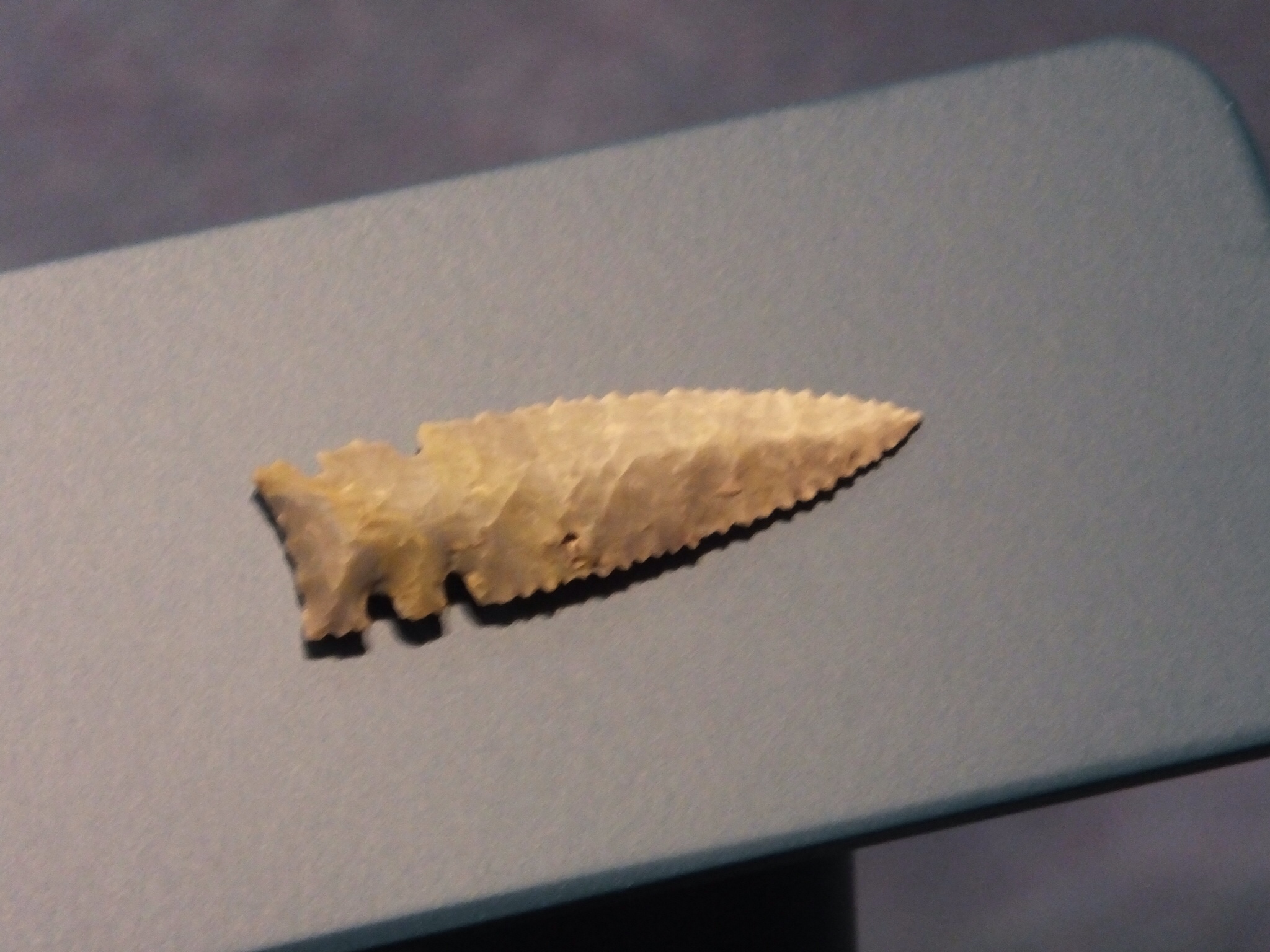
This spear tip was crafted with great care about 3000 years ago. Note the serrated edges,
The full history of the archeological digs and surveys is beyond the scope of this blog, but a significant, accidental find by a local resident brought scores of archeologists to the site in 1960 and led the Canadian government to declare it a National Historic site. Unfortunately, there is no active digging going on now so I couldn’t talk with any archaeologists, but I was able to pick the brain of a knowledgeable interpretive center staffer for about an hour. I found it fascinating (I’m sure others would not find it so fascinating) to learn about the migratory patterns of these ancient people for thousands of years as they followed the seal migrations up and down the coast. Their ability to survive on the cold, rocky shores of present day Newfoundland and Labrador is a testament to their ingenuity and their skill at hunting and using completely all that the seals had to offer.
By the time Europeans arrived, all that remained were their buried remains and thousands of artifacts (spelled “artefacts” in Canada, I noticed) that range from cleverly designed fish hooks to meticulously created spear points to lamps and pots carved from solid sandstone. We often think of these people as “primitive,” yet if left to our own resources could we develop the same tools before we perished of cold or hunger? They migrated hundreds of miles over the course of each year and kept alive their cultures for millennia. Quite a feat.
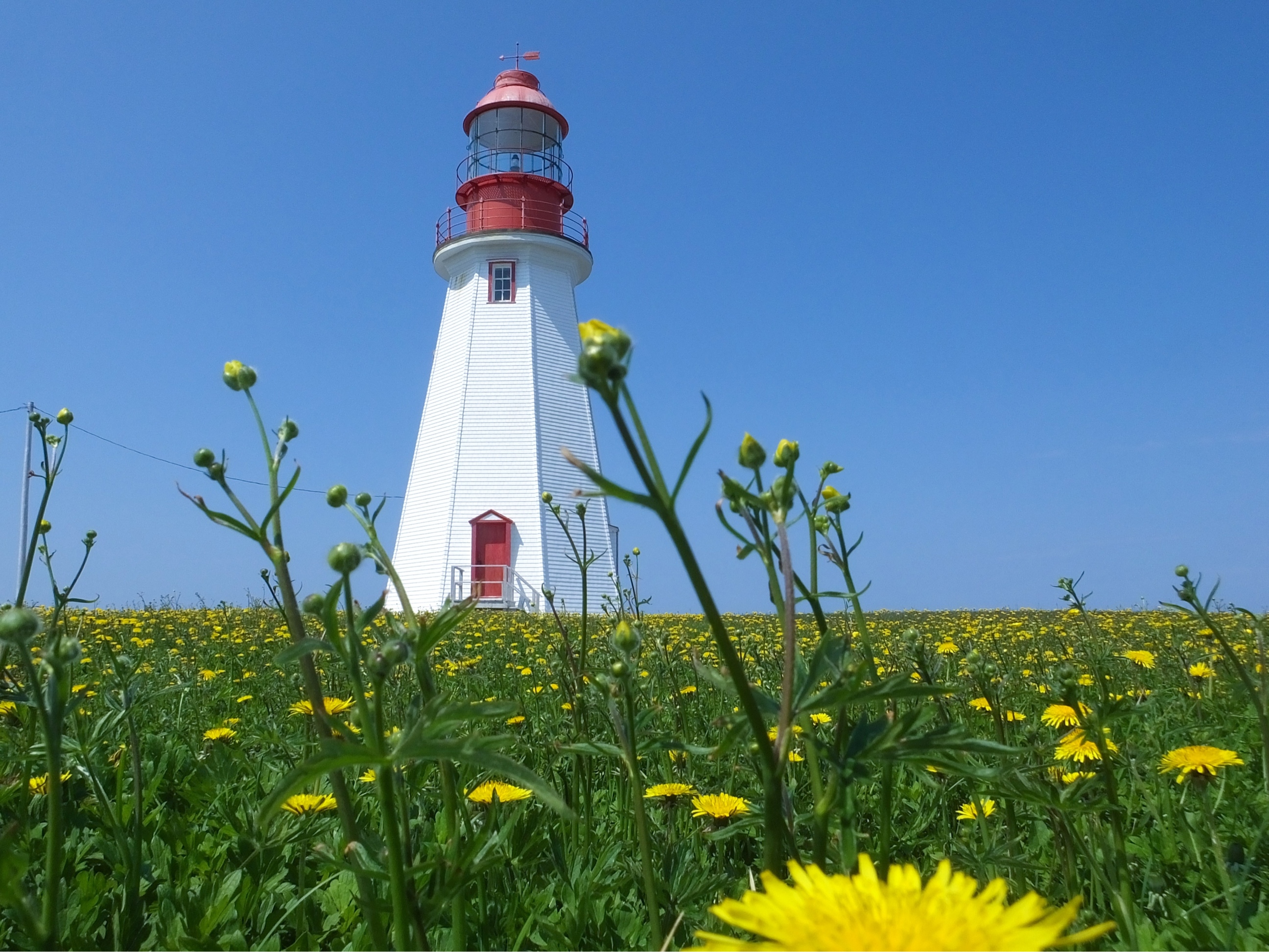
Point Riche lighthouse
Following my time at the Port au Choix interpretive center, I made a short run to see a more modern artifact: the Point Riche lighthouse. I don’t believe this one is in operation any longer, but it still stands as a proud beacon on the rocky coast. A couple of pictures and a walk on the windswept beach and I was off again, headed north to another historical site, this one involving the Vikings.
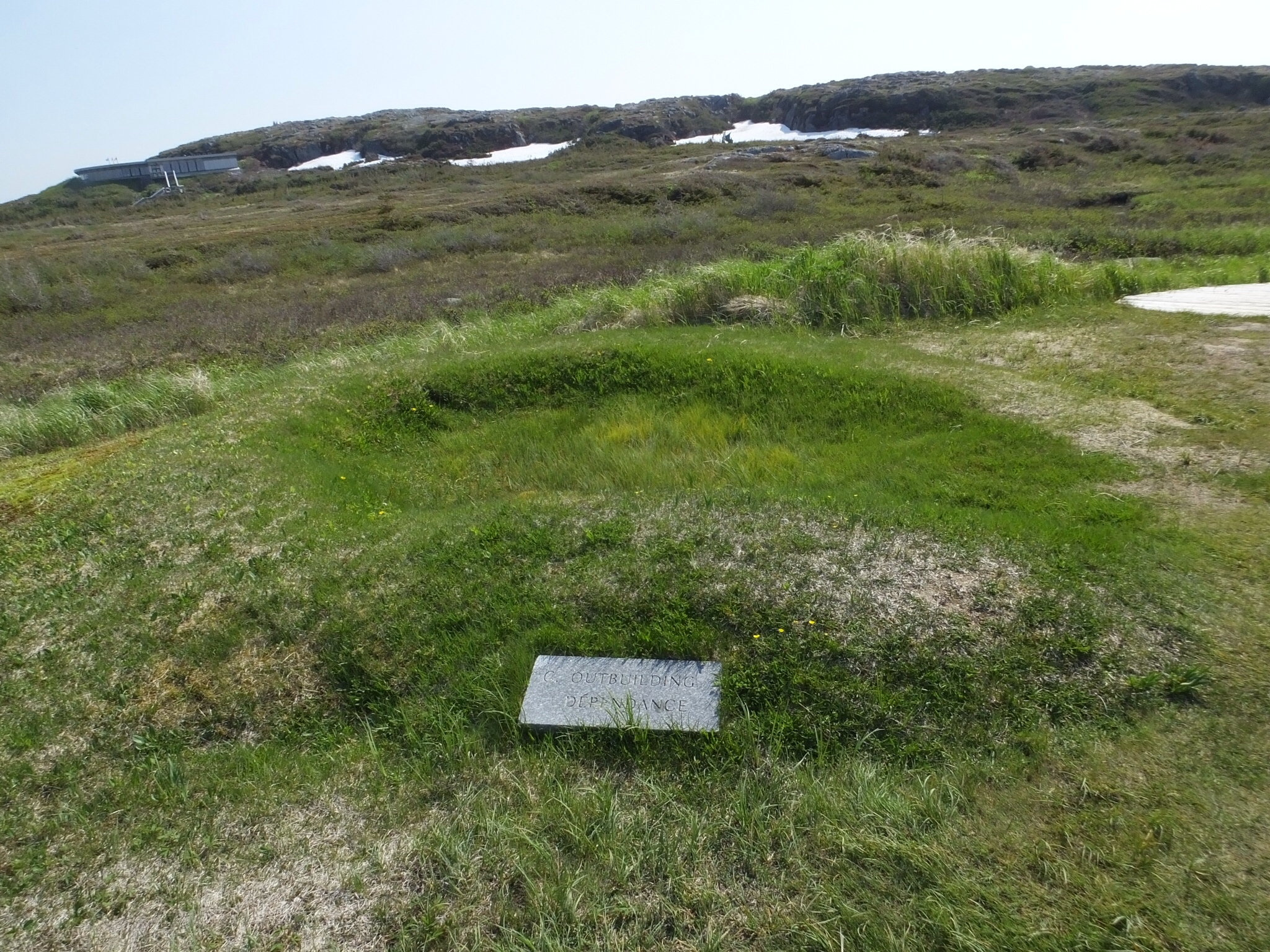
Actual location of a Viking sod (peat) house. I could stand on the very ground where Vikings stood. Cool.
Norsemen (and Norsewomen) landed at the northern tip of Newfoundland in about the year 1000, predating Columbus’s “discovery” by almost 500 years. For hundreds of years Norse sagas spoke of the settlement at Vinland but not until 1960 did an historian and his archaeologist wife find the actual site of the landing. Local people at L’Anse aux Meadows knew of some strange indentations in the ground but had always assumed they were Indian in origin. But archaeologists found solid, artifactual evidence that proved the site had in fact been inhabited by Vikings off and on for about 25 years.
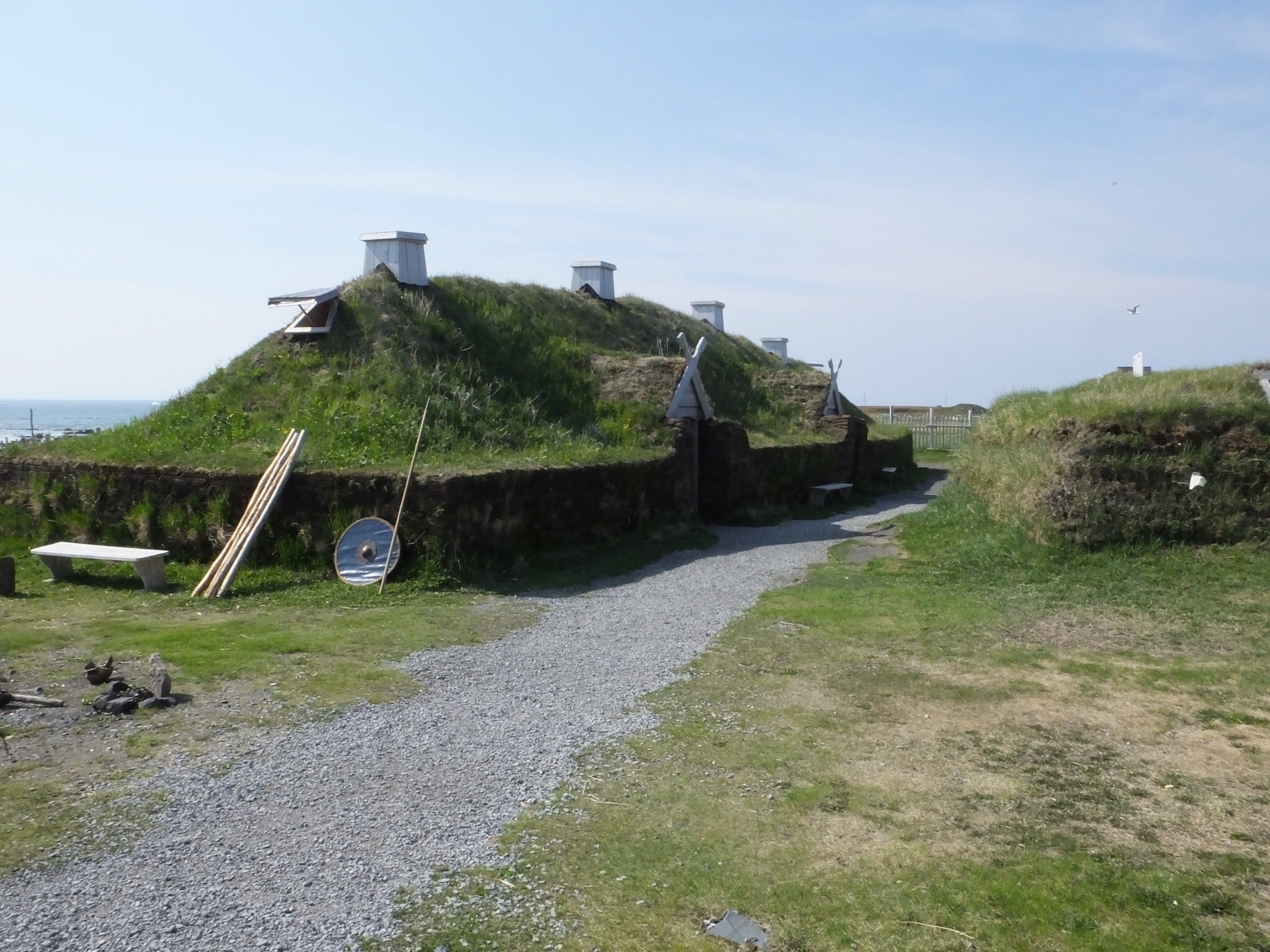
Reconstruction believed to be about 90% accurate.
Parks Canada has once again done an outstanding job of interpreting the site and making it available to visitors. Maybe too much so, since I was amazed to discover that I could actually walk on the remains of the site declared a World Heritage site by UNESCO. Eventually, I suspect, they will have to fence it off or at least restrict access in some way in order to preserve it.
A sculpture on the grounds makes an interesting connection to emphasize the importance of this site. And that importance is this: Beginning about 100,000 years ago our ancestors began to leave the plains of Africa. Some headed North and West, others headed East and for the next 100,000 years there was no contact. But when the Vikings (from Europe) first met the natives of Newfoundland and Labrador (whose ancestors had migrated across the Bering Strait about 15,000 years earlier), the circle had been completed. East had met West for the first time in 100,000 years. Pretty cool, eh?
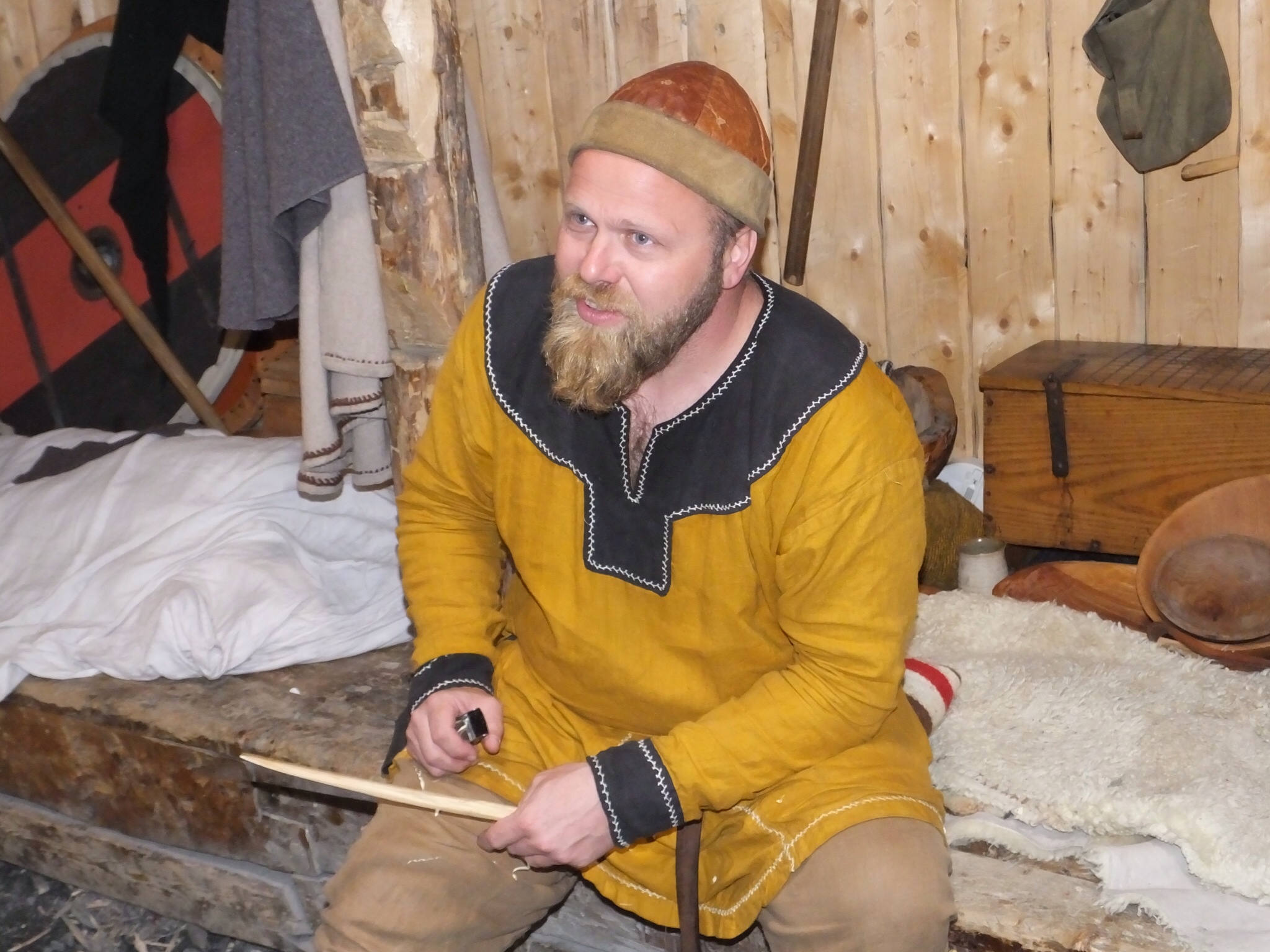
A Viking re-enactor. He knew his stuff.
One of their interpretive efforts included a reconstruction of one of the houses (probably Leif Erickson’s) that could hold up to 30 men and a few women. They recreated it on exactly the dimensions of the ruins found at the site and using a model of a still existing structure in Iceland. Two re-enactors and a walking tour guide were able to answer all the questions tourists could throw at them. There’s still much that historians and archaeologists don’t know about the short-lived Viking visitors, but they know they were here, how they lived, and why they came.
In one day, I covered more than 5000 years of history, including the first landing by Europeans in America. In addition, I saw my first icebergs. More on icebergs tomorrow after I’ve gone to the beach to watch them float by. There are hundreds of them floating down from Greenland and bumping into the coast of Newfoundland so I’ll see them tomorrow morning here in St. Anthony and again tomorrow afternoon when I take the ferry across to Labrador.
Sorry for the long post, but I have more than a passing interest in history and want to pass it along when I can.
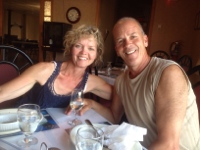
Andre and Johanna: Meeting nice people is part of the adventure
One more note for today’s blog: Three days ago when I was waiting to board the ferry to Newfoundland from Nova Scotia I struck up a conversation with a couple from Ontario. We talked and said good bye. Then two days ago, just before I started my ill-starred 9-mile hike, I ran into them again at an overlook at the Tablelands. We had another short but pleasant conversation and went our separate ways. Tonight, when I went to the restaurant at my hotel, Andre and Johanna were sitting in an empty dining room and I joined them for dinner and a truly delightful conversation. We may meet again given our predilection to traveling to the places. But if not, I wish them well and bid them adieu.
Oh, I also had partridgeberry pie again. This time with ice cream.
Click here and see what you find. Will try to load pictures to Flickr.
Stay safe and watch out for the icebergs.
Newfoundland/Labrador Day 11: Slower Pace
Following yesterday’s hiking equivalent of self-flagellation, I slowed down a bit today but still managed to see several interesting locations and, of course, more beautiful scenery. I wasn’t nearly as sore as I thought I might be (no doubt a result of the medicinal properties of Jack Daniel’s) though the bottoms of my feet are a little tender. Having become better aquainted with the roads and the slow speeds they demand, I decided not to try to get to St. Anthony’s and back in a day (400 miles roundtrip) since that wouldn’t allow me time to see much while I was there. So I’m leaving Cow Head tomorrow and going to spend tomorrow night in St. Anthony before ferrying to Labrador
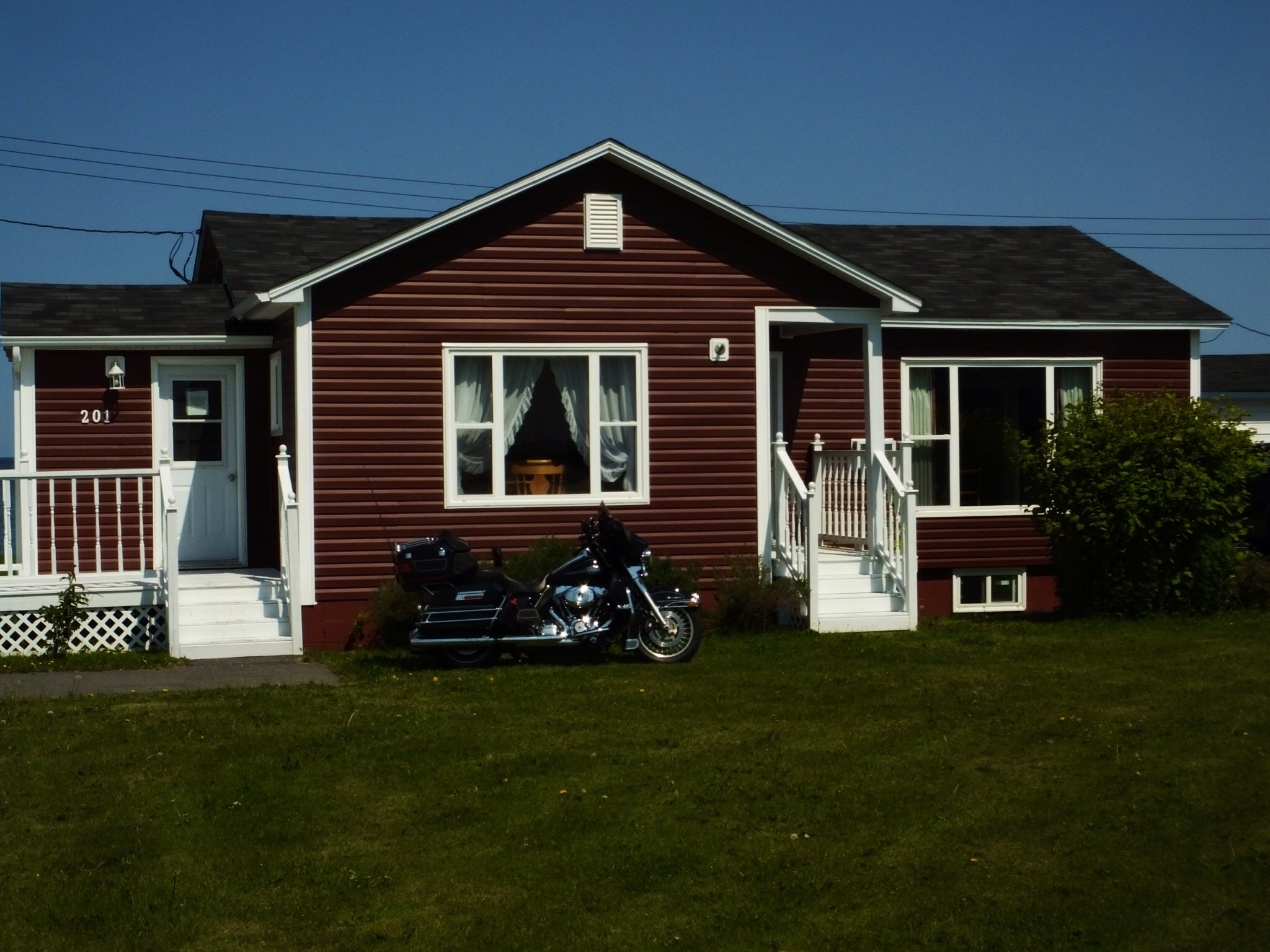
My Cow Head Bed & Breakfast
One of the things I accomplished today was uploading pictures from the last two days to Flickr. It took almost two hours to upload 40 or so pictures but I wanted to share more of what I’m seeing and, besides, it gave me two hours that I wasn’t hiking somewhere. I’ll try to upload today’s pictures, too, but, once again it’s past 10 now and uploading pictures will once again end my day about midnight. Nothing is too inconvenient for my faithful followers. I’ll put the link at the end of this post in an effort to make you read the blog instead of clicking immediately on the pictures. Ha!
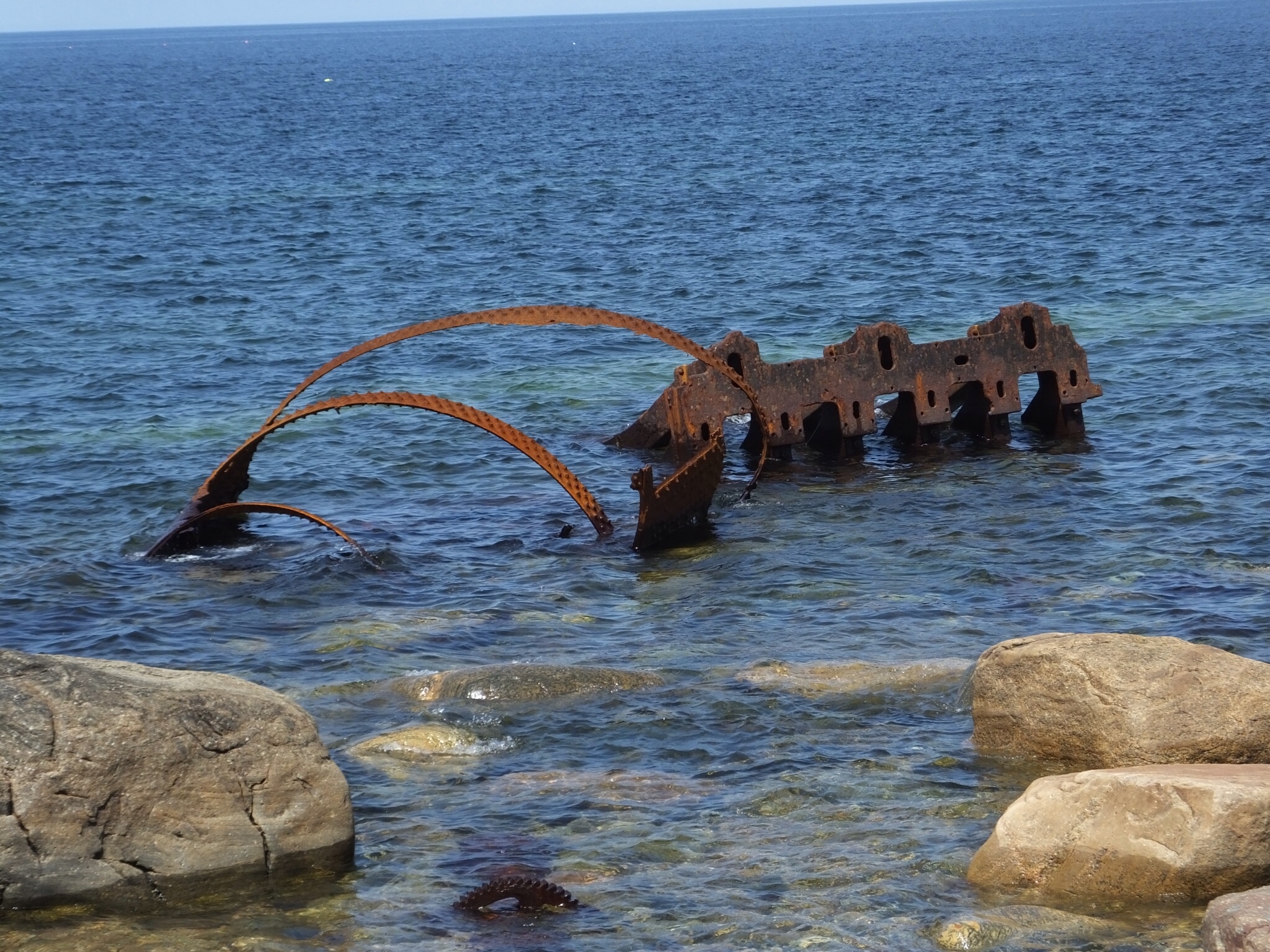
Rusted remains of the SS Ethie
Once my Cow Head chores were done, I went south again to have a look around at some of things I missed while I imperiled my aging bones yesterday in the mountains. Before I got as far south as I was going to go today, I made a brief stop at the site of a 1919 ship wreck that could have been disastrous but, as it turned out, all 96 people aboard were rescued from the SS Ethie in a driving winter gale. The ship was done for, though, and its rusted remains still lie scattered like the bones of some strange sea creature on the beach. In this area, the Wreck of the Ethie is part of the heroic folk lore of the dangers of the sea and the bravery of those who sail it.
Next stop was the Gros Morne National Park Visitor Center where I picked up an annual pass that allows me to get into all the parks in Canada for a year. $56 for a senior pass, which the young woman at the desk made me ask for, bless her heart. Not bad, but I guess that means I have to come back next year to get my money’s worth. Hmmmm
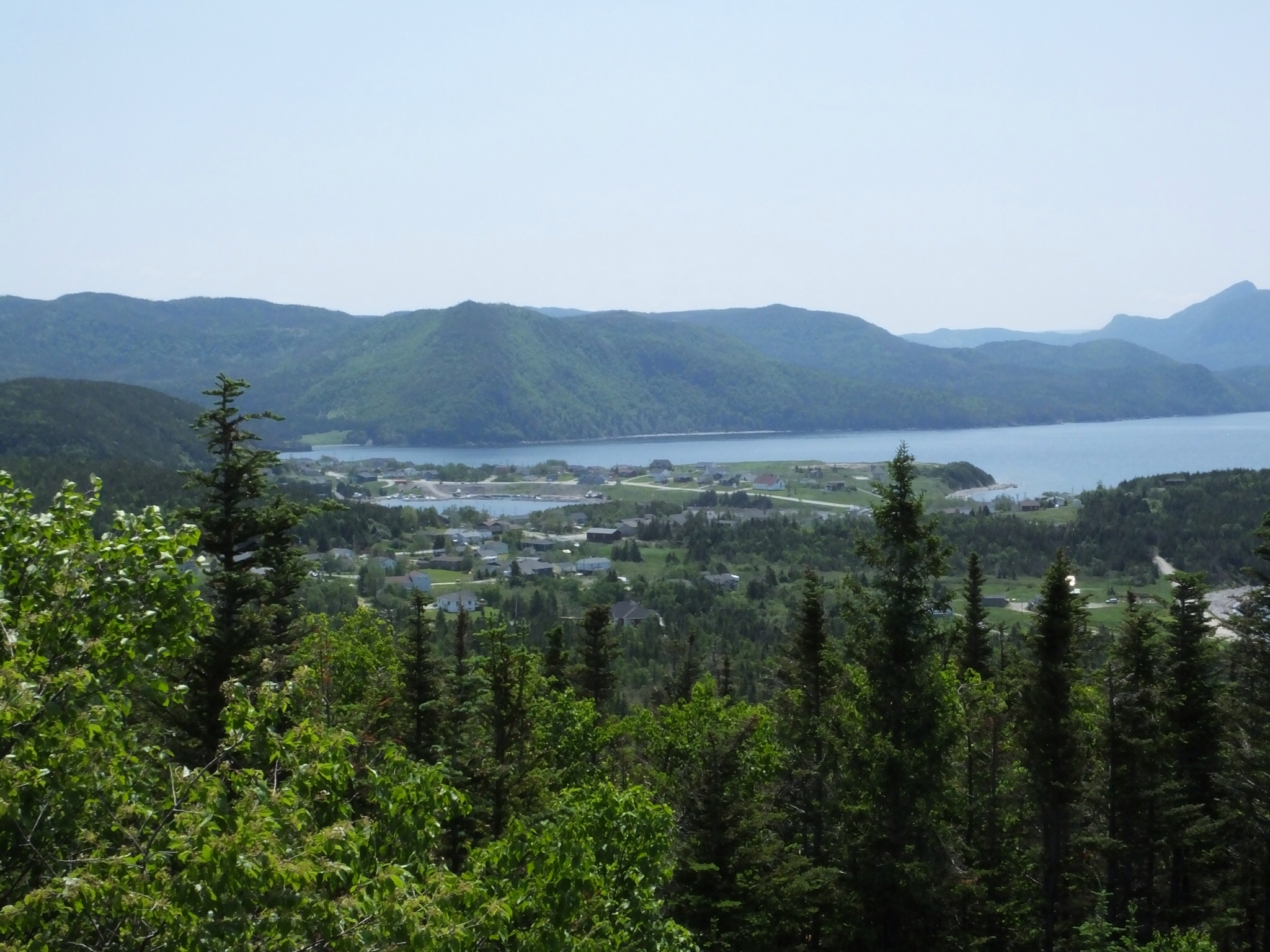
The Village of Norris Point on Bonne Bay.
Not far from the Visitor Center the village of Norris Point snuggles on the shore of Bonne Bay with colorful fishing boats tied up at various docks and other vessels beached at scattered locations. I had received several recommendations to go there to check out a couple things including a boat ride across the bay and the Memorial University sponsored Bonne Bay Marine Station and, since neither of these involved hiking in the wilderness, I went. It was too late in the afternoon to take advantage of the boat ride so I putted my scoot to the Marine Station.
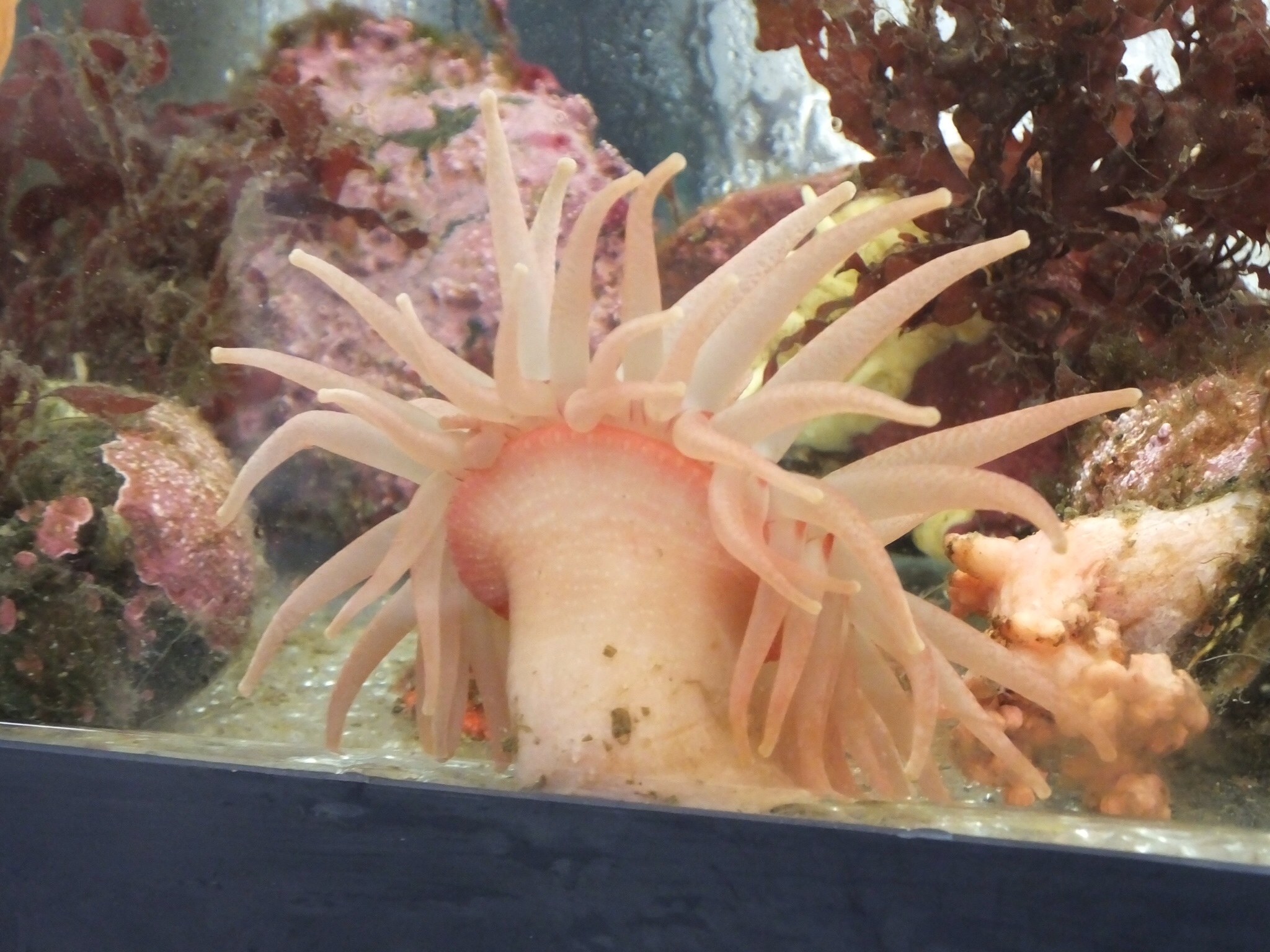
The staff told me what it was, but I forgot.
It was a good $5.00 lesson in the geology and marine life of the area. The staff explained how the two-arm bay was created by ancient glaciers slowly carving their way to the sea. Then they noted that certain aspects of its creation made it a unique marine habitat. For example, where the two arms come together at a narrow point, the water is only about 45 feet deep as a result of massive glacial deposits. But the northern arm is over 700 feet deep at its deepest. What that means for marine biologists is that the aquatic creatures that live at the lower depths have lived there unaffected by outside populations for hundreds of thousands of years and have, as a result, developed distinct subspecies.
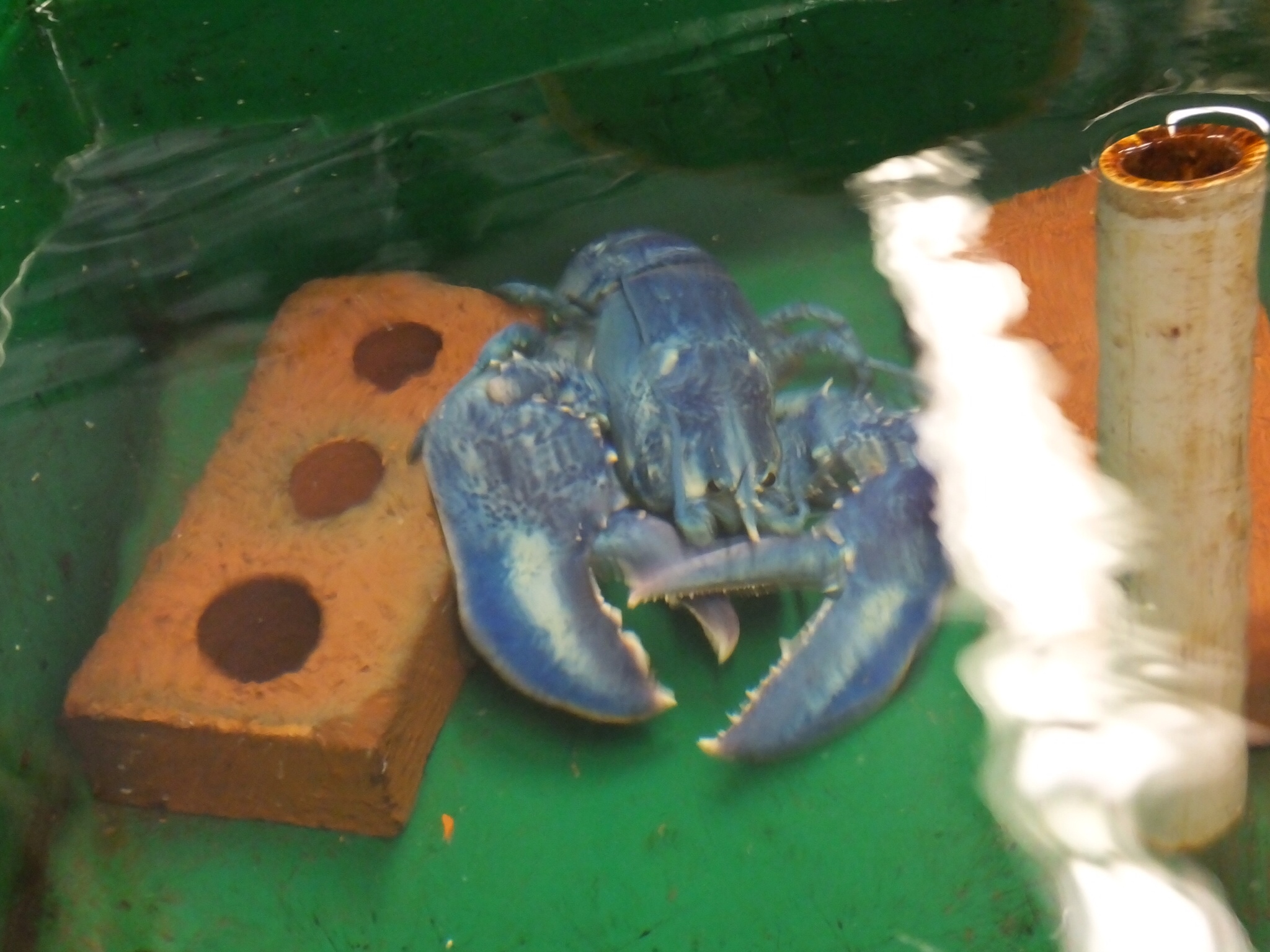
Maybe it’s just very, very cold.
The marine and fisheries biologists who study and work at the Station also work to understand and help improve the local fisheries on which so many people here depend for a living. At any rate, they keep a lot of live specimens around that I was able to see, touch, hold, examine. Pretty cool. One of the coolest things was the blue lobster. Sounds like it could be a new grunge band, but it was actually a real live blue lobster. Had something to do with mutated pigmentation. Lots of other creatures and unfamiliar (to me at least) fish.
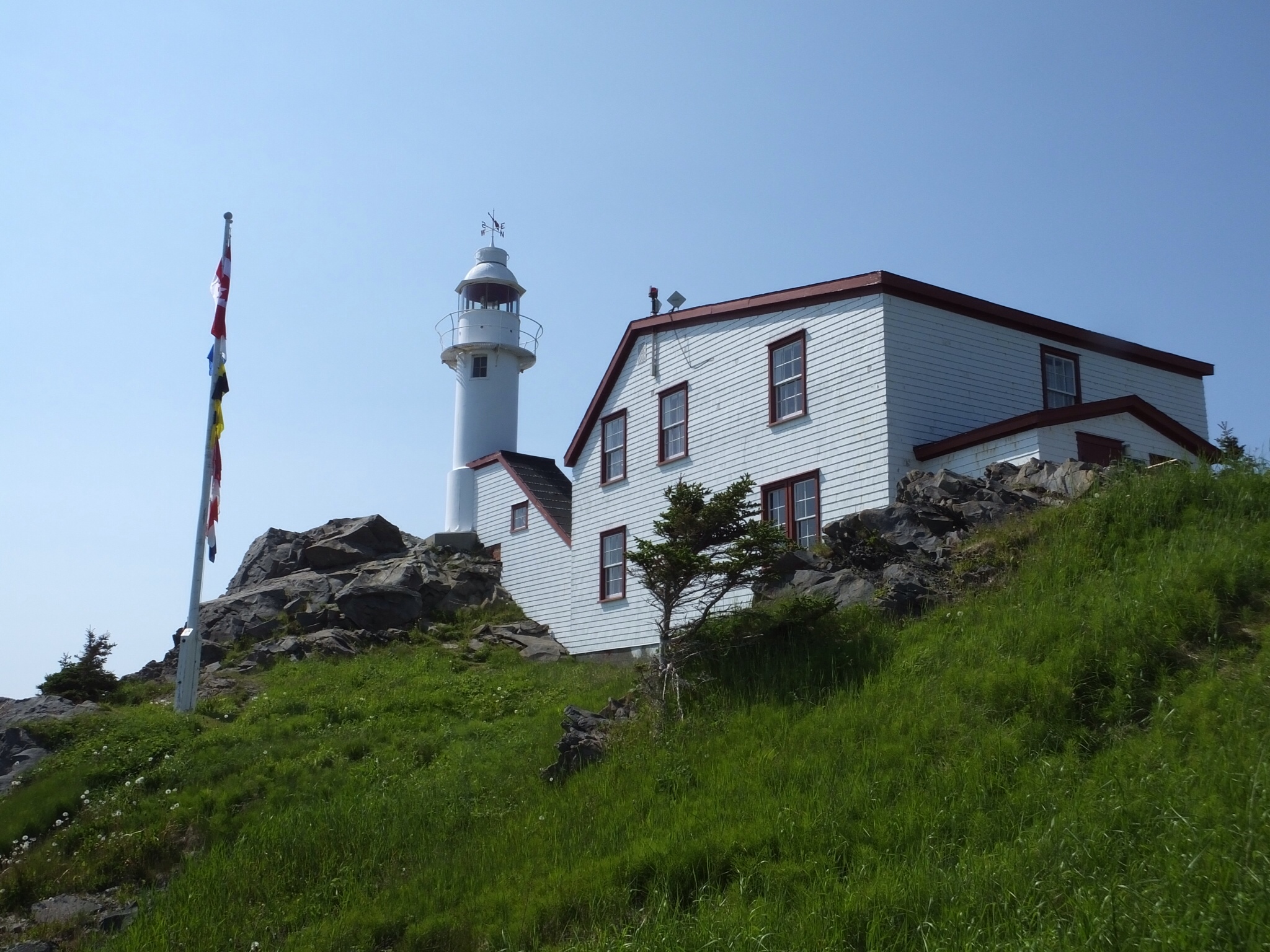
Perched on a rocky point for almost 120 years.
Next stop, the Lobster Cove Head Lighthouse, still operated as a lighthouse by the Coast Guard and also run as an historic site by Parks Canada. Unfortunately the interior of the lighthouse keeper’s house was being rennovated, so I couldn’t go in. But they had the displays set up in another building on the site and I could walk around the site and take a look at the 1890s lighthouse.
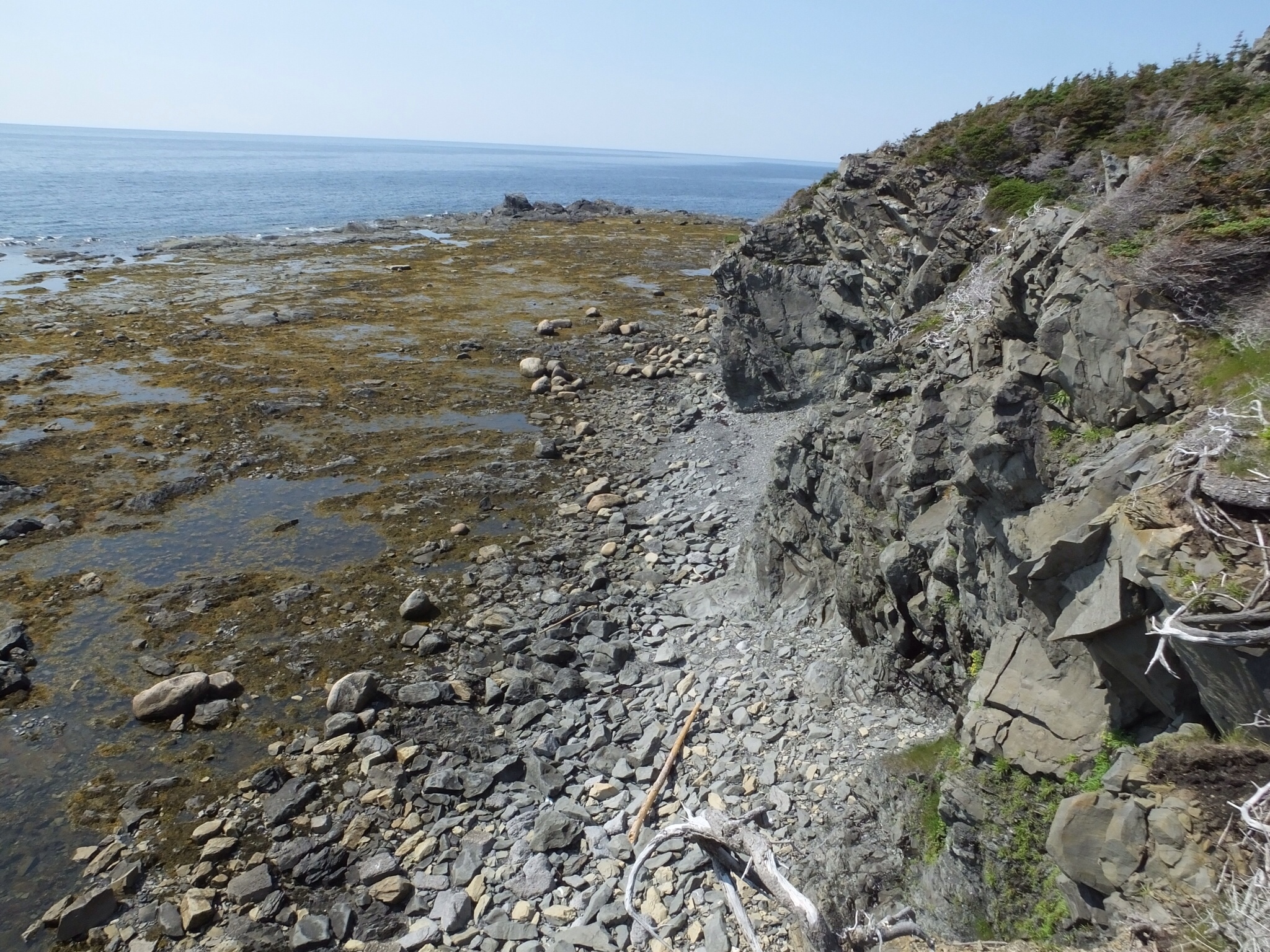
Rocks: Hard on ships and feet.
After seeing the rocky cliffs on which it sits and the rocks that line the shore, I can see why 19th century sailors thought a lighthouse on that rocky point was a good idea.
After a solid afternoon of no-hiking, I indulged in a large fish dinner (hey, when in Rome…..) complemented with a new addition to my pie repertoire. As soon as the weathered waitress mentioned “partridgeberry” I knew what I was having for desert.
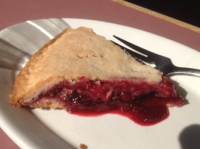
Newfoundland Partridgeberry Pie
The term “partridgeberry” is common to Labrador, Newfoundland and northern Nova Scotia and refers to what other parts of the world refer to as the Lingon Berry. It grows wild here and no one farms it commercially; they just go where their mothers and their grandmothers used to go and pick a bucketful of berries. They’re small and a little tart, but they make a dandy pie. I ate this one straight up–no ice cream–but the next time I’ll go full out. And there will be a next time.
OK, now you can go look at pictures. Click here for Flickr.
Take care. Tomorrow I’m off to see Vikings and Icebergs.
Newfoundland/Labrador Day 10: Gros Morne National Park
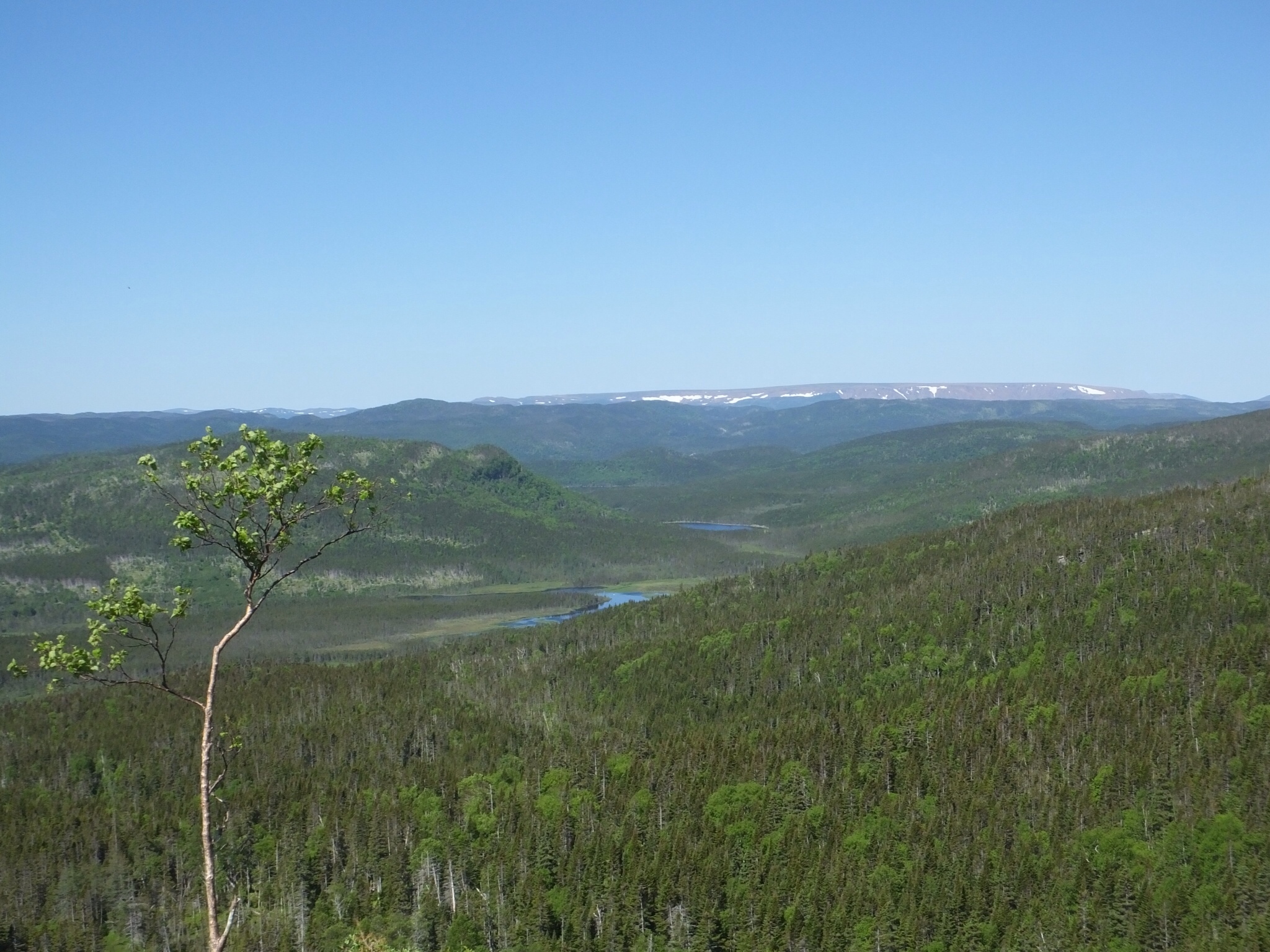
Note the snow on mountains that are less that 2,000 feet above sea level.
It’s been another great day on the road with weather the locals say almost never happens, but too many more great days like this one and I’ll have to stop for a while. One of the most signifcant parts of seeing western Newfoundland is seeing Gros Morne National Park, designated as a UNESCO World Heritage site for its significant geology. It’s a large park and I’ve only seen parts of it but what I saw today was beautiful, rugged and unlike any place I’ve ever been to. Interestingly, the mountains here are actually the northern end of the Appalachian chain, created at the same time as my North Carolina mountain on which sits my humble cabin when two continents collided hundreds of millions of years ago.
I’m tired and sore for reasons I’ll explain in a minute so this blog will be short. I’ll make up for it with some great pictures. Still no new pictures on Flickr, by the way, and I don’t know when I’m going to find a strong wifi to add more. Will create a link when new pictures go up.
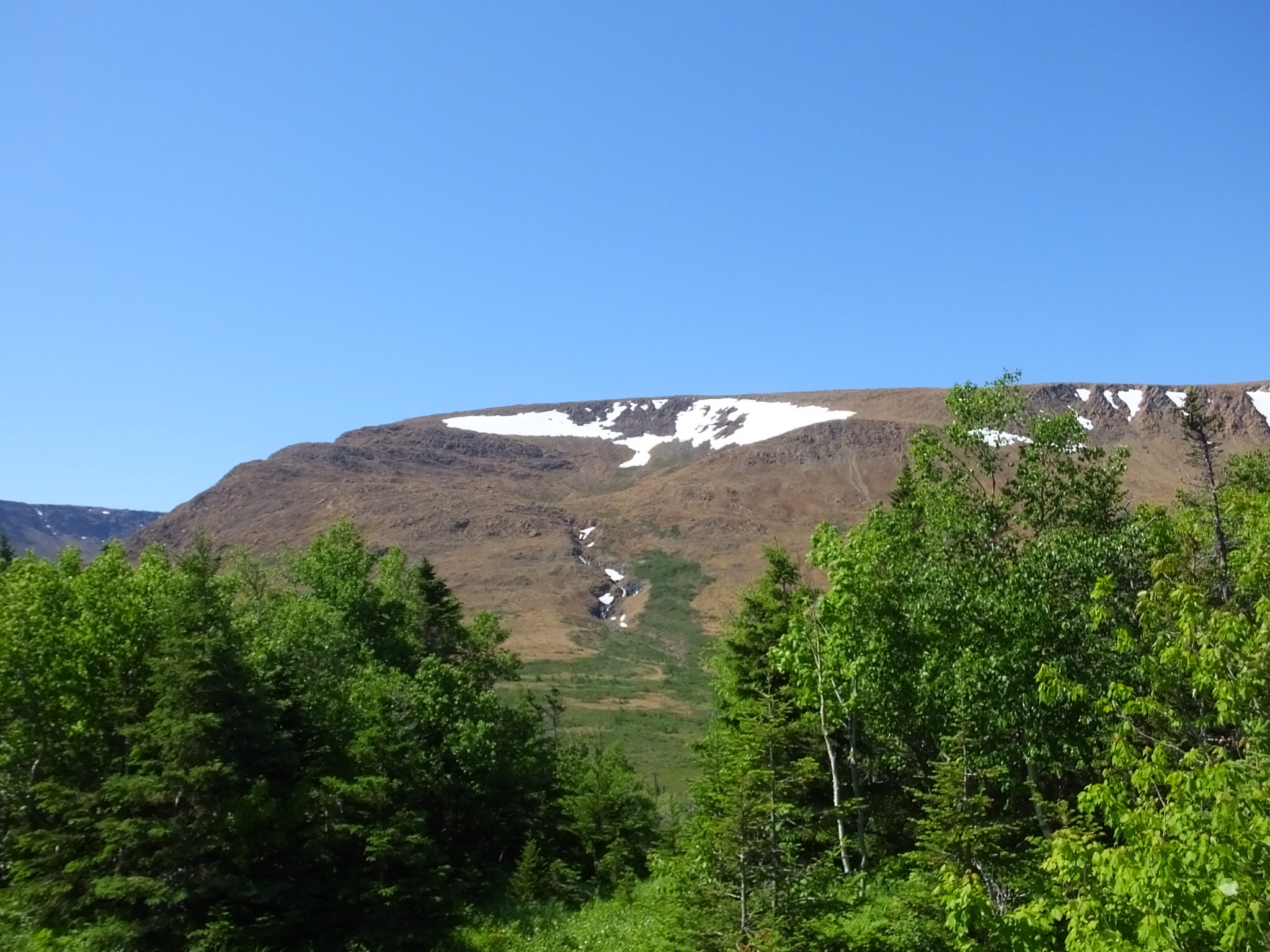
Geologists studied these mountains when developing plate tectonic theory.
I headed about 50 miles up the road from where I’m staying to one of three visitors centers they have in the park to pay my fee ($8.90 is a bargain, believe me) and to get some suggestions for how to attack the park. The Parks Canada staff was helpful as they always are at all the National Parks I’ve been to in Canada. The young staffer helped me sort the park into different areas and then suggested that I take on the southern half today and the northern half tomorrow or Sunday. She mentioned about four or five places I could go today, but, as it turned out, I only got to two of them.
One section of the park is known as the Tablelands and it’s literally a world-class example of the power of plate tectonics. The barren red rock at the top of the mountains in the Tablelands was once a seafloor and the oldest rock is at the very top while the youngest is down near the base. I stopped and took it in before heading to my real destination for the day: the fishing village of Trout River and the Trout River Pond hiking trail.
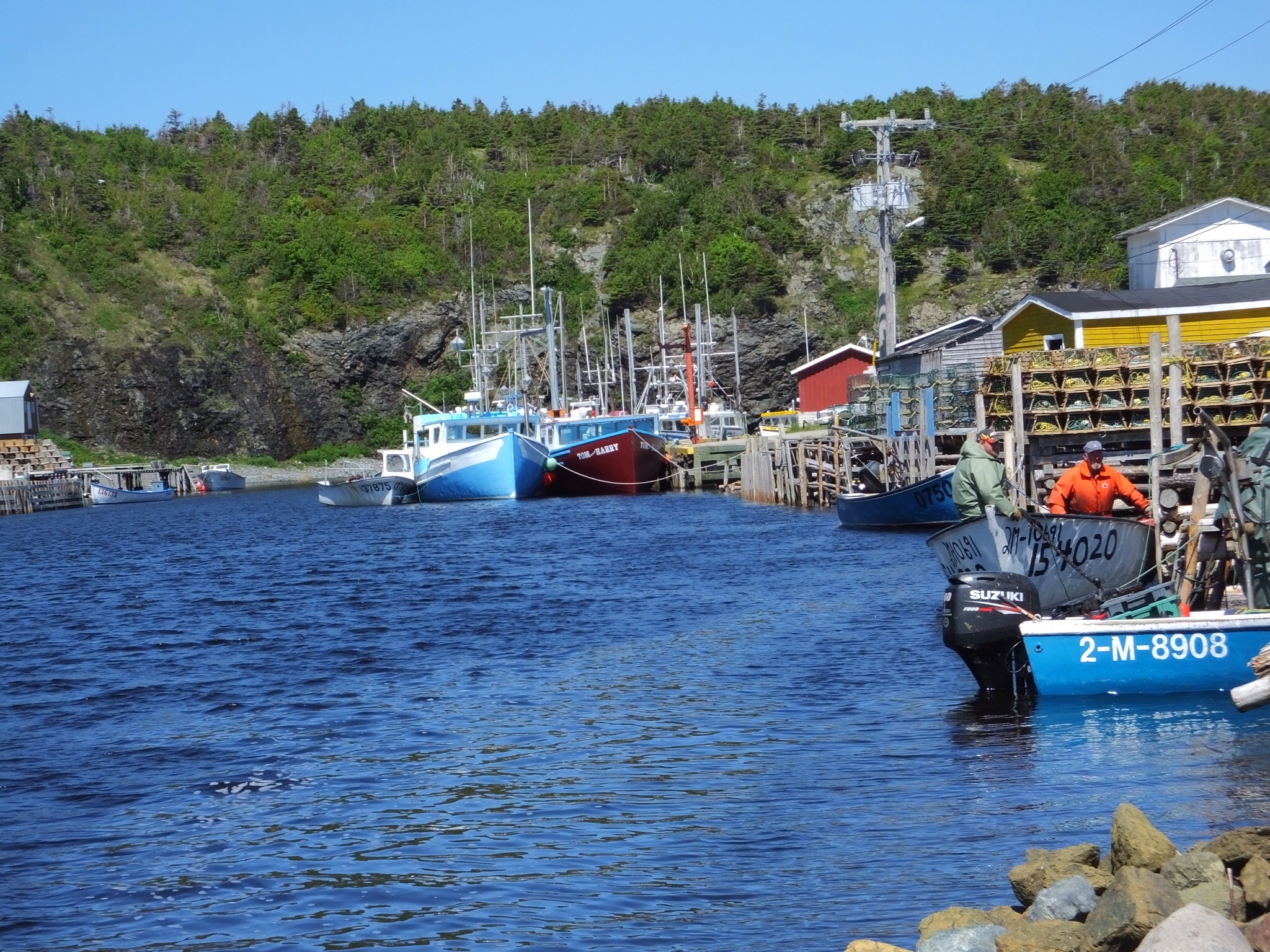
Men go out to the sea in ships, and little boats too.
I didn’t spend much time in the village because there wasn’t much there. It’s not a tourist spot. It’s a real-life fishing village where people try to squeeze a hard and dangerous living out of the sea.
I had said I wanted to do some hiking (and maybe some kayaking) on this trip and this was my first opportunity to hit the trail. I’m not sure I chose wisely. The Gros Morne National Park visitor’s guide described the trail I chose as “gentle” though noting that it was an approximately 9 mile round trip. No problem, I said to myself, remembering the last back packing I did for a week 25 years ago in the Sierra Nevadas. The key to that last sentence is “25 years ago.” Body-related things, apparently, have changed since then.
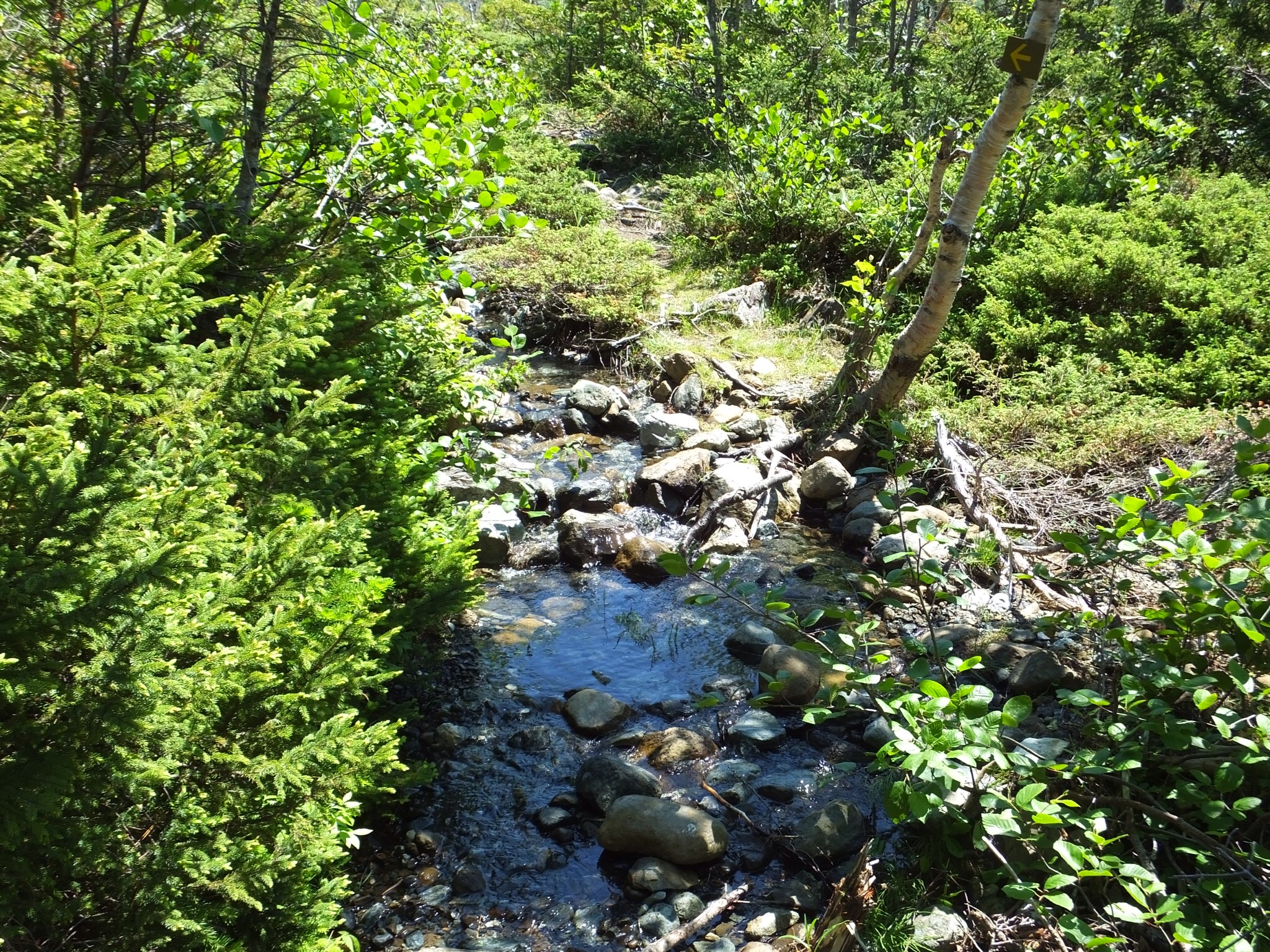
This was part of the trail.
I had a clue that I might be in for some trouble before I even set foot on the trail when I spoke with a park ranger who rode up on a mountain bike. “Did you make it to the end of the trail?” I said. “No.” he replied. “Too muddy. Winter was hard on the trail this year.” Undeterred and determined to take a brisk walk in the mountains, I set off. It didn’t take long to discover the truth of his “too muddy” statement. Long sections of the trail had water running down it and mud several inches deep. And the forest was too thick to get off the trail and go around the mud. So I slogged on. After about the first hour the nature of the trail changed and the mud was no longer a problem. But now the trail consisted of large rocks and gravel with sharp, pointy corners. Oh, did I mention I was wearing running shoes. Running shoes! Did I think I was going to outrun a moose? But my only other choice was my motorcycle riding/rain boots and I didn’t think they would work well either.
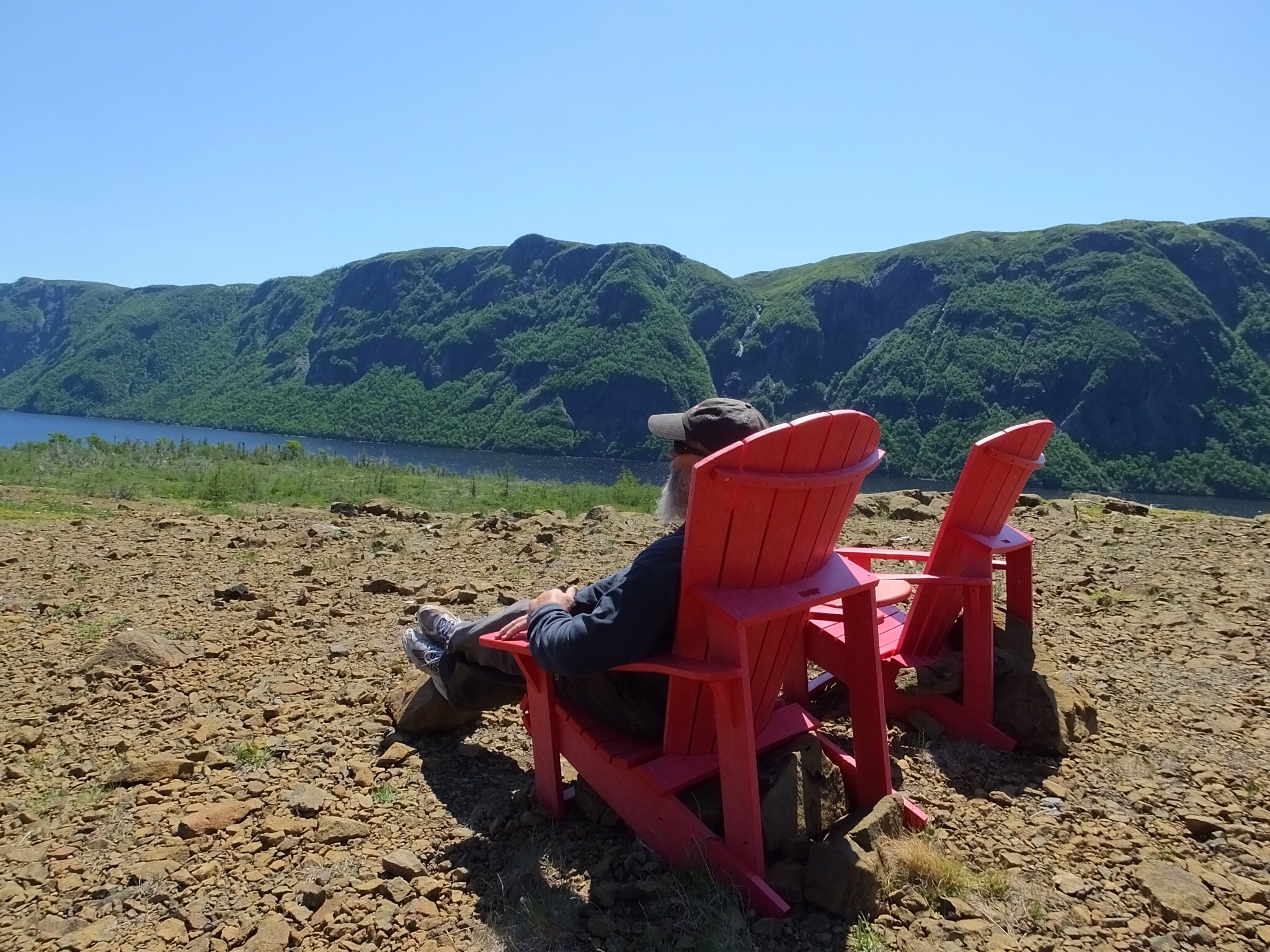
I think Newfies have a sense of humor. Chairs were a nice touch.
So onward and, literally, upward I went as the trail veered away from the rivulet-filled forest and the lake I had been following and up the side of one of the Tableland Mountains. With only the occassional huff and puff, I hiked my way further along the lake and further up the mountain. Finally, after about two hours and 4 1/2 miles, I came to the end of the trail, which consisted of a big pile of rocks and two bright red adirondack chairs. I enjoyed the sit down briefly, but knew I had to walk back the same way I came in. There was no bus service in the wilderness.
By now my old feet, old legs and old knees were wondering why I hadn’t chosen a flatter, dryer, softer trail and began to scream obscene questions at my brain. By the time I got back to the motorcycle (having seen no one all day except the ranger on the bike), putting one sore foot in front of the other was becoming increasingly difficult. You can’t imagine how glad I was that I opted NOT to sleep in a tent and sleeping bag on this trip (but thanks for the offer, Greg). I knew I could get a hot bath and a glass of Jack back at my room. But that was still two hours away over Newfoundland roads that apparently had the same problem with winter that the trail did.
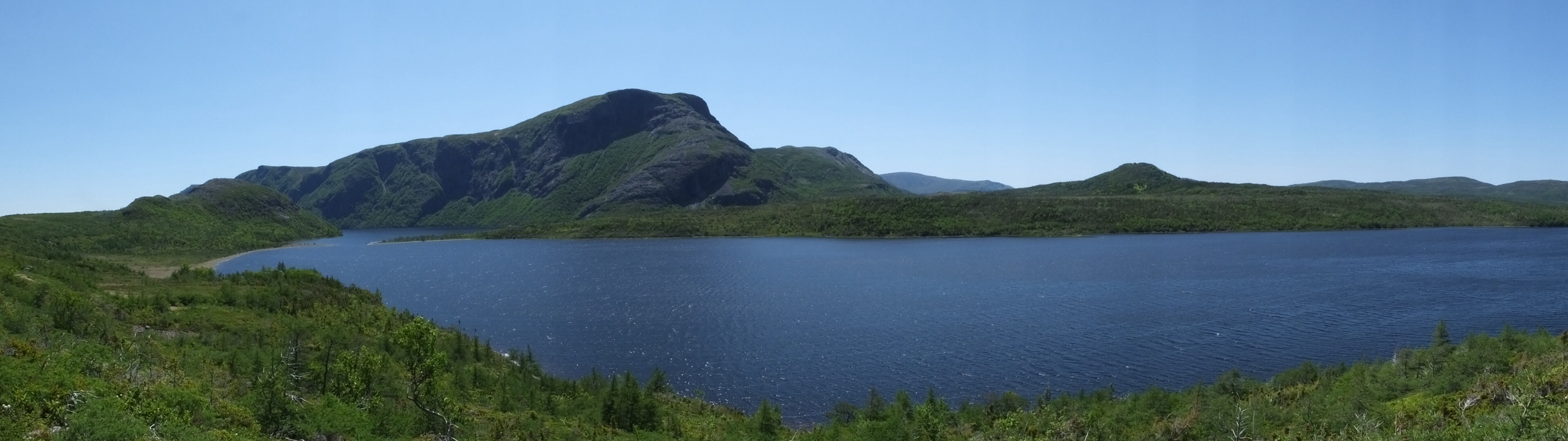
This, of course, is why I took a hike.
When I got back I hobbled over to a theatre to listen to some local Newfoundland music played by six reasonably talented musicians/singers. They were good and I enjoyed the evening. But I’ve seen “Men of the Deeps” and I’m spoiled.
I had planned on taking a nine-hour round trip motorcycle ride tomorrow to see the Viking site at L’Anse aux Meadows on the northern tip of the island, but I think I’ll hold that until Sunday, if I go at all. We’ll see how quickly this old body recovers.
Everyone take care. Watch out for moose. I know I do.
Newfoundland/Labrador Day 9: I Found a New Land
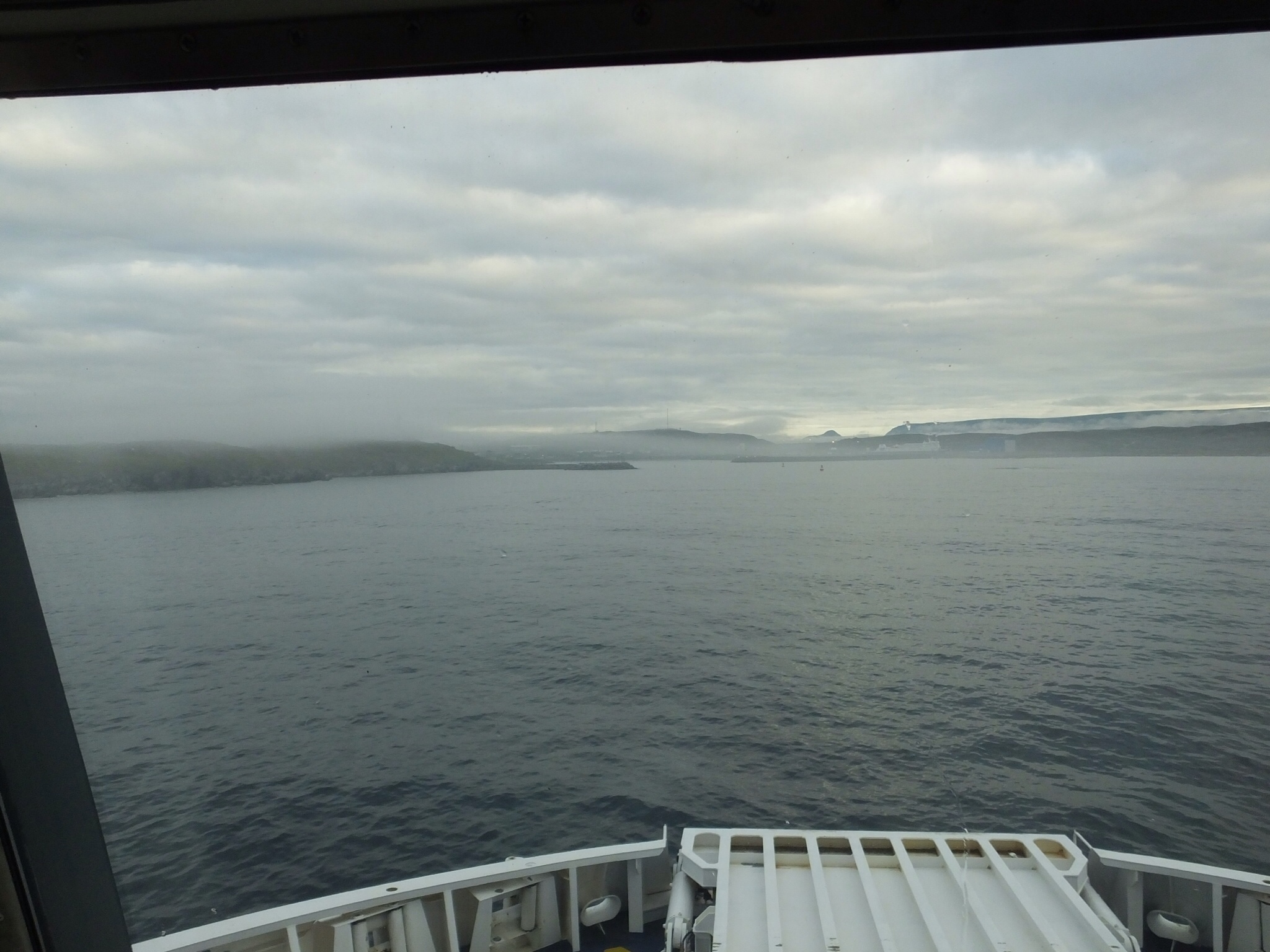
My first view of Newfoundland from the 7th deck of the ferry.
After eight days on the road, I finally rode my bike off the ferry this morning at 7 a.m. onto Newfoundland, where I expect to spend 16 glorious days exploring this new found land. The ferry ride was uneventful; it departed on time and arrived on time. But their wifi didn’t work, so it was a good thing I posted the blog a little early yesterday.
The ferry had three decks for vehicles and probably room for about 700 people though I heard one of the crew members say there were about 375 passengers on board. Lots of commercial trucks and campers and five other bikes besides mine. By the time I got loaded, tied the bike down, found my reclining chair and settled down it was after midnight. Then at five I woke up to the sound of the ship’s foghorn being sounded about every 3-4 minutes as we neared the coast of Newfoundland in a fog.
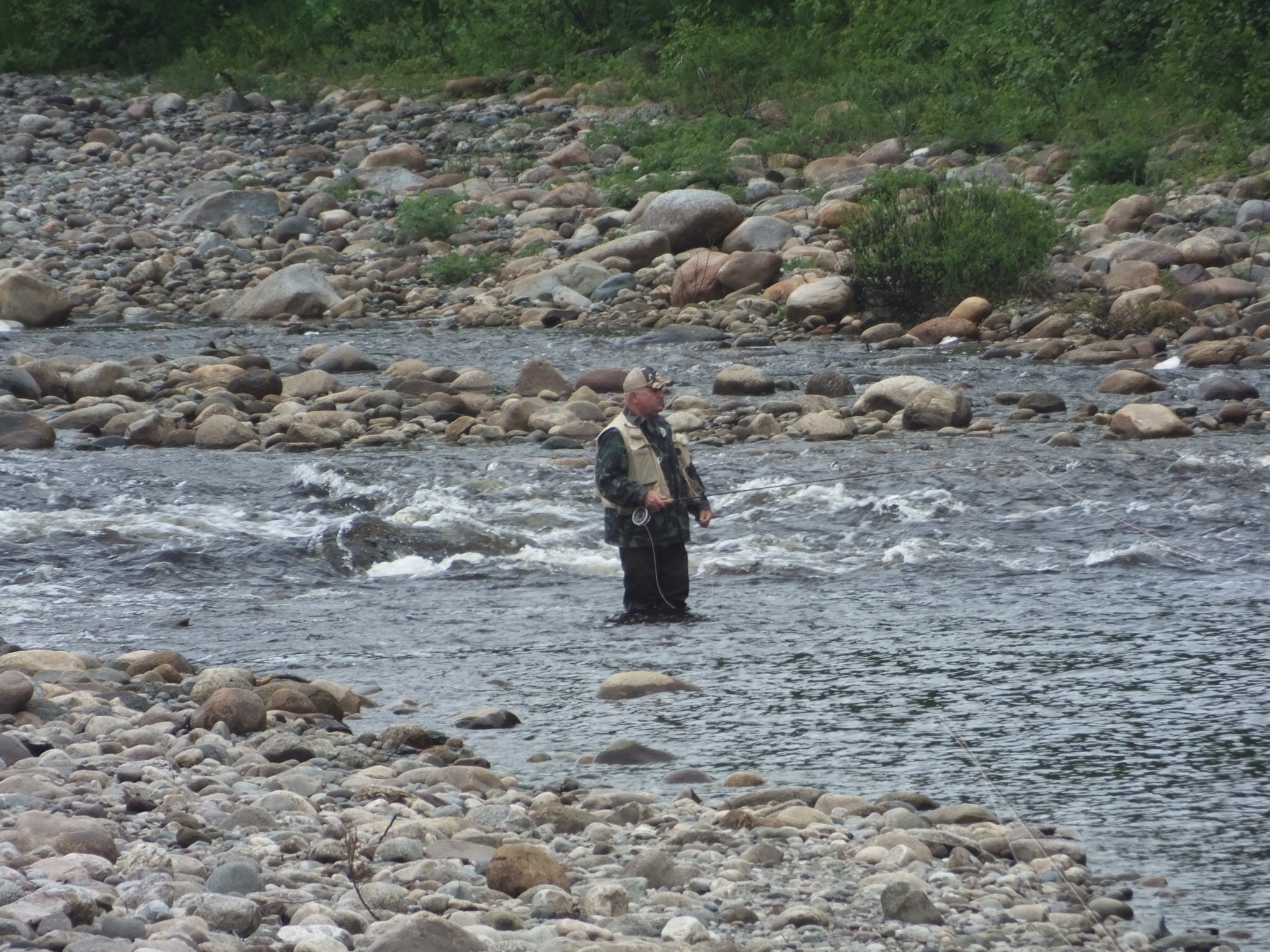
Several guys were wetting a line in a brook.
I had a destination for today already picked out and a room at a B&B reserved in Cow Head on the western coast, but I didn’t have a specific route mapped out so I made a 3 hour detour off the main road (the Trans Canada Highway) on the way here to see more of the Newfoundland coast out at Cape St. George. The roads were pretty good and the scenery was, at times, striking. I’m going to add a couple pictures to this post (don’t forget to double click on them to make them bigger) but when I tried to load pictures to Flickr, they wouldn’t go. I think I’m going to have a weak wifi connection at all the small bed and breakfasts that will limit or even prevent loading large-file images, but I’ll let try to get pictures on Flickr and make a link to them when I can. But not tonight.
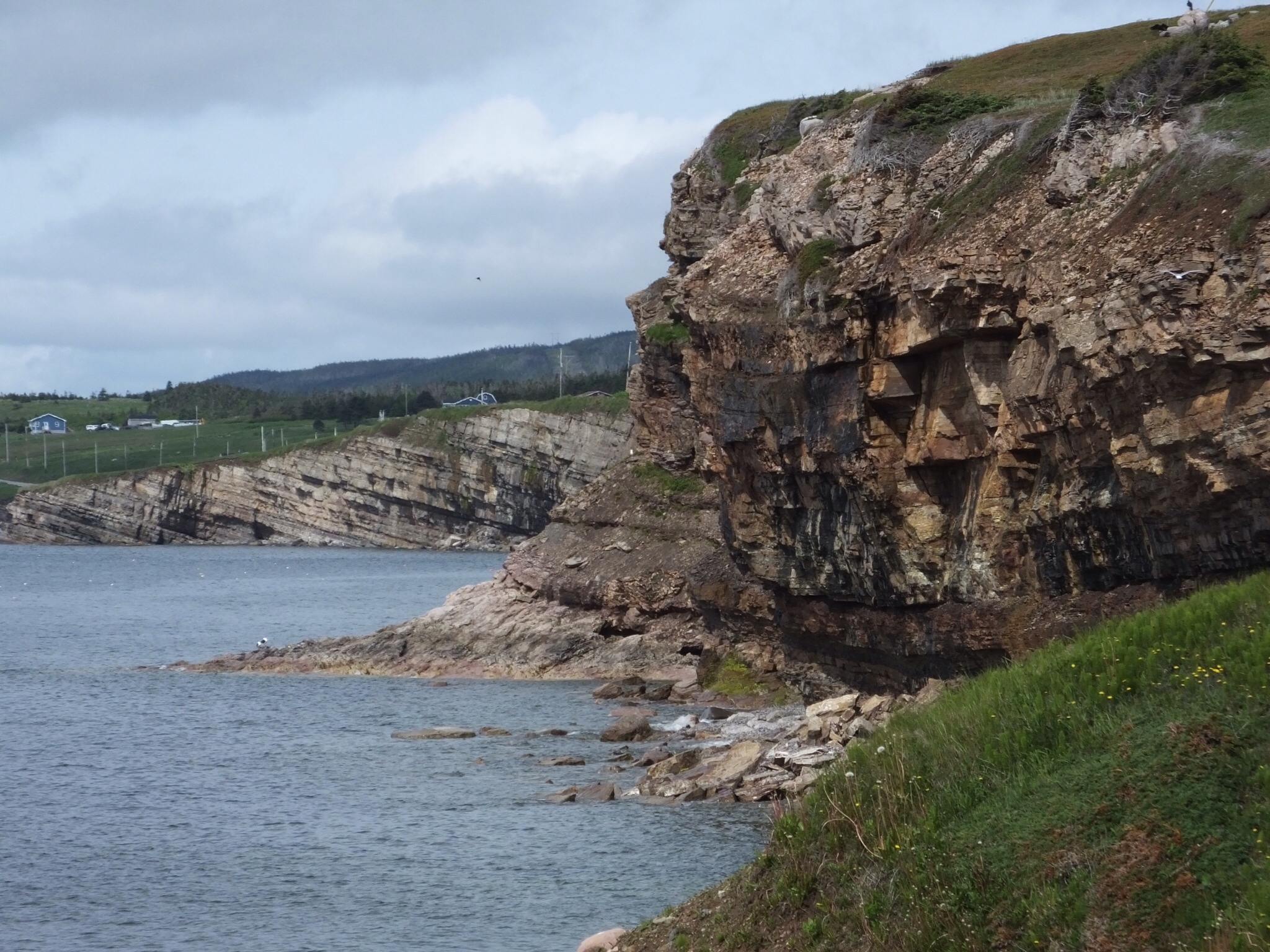
This was near Cape St. George on the detour I took.
It’s going to be a shame if I can’t post as many pictures on Flickr as I want because I have a feeling I’m going to see some great sights and take some pretty good pictures during the next two weeks.
Since there aren’t many roads in Newfoundland, I didn’t have need of the GPS, so I turned it off, loaded my new CD by “Men of the Deeps,” put my feet up, and listened to songs of working men while I enjoyed spectacular scenery passing by on both sides. Sometimes, maybe too often, I’d stop and linger, wander around and take a longer look before snapping a few pictures. I think that’s how I turn a two-hour ride off the main road into a three-hour ride.
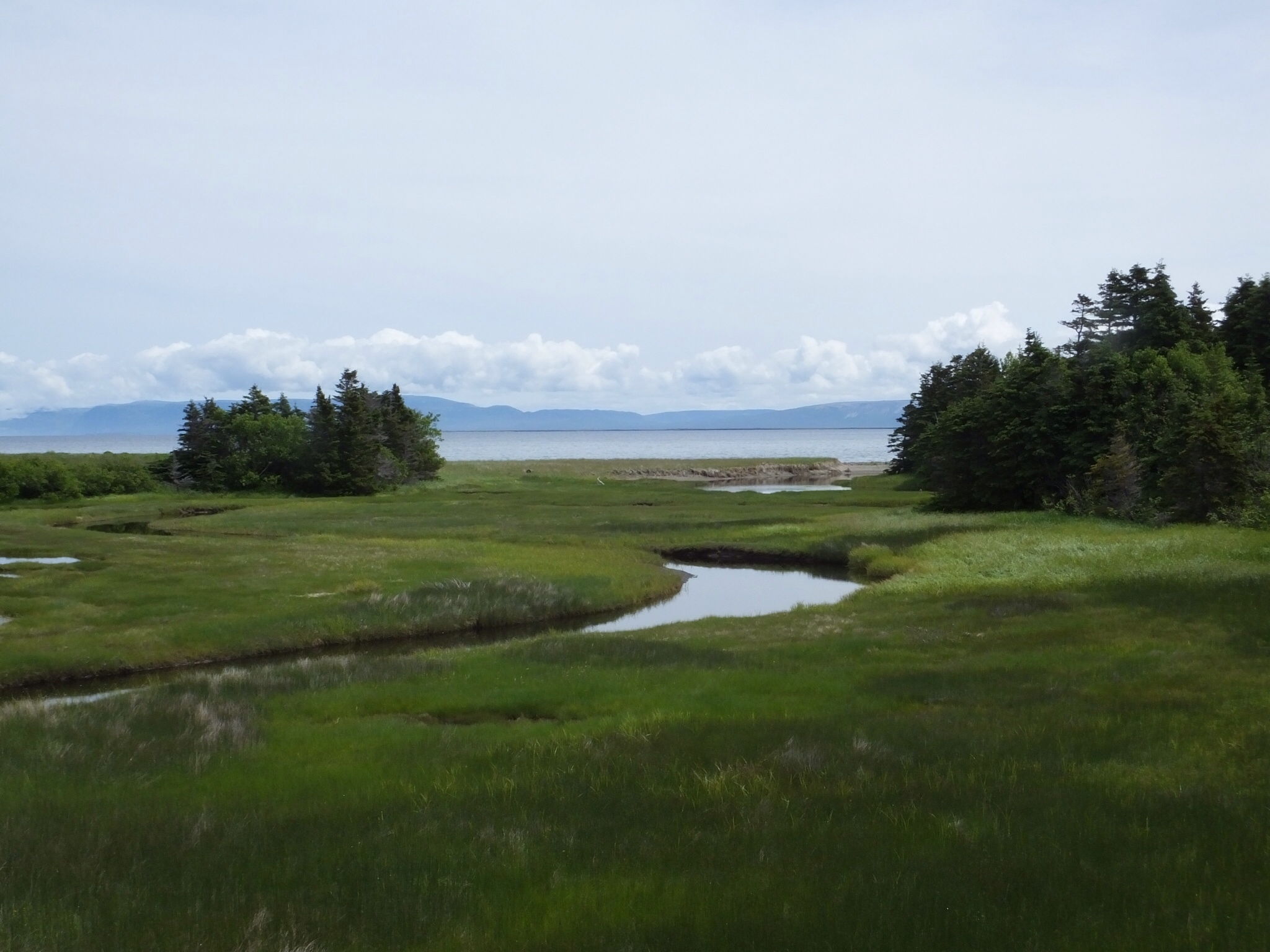
A creek flows to the Gulf of St. Lawrence.
One of the reasons I chose Cow Head (besides the really great name) is that the Gros Morne Theatre Festival here that lasts all summer. Tonight (it’s now 11:30 p.m.) I took in a play about a nurse in western Newfoundland who was a legend in her own time and who was awarded various medals of merit from the British Crown and the Canadian government. The play, “Tempting Providence,” was written shortly after her death at age 100 in 1994 and has been traveling throughout Canada for the past 20+ years. Very well done and the four players in the cast were all professionals. A nice change of pace from all the gorgeous scenery.
I’m not sure where I’m going tomorrow, but I will probably either head four hours up the West Coast to St. Anthony and a UNESCO World Historic Site where the Vikings landed about 900 years ago or I’ll stick around here and explore some of Gros Morne National Park. In either event, I’ll be back at this same B&B.
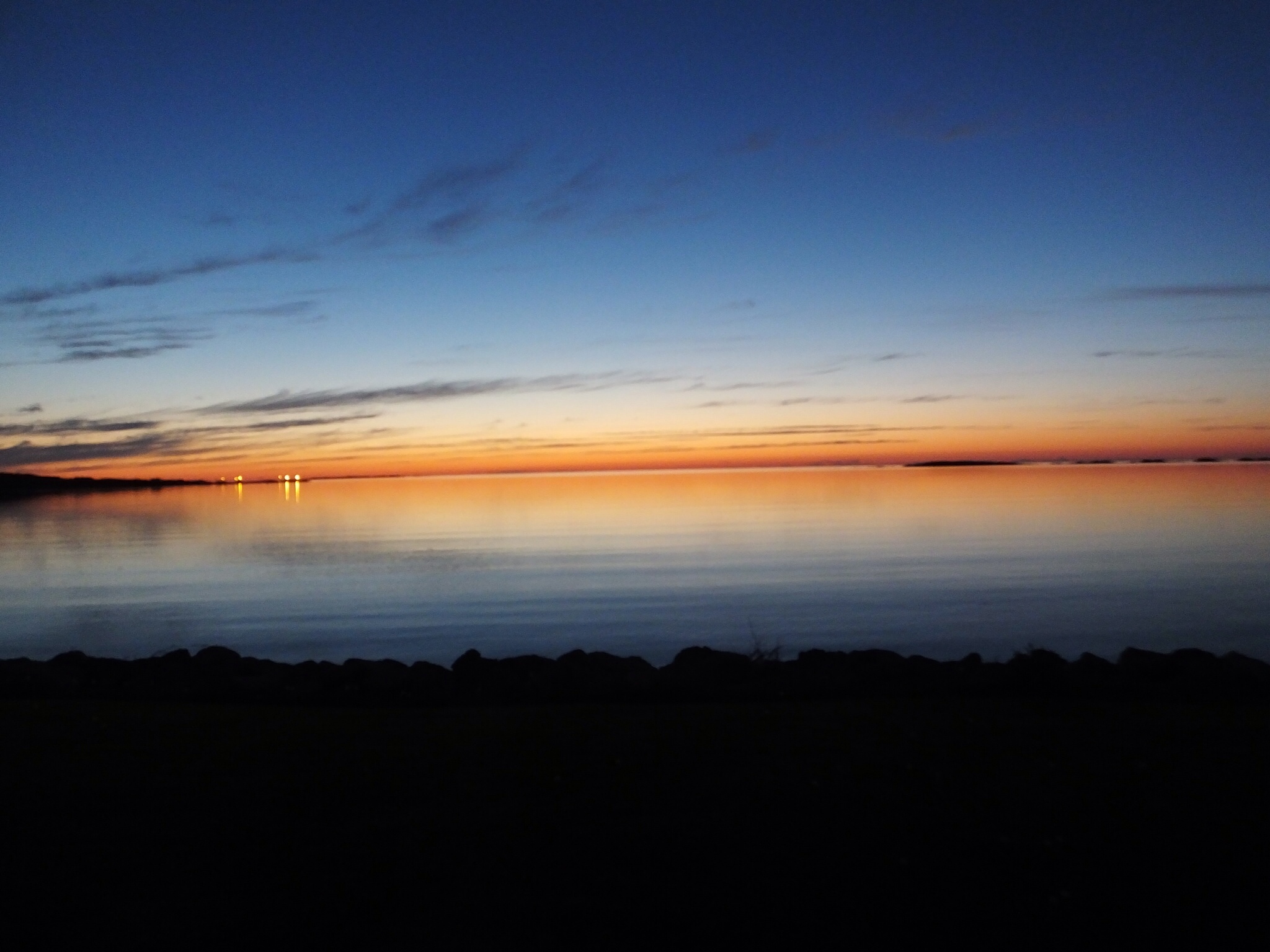
I think lovely sunsets are in my future for the next couple days.
After five hours of sleep in a recliner not nearly as comfortable as the one I sleep in at home, then eight hours on the road to get here, plus two hours at the theater, I’m beat. I must be getting old. I can’t seem to handle 18-hour days like I used to. So I’ll sign off and leave you with a picture of the 10:30 sunset I enjoyed from the porch just off my room at the Bay View B&B following the play.
Tired? Yes. But: “I Can’t Wait to Get on the Road Again.”
 hdriderblog